
3.5.2. Measures to control Golden Apple Snail (Pomacea ciculata)
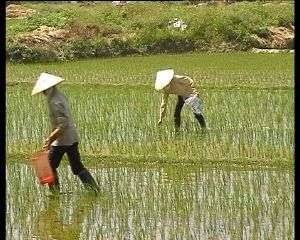
a. Mechanical measures
Figure 3.31: People collect Golden Apple Snails in rice fields
Maybe you are interested!
-
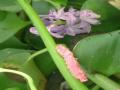
 Golden Apple Snail Eggs On Japanese Water Fern Stems At Bo Lac Lake, Dong Que Commune - Tam Dao
 -
 Internal control of revenue and expenditure activities at the National Children's Hospital - 2
 -
 Measurement and Remote Control – Electrical Engineering Industry - 8
 -
 The Nature and Role of the Internal Control System
 -
 Study on asthma control status in children with bronchial asthma and allergic rhinitis - 18
- Catching golden apple snails: Catch snails and collect egg nests by hand. Snails should be caught early and continuously from the time of sowing rice until the rice is 2-3 weeks old, caught early in the morning or in the cool afternoon because at this time the snails are flexible and easy to see. Collected snails can be used for food or sold to duck farms, fish farms, shrimp farms, etc.
- Place metal mesh, nylon mesh or bamboo mesh in sewers and water pipes to prevent snails from spreading and also make them easy to collect. The mesh should be placed early, from the beginning of the season until harvest.
- Dig trenches in the fields so that when the water is drained, snails can be collected in the trenches for easy collection.
- Plant stakes scattered across the field for snails to lay eggs and then collect them by hand.
- Make a bank of ash or lime around the damaged area. When the golden apple snail climbs over the bank, it will die due to dehydration.
b. Biological measures
- Releasing ducks to eat snails: You can release ducks after the last plowing and then watering the field or release ducks right after harvest. For 1,000m2 , you only need to release 20 ducks to significantly reduce golden apple snails.
- Fish release: In flooded and difficult-to-drain areas, the rice-fish model is the best measure to reduce damage caused by golden apple snails.
c . Herbal medicine
The following plants can be used:
- Oleander leaves 30 - 40 kg leaves/ha.
- Xoan ta seeds 20 - 30 kg seeds/ha.
- Fish medicine roots 30 - 40 kg roots/ha.
The roots, leaves and seeds of the above plants are dried, crushed and sprinkled evenly over the field; water level is kept at 3 - 5 cm.
d. Biological attraction
Using cactus, cut it down and drop it into the water, the poisonous sap makes the snails drunk, floating on the water surface, making it easier to collect the snails. In many areas, farmers use papaya leaves, castor leaves, squash leaves, jackfruit fibers, cassava stems and leaves, etc., dropped into the water to attract snails and then collect them.
Plant traps: Based on the daytime hiding characteristics of golden apple snails, cut green grass and build small mounds throughout the field. Collect golden apple snails in the cool afternoon and destroy them, doing this continuously for many days. In the Mekong Delta, farmers use jackfruit fiber in the above way with high efficiency.
Chicha beer trap: Use rice, corn and sugar to make chicha. Use 2.5kg of rice and corn soaked to germinate, after 3 days of germination add water and boil until done then let cool, add half a kilo of sugar and leave for another 3 days before using. Use a 1 liter can, fill 2/3 of the can with chicha and place it in the field so that the mouth of the can is level with the water. The aroma will attract golden apple snails to gather around the can. Set the trap in the cool afternoon and collect it early in the morning. Replace the bait every 3 days.
Milk trap: Mix 4 liters of water + 1 liter of milk and soak a piece of coarse cloth in it. Place the cloth in an area where the golden apple snails are heavily damaged. The next morning, collect the cloth with the golden apple snails attached and destroy it. This is a very effective method.
e. Chemical measures
Use lime, copper (CuSO4) and chemicals according to the instructions of plant protection officers. Some commonly used chemicals to control golden apple snails are:
1-Mossade 700WP: Has a water contact effect on snails' mouths, destroying their digestive and respiratory systems. After contact with the drug, snails will die within 24 hours. Dosage: mix 18g packet/16 liter tank and spray for 1 sao 500 m 2 .
2-Deadline Bullets 4%: Low density spray 1-2 kg/ha, high density spray 10 snails/m2 spray 6-8 kg/ha. Spray in clusters 3m apart (5-10g/cluster) along the banks and places where golden apple snails gather, spray in the cool afternoon.
3.5.3. Measures to eradicate Japanese duckweed (Eichhirrua Crassipes)
Currently, Japanese duckweed is encroaching on most of the water surface area in the whole province. Not only that, Japanese duckweed is also encroaching on rice fields, causing negative impacts on the economy, environment, and biodiversity of the province. Therefore, there is a need for optimal solutions to limit and control the development of this species, while still promoting its benefits.
a. Mechanical measures
The main method used to eradicate Japanese water fern was applied very early, when Japanese water fern invaded and directly affected the economic interests of the people. This method is often applied in areas where the area of invaded water fern is stable and large, the water fern has grown high and has a high density. Use a specialized chainsaw to cut the water fern and then bring it to the shore for treatment...
b. Biological measures
- Using weevils to destroy Japanese duckweed: According to research, scientists have found a type of weevil that is highly effective in destroying Japanese duckweed, which is Neochetina eichhornia . This species has been used to destroy Japanese duckweed since 1972 in the US, and has since been used in many countries.
- Using caterpillars to control Japanese duckweed ( Sameodes albiguttalis ): This caterpillar can slow growth in the early stages of Japanese duckweed, when the duckweed begins to invade the water surface.
- Using Japanese duckweed to treat wastewater: Through many experimental studies, it has been shown that 1 hectare of water surface planted with water hyacinth in 24 hours can absorb 34 kg of Na; 22 kg of Ca; 17 kg of P; 4 kg of Mn; 2.1 kg of Phenol; 89g of Hg; 104g of Al; 297g of Nipper; 321g of
Strontium… has a very strong ability to absorb zinc and also has the ability to decompose phenol and cyanide… Although the water treatment efficiency of Japanese duckweed is very high, in the process of
The usage process must be strictly controlled or it will cause negative effects.
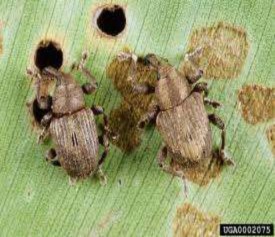
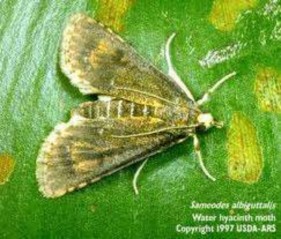
Figure 3.32 Leaf weevil Figure 3.33: Butterfly controlling duckweed
- Using Japanese water hyacinth as raw material for handicrafts: In 2000, from the initiative of a small business owner, water hyacinth stems became raw materials for producing handicrafts for export with increasingly diverse products, such as wall hangers, table and chair cushions, fruit baskets, book and newspaper shelves, pedestals, flower pots, doormats, flower baskets, travel bags, chairs, salons, night lampshades, mats, bedroom slippers, very light and soft, favored by many countries in the world because it adapts to all temperatures "not crispy in hot, not hard in cold". Handicraft products from water hyacinth stems have been exported to Japan, Korea, Taiwan, the Netherlands, Germany, Russia, the Czech Republic... with increasing quantities, creating jobs for tens of thousands of people in rural areas, earning tens of millions of dollars... Japanese water hyacinth has truly become a "poverty alleviation and poverty reduction tree" in rural areas. Because of these benefits, people in the province should be encouraged to collect duckweed as raw materials for the production of handicrafts.
- Using Japanese duckweed as bio-fertilizer: The entire root, stem, leaves, and stem of the duckweed waste are used as a substrate to "grow straw mushrooms very well", with productivity four times higher than growing on straw, because it retains moisture for a long time, reduces watering work, mushroom spawn costs less, and the quality is better.
The mushrooms are tastier and crispier than traditional straw mushroom growing, and are rich in nutrients and non-toxic. The residue of water fern after growing straw mushrooms is composted into organic fertilizer to fertilize fruit trees very effectively. Or used as "organic microbial fertilizer": Japanese water fern residue after growing mushrooms + livestock manure + microbial yeast... all piled up, lined with nylon... watered with urea (or molasses, rice bran) and covered, after about six weeks if it has not decomposed, stir, mix, continue to water and cover for 2-3 weeks. Using this type of fertilizer makes the soil more and more porous, and also obtains clean products, without chemical residues as required by foreign buyers. It is possible to reduce 70 percent of chemical fertilizers or more, because water fern contains up to 16 essential nutrients for plants that chemical fertilizers cannot provide. In addition to being used as fertilizer, duckweed roots (about 1m long) can also be used as very good "branches". The roots are washed and dried, used as very good lining, have high elasticity, can withstand common chemicals, and are not easily crushed. Fresh water hyacinth leaves can be used to wrap fresh fruits such as star apple, sapodilla, mango... The water content in the leaves is high, so it keeps the moisture, helping the fruit stay fresh twice as long as dried banana leaves or straw... According to some documents, each stack of 20 leaves currently costs 1,000 - 2,000 VND depending on the season, giving economic efficiency.
- Using Japanese duckweed as animal feed: This is a simple but effective solution in eradicating. Fresh, young Japanese duckweed stems can also be used as green feed for livestock by chopping, pounding, cooking and mixing with bran, porridge... for pigs and chickens to eat. Or Japanese duckweed is fermented by wilting, chopping, and fermenting in a ratio of four duckweed and one molasses to feed pigs...
In addition, it is necessary to fully exploit the benefits of Japanese duckweed to limit and control the development of this invasive alien species, such as using it as a vegetable for human consumption, as raw material for biogas digesters, etc.
CONCLUSION AND RECOMMENDATIONS
Conclude
Hien Phuc.
There are currently 12 invasive alien species present in Vinh province.
Invasive alien species are distributed throughout the province. The area is increasing. Especially wetlands and abandoned or deserted lands .
They have had and are having a strong impact on biodiversity, the environment and the economy.
The province's society. Especially three species: Golden apple snail, Mimosa, Japanese duckweed.
They entered the province through many different routes , both intentional and unintentional .
There are no measures to control alien organisms. Eradication measures are mainly manual at household scale and are ineffective and not thorough.
Information and impacts of alien species on people and environmental management officers are very limited.
Recommendation
The Department of Natural Resources and Environment is the focal point, coordinating with other units such as the Department of Agriculture; Environmental Police Department... to manage invasive alien species.
For the Red-eared Slider it is a special species .
know danger, present
There are many of them now.
Temples, pagodas and shrines are very susceptible to destruction .
spiritual feeling . Suggested
recovery and
Continue to research and determine the impact of some alien species. From there, propose management and eradication measures. Pilot application in some localities.
Continue
Conduct research on the impact of invasive alien species
to ecosystems such as: Wetlands, agricultural ecosystems , forest ecosystems ....
Develop a plan to propagate and raise awareness of SVNLXH for the people. Train and improve knowledge of managers about SVNLXH.
REFERENCES
1. Duong Van Chin (2008) Mimosa pigma L - A dangerous invasive weed to agricultural ecosystems in Vietnam. Mekong Delta Rice Research Institute.
2. Pham Van Lam (2003) Mimosa pigra L. A very dangerous environmental weed, difficult to control. In the proceedings of the national workshop on Management and prevention of invasive species, Department of Environmental Protection, October 7-8, 2003.
3. Pham Van Lam, Nguyen Hong Son, Nguyen Van Dung and Pham Huu Khanh (2003) Initial assessment of the level of invasion and research on immediate solutions to prevent Mimosa pigra in Tram Chim and Cat Tien national parks. In Proceedings of the national workshop on Management and prevention of invasive species, Department of Environmental Protection, October 7-8, 2003.
4. Pham Van Lam (2003) Mimosa pigra L. A very dangerous environmental weed, difficult to control. In the proceedings of the national workshop on Management and prevention of invasive species, Department of Environmental Protection, October 7-8, 2003.
5. Nguyen Thi Lan Thi (2000). Invasion of Mimosa pigra L. in Tram Chim National Park, Dong Thap province. Master's thesis, Ho Chi Minh City University of Science.
6. Nguyen Thi Lan Thi, Nguyen Phi Nga and Tran Triet (2007). Environmental weeds on wetlands of Lo Go Xa Mat National Park, Tay Ninh province. Abstract. Faculty of Biology, University of Science, HCMC.
7. Nguyen Thi Lan Thi, Nguyen Phi Nga and Tran Triet (2007). Environmental weeds on wetlands of Lo Go Xa Mat National Park, Tay Ninh province. Abstract. Faculty of Biology, University of Science, HCMC
8. Nguyen Nghia Thin, Vu Anh Tai, Nguyen Hoai An, Vu Van Can, Vu Van Dung (2004). Current status of wild plant invasion in Bach Ma National Park, Thua Thien Hue province. Journal of Genetics and Applications, 3/2004, pp. 41-45.
9. Duong Minh Tu (2003) Assessment of the impact of invasive alien species on agricultural and forestry production. In Proceedings of the national workshop on management and prevention of invasive alien species. Department of Environmental Protection, 2003.
10. Dao Trong Tu (2009). Mekong development policy at the regional scale: Impacts and responses from Vietnam. Paper presented at the Press Conference on Environmental Policy Discussion in the Context of Vietnam's Development, September 8-9, 2009, HCMC. Center for People and Nature.
11. Tran Triet, Nguyen Thi Lan Thi, Nguyen Phi Nga. 2008. Environmental weeds in Vietnam's national parks. Summary report of key research topics, Ho Chi Minh City National University.
12. Ministry of Agriculture and Rural Development, Decision No. 3061/QD-BNN-KHCN of the Minister of Agriculture and Rural Development dated October 15, 2007 on temporary recognition of the "Integrated control process for Mimosa pigra L. in Vietnam" as a Technical Advance.
13. Department of Natural Resources and Environment of Vinh Phuc, Report "Investigation, statistics of area and current status of biodiversity of wetlands in Vinh Phuc province, Vinh Phuc.
14. Vinh Phuc Provincial Statistics Office (2010), Vinh Phuc Provincial Statistical Yearbook 2009, Statistical Publishing House, Hanoi.
15. Baki Hj Bakar (2004) Invasive Weed Species in Malaysian Agro-Ecosystems: Species, Impacts and Management. Malaysian Journal of Science 23: 1 - 42 (2004)
16. Banpot Napompeth (1982). Background, threat and distribution of Mimosa pigra L. in Thailand. In proceedings of an international symposium on Mimosa pigra management, February 22-26, 1982 Chiang Mai, Thailand.
17. Banpot Napompeth (1994). Biological control of paddy and aquatic weeds in Thailand. National Biological Control Research Center, Kasetsart University, Bangkok. Source: http://www.agnet.org/library/bc/45011/