
Consumers receive the greatest amount of information about products from commercial sources, which are strongly influenced by market actors. Personal sources are the most effective. Each type of source may influence purchase decisions differently. Commercial sources usually only report information, while personal sources confirm and/or evaluate information. For example, doctors learn about new drugs from commercial sources, but they must discuss the information with their peers to evaluate it.
Through information gathering, consumers gain a better understanding of the brands available in the market and their characteristics. For example, a person who wants to buy a camera, before collecting information, he or she knows only a few brands of cameras out of the entire range of cameras that he or she can collect (see Figure 5). The brands that are familiar to him or her form the known brand set. New information expands this brand set, and additional information helps to filter out some of the brands that have been considered. The remaining brands that meet the buyer's criteria form the choice set. From this choice set, the person will make a definitive decision on his or her choice.
SELECTED BRAND SET
- Nikon
- Leica
Maybe you are interested!
-
 Research on factors affecting the decision to purchase gypsum board of Huy An private trading enterprise from institutional customers in Ho Chi Minh City - 13
 -
 Research on building coffee tourism products into one of the main brands of Dak Lak tourism - 2
 -
 Sequence Diagram of Accounting for Other Operating Income
 -
 Perfecting the Operations of Asset Management Companies of Vietnamese Credit Institutions to Promote the Purchase and Handling of Bad Debts
 -
 Building and protecting Vietnamese export brands - 2
- Minolta
- Canon
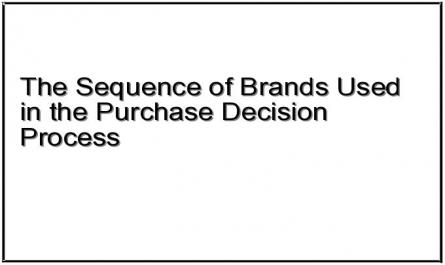
Figure 5: The sequence of brand sets used in the purchase decision process
FULL RANGE OF BRANDS AVAILABLE ON THE MARKET
- Nikon
- Rolley
- Leica
- Minox
- Minolta
- Canon
- Olympus
- Pentax
THE BRAND THAT CUSTOMERS KNOW
- Nikon
- Leica
- Minolta
- Canon
- Olympus
- Pentax
DECISION
?
(Source: Philip Kotler, Basic Marketing , Statistical Publishing House, 3rd edition, page 144)
Therefore, the company must build a marketing-mix system with the aim of bringing its brand into the known brand set and the consumer's chosen brand set. If the brand cannot penetrate these sets, the company will lose its sales potential. In addition, it must also learn about the brands in the chosen brand set to know its competitors and make correct judgments.
As for the sources of information that consumers use, the marketer must fully identify them and then determine their relative information value. First, it is necessary to find out how consumers first become aware of the brand, what other information they have, and how they evaluate each source of information they use. This information will be crucial in crafting effective information for the target market.
2. Consumer behavior when buying
2.1. Evaluation of options
We know that consumers use information to build up a set of brands for their final choice. The question is how is the choice of a particular brand made among these brands, and how does the consumer evaluate the information?
We will analyze some factors that influence evaluation and choice tendencies to better understand consumer evaluation of alternatives.
_ First , the concept of product attributes. Philip Kotler believes that every consumer considers any product as a set of certain attributes. For example, below are some attributes of some common products that consumers are often interested in:
+ Camera: sharpness of captured images, ease of use, size, price;
+ Hotel: location, cleanliness, atmosphere, price;
+ Toothpaste: color, effectiveness, price, taste;
+ Lipstick: color, packaging, price, flavor.
The above attributes are generally of interest to everyone, but different consumers consider different attributes to be important to them. People usually pay the most attention to attributes that are relevant to their needs.
_ Second, consumers tend to assign different levels of importance to the attributes they consider important to them. It is possible to distinguish between the importance of an attribute and its salience, that is, its salience. Salience is the attribute that comes to mind first when asked about the quality of a product. However, these attributes are not necessarily the most important because some of them may be salient because the consumer has just been exposed to advertising that mentions them or has encountered a problem related to them that has “come to the forefront” in the consumer’s mind. Furthermore, the product may have more important attributes that the consumer has forgotten to mention.
_ Third, consumers tend to develop a set of beliefs about brands, when each brand is evaluated according to the degree to which it possesses certain attributes. The set of beliefs about a particular product is called the brand image. Consumer beliefs can range from knowledge about real attributes based on personal experience to knowledge that is the result of selective learning, selective distortion, and selective recall.
_ Fourth, consumers often assign a utility function to each attribute. Utility function describes the extent to which each attribute satisfies expectations. In addition, the preference for a certain brand also depends on the presence of that brand in the market and the price.
_ Fifth, attitudes toward brands are formed in consumers after they have evaluated them. But consumers choose brands in different ways.
2.2. Purchase Decision – Purchase Action
After evaluating the purchase options, the consumer will rank the items in the brand set. In the consumer's mind, a purchase intention is formed, but it must be the most preferred item. But from the point of purchase intention to the point of purchase decision, there are two more factors that can intervene in the purchase decision. (Figure 6)
Figure 6: Factors that inhibit the process of converting purchase intention into purchase decision
Purchase decision
Evaluate the options
The element of surprise
Attitudes of others
Purchase Intent
(Source: Philip Kotler (2002), Basic Marketing , Statistical Publishing House, 3rd edition, page 146)
_ The first factor is the attitude of others . The degree to which the purchase intention will change will depend on the opinions of others regarding the consumer's preferred option and the extent to which the consumer is open to the opinions of others. The stronger the agreement or disagreement of others and the closer that person is to the consumer, the more determined the consumer will be to reconsider his or her purchase decision.
_ The second factor is unexpected factors . Intentions are formed on the basis of expected family income, expected price and expected benefits of that purchase. Unexpected situations can arise suddenly and change the purchase decision at the exact moment when the consumer is ready to act. For example, the consumer is forced to use the intended purchase money for a certain urgent need or someone among his friends expresses disappointment with the type of goods he intends to buy.
3. Post-purchase consumer behavior
After purchasing a product, during the consumption process, consumers will feel the level of satisfaction or dissatisfaction with that product. Marketers need to study and analyze consumer behavior after purchase as well as their response to the state of satisfaction or dissatisfaction with the product in order to have marketing solutions that respond and adjust promptly to improve the situation. Thus, the marketer's job does not end when the product has been purchased, but extends to the post-purchase stage.
_ Post-purchase satisfaction: What determines whether a consumer is satisfied or dissatisfied with a purchased product is the correlation between the consumer's expectations and the product attributes they have received. If the goods match expectations, the consumer is satisfied, if they exceed expectations, the consumer is very satisfied, and if they are lower than expectations, the consumer is dissatisfied.
_ Post-purchase actions: Satisfaction or dissatisfaction with a product will influence subsequent purchase behavior. A satisfied consumer is likely to buy the product again and will speak well of it to others. According to marketers, “a satisfied customer is our best advertisement.” Dissatisfied consumers may respond differently. Dissatisfied consumers may try to reduce their discomfort by abandoning or exchanging the product, or they may simply stop buying the product or inform their friends about the product’s shortcomings, etc. In all cases, the seller will lose something.
_ The ultimate fate of the purchased item: Another issue to consider here is what the consumer will do with his or her purchase? The following are the main possible courses of action for the consumer. (Figure 7)
Figure 7: How consumers use or dispose of goods
Remove goods for a period of time
(for rent or lease)
Give back
In return
Goods
Sell
Keep the goods for yourself (use them as originally intended), use them for a new purpose
Discard
Permanently remove goods
(Source: Philip Kotler, Basic Marketing , Statistical Publishing House, 3rd edition, page 148)
If the consumer uses the product for new purposes, the seller must be concerned, because these new purposes may be profitable in advertising. If the consumer puts the product aside, hardly uses it, or tries to get rid of it, it means that the product does not satisfy him, and the good rumors in favor of the product will not have much effect. To some extent, the consumer must also be concerned about how he gets rid of the product. If he sells it or exchanges it, it will contribute to reducing the volume of further sales. Therefore, the seller must study how the consumer uses the product and gets rid of it, in order to find solutions to problems or possibilities that may arise.
IV. IMPACT OF CONSUMER BEHAVIOR ON BUSINESS ACTIVITIES
1. The impact of consumer behavior on product policy
In business, from small exporting companies to multinational companies, product policy is always a concern at all levels of management. On the other hand, consumers in different countries have different needs and demands; markets have different values and attitudes towards work, success, clothing, food, gender, social status, etc. (for example, attitudes towards personal care and thus personal care products vary greatly between markets). Therefore, when considering bringing products into foreign markets, businesses need to assess the suitability of the product to the consumer culture of that country, specifically the behavior of consumers in that country. Knowledge of consumer behavior helps businesses design products as well as make decisions related to product characteristics such as product types, packaging, brands, etc. Specifically:
1.1. Types of goods
Because each market and each country has different consumer culture, consumer tastes, consumer habits, etc., the same type of product when sold in different markets and aimed at different consumers must have its own characteristics and features. These characteristics will help businesses make decisions about the appropriate type of goods in different markets. We can take the example of means of transport in Vietnam. Due to economic conditions and roads that are not really good, motorbikes are still the main means of transport. Advantages
The advantage of motorbikes is that they can move in the city, on roads with many turns, in small and deep alleys. Therefore, to suit the traffic conditions in Vietnam, motorbikes produced for this market must be of a reasonable size for easy movement, especially not taking up much space in small houses, unlike European countries where the infrastructure is developed, the main means of transportation are cars and public transport, motorbikes are only used on highways, so in these markets the popular motorbikes are motorbikes with large displacement. Another example is when Walt Disney opened Disneyland Hong Kong, in addition to the beloved and popular characters in Walt Disney World such as Donald Duck, Mickey Mouse or Snow White and the Seven Dwarfs, Walt Disney also introduced traditional and beloved characters in China such as Sun Wukong and Tang Monk and his disciples. The company has achieved great success in this market.
1.2. Product quality
Consumer behavior has an important impact on the quality of exported products. Most consumers want to consume high quality products, however, the level of “high quality” standards depends on each different market, specifically consumers of each different country, especially in the consideration between quality, price and many other factors. In Vietnam and developing countries, the majority of consumers are willing to accept goods with beautiful designs, average quality and affordable prices, only a small number of people with high living standards have strict requirements on product quality. Therefore, Chinese goods are very popular in the Vietnamese market because they meet the above requirements. The Chinese market is different, due to its large area, large population, different regions with different economic development and income levels, so consumer demand for product quality is also very different. For example, for high-income consumers in big cities like Beijing, Shanghai, Guangdong, etc., goods must be of good quality, high technical content, rich designs, and beautiful styles; for low-income consumers in Sichuan, Yunnan, Guangxi, etc., goods only need to be of moderate quality, low technical content, and not demanding in form. As for developed countries like the US, EU, and Japan, goods must have
Good quality, especially in the food and foodstuff group. Goods exported to this market must meet a high standard system of product quality. This is also the main barrier for Vietnamese goods exported to these demanding markets.
1.3. Product form
Product design and model are important factors that attract consumers' attention. Enterprises need to study consumer behavior to discover the requirements for design and model for their products. For example, if a furniture business discovers that consumers want furniture products that emphasize comfort and elegance, it should focus on exporting products with bright colors, vibrant designs, unique materials and new breakthroughs. In addition, based on understanding consumer behavior, enterprises can consider improving products by answering the question: What improvements? Does the improvement meet the specific needs of the market? For example, due to religious rituals, in India, Hindus do not eat beef and Muslims abstain from pork. Recognizing this dietary practice, McDonald's replaced it with lamb to serve its parishioners and achieved success in this market.
Product packaging is also a factor that needs special attention. Packaging is the outer shell of the product. In addition to the basic functions such as protecting the product, preserving, maintaining product quality, etc., packaging also has the function of promoting and supporting business. To perform the last function, the packaging must be "eye-catching" and suitable for the market. For example, Europeans like colorful packaging while Americans like packaging with product photos because they want to know the content inside the packaging. The preferred color of packaging also varies depending on consumer habits and customs. For example, red means cleanliness in the US (Colgate toothpaste has red packaging in the US market) but is considered the dirtiest color in the UK. Green is a favorite color for Muslims, so in these countries, packaging is often green. The color of packaging must also be designed to suit each type of product. Microsoft Corporation changed the color of the packaging of its software products from green to red and blue because experts said that green was not eye-catching and reminded consumers of vegetables rather than high-tech products. In addition, the design of images on the packaging also needs to be based on the culture.