
- Core 170408-3: 13.5km off the coast of Dong Hai district, Bac Lieu province, at a depth of 8.8m below sea level. Sample collection time: 8:36 am, April 17, 2008.
- Core 070408-1: 5.7km from the coast of U Minh district, Ca Mau province, at a depth of 9.4m below sea level. Sample collection time: 13:50, April 7, 2008.
Table 2.1. Coordinates of sediment sampling areas
Core
GH01 | 070408-1 | 160408-1 | 160408-2 | 170408-3 | |
Latitude | 105 o 27'59” | 104 o 46'22” | 105 o 32'5” | 105 o 33'48” | 105 o 35'09” |
Longitude | 9 o 04'2” | 9 o 20'19” | 9 o 05'19” | 9 o 02'45” | 9 o 0'22” |
Maybe you are interested!
-
 The Nature and Role of the Internal Control System
 -
 Some Solutions to Improve the Legal System of Alimony
 -
 Model system to assess the suitability of Vietnam's population-economic development process - 21
 -
 Building a system to monitor water level, temperature and send warnings via SMS/GSM network - 2
 -
 The Impact of Accounting Information System Quality on Operational Performance
The sediment sampling process was carried out by Dr. Le Xuan Thuyen and colleagues from the Department of Biology, University of Science - Ho Chi Minh City.
b) Process of preparing analytical samples, standard samples and probes:
After being collected from coastal areas of Bac Lieu and Ca Mau provinces, sediment samples were transferred to the INAA laboratory, the analysis center of the Dalat Nuclear Research Institute for analysis.
In the sample preparation room, the sediment samples were ground into a fine powder of about 200 mesh (or < 0.08 mm) using a specialized sample mill. After being ground, the samples were put into a glass cup and dried at 105 0 C for about 3 hours. The samples were packaged in clean polyethylene bags and weighed using an electronic balance with an accuracy of 0.0001g according to the short, medium and long sample irradiation times with corresponding masses of 30 mg, 50 mg and 100 mg. After completing the weighing and packaging of the samples, the polyethylene sample bags were sealed with a specialized soldering iron in the laboratory. The samples were marked in order and irradiation time to ensure the correct procedure.
After being packaged and checked for tightness, the sediment samples are placed in plastic or aluminum containers along with standard samples and probes for control.
The procedure depends on the length of the exposure time. The standard samples and probes used in the exposure of sediment samples are:
- Standard sample NMIJ CRM 7302a Marine sediment.
- IRMM-530RC flux probe (Al-0.1%Au).
2.2. Experimental projection and sample measurement
Each radioactive isotope has a specific half-life, so to determine all the elements contained in the sample to be analyzed, the sample irradiation process must comply with certain rules for each different element, so in the sample irradiation process, the irradiation time is divided into three types: short sample irradiation time, medium sample irradiation time and long sample irradiation time.
a) Short sample exposure time:
Used to determine isotopes present in samples that have relatively short half-lives ranging from a few minutes to several hours.
Sample irradiation position: channel 7-1 reactor.
Sample exposure time: t i = 45 seconds
The sample is placed in a plastic container, irradiating 03 analysis samples plus 01 Au probe with a mass of 3-5g to control the flux during the irradiation time at the sample irradiation location.
The analyzed samples after irradiation were measured at the automatic INAA analysis room, using a spectrometer system with GMX-30190 detector with liquid nitrogen, calibrated for energy and resolution for the energy range of 50 3200keV. Using Genie-2K gamma spectrum recording software.
Measure the sample twice:
First measurement: Disintegration time (t d ) from 10 20 minutes, measurement time (t c ) 120 seconds to determine the elements Al, Ti, and V.
Second measurement: Disintegration time 1 3 hours, measurement time 600 seconds/sample to determine the elements Dy and Mn.
b) Average sample exposure time:
Used to determine radioactive isotopes with relatively long half-lives of the order T 1/2 = 10 15 hours.
Sample irradiation position: Reactor turntable.
Sample exposure time: t i = 1 hour.
The sample is contained in an aluminum container, irradiating 50 samples at the same time plus 01 standard sample and 01 probe to control the process.
The sample measurement procedure is the same as in the short-time irradiation sample but the measurement is only performed once: Disintegration time (t d ) from 2 to 4 days, measurement time (t c ) 900 seconds to determine the elements As, K, Na.
c) Long exposure time:
Used to determine elements with long half-lives, with T 1/2 ranging from > 5 days.
Sample irradiation position: Reactor turntable.
The sample is contained in an aluminum container, irradiating 50 analysis samples at the same time plus 03 probes and 03 standard samples to control the process.
Sample exposure time: t i = 10 hours.
Conduct sample measurements in the laboratory twice:
First measurement: Disintegration time (t d ) from 5 to 7 days, measurement time (t c ) 1200 seconds, dead time ≤ 8% to determine the elements Nd, Lu, Sm, La.
Second measurement: Disintegration time (t d ) > 25 days, measurement time (t c ) 7200 seconds to determine the elements Ce, Co, Cr, Cs, Eu, Fe, Hf, Rb, Sc, Sb, Tb, Th.
Table 2.2. Gamma spectrometer system using HPGe GMX-30190 detector at INAA Laboratory, Dalat Nuclear Research Institute
HPGe Detector (Ortec)
GMX-30190 | |
High Voltage (CANBERRA) | 3106D (-2500V) |
Amplification (CANBERRA) | 2026 |
MCA (CANBERRA) | Accuspec/A, 8K |
Gamma spectrum acquisition software | Genie-2k |
Table 2.3 . Summary of the irradiation-disintegration-measurement modes for sediment samples.
Projection time (volume)
Projection position ( th / / f ) | Disintegration time (t d ) | Measurement time (t c ) | Isotopes measured | |
45 seconds (~30 mg) | Channel 7.1 (5×10 12 n.cm -2 .s - 1 /0.017/9.8) | 10 - 20 Minutes | 120 Seconds | 28 Al, 51 Ti, 52 V |
1 - 3 Hours | 600 Seconds | 56 Mn, 165 Dy | ||
1 hour (~50 mg) | Turntable (4.2× 10¹² n.cm - 2 .s -1 /0.073/40) | 2 - 4 Days | 900 seconds | 24 Na, 42 K, 76 As |
10 hours (~100 mg) | Turntable (4.2×10 12 n.cm - 2 .s -1 /0.073/40) | 5 - 7 Days | 1200 seconds | 140 La, 147 Nd, 153 Sm, 177 Lu |
> 25 Days | 7200 seconds | 46 Sc, 51 Cr, 59 Fe, 60 Co, 86 Rb, 124 Sb, 134 Cs, 141 Ce, 152 Eu, 160 Tb, 169 Yb, 181 Hf, 182 Ta, 233 Pa (Th) |
2.3. Process gamma spectrum and calculate results using program k 0 - DALAT
The gamma spectrum obtained by Genie-2k software is transferred to k 0 -DALAT software for processing. The software is based on the k 0 -INAA standardization method developed and applied by Dr. Ho Manh Dung of the Analysis Center - Dalat Nuclear Research Institute.
In the main menu of the k 0 -DALAT program , the function F1 is for user help, F2 is for exiting the program, F3 is for viewing the results, F4 is for accessing the database of k 0 -DALAT coefficients and other nuclear parameters or for changing the spectrum format, F5 and F6 are options for the bare or Cd-coated experimental scheme.
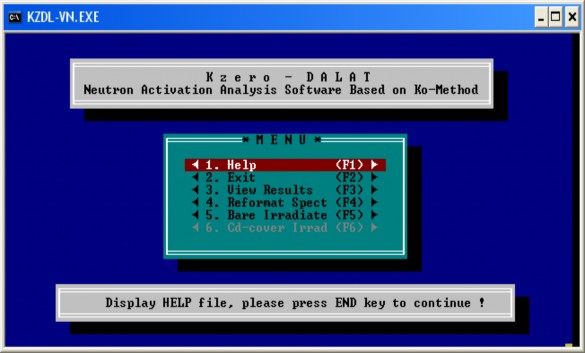
Figure 2.2. Program interface k 0 - DALAT
The k 0 - DALAT program is capable of calculating the content, content error and detection limit (LOD) of elements based on gamma spectrum processing and related neutron spectrum parameters such as A sp (Au), α, th , f , etc. In addition, the k 0 - DALAT program is capable of exporting files in text format (*.TXT) for easy subsequent processing.
Chapter 3
REPORT RESULTS AND COMMENTS
3.1. Results of content analysis
Table 3.1 . Average content and range of 26 elements in 10 sediment samples in core GH01.
STT
Element | Average content (range of content), ppm | Standard deviation (σ) | |
1 | Al | 44000 (36540-53140) | 4967 |
2 | Ti | 4500 (2400-7457) | 1706 |
3 | V | 60 (37.5-73.3) | 11.2 |
4 | Mn | 881 (497-1730) | 386 |
5 | Dy | 6.22 (4.71-10.6) | 1.63 |
6 | Na | 9700 (8369-12240) | 1175 |
7 | K | 13700 (10680-18480) | 2261 |
8 | As | 16 (9.3-22.9) | 4.01 |
9 | La | 48.66 (33-94.7) | 17.2 |
10 | Sm | 8.06 (5.97-15.2) | 2.65 |
11 | Lu | 0.807 (0.55-1.63) | 0.32 |
12 | Sc | 9,909 (7.64-12.3) | 1.52 |
13 | Cr | 99.95 (76.8-154.6) | 23.0 |
14 | Fe | 31300 (24750-37960) | 3581 |
15 | Yes | 11.63 (9.82-13.8) | 1.46 |
16 | Rb | 86.2 (51.1-128.6) | 24.6 |
17 | Sb | 1.62 (1-2.23) | 0.41 |
18 | Cs | 5.63 (4-8.4) | 1.30 |
19 | Ce | 112 (69.8-217.6) | 42.2 |
20 | Nd | 39.68 (21-152.9) | 40.8 |
21 | EU | 1,491 (1.2-2.25) | 0.30 |
22 | Tb | 1.088 (0.75-1.96) | 0.36 |
23 | Yb | 5.79 (3.63-11.44) | 2.13 |
24 | Hf | 22.77 (12.7-58) | 13.0 |
25 | I | 0.82 (0.53-1.56) | 0.30 |
26 | Th | 21.01 (15.3-42.2) | 7.88 |
Table 3.2 . Average content and range of 26 elements in 14 sediment samples in core 160408-1.
STT
Element | Average content (range of content), ppm | Standard deviation (σ) | |
1 | Al | 66360 (56650-79410) | 6698 |
2 | Ti | 3600 (2518-5197) | 871 |
3 | V | 83.6 (45.8-111.5) | 18.3 |
4 | Mn | 813 (644-1013) | 88.3 |
5 | Dy | 4.6 (3.31-5.68) | 0.68 |
6 | Na | 12492 (10492-24972) | 3637 |
7 | K | 21715 (15047-45281) | 7564 |
8 | As | 21.6 (13.9-43.3) | 6.88 |
9 | La | 47.15 (36.7-90.4) | 13.1 |
10 | Sm | 8 (5.9-15.3) | 2.24 |
11 | Lu | 0.54 (0.25-1.06) | 0.17 |
12 | Sc | 11.18 (8.75-13.3) | 1.44 |
13 | Cr | 76.86 (60.8-85) | 6.85 |
14 | Fe | 35003 (25850-42210) | 3987 |
15 | Yes | 13.2 (10.8-15.5) | 1.23 |
16 | Rb | 124 (89.4-163.1) | 21.7 |
17 | Sb | 1.34 (0.98-1.61) | 0.22 |
18 | Cs | 8.25 (6.33-9.69) | 1.07 |
19 | Ce | 66.7 (51-79.6) | 8.04 |
20 | Nd | 29.16 (13.3-43.1) | 8.49 |
21 | EU | 1.15 (0.88-1.33) | 0.12 |
22 | Tb | 0.72 (0.46-1) | 0.16 |
23 | Yb | 3.0 (2.5-3.55) | 0.34 |
24 | Hf | 4.5 (3.79-5.29) | 0.51 |
25 | I | 0.46 (0.36-0.56) | 0.04 |
26 | Th | 12.4 (9.9-14.9) | 1.34 |
Table 3.3 . Average content and range of 26 elements in 11 sediment samples in core 160408-2.
STT
Element | Average content (range of content), ppm | Standard deviation (σ) | |
1 | Al | 86000 (80540-98300) | 5158 |
2 | Ti | 6203 (3386-8805) | 1787 |
3 | V | 112.5 (84.1-139.9) | 16.3 |
4 | Mn | 713.1 (630-843) | 68.1 |
5 | Dy | 5.3 (4.57-6.05) | 0.52 |
6 | Na | 13130 (12440-14660) | 662 |
7 | K | 24368 (19420-33920) | 4225 |
8 | As | 20.68 (18.2-25.4) | 2.34 |
9 | La | 42.8 (39.8-46.7) | 1.98 |
10 | Sm | 7.32 (6.93-7.88) | 0.30 |
11 | Lu | 0.59 (0.34-0.89) | 0.16 |
12 | Sc | 17.4 (16.4-18.6) | 0.77 |
13 | Cr | 109 (100.1-129.3) | 8.78 |
14 | Fe | 47683 (44530-51870) | 2153 |
15 | Yes | 18.2 (17.5-19.5) | 0.75 |
16 | Rb | 161 (131.6-215.9) | 25.6 |
17 | Sb | 1.9 (1.37-2.47) | 0.37 |
18 | Cs | 13.3 (12.2-14.6) | 0.69 |
19 | Ce | 100.6 (95-109.7) | 4.37 |
20 | Nd | 36 (25.6-59.8) | 11.30 |
21 | EU | 1.63 (1.55-1.8) | 0.08 |
22 | Tb | 1.07 (0.72-1.6) | 0.29 |
23 | Yb | 4.49 (3.82-5.82) | 0.52 |
24 | Hf | 5.35 (3.93-6.25) | 0.66 |
25 | I | 0.75 (0.56-0.89) | 0.10 |
26 | Th | 18.63 (17.5-20.4) | 0.84 |