
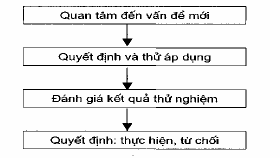
When educated subjects refuse to perform new health-promoting behaviors, health educators must find out the reason why, whether it is a matter of knowledge, attitude or lack of practical skills. lack of support ... to adjust appropriate forms of education.
Usually in a community there are always different types of people who are interested in receiving new knowledge, we can group them as follows:
Group l: group of people who initiate innovation. This group is about 2.5% according to author Roger 1983 (Innovation - decision process).
Group 2: group of people who adopt healthy behavioral ideas early. This group is about 13.5%. They are exemplary pioneers. They are called “ opinion leaders,” and they may have informal authority (because they are not often community leaders, but they have credibility and are sought after by others). This group often has a high level of cultural knowledge and wide connections, so they play an important role in the community.
Group 3: the majority group accepts change early. This group often accepts new behavioral ideas following group 2, and is often influenced early by groups 1 and 2. This group accounts for about 34%.
Group 4: the majority group accepts late change. This group is also about 34%, the acceptance of changing behavior is later, but the number of people in this group is also quite large. equivalent to group 3, this group is heavily influenced by group 3.
Group 5: slow, conservative and backward group. This group accounts for 16%. Influencing this group is often very difficult and ineffective, so we must be very persistent and use appropriate solutions to prevent this group from having a negative impact on other groups because this group often tends to oppose the leaders. innovative, progressive ideas and strive to entice others to follow them.
When spreading a new idea or health behavior, you need to pay attention to detecting and classifying objects in the community for impact. Finding a group of " opinion leaders" is of great significance in health education because they are the nucleus of innovation. We often see them as people who play a key role in the community and make an important contribution to the success of the campaign to educate a new ideology and healthy behavior. They are the ones who need to be impacted first and through them will impact other subjects in the community.
So we see clearly:
Changing health behavior is a very complex process, requiring a lot of effort from the subjects themselves and the dedicated help of health education communication staff as well as other people in the community.
In conventional health education programs, we only help subjects move to step 2 (belonging to the sensory perception process), but do not help them pass step 3 and complete the transition. steps 4
and 5 (rational cognition), so the results of educational communication are still limited and not very effective.
- If you want to completely change an individual's behavior, you must fully experience those 5 steps many times, not just once to achieve the desired results immediately, so each individual must consider educating themselves through Their own experiences are what determine any sustainable results.
Health is a process of self-education for each individual through their own experiences, which determines all sustainable results.
If we want to build people who meet the development requirements of a new society, we must pay attention to school health education. Early education right from kindergarten age aims to form good personalities with healthy behaviors in children. School health education programs play a very important role and are highly effective because students' ages are very sensitive in forming healthy health behaviors, and through health education, students will have affecting their families and the community in general.
In short, depending on the reasons behind the behavior or the causes leading to the behavior, we have operational strategies and coordinated health education methods to support the behavior change process such as Table 1 below: Combining health education methods for the behavior change process
Problem
Necessary activity | Health education methods can be coordinated | |
Lack of understanding | Provide information | Health talks, consultations, radio broadcasts, |
Lack of skills | Train | Demonstrations, practical instructions, games |
Lack of trust | Support | Consulting, group discussion, club, closing |
Lack of resources | Develop resources | Community survey, group and joint meetings |
Conflict with | Explain clearly | Role play, storytelling, games, educational, private |
Maybe you are interested!
-
 Results of Intervention to Prevent Mother-to-Child Transmission of HBV Using Health Education for Mothers and Children at Hai Phong Obstetrics and Gynecology Hospital
 -
 Oral diseases and integrated oral health education for primary school students - 12
 -
 Assessing Patient Satisfaction with Communication Channels, Providing Medical Information and Health Education Used by Social Work Staff.
 -
 Obesity and integrated health education to prevent obesity for primary school students - 13
 -
 Content of Implementation of Legal Policy on Management of Education Sector Officials
Thus, the necessary conditions to change health behavior are: 1 The subject must realize that they have a health problem.
2. The subject must want to solve their health problem.
3. Subjects must clearly understand healthy behaviors to solve health problems
That's good.
4. Healthy behavior must be feasible and accepted by the community.
5. Subjects must experiment with healthy behavior.
6. Subjects must be able to evaluate the effectiveness of performing healthy behaviors.
7. The subject accepts to perform that healthy behavior.
8. There must be support to help subjects maintain healthy behavior (support from health workers, community leaders and the community).
SELF EVALUATION
1. Self-evaluation question
Part 1. Objective test
*Shortly answer questions 1 to 3 by filling in the appropriate words or phrases in the space below:
1. The purpose of health education is to provide people with the necessary knowledge to protect and improve health, prolong life and be beneficial to society. Introducing health services for everyone to know. Mobilize and persuade people to give up these things . . . . . A. . . . . . . . . . . . . harmful to their health and practice healthy health behaviors so that they can create, protect and improve their own health for their families and communities through their own efforts.
2. Health education aims to create ............A................., the most important thing is to create the good habits, healthy behaviors in children and changing harmful health behaviors in adults, especially the elderly because they have a great influence on the next generation.
3. The basic requirement of health educators is to cultivate knowledge about medical education, .........A............. .........., anthropology and medical knowledge, know how to apply creativity to real-life conditions in health education.
*Choose the best answer for questions 4 to 21 by ticking
X in the box with the letter corresponding to the first letter of the answer you choose
question
A | B | C | D | |
4. Human behavior is: A. Complex human actions B. Human behavior C. People's habits and customs D. Human lifestyle | ||||
5. Behavior is influenced by factors, EXCEPT. A. Economics |
A | B | C | D | |
B. Culture C. Ecology D. Society | ||||
6. Health behaviors are: A. Habits that are harmful to health B. Behaviors that have beneficial or harmful effects on health C Customs and habits can be beneficial or harmful to health D. A healthy lifestyle | ||||
7. Some ethnic groups have the habit of wearing silver bracelets for children, which is the act of: A. Beneficial for health B. Harmful to health C Neither beneficial nor harmful to health D. Being influenced by cultural practices that are harmful to health | ||||
8. If you are a health worker working in a locality where it is customary for all children to wear silver bracelets after birth, you will: A. Advise mothers not to wear bracelets for their children because it is not beneficial to their health B. Encourage mothers to continue that practice because it is beneficial for their health C Ask the mother to immediately stop wearing bracelets for her child because you think that behavior is not beneficial to health D. Explain clearly to mothers that such behavior has no effect regarding health behavior, we should preserve that cultural beauty | ||||
9. Components of behavior include: A. Knowledge, attitudes, beliefs, values, practices B. Practices, perceptions and ways of looking at a certain problem C Knowledge, values, practices and attitudes D. Knowledge, attitudes, beliefs, practices | ||||
10. To help people change their health behavior, health workers first need to: A. Impacts all three main components of behavior B. Analyze the subject's deficiencies in the above components C Improve the subject's practical skills D. Help subjects identify their own health problems and related health behaviors |
Question
A | B | C | D | |
11 . Knowledge of health education subjects is: A. Subject's understanding of health issues and influencing factors B. Subjects' awareness of their own health problems. C Level of understanding of factors related to the problem health . D. Subject's understanding of behaviors that affect their health | ||||
12. Health education workers need to: A. Implement necessary interventions for subjects to change their health behaviors B. Help subjects understand their own health problems, encourage them to find reasonable solutions to solve their health problems C Make decisions to come up with the best solutions to solve their health problems D. Outline the steps that must be taken to change the behavior of health education subjects | ||||
13. In Information - Health Education, the difficulty to detect is change: A. Knowledge B. Practice C Awareness D. Attitude | ||||
14. Communication - Health education is an collaborative process Actions need to be, EXCEPT. A. Persistence and continuity B. Have a plan C Involves the subject D. There is active support from the government | ||||
15. It is necessary to carefully analyze the basic components of behavior: A. Knowledge, attitudes, values B. Attitudes, beliefs, values C Practice, belief, knowledge D. Knowledge, attitude, practice | ||||
16. Purpose of Communication - Health Education to: A. Provide information that can change behavior. B. Medical staff decides on intervention solutions to help the subject change their behavior. |
Question
A | B | C | D | |
C. Consult the subject with enough knowledge to change his or her behavior D. Help people recognize health problems, support and encourage them to find and implement behavior change solutions themselves | ||||
17. The proportion of health problems and diseases in the world whose causes are related to human health behavior is: A. 60% B. 70% C 80% D. 90% | ||||
18. The basic reasons for carefully analyzing behavior in Health Communication - Education are: A. To understand the subject's level of knowledge about their health problems B. Learn the capacity to perform health behaviors C Assess the subject's attitudes about behavior related to health issues D. Find out the reasons behind relevant behaviors to health for appropriate solutions | ||||
19. In an area in South Africa, people here have a custom that when a pregnant woman gives birth, they ask her to bite a wooden stick through her mouth. They think and believe that doing so is so that when the mother warns the fetus, it will not come out of the mother's mouth and harm the fetus. According to you, such customs are: A. Beneficial for health B. Harmful to health C Neither beneficial nor harmful to health D. No effect | ||||
20. In some areas of the world, when pregnant women often abstain from eating certain types of animals, they believe that if they do not abstain, their children will behave like that animal after birth. . That behavior is the behavior: A. Beneficial B. Harmful C Neither beneficial nor harmful D. No effect |
Question
A | B | C | D | |
21. In a certain region, there is a custom that when pregnant women are not allowed to work outside in the sun or heat because if they do, the "devil" will take the fetus away. As a medical officer What would you do in such an area? A. Thinking it is an outdated, superstitious practice, trying to dissuade them from believing in it. B. Go to the house to propagate and explain that doing so is not right and is not good for the mother's health because they need to do light labor during pregnancy. C Explain to them that it is not like that, but That is good for the health of mother and fetus. D. Don't interfere, let everything happen naturally | ||||
22. To assess the understanding of health education subjects in the most accurate and complete way, it is necessary to: A. Collect indirectly through others to understand the subject B. Create good relationships, be open and intimate, and collect information directly C Use a knowledge assessment questionnaire by filling it out yourself D. Collect information through available reports and documents | ||||
23. The basic advantages of collecting information directly are: A. Takes less time and effort to prepare B. Having direct contact with the subject, having the opportunity to understand the subject better C. Collect accurate information about the subject D. Build a good relationship with the subject | ||||
24. The basic disadvantages of the method of collecting information through other sources are: A. The subject's entire perception cannot be assessed B. Collecting information about the subject's knowledge is not objective C The information obtained depends on the subjectivity of the information provider D. Information depends on the relationship of the person providing the information | ||||
25. The basic disadvantage of collecting available information is: A. Lack of desired information, available data is not collected systematically B. Inaccurate, not enough information as required C Wastes time and resources D. The available information system is not well established |
question
A | B | C | D | |
26. The average cognitive level of the subject compared to the commonly achieved standard is: A. 50- 60 % B. 60 - 80 % C 60 - 70 % D. 50- 70 % | ||||
27. Weak cognitive level of the subject compared to commonly achieved standards is: A. <40 % B. 40 - 60 % C 40- 50 % D. < 50 % | ||||
28. Attitude is: A. Behavior belongs to the moral category of the subject B. Tendencies of the subject's feelings and emotions about the event C How to act according to the subject's feelings D. Subject's perspective on a health issue | ||||
29. According to Jimoodtor's Diffusion of Innovation Theory, the proportion of people in a community who are greatly influenced by public opinion is: A. 20 % B. 25 % C 30 % D. 35% | ||||
30. According to Jimoodtor, the tendency to change behavior in community groups as follows: A. Early progress B. Advanced leader C Early adopter D. Backward conservative | ||||
31. The proportion of groups making slow progress in addition, according to the diffusion of innovation theory is: A. 25- 37% B. 30- 37.5% C 34- 37.5% D. 32- 37% |
Question
A | B | C | D | |
32. As a health officer, when assigned to mobilize people to use bed nets and spray them, who do you think will be the main participants in the above communication campaign: A. Conservative, backward B. Early progress C. Early progress and conservatism and backwardness D. Early progress and slow progress | ||||
33. The basis for choosing a group of subjects to participate in the subject of bednet and bednet impregnation education is, EXCEPTION. A. Target group in the campaign, related to the above activity B. The group makes up a large proportion of the community C The group is easily influenced by many internal and external factors D. The group is very concerned about malaria | ||||
34. To understand the subject's attitude, the best way is: A. Observation without participation B. Participatory observation C Observation combined with interviews D. Observation with discussion | ||||
35. To collect complete information about the subject's attitude exactly, the medical officer needs to, EXCEPT. A. Create an information exchange environment that the audience feels is safe. confident B. Coordinate information collected from many sources, cross-check information C In many cases, subjects are asked to take a test to test both skills and attitudes D. Know a lot about the subject | ||||
36. The best method to evaluate and analyze a subject's practical skills is: A. Interview based on a set of questions B. Skills assessment checklist C Non-participatory observation with participation D. Observation based on checklist | ||||
37. Method of assessing subjects' practical skills indirectly through relatives. neighbors, other medical staff, the main disadvantages are: A. Lack of information |