
1.1.1.2. Quality of human resources
In this study, due to limitations in the quality of human resources in terms of training and professional expertise, physical, moral and mental factors have not been studied by us.
The quality of human resources is not only an indicator reflecting the economic level but also an indicator reflecting the level of development in terms of social life, because high quality human resources will create a stronger driving force for development as not only a resource for development, but also a demonstration of the level of civilization of a certain society. The quality of human resources reflects the relationship between the elements that make up the internal nature of human resources, expressed through the criteria: health, professional qualifications, educational level and psychosocial qualities. The quality of human resources is a comprehensive concept including the characteristics of the intellectual state, physical strength, moral style, lifestyle and spirit of human resources. The quality of human resources is determined by the level of socio-economic development and the government's investment policy in human resource development [9, pp. 55,56]. Specifically as follows:
Intelligence is the capacity of the mind, which largely determines the creative labor ability of humans. Intelligence is considered the most important factor of human resources because everything that motivates people to act must of course go through their minds. Exploiting and promoting intellectual potential becomes the most important requirement for promoting human resources, including the comprehensive level of culture, expertise, technology, and labor skills. Cultural level, with a certain educational background, is the basis for developing technical expertise. Technical expertise is the condition to ensure that human resources operate in a specialized and professional manner. Labor skills according to each profession and field are a particularly important requirement in developing human resources in industrial society.
Physical strength is the state of human health, a condition that ensures that humans develop and mature normally, or can meet the demands of physical, mental and muscular expenditure in labor. Intelligence increasingly plays a decisive role in the development of human resources. However, human intellectual strength can only develop its advantages on the basis of healthy physical strength. Health care is a very basic task to improve the quality of human resources, creating a premise to effectively develop human potential.
Maybe you are interested!
-
 Dialectical Materialism and Historical Materialism
 -
 Identify Rating Levels and Rating Scales
zt2i3t4l5ee
zt2a3gstourism,quan lan,quang ninh,ecology,ecotourism,minh chau,van don,geography,geographical basis,tourism development,science
zt2a3ge
zc2o3n4t5e6n7ts
of the islanders. Therefore, this indicator will be divided into two sub-indicators:
a1. Natural tourism attractiveness a2. Cultural tourism attractiveness
b. Tourist capacity
The two island communes in Quan Lan have different capacities to receive tourists. Minh Chau Commune is home to many standard hotels and resorts, attracting high-income domestic and international tourists. Meanwhile, Quan Lan Commune has many motels mainly built and operated by local people, so the scale and quality are not high, and will be suitable for ordinary tourists such as students.
c. Time of exploitation of Quan Lan Island Commune:
Quan Lan tourism is seasonal due to weather and climate conditions and festivals only take place on certain days of the year, specifically in spring. In Quan Lan commune, the period from April to June and from September to November is considered the best time to visit Quan Lan because the cultural tourism activities are mainly associated with festivals taking place during this time.
Minh Chau island commune:
Tourism exploitation time is all year round, because this is a place with a number of tourist attractions with diverse ecosystems such as Bai Tu Long National Park Research Center, Tram forest, Turtle Laying Beach, so besides coming to the beach for tourism and vacation in the summer, Minh Chau will attract research groups to come for tourism combined with research at other times of the year.
d. Sustainability
The sustainability of ecotourism sites in Quan Lan and Minh Chau communes depends on the sensitivity of the ecosystems to climate changes.
landscape. In general, these tourist destinations have a fairly high level of sustainability, because they are natural ecosystems, planned and protected. However, if a large number of tourists gather at certain times, it can exceed the carrying capacity and affect the sustainability of the environment (polluted beaches, damaged trees, animals moving away from their habitats, etc.), then the sustainability of the above ecosystems (natural ecosystems, human ecosystems) will also be affected and become less sustainable.
e. Location and accessibility
Both island communes have ports to take tourists to visit from Van Don wharf:
- Quan Lan – Van Don traffic route:
Phuc Thinh – Viet Anh high-speed boat and Quang Minh high-speed boat, depart at 8am and 2pm from Van Don to Quan Lan, and at 7am and 1pm from Quan Lan to Van Don. There are also wooden boats departing at 7am and 1pm.
- Van Don - Minh Chau traffic route:
Chung Huong high-speed train, Minh Chau train, morning 7:30 and afternoon 13:30 from Van Don to Minh Chau, morning 6:30 and afternoon 13:00 from Minh Chau to Van Don.
f. Infrastructure
Despite receiving investment attention, the issue of infrastructure and technical facilities for tourism on Quan Lan Island is still an issue that needs to be resolved because it has a direct impact on the implementation of ecotourism activities. The minimum conditions for serving tourists such as accommodation, electricity, water, communication, especially medical services, and security work need to be given top priority. Ecotourism spots in Minh Chau commune are assessed to have better infrastructure and technical facilities for tourism because there are quite complete and synchronous conditions for serving tourists, meeting many needs of domestic and foreign tourists.
3.2.1.4. Determine assessment levels and assessment scales
Corresponding to the levels of each criterion, the index is the score of those levels in the order of 4, 3, 2, 1 decreasing according to the standard of each level: very attractive (4), attractive (3), average (2), less attractive (1).
3.2.1.5. Determining the coefficients of the criteria
For the assessment of DLST in the two communes of Quan Lan and Minh Chau islands, the students added evaluation coefficients to show the importance of the criteria and indicators as follows:
Coefficient 3 with criteria: Attractiveness, Exploitation time. These are the 2 most important criteria for attracting tourists to tourism in general and eco-tourism in particular, so they have the highest coefficient.
Coefficient 2 with criteria: Capacity, Infrastructure, Location and accessibility . Because the assessment area is an island commune of Van Don district, the above criteria are selected by the author with appropriate coefficients at the average level.
Coefficient 1 with criteria: Sustainability. Quan Lan has natural and human-made ecotourism sites, with high biodiversity and little impact from local human factors. Most of the ecotourism sites are still wild, so they are highly sustainable.
3.2.1.6. Results of DLST assessment on Quan Lan island
a. Assessment of the potential for natural tourism development
For Minh Chau commune:
+ Natural tourism attractiveness is determined to be very attractive (4 points) and the most important coefficient (coefficient 3), so the score of the Attractiveness criterion is 4 x 3 = 12.
+ Capacity is determined as average (2 points) and the coefficient is quite important (coefficient 2), then the score of Capacity criterion is 2 x 2 = 4.
+ Exploitation time is long (4 points), the most important coefficient (coefficient 3) so the score of the Exploitation time criterion is 4 x 3 = 12.
+ Sustainability is determined as sustainable (4 points), the important coefficient is the average coefficient (coefficient 1), so the score of the Sustainability criterion is 4 x 1 = 4 points
+ Location and accessibility are determined to be quite favorable (2 points), the coefficient is quite important (coefficient 2), the criterion score is 2 x 2 = 4 points.
+ Infrastructure is assessed as good (3 points), the coefficient is quite important (coefficient 2), then the score of the Infrastructure criterion is 3 x 2 = 6 points.
The total score for evaluating DLST in Minh Chau commune according to 6 evaluation criteria is determined as: 12 + 4 + 12 + 4 + 4 + 6 = 42 points
Similar assessment for Quan Lan commune, we have the following table:
Table 3.3: Assessment of the potential for natural ecotourism development in Quan Lan and Minh Chau communes
Attractiveness of self-tourismof course
Capacity
Mining time
Sustainability
Location and accessibility
Infrastructure
Result
Point
DarkMulti
Point
DarkMulti
Point
DarkMulti
Point
DarkMulti
Point
DarkMulti
Point
DarkMulti
CommuneMinh Chau
12
12
4
8
12
12
4
4
4
8
6
8
42/52
Quan CommuneLan
6
12
6
8
9
12
4
4
4
8
4
8
33/52
b. Assessment of the potential for humanistic tourism development
For Quan Lan commune:
+ The attractiveness of human tourism is determined to be very attractive (4 points) and the most important coefficient (coefficient 3), so the score of the Attractiveness criterion is 4 x 3 = 12.
+ Capacity is determined to be large (3 points) and the coefficient is quite important (coefficient 2), then the score of the Capacity criterion is 3 x 2 = 6.
+ Mining time is average (3 points), the most important coefficient (coefficient 3) so the score of the Mining time criterion is 3 x 3 = 9.
+ Sustainability is determined as sustainable (4 points), the important coefficient is the average coefficient (coefficient 1), so the score of the Sustainability criterion is 4 x 1 = 4 points.
+ Location and accessibility are determined to be quite favorable (2 points), the coefficient is quite important (coefficient 2), the criterion score is 2 x 2 = 4 points.
+ Infrastructure is rated as average (2 points), the coefficient is quite important (coefficient 2), then the score of the Infrastructure criterion is 2 x 2 = 4 points.
The total score for evaluating DLST in Quan Lan commune according to 6 evaluation criteria is determined as: 12 + 6 + 6 + 4 + 4 + 4 = 36 points.
Similar assessment with Minh Chau commune we have the following table:
Table 3.4: Assessment of the potential for developing humanistic eco-tourism in Quan Lan and Minh Chau communes
Attractiveness of human tourismliterature
Capacity
Mining time
Sustainability
Location and accessibility
Infrastructure
Result
Point
DarkMulti
Point
DarkMulti
Point
DarkMulti
Point
DarkMulti
Point
DarkMulti
Point
DarkMulti
Quan CommuneLan
12
12
6
8
9
12
4
4
4
8
4
8
39/52
Minh CommuneChau
6
12
4
8
12
12
4
4
4
8
6
8
36/52
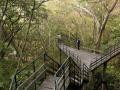
Basically, both Minh Chau and Quan Lan localities have quite favorable conditions for developing ecotourism. However, Quan Lan commune has more advantages to develop ecotourism in a humanistic direction, because this is an area with many famous historical relics such as Quan Lan Communal House, Quan Lan Pagoda, Temple worshiping the hero Tran Khanh Du, ... along with local festivals held annually such as the wind praying ceremony (March 15), Quan Lan festival (June 10-19); due to its location near the port and long exploitation time, the beaches in Quan Lan commune (especially Quan Lan beach) are no longer hygienic and clean to ensure the needs of tourists coming to relax and swim; this is also an area with many beautiful landscapes such as Got Beo wind pass, Ong Phong head, Voi Voi cave, but the ability to access these places is still very limited (dirt hill road, lots of gravel and rocks), especially during rainy and windy times; In addition, other natural resources such as mangrove forests and sea worms have not been really exploited for tourism purposes and ecotourism development. On the contrary, Minh Chau commune has more advantages in developing ecotourism in the direction of natural tourism, this is an area with diverse ecosystems such as at Rua De Beach, Bai Tu Long National Park Conservation Center...; Minh Chau beach is highly appreciated for its natural beauty and cleanliness, ranked in the top ten most beautiful beaches in Vietnam; Minh Chau commune is also home to Tram forest with a large area and a purity of up to 90%, suitable for building bridges through the forest (a very effective type of natural ecotourism currently applied by many countries) for tourists to sightsee, as well as for the purpose of studying and researching.
Figure 3.1: Thenmala Forest Bridge (India) Source: https://www.thenmalaecotourism.com/(August 21, 2019)
3.2.2. Using SWOT matrix to evaluate Quan Lan island tourism
General assessment of current tourism activities of Quan Lan island is shown through the following SWOT matrix:
Table 3.5: SWOT matrix evaluating tourism activities on Quan Lan island
Internal agent
Strengths- There is a lot of potential for tourism development, especially natural ecotourism and humanistic ecotourism.- The unskilled labor force is relatively abundant.- resource environmentunpolluted, still
Weaknesses- Poorly developed infrastructure, especially traffic routes to tourist destinations on the island.- The team of professional staff is still weak.- Tourism products in general
quite wild, originalintact
general and DLST in particularalone is monotonous.
External agents
Opportunity- Tourism is a key industry in the socio-economic development strategy of the province and Van Don economic zone.- Quan Lan was selected as a pilot area for eco-tourism development within the framework of the green growth project between Quang Ninh province and the Japanese organization JICA.- The flow of tourists and especially ecotourism in the world tends toincreasing
Challenge- Weather and climate change abnormally.- Competition in tourism products is increasingly fierce, especially with other localities in the province such as Ha Long, Mong Cai...- Awareness of tourists, especially domestic tourists, about ecotourism and nature conservation is not high.
Through summary analysis using SWOT matrix we see that:
To exploit strengths and take advantage of opportunities, it is necessary to:
- Diversify products and service types (build more tourism routes aimed at specific needs of tourists: experiential tourism immersed in nature, spiritual cultural tourism...)
- Effective exploitation of resources and differentiated products (natural resources and human resources)
div.maincontent .p { color: black; font-family:"Times New Roman", serif; font-style: normal; font-weight: normal; text-decoration: none; font-size: 14pt; margin:0pt; } div.maincontent p { color: black; font-family:"Times New Roman", serif; font-style: normal; font-weight: normal; text-decoration: none; font-size: 14pt; margin:0pt; } div.maincontent .s1 { color: black; font-family:"Times New Roman", serif; font-style: normal; font-weight: normal; text-decoration: none; font-size: 13pt; } div.maincontent .s2 { color: black; font-family:"Times New Roman", serif; font-style: normal; font-weight: normal; text-decoration: none; font-size: 13pt; } div.maincontent .s3 { color: #0D0D0D; font-family:"Times New Roman", serif; font-style: normal; font-weight: bold; text-decoration: none; font-size: 14pt; } div.maincontent .s4 { color: black; font-family:"Times New Roman", serif; font-style: italic; font-weight: normal; text-decoration: none; font-size: 14pt; } div.maincontent .s5 { color: black; font-family:"Times New Roman", serif; font-style: italic; font-weight: bold; text-decoration: none; font-size: 14pt; } div.maincontent .s6 { color: black; font-family:"Times New Roman", serif; font-style: italic; font-weight: normal; text-decoration: none; font-size: 14pt; vertical-align: -3pt; } div.maincontent .s7 { color: black; font-family:"Times New Roman", serif; font-style: italic; font-weight: normal; text-decoration: none; font-size: 14pt; vertical-align: -2pt; } div.maincontent .s8 { color: black; font-family:"Times New Roman", serif; font-style: italic; font-weight: normal; text-decoration: none; font-size: 14pt; vertical-align: -1pt; } div.maincontent .s9 { color: black; font-family:"Times New Roman", serif; font-style: normal; font-weight: normal; text-decoration: none; font-size: 14pt; } div.maincontent .s10 { color: black; font-family:"Times New Roman", serif; font-style: normal; font-weight: bold; text-decoration: none; font-size: 14pt; } div.maincontent .s11 { color: black; font-family:"Times New Roman", serif; font-style: normal; font-weight: normal; text-decoration: none; font-size: 14pt; } div.maincontent .s12 { color: black; font-family:Symbol, serif; font-style: normal; font-weight: normal; text-decoration: none; font-size: 14pt; } div.maincontent .s13 { color: black; font-family:Wingdings; font-style: normal; font-weight: normal; text-decoration: none; font-size: 14pt; } div.maincontent .s14 { color: black; font-family:"Times New Roman", serif; font-style: normal; font-weight: normal; text-decoration: none; font-size: 9pt; vertical-align: 5pt; } div.maincontent .s15 { color: black; font-family:"Times New Roman", serif; font-style: normal; font-weight: normal; text-decoration: none; font-size: 9pt; vertical-align: 5pt; } div.maincontent .s16 { color: black; font-family:Cambria, serif; font-style: italic; font-weight: normal; text-decoration: none; font-size: 14pt; } div.maincontent .s17 { color: #080808; font-family:"Times New Roman", serif; font-style: normal; font-weight: bold; text-decoration: none; font-size: 14pt; } div.maincontent .s18 { color: #080808; font-family:"Times New Roman", serif; font-style: normal; font-weight: normal; text-decoration: none; font-size: 14pt; } div.maincontent .s19 { color: black; font-family:"Times New Roman", serif; font-style: normal; font-weight: normal; text-decoration: none; font-size: 11pt; } div.maincontent .s20 { color: black; font-family:"Times New Roman", serif; font-style: normal; font-weight: normal; text-decoration: none; font-size: 10pt; } div.maincontent .s21 { color: black; font-family:"Times New Roman", serif; font-style: normal; font-weight: bold; text-decoration: none; font-size: 11pt; } div.maincontent .s22 { color: black; font-family:"Times New Roman", serif; font-style: normal; font-weight: normal; text-decoration: none; font-size: 11pt; } div.maincontent .s23 { color: black; font-family:"Times New Roman", serif; font-style: italic; font-weight: normal; text-decoration: none; font-size: 14pt; } div.maincontent .s24 { color: #212121; font-family:"Times New Roman", serif; font-style: normal; font-weight: normal; tex
Identify Rating Levels and Rating Scales
zt2i3t4l5ee
zt2a3gstourism,quan lan,quang ninh,ecology,ecotourism,minh chau,van don,geography,geographical basis,tourism development,science
zt2a3ge
zc2o3n4t5e6n7ts
of the islanders. Therefore, this indicator will be divided into two sub-indicators:
a1. Natural tourism attractiveness a2. Cultural tourism attractiveness
b. Tourist capacity
The two island communes in Quan Lan have different capacities to receive tourists. Minh Chau Commune is home to many standard hotels and resorts, attracting high-income domestic and international tourists. Meanwhile, Quan Lan Commune has many motels mainly built and operated by local people, so the scale and quality are not high, and will be suitable for ordinary tourists such as students.
c. Time of exploitation of Quan Lan Island Commune:
Quan Lan tourism is seasonal due to weather and climate conditions and festivals only take place on certain days of the year, specifically in spring. In Quan Lan commune, the period from April to June and from September to November is considered the best time to visit Quan Lan because the cultural tourism activities are mainly associated with festivals taking place during this time.
Minh Chau island commune:
Tourism exploitation time is all year round, because this is a place with a number of tourist attractions with diverse ecosystems such as Bai Tu Long National Park Research Center, Tram forest, Turtle Laying Beach, so besides coming to the beach for tourism and vacation in the summer, Minh Chau will attract research groups to come for tourism combined with research at other times of the year.
d. Sustainability
The sustainability of ecotourism sites in Quan Lan and Minh Chau communes depends on the sensitivity of the ecosystems to climate changes.
landscape. In general, these tourist destinations have a fairly high level of sustainability, because they are natural ecosystems, planned and protected. However, if a large number of tourists gather at certain times, it can exceed the carrying capacity and affect the sustainability of the environment (polluted beaches, damaged trees, animals moving away from their habitats, etc.), then the sustainability of the above ecosystems (natural ecosystems, human ecosystems) will also be affected and become less sustainable.
e. Location and accessibility
Both island communes have ports to take tourists to visit from Van Don wharf:
- Quan Lan – Van Don traffic route:
Phuc Thinh – Viet Anh high-speed boat and Quang Minh high-speed boat, depart at 8am and 2pm from Van Don to Quan Lan, and at 7am and 1pm from Quan Lan to Van Don. There are also wooden boats departing at 7am and 1pm.
- Van Don - Minh Chau traffic route:
Chung Huong high-speed train, Minh Chau train, morning 7:30 and afternoon 13:30 from Van Don to Minh Chau, morning 6:30 and afternoon 13:00 from Minh Chau to Van Don.
f. Infrastructure
Despite receiving investment attention, the issue of infrastructure and technical facilities for tourism on Quan Lan Island is still an issue that needs to be resolved because it has a direct impact on the implementation of ecotourism activities. The minimum conditions for serving tourists such as accommodation, electricity, water, communication, especially medical services, and security work need to be given top priority. Ecotourism spots in Minh Chau commune are assessed to have better infrastructure and technical facilities for tourism because there are quite complete and synchronous conditions for serving tourists, meeting many needs of domestic and foreign tourists.
3.2.1.4. Determine assessment levels and assessment scales
Corresponding to the levels of each criterion, the index is the score of those levels in the order of 4, 3, 2, 1 decreasing according to the standard of each level: very attractive (4), attractive (3), average (2), less attractive (1).
3.2.1.5. Determining the coefficients of the criteria
For the assessment of DLST in the two communes of Quan Lan and Minh Chau islands, the students added evaluation coefficients to show the importance of the criteria and indicators as follows:
Coefficient 3 with criteria: Attractiveness, Exploitation time. These are the 2 most important criteria for attracting tourists to tourism in general and eco-tourism in particular, so they have the highest coefficient.
Coefficient 2 with criteria: Capacity, Infrastructure, Location and accessibility . Because the assessment area is an island commune of Van Don district, the above criteria are selected by the author with appropriate coefficients at the average level.
Coefficient 1 with criteria: Sustainability. Quan Lan has natural and human-made ecotourism sites, with high biodiversity and little impact from local human factors. Most of the ecotourism sites are still wild, so they are highly sustainable.
3.2.1.6. Results of DLST assessment on Quan Lan island
a. Assessment of the potential for natural tourism development
For Minh Chau commune:
+ Natural tourism attractiveness is determined to be very attractive (4 points) and the most important coefficient (coefficient 3), so the score of the Attractiveness criterion is 4 x 3 = 12.
+ Capacity is determined as average (2 points) and the coefficient is quite important (coefficient 2), then the score of Capacity criterion is 2 x 2 = 4.
+ Exploitation time is long (4 points), the most important coefficient (coefficient 3) so the score of the Exploitation time criterion is 4 x 3 = 12.
+ Sustainability is determined as sustainable (4 points), the important coefficient is the average coefficient (coefficient 1), so the score of the Sustainability criterion is 4 x 1 = 4 points
+ Location and accessibility are determined to be quite favorable (2 points), the coefficient is quite important (coefficient 2), the criterion score is 2 x 2 = 4 points.
+ Infrastructure is assessed as good (3 points), the coefficient is quite important (coefficient 2), then the score of the Infrastructure criterion is 3 x 2 = 6 points.
The total score for evaluating DLST in Minh Chau commune according to 6 evaluation criteria is determined as: 12 + 4 + 12 + 4 + 4 + 6 = 42 points
Similar assessment for Quan Lan commune, we have the following table:
Table 3.3: Assessment of the potential for natural ecotourism development in Quan Lan and Minh Chau communes
Attractiveness of self-tourismof course
Capacity
Mining time
Sustainability
Location and accessibility
Infrastructure
Result
Point
DarkMulti
Point
DarkMulti
Point
DarkMulti
Point
DarkMulti
Point
DarkMulti
Point
DarkMulti
CommuneMinh Chau
12
12
4
8
12
12
4
4
4
8
6
8
42/52
Quan CommuneLan
6
12
6
8
9
12
4
4
4
8
4
8
33/52
b. Assessment of the potential for humanistic tourism development
For Quan Lan commune:
+ The attractiveness of human tourism is determined to be very attractive (4 points) and the most important coefficient (coefficient 3), so the score of the Attractiveness criterion is 4 x 3 = 12.
+ Capacity is determined to be large (3 points) and the coefficient is quite important (coefficient 2), then the score of the Capacity criterion is 3 x 2 = 6.
+ Mining time is average (3 points), the most important coefficient (coefficient 3) so the score of the Mining time criterion is 3 x 3 = 9.
+ Sustainability is determined as sustainable (4 points), the important coefficient is the average coefficient (coefficient 1), so the score of the Sustainability criterion is 4 x 1 = 4 points.
+ Location and accessibility are determined to be quite favorable (2 points), the coefficient is quite important (coefficient 2), the criterion score is 2 x 2 = 4 points.
+ Infrastructure is rated as average (2 points), the coefficient is quite important (coefficient 2), then the score of the Infrastructure criterion is 2 x 2 = 4 points.
The total score for evaluating DLST in Quan Lan commune according to 6 evaluation criteria is determined as: 12 + 6 + 6 + 4 + 4 + 4 = 36 points.
Similar assessment with Minh Chau commune we have the following table:
Table 3.4: Assessment of the potential for developing humanistic eco-tourism in Quan Lan and Minh Chau communes
Attractiveness of human tourismliterature
Capacity
Mining time
Sustainability
Location and accessibility
Infrastructure
Result
Point
DarkMulti
Point
DarkMulti
Point
DarkMulti
Point
DarkMulti
Point
DarkMulti
Point
DarkMulti
Quan CommuneLan
12
12
6
8
9
12
4
4
4
8
4
8
39/52
Minh CommuneChau
6
12
4
8
12
12
4
4
4
8
6
8
36/52
Basically, both Minh Chau and Quan Lan localities have quite favorable conditions for developing ecotourism. However, Quan Lan commune has more advantages to develop ecotourism in a humanistic direction, because this is an area with many famous historical relics such as Quan Lan Communal House, Quan Lan Pagoda, Temple worshiping the hero Tran Khanh Du, ... along with local festivals held annually such as the wind praying ceremony (March 15), Quan Lan festival (June 10-19); due to its location near the port and long exploitation time, the beaches in Quan Lan commune (especially Quan Lan beach) are no longer hygienic and clean to ensure the needs of tourists coming to relax and swim; this is also an area with many beautiful landscapes such as Got Beo wind pass, Ong Phong head, Voi Voi cave, but the ability to access these places is still very limited (dirt hill road, lots of gravel and rocks), especially during rainy and windy times; In addition, other natural resources such as mangrove forests and sea worms have not been really exploited for tourism purposes and ecotourism development. On the contrary, Minh Chau commune has more advantages in developing ecotourism in the direction of natural tourism, this is an area with diverse ecosystems such as at Rua De Beach, Bai Tu Long National Park Conservation Center...; Minh Chau beach is highly appreciated for its natural beauty and cleanliness, ranked in the top ten most beautiful beaches in Vietnam; Minh Chau commune is also home to Tram forest with a large area and a purity of up to 90%, suitable for building bridges through the forest (a very effective type of natural ecotourism currently applied by many countries) for tourists to sightsee, as well as for the purpose of studying and researching.
Figure 3.1: Thenmala Forest Bridge (India) Source: https://www.thenmalaecotourism.com/(August 21, 2019)
3.2.2. Using SWOT matrix to evaluate Quan Lan island tourism
General assessment of current tourism activities of Quan Lan island is shown through the following SWOT matrix:
Table 3.5: SWOT matrix evaluating tourism activities on Quan Lan island
Internal agent
Strengths- There is a lot of potential for tourism development, especially natural ecotourism and humanistic ecotourism.- The unskilled labor force is relatively abundant.- resource environmentunpolluted, still
Weaknesses- Poorly developed infrastructure, especially traffic routes to tourist destinations on the island.- The team of professional staff is still weak.- Tourism products in general
quite wild, originalintact
general and DLST in particularalone is monotonous.
External agents
Opportunity- Tourism is a key industry in the socio-economic development strategy of the province and Van Don economic zone.- Quan Lan was selected as a pilot area for eco-tourism development within the framework of the green growth project between Quang Ninh province and the Japanese organization JICA.- The flow of tourists and especially ecotourism in the world tends toincreasing
Challenge- Weather and climate change abnormally.- Competition in tourism products is increasingly fierce, especially with other localities in the province such as Ha Long, Mong Cai...- Awareness of tourists, especially domestic tourists, about ecotourism and nature conservation is not high.
Through summary analysis using SWOT matrix we see that:
To exploit strengths and take advantage of opportunities, it is necessary to:
- Diversify products and service types (build more tourism routes aimed at specific needs of tourists: experiential tourism immersed in nature, spiritual cultural tourism...)
- Effective exploitation of resources and differentiated products (natural resources and human resources)
div.maincontent .p { color: black; font-family:"Times New Roman", serif; font-style: normal; font-weight: normal; text-decoration: none; font-size: 14pt; margin:0pt; } div.maincontent p { color: black; font-family:"Times New Roman", serif; font-style: normal; font-weight: normal; text-decoration: none; font-size: 14pt; margin:0pt; } div.maincontent .s1 { color: black; font-family:"Times New Roman", serif; font-style: normal; font-weight: normal; text-decoration: none; font-size: 13pt; } div.maincontent .s2 { color: black; font-family:"Times New Roman", serif; font-style: normal; font-weight: normal; text-decoration: none; font-size: 13pt; } div.maincontent .s3 { color: #0D0D0D; font-family:"Times New Roman", serif; font-style: normal; font-weight: bold; text-decoration: none; font-size: 14pt; } div.maincontent .s4 { color: black; font-family:"Times New Roman", serif; font-style: italic; font-weight: normal; text-decoration: none; font-size: 14pt; } div.maincontent .s5 { color: black; font-family:"Times New Roman", serif; font-style: italic; font-weight: bold; text-decoration: none; font-size: 14pt; } div.maincontent .s6 { color: black; font-family:"Times New Roman", serif; font-style: italic; font-weight: normal; text-decoration: none; font-size: 14pt; vertical-align: -3pt; } div.maincontent .s7 { color: black; font-family:"Times New Roman", serif; font-style: italic; font-weight: normal; text-decoration: none; font-size: 14pt; vertical-align: -2pt; } div.maincontent .s8 { color: black; font-family:"Times New Roman", serif; font-style: italic; font-weight: normal; text-decoration: none; font-size: 14pt; vertical-align: -1pt; } div.maincontent .s9 { color: black; font-family:"Times New Roman", serif; font-style: normal; font-weight: normal; text-decoration: none; font-size: 14pt; } div.maincontent .s10 { color: black; font-family:"Times New Roman", serif; font-style: normal; font-weight: bold; text-decoration: none; font-size: 14pt; } div.maincontent .s11 { color: black; font-family:"Times New Roman", serif; font-style: normal; font-weight: normal; text-decoration: none; font-size: 14pt; } div.maincontent .s12 { color: black; font-family:Symbol, serif; font-style: normal; font-weight: normal; text-decoration: none; font-size: 14pt; } div.maincontent .s13 { color: black; font-family:Wingdings; font-style: normal; font-weight: normal; text-decoration: none; font-size: 14pt; } div.maincontent .s14 { color: black; font-family:"Times New Roman", serif; font-style: normal; font-weight: normal; text-decoration: none; font-size: 9pt; vertical-align: 5pt; } div.maincontent .s15 { color: black; font-family:"Times New Roman", serif; font-style: normal; font-weight: normal; text-decoration: none; font-size: 9pt; vertical-align: 5pt; } div.maincontent .s16 { color: black; font-family:Cambria, serif; font-style: italic; font-weight: normal; text-decoration: none; font-size: 14pt; } div.maincontent .s17 { color: #080808; font-family:"Times New Roman", serif; font-style: normal; font-weight: bold; text-decoration: none; font-size: 14pt; } div.maincontent .s18 { color: #080808; font-family:"Times New Roman", serif; font-style: normal; font-weight: normal; text-decoration: none; font-size: 14pt; } div.maincontent .s19 { color: black; font-family:"Times New Roman", serif; font-style: normal; font-weight: normal; text-decoration: none; font-size: 11pt; } div.maincontent .s20 { color: black; font-family:"Times New Roman", serif; font-style: normal; font-weight: normal; text-decoration: none; font-size: 10pt; } div.maincontent .s21 { color: black; font-family:"Times New Roman", serif; font-style: normal; font-weight: bold; text-decoration: none; font-size: 11pt; } div.maincontent .s22 { color: black; font-family:"Times New Roman", serif; font-style: normal; font-weight: normal; text-decoration: none; font-size: 11pt; } div.maincontent .s23 { color: black; font-family:"Times New Roman", serif; font-style: italic; font-weight: normal; text-decoration: none; font-size: 14pt; } div.maincontent .s24 { color: #212121; font-family:"Times New Roman", serif; font-style: normal; font-weight: normal; tex -
 Developing human resources for Ho Chi Minh City's tourism industry in the period 2013-2020 - 2
 -
 Exploiting human tourism resources to develop tourism in Ho Chi Minh City - 29
 -
 Research on some solutions to improve the quality of human resources at Khanh An Preschool Education Equipment Production and Trading Company Limited - 1
The specific criteria of physical strength are: having endurance, meeting the continuous and long-term production process; having anthropological parameters meeting the technological equipment systems that are commonly produced and exchanged in the regional and world markets; always being alert and mentally refreshed.
Mental strength: also known as psychological-social qualities, is the working style, spirit-consciousness such as: industrial style (urgent, punctual...), high self-awareness, passion for professional career, creativity, dynamism in work; high ability to change jobs to adapt to changes in technology and management.

Nowadays, what brings advantages to human resources, in addition to intelligence and physical strength, must also take into account human moral qualities and personality. Developing personality and morality gives people the ability to perform well social functions, enhancing their creativity in social activities. Therefore, developing human resources, in addition to paying attention to raising the level and knowledge of the people, improving the health of each person and the community, it is necessary to attach importance to building human morality, personality, and ideals.
1.1.1.3. Tourism industry
1.1.1.3.1. Tourism
The term tourism in many languages originates from Greek with the meaning of going around. This term was Latinized into tornus and then into tourisme (French), tourism (English). Until now, there are many different views on the concept of tourism:
Professor, Dr. Hunziker and Professor, Dr. Krapf give the following definition: " Tourism is the set of relationships and phenomena arising from the journeys and stays of non-locals, if such stays do not lead to permanent residence and are not related to profit-making activities" .
The World Tourism Organization (UNWTO) - an organization of the United Nations, gives the definition: "Tourism includes all activities of people traveling, staying temporarily, for the purpose of sightseeing, exploring and learning, experiencing or for the purpose of resting, entertaining, relaxing; as well as the purpose of practicing and other purposes, for a continuous period but not more than one year, outside the settled living environment; but excluding trips whose main purpose is to earn money. Tourism is also a form of active rest in a living environment completely different from the settled place" .
In our country, the concept of tourism is also understood as follows: " Tourism is activities related to human trips outside their regular place of residence to meet the needs of sightseeing, learning, entertainment, and relaxation within a certain period of time ".
In short, there are many different views on tourism, but in summary we see that tourism contains the following basic elements:
Tourism is a socio-economic phenomenon.
Tourism is the movement and temporary stay outside the usual place of residence of individuals or groups to satisfy their diverse needs.
Tourism is a set of rich and diverse business activities to serve the journeys, temporary stays and other needs of individuals or groups when they are outside their usual place of residence.
The journeys and temporary stays of individuals or groups all have certain purposes, including peaceful purposes.
1.1.1.3.2. Tourism industry
The tourism industry developed in the mid-19th century. The pioneer of modern tourism, Thomas Cook, from the perspective of a tourism businessman, stated that tourism is: " To let tourists gain the greatest social and emotional excitement, and to organize a career so that people can take on the greatest responsibility ."
Mexican scholars in the tourism industry are intermediaries of human communication, arguing that: "The tourism industry can be considered as the sum of relationships formed to provide services and other conveniences to tourists" . So the tourism industry is a comprehensive industry that takes tourists as its object, providing necessary products and services to tourists, creating favorable conditions for their activities.
Tourism is a special economic sector because people are both the input and output of tourism service business activities. Labor directly serving tourists has the most direct and greatest impact on service quality, and thus on tourism product quality. Therefore, tourism products are mainly spiritual products, creating added value.
1.1.1.4. Quality of human resources in the tourism industry
1.1.1.4.1. Human resources in the tourism industry
Human resources in the tourism industry are understood as the labor force participating in the tourism development process, including direct labor and indirect labor. Direct labor includes jobs that directly serve tourists such as in hotels, restaurants, travel agencies, retail stores serving tourists, and tourism management agencies.
Human resources in the tourism industry are divided into two types: direct labor and indirect labor.
Characteristics of human resources in the tourism industry are divided into 3 groups with different characteristics:
The group of state management workers for tourism plays an important role in building the national and local tourism development strategy, advising on tourism development policy planning. They represent the State to guide, help create conditions for tourism businesses to operate effectively; inspect and supervise business activities.
The tourism career functional labor group is a group with high educational qualifications, in-depth knowledge of the tourism industry, with the function of training, scientific research on tourism and playing a great role in developing human resources in the tourism industry, greatly affecting the quality and quantity of current and future tourism human resources.
The group of workers with business functions accounts for the largest number in tourism industry activities and needs to be studied most carefully.
Within the framework of this topic, I only focus on researching the group of business functional workers. This is also the main research object of the thesis.
1.1.1.4.2. Quality of human resources in the tourism industry
The quality of tourism human resources is made up of many factors such as intelligence, qualifications, understanding, ethics, skills, health, aesthetics... of employees working in the enterprise. Among the above factors, intelligence and physical strength are the two most important components. In addition, the quality of tourism human resources is also the level of performance of all members to contribute to that enterprise, as well as to contribute to the strength of the organization in the market and it is determined by the knowledge, skills, attitudes and health of the workforce in the organization. From the above approaches, this study argues that the quality of tourism human resources is a concept synthesized from many different components such as: knowledge, skills, attitudes (KAS) as well as the health of employees.
1.1.2. Theoretical approach
1.1.2.1. Dialectical materialism and historical materialism
The topic uses the methodology of dialectical materialism and historical materialism. This is the methodology to explain events and phenomena in the process of analyzing the research content of the topic.
Specifically, the factors affecting the quality of human resources in general and the quality of human resources in the tourism industry in particular in Nha Trang city always exist objectively. This is an issue consistent with the inevitable development of society and the economy. Vietnam is entering the process of diverse development and integration, so it is obvious that factors affecting the quality of human resources. These impacts can bring positive factors but can also cause impacts in the opposite direction. The topic has the task of researching and analyzing these impacts according to multidimensional and objective relationships.
The cognitive process does not stop at describing external phenomena but also aims to perceive the internal nature of the problem. In this thesis, we conduct an assessment of the factors affecting the quality of human resources in the tourism industry in Nha Trang city with the aim of understanding the causes of these factors and trying to explain the level of impact and the level of influence of the factors on the quality of human resources in the tourism industry in the research area.
The research is always closely linked to the reality of the development history of each specific society, in accordance with the actual needs of each target group. The thesis topic tries to closely follow the demand for human resources in the tourism industry in Nha Trang city to analyze and evaluate the factors affecting the quality of human resources in the tourism industry in the current social context.
Thus, by applying the dialectical materialist and historical materialist perspectives to the study of factors affecting the quality of human resources in the tourism industry in Nha Trang city, the thesis topic will have a multi-dimensional view, studying the issue of characterizing the relationship of social development.
1.1.2.2. Human capital theory
According to R. Crawford, the concept of human capital – skilled people, educated people – is central to the global transformation. Although the concept of human capital/resources was known to Adam Smith and other economists in the early 18th century, serious economic theory of human resources/human capital is completely new. The term “Human Capital” first appeared in the economic literature in 1961, in an article entitled “Investment in Human Capital” by Theodoro W. Schulz, a Nobel Prize winner in economics, published in the American Journal of Economics.
According to Gary Backer (Chicago University and Hoovar Institute), “the concept of human capital also encompasses other work and habits, even harmful ones such as smoking and drug addiction. Human capital in the form of good work habits or alcoholism has positive or negative consequences for productivity in the market and non-market sectors.”
The history of development of countries shows that all countries are interested in developing human capital. The World Bank's concept of human development is presented in two types of capital: human capital/human capital and physical capital; in which human capital determines the development of other types of capital.
Human resource development and human development are concepts that were formed and widely used in the world in the 70s. It is mainly based on the new concept of developing the role of humans in development. Human development is to increase human value (spiritual value, moral value, physical value, material value...). Therefore, when considering humans as a resource, a resource, as an important resource creating socio-economic development, human resource development becomes the central task. In 1997, UNESCO stated: "Humans stand at the center of development, with the meaning of both the purpose and the engine of development". In the United Nations development program, 5 factors of human resource development are emphasized, specifically including education and training, health, environment, employment and human liberation. These factors are linked and affect each other, in which education and training are the basis for sustainable development. Therefore, in the development strategies of countries, the issue of training is always mentioned first.
Reviewing the viewpoints on the human capital approach to see that, since the birth of this theory, people have always been placed at the center of development. For the framework of the thesis topic, we apply the human capital approach to consider the human resources of the tourism industry as the center of the development of the tourism industry in Nha Trang city. Here, it can be understood that the human resources of the tourism industry include people with knowledge, professional skills and labor skills in the tourism sector. And with the human capital approach, the thesis topic will focus on the knowledge factor and professional qualifications of the human resources of the tourism industry. According to the concept of this approach, knowledge is extremely important in organizing and changing activities in the tourism industry in Nha Trang city. Specifically, all factors affecting the knowledge of laborers in the tourism industry are analyzed in this topic such as: training, professional qualifications, knowledge, professional skills... and these are seen as factors directly affecting the quality of human resources in the tourism industry.
Besides, the topic also focuses on other factors affecting human resources such as spiritual values, material values... which have an impact on the quality of human resources in the tourism industry.
1.1.2.3. Max Weber's ideal type
Weber believed that sociology needed to develop specific methods capable of combining the study of the general and the particular of social reality. One of the typical methods of Weber's sociology is the " ideal type" method. For Weber, the ideal type is a conceptual tool not for description but for analysis and emphasis of the most important, basic and general properties and characteristics of a socio-historical phenomenon or event.
Based on the level of generalization and emphasis of the ideal type, Weber distinguishes three types of ideal types as follows.
The first type is the event-ideal type: ideal types are drawn from specific social situations, cultural contexts, and historical periods.
The second type is the ideal conceptual type: This ideal type is the result of generalization and abstraction of the characteristics and properties of a certain type of social phenomenon.
Finally, the theoretical ideal type: This ideal type is constructed as a theoretical tool, a conceptual tool aimed at studying a certain form of social action.
Applying Weber's theoretical perspective, in the analytical model of the topic, we choose the "theoretical ideal type". On the basis of building an ideal model of human resource development in the tourism industry in Nha Trang city, the topic compares the correlation between the ideal model and the existing actual model. The basis of this comparison will create conditions for the topic to make proposals and recommendations to build a more suitable human resource development policy for the tourism industry in the current economic context. In particular, the topic uses the "ideal model" to measure the gap between the expected quality of human resources and the actual status of tourism human resources in Nha Trang city.
1.2. PRACTICAL BASIS: CHARACTERISTICS OF THE STUDY AREA
Nha Trang is a coastal city and the political, economic, cultural, scientific and technological and tourism center of Khanh Hoa province, Vietnam. Nha Trang was recognized as a first-class urban area by the Prime Minister of Vietnam on April 22, 2009. This is one of eight first-class urban areas under the province.
of Vietnam. According to the 2009 census, the city's total population is
392,279 people, of which the urban population accounts for 74.6%, the rural population accounts for 25.4%. In terms of gender ratio, males account for 48.5% and females account for 51.5%. The current population size of Nha Trang is about 480,000-490,000 people (including students of universities, colleges, vocational high schools, permanent temporary workers, temporary residents... but not including tourists). The average population density of the whole city is 1,562 people/ km2 .
Nha Trang is known as the pearl of the East Sea, the green pearl because of its natural value, beauty and climate. Nha Trang has a coastline of more than 200km and nearly 200 large and small islands and many beautiful bays such as Van Phong, Nha Trang (one of the 29 most beautiful bays in the world), Cam Ranh... with a temperate climate, more than 300 sunny days a year, and many famous historical and cultural relics and scenic spots such as: Ponagar Tower, Dien Khanh ancient citadel, relics of scientist Yersin... With these advantages, Nha Trang has become one of the major tourist centers of Vietnam.
In addition to its position as a major tourist center, Nha Trang has recently become the destination of many major events in Vietnam and the World such as: Miss Vietnam, Miss World Vietnamese 2007 and 2009, Miss Universe 2008, Miss Earth 2010... along with the Sea Festival (Nha Trang) held every 2 years has contributed to promoting Nha Trang tourism to the world.
Nha Trang city's human resource training has achieved many successes, meeting the requirements in terms of quantity and initially increasing the proportion of skilled workers with professional expertise in tourism. Since 2001, the city has conducted training for managers and service staff in the industry. In addition, vocational high schools, universities and colleges in the city have implemented integrated teaching programs introducing tourism culture in the school's social science subjects, organizing
training short-term and long-term courses in tourism. Tourism businesses, especially high-level establishments ranked 3 stars or higher, have proactively planned on-site training, or contracted with schools to organize training courses according to the development needs of the unit. In 2003, the number of staff serving in the tourism industry of Nha Trang city was
4,354 people. By 2007, there were nearly 8,000 people (of which, 1,809 students were trained in tourism in schools, institutes, and centers of Nha Trang city). In 2010, Khanh Hoa tourism industry welcomed 1,800,000 visitors, with a direct labor demand of over 40,000 people.