
CONCLUSION OF CHAPTER 2
To assess the overall impact of tourism on economic growth in a comprehensive and complete manner, the thesis uses the IO Table as a research tool to identify and quantify the impact of tourist activities on economic growth through the relationship and balance between supply and demand of the economy.
Chapter 2 introduces the IO Table, the thesis has clarified the relationship between tourism and economic growth expressed through the IO Table. This part introduces the method of using the IO Table to assess the impact of tourism on economic growth in detail according to the two main components of tourism: International tourism and domestic tourism through the spending indicators of international tourists and domestic tourists.
The identification of necessary information sources to assess the direct, indirect and aggregate impacts of tourism on economic growth is also presented in detail in Chapter 2. These are secondary information sources, mainly exploited from the General Statistics Office and the General Department of Tourism.
Maybe you are interested!
-

 Methods of Collecting, Processing, Analyzing and Synthesizing Documents
 -
 Theoretical Research Method: Collecting Documents Related to the Thesis, Analyzing, Synthesizing to Build a Theoretical Framework
 -
 Research on the application of the process of collecting, processing and preserving community umbilical cord blood stem cells - 19
 -
 Issues Raised in the Approach and Processing of Information on the Social Insurance Policy of the Austrian Family
 -
 Sample Size Distribution for Information Collection and Assessment of the Level of Linkage of Seafood Processing Facilities
Chapter 2 also presents the assessment of tourism activities from different approaches. These are the supply-side and demand-side approaches, direct impacts, indirect impacts and combined impacts. Tourism activities are examined in more detail and specifically through the division of domestic tourism and international tourism. With this perspective, the study will present a more detailed measurement method, allowing for a more comprehensive, complete and specific assessment of the impact of domestic tourism and international tourism on economic growth.
Based on the identification of the model and existing information sources, Chapter 2 proposed a method for estimating indicators reflecting the direct, indirect and total impacts of tourism on economic growth, expressed through 6 calculation steps. The content of the calculation steps provided detailed instructions on how to process and complete the information source on the IO Table and input data. At the same time, it presented how to estimate each tourism measurement indicator, the indicators reflecting economic growth created by the impact of tourism mentioned in Chapter 1. The calculation steps also presented how to put this information into the tool to calculate data to serve the assessment of the total impact of international tourism and domestic tourism on GDP growth and job creation in the economy.
The evaluation method presented in Chapter 2 will be applied to the case of Vietnam to test the calculation of the combined impact of inbound and domestic tourism on economic growth in the next chapter.
CHAPTER 3
TOTAL TOURISM IMPACT ASSESSMENT
TO VIETNAM'S ECONOMIC GROWTH IN 2013
The general theory of the total impact of tourism and the method of assessing the total impact of tourism on economic growth have been clarified in Chapter 1 and Chapter 2 of the thesis; based on the selected methodology and available information sources, Chapter 3 will be applied to assess the total impact of domestic and international tourism on Vietnam's economic growth in 2013.
Case study of Vietnam in 2013 for experimental calculation
Assess the overall impact of tourism on Vietnam's economic growth for the following reasons:
- 2013 is the closest year to the year of IO Table 2012;
- According to the statistical survey program, every two years, the General Statistics Office conducts a survey on tourist spending. In 2013, the General Statistics Office conducted a survey on international and domestic tourist spending;
- The survey to calculate the coefficients of domestic overnight visitors and domestic day visitors of the General Department of Tourism (GDT) is not conducted regularly every year. In 2013, GDT conducted a survey and estimated the coefficients of overnight visitors and day visitors of domestic tourists.
Thus, choosing 2013 for calculation for Vietnam can use information from the latest IO Table, at the same time exploiting the maximum relevant information sources, minimizing assumptions for information in the trial calculation.
Chapter 3 is presented in three main contents, including: (1) Collecting, synthesizing and processing information to serve the assessment of the total impact of tourism on Vietnam's economic growth in 2013; (2) Calculating the total impact of tourism on Vietnam's economic growth in 2013; (3) Commenting and assessing the total impact of tourism on Vietnam's economic growth through calculated data in 2013. The detailed content of the three parts mentioned above is mentioned in the following sections.
3.1. Collect, synthesize and process information to assess the overall impact of tourism on Vietnam's economic growth in 2013
Information serving to assess the overall impact of tourism on Vietnam's economic growth in 2013, was collected, synthesized and processed by the thesis on tourists, Table IO and other relevant information as follows:
3.1.1. Collecting, synthesizing and processing tourism information
To identify the collection, synthesis and processing of tourism information to serve the assessment of the overall impact of international and domestic tourism on Vietnam's economic growth, it is necessary to first generalize the picture of Vietnam's tourism with its potential and performance in recent years; from there, exploit, synthesize and process these sources of information to serve the author's research.
3.1.1.1. Overview of Vietnam tourism
a. Vietnam tourism potential
Vietnam's tourism potential is diverse and rich, demonstrated in its strengths in scenic spots, monuments, UNESCO heritage sites, culture and festivals.
(1) Regarding relics : As of 2010, Vietnam owns a large number of relics and scenic spots with more than 40,000 points, of which more than 100 are nationally ranked relics.
3,000 and provincially ranked relics have more than 7,000. In addition to 72 relics ranked as special national relics, Vietnam also has 117 museums, with 38 museums managed by ministries and 79 museums managed by localities. The Vietnam Revolution Museum and the Vietnam History Museum are two national history museums. (Wikipedia, 2016)
(2) Regarding scenic spots: Vietnam is an attractive destination for many international tourists with 30 national parks; 400 hot water sources from 40 degrees and above and many natural streams across the country. Up to now, Vietnam has more than 1000 explored caves but the number exploited for tourism purposes is still limited. (Wikipedia, 2016)
Vietnam has 125 beaches, most of which are beautiful and many are world-famous. Ha Long Bay and Nha Trang Bay put Vietnam on the list of twelve countries with the most beautiful bays in the world.
( 3) Regarding UNESCO titles: World heritage sites are currently all attractive tourist destinations. UNESCO titles in Vietnam include a list of world heritage sites, world biosphere reserves, world documentary heritages, global geoparks, intangible cultural heritages of humanity... recognized by UNESCO in Vietnam.
In the UNESCO system of titles, world heritage is the most prestigious and oldest title. The capital Hanoi is known as one of the cities with many heritages recognized by UNESCO such as: Thang Long Imperial Citadel, Thang Long Temple of Literature, Ca Tru and Giong Festival...
By the end of 2015, Vietnam had been recognized by UNESCO as having 8 world biosphere reserves: Red River Delta, Cat Ba, Western Nghe An, Dong Nai, Cu Lao Cham, Can Gio, Ca Mau and Kien Giang sea.
There are 9 world intangible cultural heritages in Vietnam such as Hue Royal Court Music, Central Highlands Gong Cultural Space, Quan Ho, Ca Tru, Giong Festival, Xoan singing, and Hung King worship.
(4) Regarding culture: Vietnam has 54 ethnic groups, each with its own cultural characteristics, customs and lifestyle. The tourism industry and localities have made efforts to build a number of unique tourist destinations, such as Sa Pa community tourism, Ban Lat tourism in Mai Chau...
The birth and development of Vietnamese folk theater is closely linked to agricultural life. Water puppetry is a folk art of farmers working in the Red River Delta, often performed during festivals and leisure time. Water puppetry is a synthesis of sculpture, lacquer, music, painting and literature. Along with water puppetry, the arts of Cheo, Tuong and Cai Luong have contributed to enriching the traditional Vietnamese theater. Since the beginning of the 20th century, along with the influence of Western theater, modern Vietnamese theater has been supplemented with drama, comedy, circus, magic, dance, ballet, opera, etc.
Vietnamese folk music also has a long tradition, starting with Chau Van, Quan Ho, Ca Tru, Hat Vi, Dan Ca, Vong Co, Royal Music, etc. of the Vietnamese people and besides that there is folk music of other ethnic groups such as Hat Luon of the Tay people, Hat Sli of the Nung people, Hat Khan of the E De people, Hat Du Ke of the Khmer people... Along with other modern arts, modern Vietnamese music was formed and developed to this day and is called modern Vietnamese music with pre-war music, red music, yellow music, overseas music and youth music. However, after more than 20 years of tourism development, Vietnam still does not have a stage or theater to perform traditional arts large enough to introduce to international tourists, to diversify tourism products. Water puppetry has a small stage in Hanoi and the Golden Dragon water puppetry stage in Ho Chi Minh City.
(5). Regarding Vietnamese festivals: According to statistics up to 2009, Vietnam currently has 7,966 festivals; of which there are 7,039 folk festivals (accounting for 88.36%), 332 historical festivals (accounting for 4.16%), 544 religious festivals (accounting for 6.28%), 10 festivals imported from foreign countries (accounting for 0.12%), the rest are other festivals (accounting for 0.5%). By the end of 2014, Vietnam had 27 festivals included in the list of national intangible cultural heritage, including the Gióng Festival at Phù Đổng Temple and Sóc Temple.
b. Vietnam tourism activities
With the above-mentioned rich and diverse tourism potential, Vietnam tourism has been identified as a key economic sector. Over the past 15 years, Vietnam tourism activities have had significant changes, reflected in the number of international visitors to Vietnam increasing from more than 2 million to nearly 8 million.
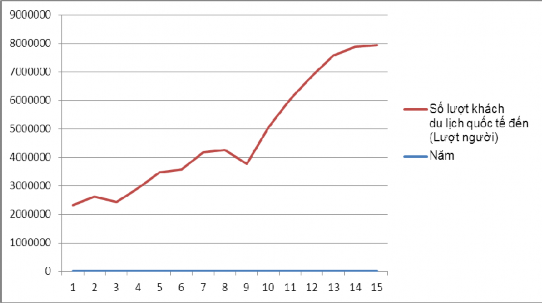
Chart 3.1: Number of international visitors to Vietnam from 2001 to 2015
According to the General Statistics Office, in 2012, Vietnam attracted more than 6.8 million international tourists, exceeding the plan by 0.3 million visitors and increasing by nearly 14% compared to 2011 (General Statistics Office, 2012). Domestic tourists in 2012 reached 32.5 million visitors, an increase of 8.3% compared to 2011. Therefore, tourism activities in 2012 achieved a revenue of about 160 trillion VND, an increase of over 23% compared to the previous year.
In 2013, the number of international visitors to Vietnam was 7.57 million, domestic visitors reached 35 million. Vietnam's tourism industry revenue in 2013 reached about
200,000 billion VND.
The number of international visitors to Vietnam in 2013 reached 7.57 million, domestic visitors reached 35 million. Therefore, Vietnam's total tourism revenue in 2013 was about 200,000 billion VND.
In 2014, Vietnam tourism attracted nearly 8 million international visitors and nearly 53 million domestic visitors.
In 2015, Vietnam's tourism industry achieved results with impressive marks and changes.
positive. With the recovery of growth momentum, Vietnam has successfully prevented the decline of international tourists in the first 6 months of the year, attracting more than 7.94 million international visitors (up 0.9% compared to 2014) and 57 million domestic tourists. Despite facing many difficulties and challenges, in 2015, Vietnam earned about 337,830 billion VND from tourists.
According to estimates from TCDL, revenue from tourists is expected to reach 18-19 billion USD, equivalent to about 400 trillion VND in 2020.
3.1.1.2. Sources of information about Vietnam tourism
Sources of information on Vietnam tourism serving to assess the overall impact of tourism on Vietnam's economic growth in 2013, are considered according to two main contents: Sources of information on the number of tourists and sources of information on average spending per tourist.
The source of information on tourists is mainly based on statistical surveys conducted by the General Department of Tourism and the General Statistics Office. The number of international tourists is exploited from the Statistical Yearbook of the General Statistics Office. In addition, information on the number and expenditure of tourists in the 2013 tourism statistical survey of the General Department of Tourism (GDT) and the General Statistics Office (GSO) also needs to be studied, collected, and processed to serve the experimental calculation.
Tourists include international tourists and domestic tourists, in which international tourists include international arrivals and international departures. However, currently Vietnam and many countries do not have information to estimate the total expenditure of international departures, so for international tourists, only international tourists arriving in Vietnam are calculated.
To estimate detailed tourist expenditure by international arrivals and domestic tourism across the entire economy, it is necessary to determine the number of tourist arrivals and the average expenditure per arrival.
The number of international tourist arrivals in Vietnam is exploited from the General Statistics Office (provided by the Immigration Department of the Ministry of Public Security); international visitor expenditure is exploited from a sample survey on tourist expenditure, including international visitor expenditure conducted by the General Statistics Office.
Information on the number of visitors and spending of domestic tourists is extracted from the Domestic Visitor Survey of the General Statistics Office and the Tourist Spending Survey including domestic visitor spending conducted by the General Statistics Office.
a. Source of information on total number of tourists
Collect and synthesize information on the total number of tourists detailed by the total number of international arrivals and the total number of domestic tourists.
- Total number of international tourist arrivals
Information on the number of international tourist arrivals can be obtained from the annual Statistical Yearbook of the General Statistics Office. This data is compiled from information on entry into Vietnam provided by the Immigration Department of the Ministry of Public Security and the Border Gate Department, Border Guard of the Ministry of National Defense. However, this only includes the number of international tourist arrivals in general, not divided into overnight visitors and day visitors. To estimate the number of international tourist arrivals, and domestic tourists in detail by overnight visitors and day visitors, the Tourism Information Center of the General Statistics Office conducted surveys in 2013 and 2014.
- Total number of domestic tourists
The total number of domestic tourists is exploited from the survey of the General Statistics Office. To separate the total number of domestic tourists into the number of domestic tourists staying overnight and the number of domestic tourists traveling during the day, it is necessary to exploit information according to the results of the sample survey on tourism of both the General Statistics Office and the General Statistics Office.
The survey of domestic tourists in Vietnam by TCDL was conducted according to Decision No. 360/QD-TCDL dated July 29, 2013 of the General Director of TCDL on approving the Domestic Tourist Survey Plan for 2013 - 2014. The survey was conducted by random sampling method from the number of domestic tourists who were traveling to 52 tourist areas and attractions in 26 provinces/cities in Vietnam. The survey period was from August 2013 to March 2014. The results collected information from 23,633 domestic tourists.
Combining direct investigation with domestic tourists in the form of interviews, TCDL sent survey forms to 900 accommodation establishments and 600 travel agencies welcoming domestic tourists in 26 provinces and cities selected for the survey, in order to complete the determination of the spending structure of tourists for tourists traveling on tours (summing up the average spending on tours and spending outside the tours). Summarizing the structure and average spending of tourists staying overnight at accommodation establishments and tourists traveling during the day (including trips of tourists not staying overnight at tourist accommodation establishments).
This is the second domestic tourist survey organized by TCDL (The first was conducted in 2006 - 2007). New information compared to previous surveys :
- Information on the accommodation facilities where guests stay during a trip is used to determine the coefficient to estimate the number of domestic tourists based on the total number of guests served by the accommodation facilities.
- Information on day visitors - From there, the number of day visitors can be estimated based on the ratio to overnight visitors in the survey sample.
b. Source of information on average spending per tourist
Information on average expenditure per tourist visit in detail by average expenditure per international tourist visit and domestic tourist visit is exploited from the sample survey of the General Statistics Office. Information to calculate the average expenditure per domestic tourist visit in detail by overnight visitors and same-day visitors needs to be exploited from the sample survey results of the General Department of Tourism.
The survey on tourist expenditure was conducted by the General Statistics Office under Decision No. 650/QD-TCTK dated June 25, 2013 of the General Director of the General Statistics Office in 30 key provinces and cities in terms of tourism. The subjects of the survey were international tourists and domestic tourists staying at tourist accommodation establishments. The survey was conducted by the Statistics Offices of provinces and centrally run cities in coordination with the Department of Culture, Sports and Tourism and the active participation of selected accommodation service establishments.
This is the sixth tourist spending survey conducted by the General Statistics Office, organized with the same methodology as previous ones but with a larger sample size and richer survey information content.
This survey is a sample survey of accommodation establishments serving international tourists in 14 provinces and centrally run cities and a sample of accommodation establishments serving domestic tourists in 30 provinces and centrally run cities. Each province selects 30% to 40% of the accommodation establishments; Hanoi and Ho Chi Minh City select 20-30% of the accommodation establishments.
Some of the key findings from the survey include:
Customer structure:
Total domestic tourists were 24,139 people; international tourists were 9,500 people.
Tourist structure is studied according to the following criteria:
- By gender, age (6 groups)
- By means of transport (4 types)
- By organization form (self-organized and by package program)