
use. In the piano piece by Hungarian composer Franz Liszt “La vallee d'obermann” we also see such harmonic color.
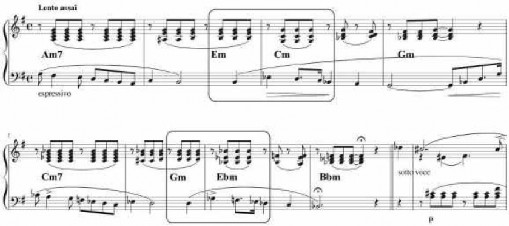
Example 2.23: Franz Liszt - la vallee d'obermann (bars 1 - 9)
2.3. BUILDING A MELODY FROM VIETNAMESE TONES AND SOME OTHER UNIQUE CHARACTERISTICS
The tones and intonations in the Vietnamese language are very diverse. That is also the origin of the folk songs of the Vietnamese ethnic groups. Based on that, the characteristics in the melodies of each region are formed.
Musician Nguyen Van Nam was very sensitive when using this technique to build melodies in his instrumental works. We have seen in example 2.16 the melody of the call of green beans cooked in sugar . That is the main theme of Symphony No. 3 titled “For the orphans after the war”. The composer shared that the call was one of his childhood memories. And so, he turned that image, that sound into music. Along with his folk melody, he chose the very typical melodies of his hometown – the Southwest.
In Chapter II, Symphony No. 5 “Mother Vietnam” , musician Nguyen Van Nam also built a theme with the melody of the poem “ In the pond, nothing is as beautiful as lotus”. The composer used the Corno solo in a small tone with a long rhythm like a reciting voice.
Example 2.24: Nguyen Van Nam – Symphony No. 5, Ch. II (beats 5 - 10)
The melody has only three notes (C - D - G) but looking at the accompaniment of the Strings, Arpa and Clarinet we can see that those three notes are in the Do Huynh mode (C - D - E - G - A) . Thus, although imitating the sound of the voice, the musician still consciously uses the tones of the Vietnamese pentatonic system and not other systems.
In Symphony No. 7 “The Tale of Kieu”, musician Nguyen Van Nam also used the melody with the tone formed from the story “ Once upon a time, remembering the old days there was Kieu…” as the main theme for the first chapter of the work. The author only used three tones (H - Fis - H on the octave) imitating the typical Vietnamese poetry recitation style with few tones and free humming. Using few tones is also one of the melodic characteristics of musician Nguyen Van Nam in his later works.
Example 2.25: Nguyen Van Nam – Symphony No. 7, Ch. I (17 - 20)
In addition to the characteristic of using the tones of the call and recitation to build the melody, another characteristic in the tone structure of musician Nguyen Van Nam is also very prominent, which is the minor second interval tone. He often intentionally emphasizes the minor second interval right on the strong beat of the rhythm, repeating it many times.
creates a feeling of extreme sadness and resentment (see more examples in Appendix 3B: 1, 2, 3).
Example 2.26: Nguyen Van Nam, Symphony No. 8, Ch. I (bars 151 - 158)
The minor second interval in Vietnamese folk songs is rarely used, and is often only used in passing. Furthermore, if the minor second interval in example 2.27 is called the lower minor second interval because it is in an upward direction, then the minor second interval used by musician Nguyen Van Nam would be the upper minor second interval because it is in a downward direction. From this, it can be seen that the upper minor second interval is a favorite tone of the author and not a characteristic of Southern folk songs.
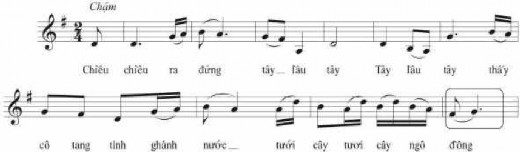
Example 2.27: Afternoon Tea - Southern Folk Song
For composer Ca Le Thuan, there are many melodies that begin with a seventh-degree jump going up through a third. This tonal structure creates the sound of a minor or major seventh (See more examples in Appendix 3C: 1, 2).
Example 2.28: Ca Le Thuan - Symphonic poem (beats 1 - 5)
Similar harmonic color was also common in Romantic period music. Piano Piece “By the Cypresses of the Villa
Franz Liszt's "d'Este" used these chords on the strong beat at the beginning of the musical phrase.
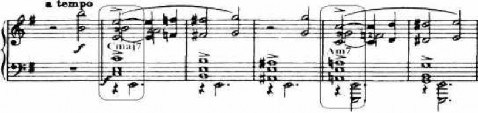
Example 2.29: Franz Liszt - By the Cypresses of the Villa d'Este (bars 16 - 21)
Table 2.1: Tempo statistics of theme melodies
Work | Theme tune | slow (Largo- Adagio) | fit (Andante-Allegretto) | Fast (Allegro-Presto) | |
Quang Hai | 12 | 46 | 2 | 23 | 21 |
(4.34%) | (50%) | (45.65%) | |||
Nguyen Van Nam | 9 | 88 | 22 | 39 | 27 |
(25%) | (44.31%) | (30.68%) | |||
Ca Le Thuan | 11 | 57 | 5 | 35 | 17 |
(8.77%) | (61.40%) | (29.82%) |
Maybe you are interested!
-

 Directions and Solutions for Building Customer Strategy of Vietnamese Commercial Banks
 -
 Building extracurricular activities content for the subject of Vietnamese Fine Arts History at Nam Dinh Pedagogical College - 13
 -
 Building customer strategies of Vietnamese commercial banks in the process of international economic integration - 9
 -
 Building and protecting Vietnamese export brands - 2
 -
 The Importance and Content of Building a New Lifestyle for Vietnamese Students in the Current Context of Globalization
Table 2.2: Summary of some influences from the mode when constructing the theme melody
Influence of Western Harmonies and Modes | Building Melodies from Vietnamese Pentatonic Scales | Building Melodies from Vietnamese Tones & Some Unique Characteristics | ||
Pure Pentatonic | Combined with harmony | |||
Quang Hai | Major - minor modes. Triads & TSD function in melody structure & movement. | Are not | Combined with a triad accompaniment based on TSD functionality. | The rhythm is steady and steady. The tone sticks closely to the tonic of the chord. Cheerful, optimistic temperament. Moderate to fast tempo. |
Nguyen Van Nam | Are not | Melody development is based on similar principles in Vietnamese Folk Songs. | Are not | Building the theme from Vietnamese tones, based on the tone of the pentatonic scale. Sad, narrative, free-reciting nature... Downward minor 2 tone. |
Ca Le Thuan | Major - minor, whole tone, semitone. Creative use of many harmonic changes to create new colors for the melody. | Are not | Combined with the rotation between minor chords spaced 3 apart to create new colors. | Often uses a jump to open a musical phrase. Moderate rhythm. Romantic, contemplative nature. Often uses minor chords and major and minor seventh chord colors. |
CHAPTER 2 SUMMARY
Analyzing the way musicians Quang Hai, Nguyen Van Nam and Ca Le Thuan construct the theme melody, focusing on the aspects of tone structure, mode and rhythm, we initially notice the similarities and differences of each musician. When using the pentatonic mode, they all prefer and use a lot of Ai and Oan melodies . This is also understandable because those are also the typical modes of Southern folk music where they were born, grew up and spent their whole working lives. They all have the desire to combine traditional music with new techniques of Western music, but each has a different way of doing it.
Musician Quang Hai attaches great importance to classical harmony along with the functional system of the 18th century - the golden age of classical music. Therefore, the melodies he composed or the folk songs he used were all coordinated on the basis of classical harmony. Sometimes this combination is not very reasonable because of the difference in tonal structure between the pentatonic scale in Vietnamese folk music compared to the major and minor scale of the West. Musician Quang Hai's music is cheerful. The structure is balanced, clear and coherent. The rhythm is steady, the tempo is stable with few syncopations. The melody closely follows the stable tones of the scale and harmony. Thematic melodies often have medium and fast tempos, slow tempos are rarely used (see table 2.1).
Musician Nguyen Van Nam was also formally trained in Russia like musicians Quang Hai and Ca Le Thuan, but he seems to have no “interest” in functional harmony. The tones in his melodies are selected from the pentatonic scale and are not influenced or reflect the direction of harmonic movement. He uses melodic development techniques similar to those in Vietnamese folk songs. Thus, it can be seen that he intentionally or unintentionally carries a strong national identity in his melodies. Of course, it does not mean that musician Nguyen Van Nam’s works are not modern. Melodies
His themes were developed tonally beyond the original pentatonic scale, moving into semitones or whole tones without a tonic. His themes were suitable for polyphonic presentation in Western multi-part music.
The melodies of musician Nguyen Van Nam have a very free and unbalanced structure. The tones often linger freely. In the early period (first four symphonies), the rhythm changes frequently and is quite complex. In the later period (last five symphonies), the rhythm is more stable, the melodies are longer, but the tones are less. Using less tones is also one of his characteristics. The melodies of musician Nguyen Van Nam are mostly minor and sad. His favorite melodies, in addition to the perfect fourth and perfect fifth intervals, also include the minor second interval, which is often used. He often puts it on a strong beat and repeats it many times, giving the melody a sad and mournful color. Building melodies from Vietnamese tones is his outstanding creation. Compared to the two musicians Quang Hai and Ca Le Thuan, musician Nguyen Van Nam uses the most medium and slow tempos.
The author has a habit of not writing the accidentals at the beginning of his works (except for the third movement of Symphony No. 7 which has four sharps and the fourth movement of Symphony No. 8 which has five flats), he uses unusual accidentals on the notes in the piece.
Musician Ca Le Thuan not only mastered classical harmony, he also skillfully used romantic and modern harmony techniques, so his harmonic combinations had more romantic and modern colors. He was very creative in combining the tones of the pentatonic scale with unexpected harmonic rotations, creating new colors for the melody.
Musician Ca Le Thuan is a very creative person in the techniques of constructing thematic melodies. The structure of the themes is also very tight and often balanced. He himself created a harmonic cycle consisting of minor chords following the ascending or descending minor third interval to motivate the development of the melody. The tones in the theme are arranged up and down in a regular rhythm. In addition
In addition to using harmony to support or develop the melody, he also uses techniques of imitating characteristic tones and changing rhythms. He often uses many sounds outside of chords to enrich the melody. The harmonic color is close to the Romantic school in Western music. The melody that musician Ca Le Thuan likes is the seventh-interval jump going up through the third interval with the color of a minor or major seventh chord at the beginning of a musical phrase. He especially likes to choose the entire key of D minor (8/14 works). The theme melodies of musician Ca Le Thuan are often moderate in tempo and also rarely slow in tempo.