
The spirit of individuals is brought out or is capable of being brought out to use in the process of social development. When talking about human resources, we are talking about the source of labor supply for society. The three factors of physical strength, intelligence, and morality are the three basic factors of human resource structure.
Young human resourcesare human resources at a young age. The author uses young human resources to mean only civil servants and public employees under the age of 35 working in organizations and agencies receiving salaries from the state budget or working in state-owned enterprises (also known as young cadres working for state agencies).
Human resource development is the development of people to train, foster and promote moral qualities, capacity and qualifications to meet the requirements of society. The development of young human resources in the thesis refers to officials and civil servants under 35 years old working in organizations and agencies receiving salaries from the state budget or working in state-owned enterprises - to train, foster and practice ethics and lifestyle, knowledge and skills.
Social capital in youth human resource development is the process by which young people create, maintain and use social networks, reciprocal relationships, and trust, through investing in social relationships in groups and communities, to seek recruitment opportunities, opportunities to participate in training, improve skills, expertise, and professionalism, and opportunities to be appointed to suitable job positions, perform public duties best, and increase income.
Maybe you are interested!
-
 Social capital in developing young human resources in Hanoi and Ho Chi Minh City - 27
 -
 Building a Policy for Developing Corporate Human Resources
 -
 Creating and Maintaining Social Capital Through Communication
 -
 Demand, Capability and Perspectives on Mobilizing Investment Capital for Developing Human Resources for Vietnam Tourism in International Economic Integration to 2020
 -
 Human resources for socio-economic development in Vientiane Capital - 1
The theories of social capital, social networks as well as policy practices on the issue of developing young human resources used in the thesis aim to contribute to providing research hypotheses, theoretical frameworks as well as theoretical and practical bases for the research problem.
Chapter 3
CURRENT STATUS OF CREATION AND MAINTENANCE OF SOCIAL CAPITAL OF YOUNG HUMAN RESOURCES IN HANOI AND HO CHI MINH CITY
3.1. Introduction
Regarding the concept of social capital, Bourdieu emphasized that all actual and potential resources come from direct or indirect acquaintance networks (such as members of the same religion, or the same birthplace or schoolmates) [Tran Huu Dung, 2003]. Researchers have stated that, in the most general sense, social capital is considered as norms and social relations closely linked in the social structure of the group, through which individuals coordinate actions to achieve goals [Nguyen Quy Thanh, 2013]. Therefore, interactions between individuals and the institutions that govern them are guided by norms and values, social capital is related to the internal social and cultural cohesion of society. On the other hand, social capital is considered as channels of access to inherent resources belonging to certain relationships. For example, job opportunities are only available in relation to employers, loans are available in relation to lenders such as banks, credit funds or people with money to lend. Around each individual there are many relationships, which can form networks of relationships that provide capital, that is, channels of access to resources in that network of relationships.
Coleman (1994) proposed a three-person network structure in the form of an equilateral triangle in which human capital is located at the three vertices and social capital is located at the three sides of the triangle, that is, the relationships between individuals. From this simple structure, according to Le Ngoc Hung, a synthetic structure of the social network in the relationship between individuals and groups and communities can be established. Accordingly, human capital is a set of capabilities that exist in each individual, group, organization and is expressed in each link of social relations. In each relationship between individuals, groups, and organizations, there is the existence of social capital, that is, the social relationships between the links of the human social network [Le Ngoc Hung, 2008]
Regarding this topic, Cohen and Prusak (2001) also stated: “Social capital consists largely of cooperation built between people: Trust, mutual understanding, and the sharing of moral values and styles that connect members of groups and communities together, making coordination of actions possible.
"The ability to perform actions" [Don Cohen, Laurence Prusak, 2001]. This shows that, to create and maintain social capital, social individuals need to have mutual relationships. Bourdieu, Coleman, Fukuyama, Putnam, Portes all believe that social capital is created through investment in social relationships or social networks, and thanks to social capital, individuals can seek benefits. Thus, to create social capital for young human resources, it is necessary to first build relationships within the family, clan, bloodline and different social groups to form a social network around each individual.
In this thesis, the creation and maintenance of social capital is measured by indicators of membership in groups, organizations, and social networks; the level of participation in collective activities inside and outside the agency of social groups and the personal strategies of young people. Accordingly, our analysis will revolve around understanding the participation of individuals in social groups that will form social networks, the trust of group members and the reciprocal relationship to create and maintain social capital. The social groups that form the social network mentioned here include: family, relatives, colleagues, former classmates, hometown associations, hobby associations/clubs, hui groups, clans and some other socio-political organizations such as the Youth Union, Women's Union, Farmers' Association, Red Cross Society, etc.
3.2. Building and maintaining social capital through membership in groups, organizations, and social networks
The capital Hanoi and Ho Chi Minh City are two major economic - political - social centers of the country, which have great attraction for human resources in general, not excluding young human resources. For that reason, the majority of young human resources here come from other provinces to study and work, so it is inevitable that they participate in activities of social networks such as relatives, colleagues, old friends, youth, etc. There is a difference between young human resources and other human resources in that they are younger in age, less experienced but sensitive to information and dynamic, so they easily integrate and tend to like to participate in activities of different social groups. This shows that young workers do not only participate in the activities of one social group but at the same time they participate in many social groups based on different social relationships.
3.2.1. Participate in social group activities to become a member
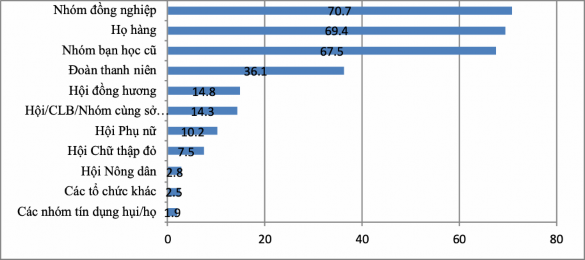
Through a survey of 1,000 young workers working in administrative and career agencies in two localities, it was shown that in order to create and maintain social capital for themselves, young human resources have proactively participated in activities of different social groups with different levels of participation of each individual. The level of participation of each individual in groups depends on the factors and personal characteristics of each person. Socio-demographic factors determine the level of participation or non-participation of young human resources in social groups to create social capital. The survey results show that young human resources participate in activities of many social groups, most in the following groups: group of colleagues, group of relatives and group of old classmates, accounting for 70.7%; 69.4%, and 67.5% respectively. At the same time, young human resources also participate in other social groups with a less active level, such as the Youth Union 36.1%, the hometown association 14.8%; the social groups that young human resources participate in the least are hobby groups, farmers' associations, credit groups... accounting for an insignificant proportion of less than 9%.
It can be seen that in the typical social network of young workers in Hanoi and Ho Chi Minh City, social relationships from groups of colleagues, relatives and former classmates form a denser network than other relationships. Specifically, out of every 10 people, about 6 people actively participate in the three main networks around them: colleagues, relatives and former classmates.
Chart 3.1: Level of active participation in activities of social groups
Source: Survey results of topic KX.03.09/11-15
Peer groups often have hierarchical and/or peer relationships. In peer groups, young workers have the opportunity to exchange knowledge, skills, and work with each other, and even share and encourage each other about joys and sorrows in life easily in this relationship. Chi-square test shows that there is no statistically significant difference between male and female workers; the group of human resources in different religions in terms of participation in peer groups, accordingly, the participation rate of male and female in peer groups is similar, following different religions, age groups, education and marital status do not affect participation in peer groups. Only the income factor, that is, young workers with different income levels have different participation rates in peer groups.
Although there is a small difference in the rate, the data shows that young human resources with income from 4 million to under 6 million have a higher rate of participation in the peer group than the other two groups. This difference needs to be investigated to explain why human resources with income from 4-6 million have a higher rate of participation in the peer group than young human resources in the groups under 4 million and over 6 million. For the group of young human resources with income under 4 million, they are mainly newly recruited into administrative agencies, careers, relationships with colleagues are only at the beginning stage, so their participation in the peer group is limited by shyness, hesitation, and even fear of others judging their attitude... This creates a difference in their level of participation in the peer group compared to the other groups. The group with income above 6 million has a higher level of participation in peer groups than the group with income below 4 million, but the level of participation is not as active as the group with income from 4 million.
- 6 million because this income group has more seniority, they have spent more time working with colleagues in the same agency, in addition, they also want to participate in other social groups, especially groups with the same profession and expertise outside the agency. That means that their social capital is not only built in a certain social group but their social capital is also built in other social groups from the outside that still serve well for the work they are doing. When talking with some young employees in this income group, it shows that the above explanation is reasonable:
“ For me, the relationships during my studies after I started working are very meaningful. For example, when I was in graduate school, I met some friends who were working in the provinces. Later, thanks to our good relationships, they supported me a lot when I had a job in those provinces. Because we are in the same field, we support each other a lot. We are both classmates and colleagues” (PVS 1, female, 35 years old).
It can be affirmed that both men and women, regardless of gender, age group, education level, residential area, and religion, actively participate in the peer group. This is completely consistent with the reality of life when young people spend more time on work and expertise than other activities during the working day. Success in career and work is both a goal and a motivation for young people. Therefore, peer relationships are often the main relationships that many young workers are interested in. Therefore, building social networks as well as creating social capital for many young people today often starts with peer relationships. The following sharing from an IT engineer clearly demonstrates the above argument:
“Actually, because my job is quite busy, the two groups of friends I still hang out with before and now are the same company and the same group of friends from middle school and high school. Besides, I don’t have time for any other groups of friends (laughs), except for my lover. The same company group meets most often, works every day and then parties according to the company’s team building schedule. In addition, the close group from the same company also gathers to go here and there. Through that, we also support each other a lot in work ” (Reporter 2, Male, 26 years old)
Regarding the level of participation in kinship groups , there was no statistically significant difference between young labor groups with different genders, education levels, incomes, areas of residence, and working seniority with the level of participation in kinship groups. The only difference that showed an unclear relationship was the age group factor. Accordingly, the kinship network, especially the kinship group near the living area and the same age as the respondent, plays an important role in sharing values, social norms, joys, sorrows, experiences in work, life, and even providing material support. Through direct meetings or
indirectly on important days of the clan, families in the clan or gatherings on birthdays, weekends, individuals in the group create relationships, create trust and confidence ... establish a social network that can help and share with each other when facing difficulties in life. Perhaps that is why there is no statistically significant difference between groups of young workers with different genders, ages, religions, marital statuses with the level of participation in the kin group.
The third social group with the highest number of young people regularly participating in activities is the old friends group with a rate of 67.5%. This is a peer social group, which has an important influence on the acquisition of social experience, the completion of scientific knowledge, labor skills and codes of conduct. People in the peer group have the same social status, so their relationships are relatively equal, they easily share their views and social perspectives with each other, together creating a cultural microenvironment, in which the values, goals and cultural norms of the group are different from the cultural norms of the whole society. Peer groups are often consciously established for specific purposes. The goals of the group are very diverse, revolving around the common values of the group. From the unique characteristics of the old friends group, regularly participating in group activities with the purpose of sharing and accumulating knowledge, skills and experiences helps them build certain social capital for themselves. Statistical testing shows that characteristics of age group, gender, marital status, and religion do not have a close relationship in the regular participation in activities of the old classmate group. However, young workers with different educational levels have relatively different levels of participation in the old classmate group. Specifically, the group of workers with postgraduate qualifications is the group with the highest rate of participation in activities with old classmate groups, corresponding to 71.4% compared to 64.8% of the group with college and university degrees; 50% of the group with high school and vocational college degrees. It is possible that due to the many years of schooling and going through many different levels of education, the network of old classmate groups is wider, so the group of postgraduate workers has more opportunities to participate in the network of old classmate groups compared to workers with the remaining levels.
In addition to the three social groups mentioned above with a large number of young workers participating, other social groups such as the Youth Union, Red Cross,
Women's associations, hometown associations, etc. have lower participation rates. However, these are still considered social networks that help young workers build social capital to seek opportunities for self-development in terms of learning to improve knowledge, experience, skills, job opportunities, social positions as well as sharing feelings and emotions in life.
Regarding the participation of young cadres in the Youth Union , it can be seen that the age group from 18 to 34 years old [Ho Chi Minh Communist Youth Union, 2012] is a social group that is still in the age of Youth Union activities, however, the rate of active participation in Youth Union activities is only 36.1%, this is the fourth highest participation choice after the three social groups analyzed above. The difference is clearly shown: the male group, the group of young people under 23 years old, the group of non-religious people and the single group have a much higher rate of active participation in Youth Union activities than the remaining groups. Perhaps to clearly assess the role of the Youth Union in creating and maintaining social capital of the group of young cadres in the state agency sector, we need a more specific and comprehensive study. However, the above results suggest some thoughts on promoting the effective role of the Youth Union in the lives of union members today.
In addition, there are two social groups with a not-so-high rate of active participation of young workers, namely the Ho Chi Minh Dong Huong (14.8%) and the Ho Chi Minh City Club (14.3%). However, when analyzing in depth the differences between young workers in terms of participation in these two groups, there are interesting findings from both quantitative and qualitative data. The Ho Chi Minh Dong Huong is a very special organization and has a lot of meaning for those who come to live and work in another locality, so the thesis still analyzes the differences between young workers in terms of participation in the Ho Chi Minh Dong Huong with the hope of demonstrating certain roles of the Ho Chi Minh Dong Huong in creating and maintaining social capital for young workers. There is a clear difference between young workers in Hanoi and Ho Chi Minh City in terms of participation in the Ho Chi Minh Dong Huong. Specifically, the participation rate in the association of young cadres in Hanoi is higher than that in Ho Chi Minh City, at 19.6% and 10% respectively.
In the opinion of many individuals, the association of fellow countrymen plays a quite important role in their lives. According to author Nguyen Quy Thanh (2016), when shifting from rural to urban society, when forms of “organic solidarity” - the term that