
geological processes, geological movements in the historical periods of the earth in the past and present. For tourism activities, research to discover the historical characteristics of geological development, geological processes of tourist territories has the meaning of serving such as: serving the arrangement and construction of effective tourism infrastructure, avoiding the negative impacts of earthquakes, honoring the value of destinations.
+ When studying terrain, including: shape, elevation, slope, direction of terrain, terrain creates beautiful landscape.
For tourism activities, the morphological characteristics of the terrain, that is, the external signs of the terrain and spectacular terrain forms, are factors that attract tourists. The terrain forms that are especially valuable for the development of tourism activities are: karst terrain and coastal, beach and island terrain.
+ Climate: is a type of resource that was exploited early to plan tourism development. From the end of the 18th century to the early years of the 20th century, there were many tourism development planning projects in the world as well as in Vietnam in places with cool, fresh climates such as: Sapa, Da Lat, Ba Na, Tam Dao...
Table 1.1: Bioclimatic indicators for humans
Class
Meaning | Average annual temperature ( 0 C) | Average monthly temperature ( 0 C) | Temperature range of average annual temperature | Annual rainfall (mm) | |
1 | Adapt | 18 – 24 | 24 - 27 | < 6 0 | 1250 - 1990 |
2 | Quite adaptable | 24 – 27 | 27 - 29 | 6 0 - 8 0 | 1990 - 2550 |
3 | Hot | 27 – 29 | 29 - 32 | 8 0 - 14 0 | > 2550 |
4 | very hot | 29 – 32 | 32 - 35 | 14 0 - 19 0 | < 1250 |
5 | Inopportune | > 32 | > 35 | > 19 0 | < 650 |
Maybe you are interested!
-
 On Implementing Key Tourism Development Indicators
 -
 Evaluation Indicators of Some Levels in Provincial Tourism Territorial Organization from the Perspective of Sustainable Development
 -
 Group of Indicators Showing the Impact of Tourism Development on Livelihood Resources
 -
 Identify Rating Levels and Rating Scales
zt2i3t4l5ee
zt2a3gstourism,quan lan,quang ninh,ecology,ecotourism,minh chau,van don,geography,geographical basis,tourism development,science
zt2a3ge
zc2o3n4t5e6n7ts
of the islanders. Therefore, this indicator will be divided into two sub-indicators:
a1. Natural tourism attractiveness a2. Cultural tourism attractiveness
b. Tourist capacity
The two island communes in Quan Lan have different capacities to receive tourists. Minh Chau Commune is home to many standard hotels and resorts, attracting high-income domestic and international tourists. Meanwhile, Quan Lan Commune has many motels mainly built and operated by local people, so the scale and quality are not high, and will be suitable for ordinary tourists such as students.
c. Time of exploitation of Quan Lan Island Commune:
Quan Lan tourism is seasonal due to weather and climate conditions and festivals only take place on certain days of the year, specifically in spring. In Quan Lan commune, the period from April to June and from September to November is considered the best time to visit Quan Lan because the cultural tourism activities are mainly associated with festivals taking place during this time.
Minh Chau island commune:
Tourism exploitation time is all year round, because this is a place with a number of tourist attractions with diverse ecosystems such as Bai Tu Long National Park Research Center, Tram forest, Turtle Laying Beach, so besides coming to the beach for tourism and vacation in the summer, Minh Chau will attract research groups to come for tourism combined with research at other times of the year.
d. Sustainability
The sustainability of ecotourism sites in Quan Lan and Minh Chau communes depends on the sensitivity of the ecosystems to climate changes.
landscape. In general, these tourist destinations have a fairly high level of sustainability, because they are natural ecosystems, planned and protected. However, if a large number of tourists gather at certain times, it can exceed the carrying capacity and affect the sustainability of the environment (polluted beaches, damaged trees, animals moving away from their habitats, etc.), then the sustainability of the above ecosystems (natural ecosystems, human ecosystems) will also be affected and become less sustainable.
e. Location and accessibility
Both island communes have ports to take tourists to visit from Van Don wharf:
- Quan Lan – Van Don traffic route:
Phuc Thinh – Viet Anh high-speed boat and Quang Minh high-speed boat, depart at 8am and 2pm from Van Don to Quan Lan, and at 7am and 1pm from Quan Lan to Van Don. There are also wooden boats departing at 7am and 1pm.
- Van Don - Minh Chau traffic route:
Chung Huong high-speed train, Minh Chau train, morning 7:30 and afternoon 13:30 from Van Don to Minh Chau, morning 6:30 and afternoon 13:00 from Minh Chau to Van Don.
f. Infrastructure
Despite receiving investment attention, the issue of infrastructure and technical facilities for tourism on Quan Lan Island is still an issue that needs to be resolved because it has a direct impact on the implementation of ecotourism activities. The minimum conditions for serving tourists such as accommodation, electricity, water, communication, especially medical services, and security work need to be given top priority. Ecotourism spots in Minh Chau commune are assessed to have better infrastructure and technical facilities for tourism because there are quite complete and synchronous conditions for serving tourists, meeting many needs of domestic and foreign tourists.
3.2.1.4. Determine assessment levels and assessment scales
Corresponding to the levels of each criterion, the index is the score of those levels in the order of 4, 3, 2, 1 decreasing according to the standard of each level: very attractive (4), attractive (3), average (2), less attractive (1).
3.2.1.5. Determining the coefficients of the criteria
For the assessment of DLST in the two communes of Quan Lan and Minh Chau islands, the students added evaluation coefficients to show the importance of the criteria and indicators as follows:
Coefficient 3 with criteria: Attractiveness, Exploitation time. These are the 2 most important criteria for attracting tourists to tourism in general and eco-tourism in particular, so they have the highest coefficient.
Coefficient 2 with criteria: Capacity, Infrastructure, Location and accessibility . Because the assessment area is an island commune of Van Don district, the above criteria are selected by the author with appropriate coefficients at the average level.
Coefficient 1 with criteria: Sustainability. Quan Lan has natural and human-made ecotourism sites, with high biodiversity and little impact from local human factors. Most of the ecotourism sites are still wild, so they are highly sustainable.
3.2.1.6. Results of DLST assessment on Quan Lan island
a. Assessment of the potential for natural tourism development
For Minh Chau commune:
+ Natural tourism attractiveness is determined to be very attractive (4 points) and the most important coefficient (coefficient 3), so the score of the Attractiveness criterion is 4 x 3 = 12.
+ Capacity is determined as average (2 points) and the coefficient is quite important (coefficient 2), then the score of Capacity criterion is 2 x 2 = 4.
+ Exploitation time is long (4 points), the most important coefficient (coefficient 3) so the score of the Exploitation time criterion is 4 x 3 = 12.
+ Sustainability is determined as sustainable (4 points), the important coefficient is the average coefficient (coefficient 1), so the score of the Sustainability criterion is 4 x 1 = 4 points
+ Location and accessibility are determined to be quite favorable (2 points), the coefficient is quite important (coefficient 2), the criterion score is 2 x 2 = 4 points.
+ Infrastructure is assessed as good (3 points), the coefficient is quite important (coefficient 2), then the score of the Infrastructure criterion is 3 x 2 = 6 points.
The total score for evaluating DLST in Minh Chau commune according to 6 evaluation criteria is determined as: 12 + 4 + 12 + 4 + 4 + 6 = 42 points
Similar assessment for Quan Lan commune, we have the following table:
Table 3.3: Assessment of the potential for natural ecotourism development in Quan Lan and Minh Chau communes
Attractiveness of self-tourismof course
Capacity
Mining time
Sustainability
Location and accessibility
Infrastructure
Result
Point
DarkMulti
Point
DarkMulti
Point
DarkMulti
Point
DarkMulti
Point
DarkMulti
Point
DarkMulti
CommuneMinh Chau
12
12
4
8
12
12
4
4
4
8
6
8
42/52
Quan CommuneLan
6
12
6
8
9
12
4
4
4
8
4
8
33/52
b. Assessment of the potential for humanistic tourism development
For Quan Lan commune:
+ The attractiveness of human tourism is determined to be very attractive (4 points) and the most important coefficient (coefficient 3), so the score of the Attractiveness criterion is 4 x 3 = 12.
+ Capacity is determined to be large (3 points) and the coefficient is quite important (coefficient 2), then the score of the Capacity criterion is 3 x 2 = 6.
+ Mining time is average (3 points), the most important coefficient (coefficient 3) so the score of the Mining time criterion is 3 x 3 = 9.
+ Sustainability is determined as sustainable (4 points), the important coefficient is the average coefficient (coefficient 1), so the score of the Sustainability criterion is 4 x 1 = 4 points.
+ Location and accessibility are determined to be quite favorable (2 points), the coefficient is quite important (coefficient 2), the criterion score is 2 x 2 = 4 points.
+ Infrastructure is rated as average (2 points), the coefficient is quite important (coefficient 2), then the score of the Infrastructure criterion is 2 x 2 = 4 points.
The total score for evaluating DLST in Quan Lan commune according to 6 evaluation criteria is determined as: 12 + 6 + 6 + 4 + 4 + 4 = 36 points.
Similar assessment with Minh Chau commune we have the following table:
Table 3.4: Assessment of the potential for developing humanistic eco-tourism in Quan Lan and Minh Chau communes
Attractiveness of human tourismliterature
Capacity
Mining time
Sustainability
Location and accessibility
Infrastructure
Result
Point
DarkMulti
Point
DarkMulti
Point
DarkMulti
Point
DarkMulti
Point
DarkMulti
Point
DarkMulti
Quan CommuneLan
12
12
6
8
9
12
4
4
4
8
4
8
39/52
Minh CommuneChau
6
12
4
8
12
12
4
4
4
8
6
8
36/52
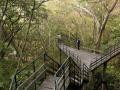
Basically, both Minh Chau and Quan Lan localities have quite favorable conditions for developing ecotourism. However, Quan Lan commune has more advantages to develop ecotourism in a humanistic direction, because this is an area with many famous historical relics such as Quan Lan Communal House, Quan Lan Pagoda, Temple worshiping the hero Tran Khanh Du, ... along with local festivals held annually such as the wind praying ceremony (March 15), Quan Lan festival (June 10-19); due to its location near the port and long exploitation time, the beaches in Quan Lan commune (especially Quan Lan beach) are no longer hygienic and clean to ensure the needs of tourists coming to relax and swim; this is also an area with many beautiful landscapes such as Got Beo wind pass, Ong Phong head, Voi Voi cave, but the ability to access these places is still very limited (dirt hill road, lots of gravel and rocks), especially during rainy and windy times; In addition, other natural resources such as mangrove forests and sea worms have not been really exploited for tourism purposes and ecotourism development. On the contrary, Minh Chau commune has more advantages in developing ecotourism in the direction of natural tourism, this is an area with diverse ecosystems such as at Rua De Beach, Bai Tu Long National Park Conservation Center...; Minh Chau beach is highly appreciated for its natural beauty and cleanliness, ranked in the top ten most beautiful beaches in Vietnam; Minh Chau commune is also home to Tram forest with a large area and a purity of up to 90%, suitable for building bridges through the forest (a very effective type of natural ecotourism currently applied by many countries) for tourists to sightsee, as well as for the purpose of studying and researching.
Figure 3.1: Thenmala Forest Bridge (India) Source: https://www.thenmalaecotourism.com/(August 21, 2019)
3.2.2. Using SWOT matrix to evaluate Quan Lan island tourism
General assessment of current tourism activities of Quan Lan island is shown through the following SWOT matrix:
Table 3.5: SWOT matrix evaluating tourism activities on Quan Lan island
Internal agent
Strengths- There is a lot of potential for tourism development, especially natural ecotourism and humanistic ecotourism.- The unskilled labor force is relatively abundant.- resource environmentunpolluted, still
Weaknesses- Poorly developed infrastructure, especially traffic routes to tourist destinations on the island.- The team of professional staff is still weak.- Tourism products in general
quite wild, originalintact
general and DLST in particularalone is monotonous.
External agents
Opportunity- Tourism is a key industry in the socio-economic development strategy of the province and Van Don economic zone.- Quan Lan was selected as a pilot area for eco-tourism development within the framework of the green growth project between Quang Ninh province and the Japanese organization JICA.- The flow of tourists and especially ecotourism in the world tends toincreasing
Challenge- Weather and climate change abnormally.- Competition in tourism products is increasingly fierce, especially with other localities in the province such as Ha Long, Mong Cai...- Awareness of tourists, especially domestic tourists, about ecotourism and nature conservation is not high.
Through summary analysis using SWOT matrix we see that:
To exploit strengths and take advantage of opportunities, it is necessary to:
- Diversify products and service types (build more tourism routes aimed at specific needs of tourists: experiential tourism immersed in nature, spiritual cultural tourism...)
- Effective exploitation of resources and differentiated products (natural resources and human resources)
div.maincontent .p { color: black; font-family:"Times New Roman", serif; font-style: normal; font-weight: normal; text-decoration: none; font-size: 14pt; margin:0pt; } div.maincontent p { color: black; font-family:"Times New Roman", serif; font-style: normal; font-weight: normal; text-decoration: none; font-size: 14pt; margin:0pt; } div.maincontent .s1 { color: black; font-family:"Times New Roman", serif; font-style: normal; font-weight: normal; text-decoration: none; font-size: 13pt; } div.maincontent .s2 { color: black; font-family:"Times New Roman", serif; font-style: normal; font-weight: normal; text-decoration: none; font-size: 13pt; } div.maincontent .s3 { color: #0D0D0D; font-family:"Times New Roman", serif; font-style: normal; font-weight: bold; text-decoration: none; font-size: 14pt; } div.maincontent .s4 { color: black; font-family:"Times New Roman", serif; font-style: italic; font-weight: normal; text-decoration: none; font-size: 14pt; } div.maincontent .s5 { color: black; font-family:"Times New Roman", serif; font-style: italic; font-weight: bold; text-decoration: none; font-size: 14pt; } div.maincontent .s6 { color: black; font-family:"Times New Roman", serif; font-style: italic; font-weight: normal; text-decoration: none; font-size: 14pt; vertical-align: -3pt; } div.maincontent .s7 { color: black; font-family:"Times New Roman", serif; font-style: italic; font-weight: normal; text-decoration: none; font-size: 14pt; vertical-align: -2pt; } div.maincontent .s8 { color: black; font-family:"Times New Roman", serif; font-style: italic; font-weight: normal; text-decoration: none; font-size: 14pt; vertical-align: -1pt; } div.maincontent .s9 { color: black; font-family:"Times New Roman", serif; font-style: normal; font-weight: normal; text-decoration: none; font-size: 14pt; } div.maincontent .s10 { color: black; font-family:"Times New Roman", serif; font-style: normal; font-weight: bold; text-decoration: none; font-size: 14pt; } div.maincontent .s11 { color: black; font-family:"Times New Roman", serif; font-style: normal; font-weight: normal; text-decoration: none; font-size: 14pt; } div.maincontent .s12 { color: black; font-family:Symbol, serif; font-style: normal; font-weight: normal; text-decoration: none; font-size: 14pt; } div.maincontent .s13 { color: black; font-family:Wingdings; font-style: normal; font-weight: normal; text-decoration: none; font-size: 14pt; } div.maincontent .s14 { color: black; font-family:"Times New Roman", serif; font-style: normal; font-weight: normal; text-decoration: none; font-size: 9pt; vertical-align: 5pt; } div.maincontent .s15 { color: black; font-family:"Times New Roman", serif; font-style: normal; font-weight: normal; text-decoration: none; font-size: 9pt; vertical-align: 5pt; } div.maincontent .s16 { color: black; font-family:Cambria, serif; font-style: italic; font-weight: normal; text-decoration: none; font-size: 14pt; } div.maincontent .s17 { color: #080808; font-family:"Times New Roman", serif; font-style: normal; font-weight: bold; text-decoration: none; font-size: 14pt; } div.maincontent .s18 { color: #080808; font-family:"Times New Roman", serif; font-style: normal; font-weight: normal; text-decoration: none; font-size: 14pt; } div.maincontent .s19 { color: black; font-family:"Times New Roman", serif; font-style: normal; font-weight: normal; text-decoration: none; font-size: 11pt; } div.maincontent .s20 { color: black; font-family:"Times New Roman", serif; font-style: normal; font-weight: normal; text-decoration: none; font-size: 10pt; } div.maincontent .s21 { color: black; font-family:"Times New Roman", serif; font-style: normal; font-weight: bold; text-decoration: none; font-size: 11pt; } div.maincontent .s22 { color: black; font-family:"Times New Roman", serif; font-style: normal; font-weight: normal; text-decoration: none; font-size: 11pt; } div.maincontent .s23 { color: black; font-family:"Times New Roman", serif; font-style: italic; font-weight: normal; text-decoration: none; font-size: 14pt; } div.maincontent .s24 { color: #212121; font-family:"Times New Roman", serif; font-style: normal; font-weight: normal; tex
Identify Rating Levels and Rating Scales
zt2i3t4l5ee
zt2a3gstourism,quan lan,quang ninh,ecology,ecotourism,minh chau,van don,geography,geographical basis,tourism development,science
zt2a3ge
zc2o3n4t5e6n7ts
of the islanders. Therefore, this indicator will be divided into two sub-indicators:
a1. Natural tourism attractiveness a2. Cultural tourism attractiveness
b. Tourist capacity
The two island communes in Quan Lan have different capacities to receive tourists. Minh Chau Commune is home to many standard hotels and resorts, attracting high-income domestic and international tourists. Meanwhile, Quan Lan Commune has many motels mainly built and operated by local people, so the scale and quality are not high, and will be suitable for ordinary tourists such as students.
c. Time of exploitation of Quan Lan Island Commune:
Quan Lan tourism is seasonal due to weather and climate conditions and festivals only take place on certain days of the year, specifically in spring. In Quan Lan commune, the period from April to June and from September to November is considered the best time to visit Quan Lan because the cultural tourism activities are mainly associated with festivals taking place during this time.
Minh Chau island commune:
Tourism exploitation time is all year round, because this is a place with a number of tourist attractions with diverse ecosystems such as Bai Tu Long National Park Research Center, Tram forest, Turtle Laying Beach, so besides coming to the beach for tourism and vacation in the summer, Minh Chau will attract research groups to come for tourism combined with research at other times of the year.
d. Sustainability
The sustainability of ecotourism sites in Quan Lan and Minh Chau communes depends on the sensitivity of the ecosystems to climate changes.
landscape. In general, these tourist destinations have a fairly high level of sustainability, because they are natural ecosystems, planned and protected. However, if a large number of tourists gather at certain times, it can exceed the carrying capacity and affect the sustainability of the environment (polluted beaches, damaged trees, animals moving away from their habitats, etc.), then the sustainability of the above ecosystems (natural ecosystems, human ecosystems) will also be affected and become less sustainable.
e. Location and accessibility
Both island communes have ports to take tourists to visit from Van Don wharf:
- Quan Lan – Van Don traffic route:
Phuc Thinh – Viet Anh high-speed boat and Quang Minh high-speed boat, depart at 8am and 2pm from Van Don to Quan Lan, and at 7am and 1pm from Quan Lan to Van Don. There are also wooden boats departing at 7am and 1pm.
- Van Don - Minh Chau traffic route:
Chung Huong high-speed train, Minh Chau train, morning 7:30 and afternoon 13:30 from Van Don to Minh Chau, morning 6:30 and afternoon 13:00 from Minh Chau to Van Don.
f. Infrastructure
Despite receiving investment attention, the issue of infrastructure and technical facilities for tourism on Quan Lan Island is still an issue that needs to be resolved because it has a direct impact on the implementation of ecotourism activities. The minimum conditions for serving tourists such as accommodation, electricity, water, communication, especially medical services, and security work need to be given top priority. Ecotourism spots in Minh Chau commune are assessed to have better infrastructure and technical facilities for tourism because there are quite complete and synchronous conditions for serving tourists, meeting many needs of domestic and foreign tourists.
3.2.1.4. Determine assessment levels and assessment scales
Corresponding to the levels of each criterion, the index is the score of those levels in the order of 4, 3, 2, 1 decreasing according to the standard of each level: very attractive (4), attractive (3), average (2), less attractive (1).
3.2.1.5. Determining the coefficients of the criteria
For the assessment of DLST in the two communes of Quan Lan and Minh Chau islands, the students added evaluation coefficients to show the importance of the criteria and indicators as follows:
Coefficient 3 with criteria: Attractiveness, Exploitation time. These are the 2 most important criteria for attracting tourists to tourism in general and eco-tourism in particular, so they have the highest coefficient.
Coefficient 2 with criteria: Capacity, Infrastructure, Location and accessibility . Because the assessment area is an island commune of Van Don district, the above criteria are selected by the author with appropriate coefficients at the average level.
Coefficient 1 with criteria: Sustainability. Quan Lan has natural and human-made ecotourism sites, with high biodiversity and little impact from local human factors. Most of the ecotourism sites are still wild, so they are highly sustainable.
3.2.1.6. Results of DLST assessment on Quan Lan island
a. Assessment of the potential for natural tourism development
For Minh Chau commune:
+ Natural tourism attractiveness is determined to be very attractive (4 points) and the most important coefficient (coefficient 3), so the score of the Attractiveness criterion is 4 x 3 = 12.
+ Capacity is determined as average (2 points) and the coefficient is quite important (coefficient 2), then the score of Capacity criterion is 2 x 2 = 4.
+ Exploitation time is long (4 points), the most important coefficient (coefficient 3) so the score of the Exploitation time criterion is 4 x 3 = 12.
+ Sustainability is determined as sustainable (4 points), the important coefficient is the average coefficient (coefficient 1), so the score of the Sustainability criterion is 4 x 1 = 4 points
+ Location and accessibility are determined to be quite favorable (2 points), the coefficient is quite important (coefficient 2), the criterion score is 2 x 2 = 4 points.
+ Infrastructure is assessed as good (3 points), the coefficient is quite important (coefficient 2), then the score of the Infrastructure criterion is 3 x 2 = 6 points.
The total score for evaluating DLST in Minh Chau commune according to 6 evaluation criteria is determined as: 12 + 4 + 12 + 4 + 4 + 6 = 42 points
Similar assessment for Quan Lan commune, we have the following table:
Table 3.3: Assessment of the potential for natural ecotourism development in Quan Lan and Minh Chau communes
Attractiveness of self-tourismof course
Capacity
Mining time
Sustainability
Location and accessibility
Infrastructure
Result
Point
DarkMulti
Point
DarkMulti
Point
DarkMulti
Point
DarkMulti
Point
DarkMulti
Point
DarkMulti
CommuneMinh Chau
12
12
4
8
12
12
4
4
4
8
6
8
42/52
Quan CommuneLan
6
12
6
8
9
12
4
4
4
8
4
8
33/52
b. Assessment of the potential for humanistic tourism development
For Quan Lan commune:
+ The attractiveness of human tourism is determined to be very attractive (4 points) and the most important coefficient (coefficient 3), so the score of the Attractiveness criterion is 4 x 3 = 12.
+ Capacity is determined to be large (3 points) and the coefficient is quite important (coefficient 2), then the score of the Capacity criterion is 3 x 2 = 6.
+ Mining time is average (3 points), the most important coefficient (coefficient 3) so the score of the Mining time criterion is 3 x 3 = 9.
+ Sustainability is determined as sustainable (4 points), the important coefficient is the average coefficient (coefficient 1), so the score of the Sustainability criterion is 4 x 1 = 4 points.
+ Location and accessibility are determined to be quite favorable (2 points), the coefficient is quite important (coefficient 2), the criterion score is 2 x 2 = 4 points.
+ Infrastructure is rated as average (2 points), the coefficient is quite important (coefficient 2), then the score of the Infrastructure criterion is 2 x 2 = 4 points.
The total score for evaluating DLST in Quan Lan commune according to 6 evaluation criteria is determined as: 12 + 6 + 6 + 4 + 4 + 4 = 36 points.
Similar assessment with Minh Chau commune we have the following table:
Table 3.4: Assessment of the potential for developing humanistic eco-tourism in Quan Lan and Minh Chau communes
Attractiveness of human tourismliterature
Capacity
Mining time
Sustainability
Location and accessibility
Infrastructure
Result
Point
DarkMulti
Point
DarkMulti
Point
DarkMulti
Point
DarkMulti
Point
DarkMulti
Point
DarkMulti
Quan CommuneLan
12
12
6
8
9
12
4
4
4
8
4
8
39/52
Minh CommuneChau
6
12
4
8
12
12
4
4
4
8
6
8
36/52
Basically, both Minh Chau and Quan Lan localities have quite favorable conditions for developing ecotourism. However, Quan Lan commune has more advantages to develop ecotourism in a humanistic direction, because this is an area with many famous historical relics such as Quan Lan Communal House, Quan Lan Pagoda, Temple worshiping the hero Tran Khanh Du, ... along with local festivals held annually such as the wind praying ceremony (March 15), Quan Lan festival (June 10-19); due to its location near the port and long exploitation time, the beaches in Quan Lan commune (especially Quan Lan beach) are no longer hygienic and clean to ensure the needs of tourists coming to relax and swim; this is also an area with many beautiful landscapes such as Got Beo wind pass, Ong Phong head, Voi Voi cave, but the ability to access these places is still very limited (dirt hill road, lots of gravel and rocks), especially during rainy and windy times; In addition, other natural resources such as mangrove forests and sea worms have not been really exploited for tourism purposes and ecotourism development. On the contrary, Minh Chau commune has more advantages in developing ecotourism in the direction of natural tourism, this is an area with diverse ecosystems such as at Rua De Beach, Bai Tu Long National Park Conservation Center...; Minh Chau beach is highly appreciated for its natural beauty and cleanliness, ranked in the top ten most beautiful beaches in Vietnam; Minh Chau commune is also home to Tram forest with a large area and a purity of up to 90%, suitable for building bridges through the forest (a very effective type of natural ecotourism currently applied by many countries) for tourists to sightsee, as well as for the purpose of studying and researching.
Figure 3.1: Thenmala Forest Bridge (India) Source: https://www.thenmalaecotourism.com/(August 21, 2019)
3.2.2. Using SWOT matrix to evaluate Quan Lan island tourism
General assessment of current tourism activities of Quan Lan island is shown through the following SWOT matrix:
Table 3.5: SWOT matrix evaluating tourism activities on Quan Lan island
Internal agent
Strengths- There is a lot of potential for tourism development, especially natural ecotourism and humanistic ecotourism.- The unskilled labor force is relatively abundant.- resource environmentunpolluted, still
Weaknesses- Poorly developed infrastructure, especially traffic routes to tourist destinations on the island.- The team of professional staff is still weak.- Tourism products in general
quite wild, originalintact
general and DLST in particularalone is monotonous.
External agents
Opportunity- Tourism is a key industry in the socio-economic development strategy of the province and Van Don economic zone.- Quan Lan was selected as a pilot area for eco-tourism development within the framework of the green growth project between Quang Ninh province and the Japanese organization JICA.- The flow of tourists and especially ecotourism in the world tends toincreasing
Challenge- Weather and climate change abnormally.- Competition in tourism products is increasingly fierce, especially with other localities in the province such as Ha Long, Mong Cai...- Awareness of tourists, especially domestic tourists, about ecotourism and nature conservation is not high.
Through summary analysis using SWOT matrix we see that:
To exploit strengths and take advantage of opportunities, it is necessary to:
- Diversify products and service types (build more tourism routes aimed at specific needs of tourists: experiential tourism immersed in nature, spiritual cultural tourism...)
- Effective exploitation of resources and differentiated products (natural resources and human resources)
div.maincontent .p { color: black; font-family:"Times New Roman", serif; font-style: normal; font-weight: normal; text-decoration: none; font-size: 14pt; margin:0pt; } div.maincontent p { color: black; font-family:"Times New Roman", serif; font-style: normal; font-weight: normal; text-decoration: none; font-size: 14pt; margin:0pt; } div.maincontent .s1 { color: black; font-family:"Times New Roman", serif; font-style: normal; font-weight: normal; text-decoration: none; font-size: 13pt; } div.maincontent .s2 { color: black; font-family:"Times New Roman", serif; font-style: normal; font-weight: normal; text-decoration: none; font-size: 13pt; } div.maincontent .s3 { color: #0D0D0D; font-family:"Times New Roman", serif; font-style: normal; font-weight: bold; text-decoration: none; font-size: 14pt; } div.maincontent .s4 { color: black; font-family:"Times New Roman", serif; font-style: italic; font-weight: normal; text-decoration: none; font-size: 14pt; } div.maincontent .s5 { color: black; font-family:"Times New Roman", serif; font-style: italic; font-weight: bold; text-decoration: none; font-size: 14pt; } div.maincontent .s6 { color: black; font-family:"Times New Roman", serif; font-style: italic; font-weight: normal; text-decoration: none; font-size: 14pt; vertical-align: -3pt; } div.maincontent .s7 { color: black; font-family:"Times New Roman", serif; font-style: italic; font-weight: normal; text-decoration: none; font-size: 14pt; vertical-align: -2pt; } div.maincontent .s8 { color: black; font-family:"Times New Roman", serif; font-style: italic; font-weight: normal; text-decoration: none; font-size: 14pt; vertical-align: -1pt; } div.maincontent .s9 { color: black; font-family:"Times New Roman", serif; font-style: normal; font-weight: normal; text-decoration: none; font-size: 14pt; } div.maincontent .s10 { color: black; font-family:"Times New Roman", serif; font-style: normal; font-weight: bold; text-decoration: none; font-size: 14pt; } div.maincontent .s11 { color: black; font-family:"Times New Roman", serif; font-style: normal; font-weight: normal; text-decoration: none; font-size: 14pt; } div.maincontent .s12 { color: black; font-family:Symbol, serif; font-style: normal; font-weight: normal; text-decoration: none; font-size: 14pt; } div.maincontent .s13 { color: black; font-family:Wingdings; font-style: normal; font-weight: normal; text-decoration: none; font-size: 14pt; } div.maincontent .s14 { color: black; font-family:"Times New Roman", serif; font-style: normal; font-weight: normal; text-decoration: none; font-size: 9pt; vertical-align: 5pt; } div.maincontent .s15 { color: black; font-family:"Times New Roman", serif; font-style: normal; font-weight: normal; text-decoration: none; font-size: 9pt; vertical-align: 5pt; } div.maincontent .s16 { color: black; font-family:Cambria, serif; font-style: italic; font-weight: normal; text-decoration: none; font-size: 14pt; } div.maincontent .s17 { color: #080808; font-family:"Times New Roman", serif; font-style: normal; font-weight: bold; text-decoration: none; font-size: 14pt; } div.maincontent .s18 { color: #080808; font-family:"Times New Roman", serif; font-style: normal; font-weight: normal; text-decoration: none; font-size: 14pt; } div.maincontent .s19 { color: black; font-family:"Times New Roman", serif; font-style: normal; font-weight: normal; text-decoration: none; font-size: 11pt; } div.maincontent .s20 { color: black; font-family:"Times New Roman", serif; font-style: normal; font-weight: normal; text-decoration: none; font-size: 10pt; } div.maincontent .s21 { color: black; font-family:"Times New Roman", serif; font-style: normal; font-weight: bold; text-decoration: none; font-size: 11pt; } div.maincontent .s22 { color: black; font-family:"Times New Roman", serif; font-style: normal; font-weight: normal; text-decoration: none; font-size: 11pt; } div.maincontent .s23 { color: black; font-family:"Times New Roman", serif; font-style: italic; font-weight: normal; text-decoration: none; font-size: 14pt; } div.maincontent .s24 { color: #212121; font-family:"Times New Roman", serif; font-style: normal; font-weight: normal; tex -
 Tourism Development Assessment Indicators
Source: Nguyen Minh Tue and colleagues, 1999. [36]
Climate resources suitable for human health, serving the treatment, convalescence, sports,... are very focused on. Therefore, climate factors in certain places at certain times can create attractive conditions for tourists, creating favorable conditions for exploiting many types of tourism.
Many climatologists in the world have built bioclimatic indicators to determine climate indicators suitable for humans. Tourists and tourism business managers often apply these indicators to evaluate the advantages, disadvantages, and suitability of climate for human health in tourism activities.
+ Water resources: Water is considered an important resource, creating conditions for tourism development in general and for the development of many types of tourism in particular. Water resources that have been exploited and are tourism resources include:
Surface water: Rivers, lakes, streams, waterfalls, freshwater wetlands, coastal waters are considered important factors for choosing to build tourist attractions, creating scenic spots. Waterfalls and coastal waters are also places with beautiful and attractive landscapes, which can be exploited very well for tourism activities. In addition, mineral water and hot springs are also valuable resources for exploiting types of resort tourism, mineral baths, and medical treatment.
Up to now, there has been no unified regulation in the world on the lower limit of mineralization elements, composition... to distinguish mineral water from normal water, but in many countries, researchers and environmental agencies have established the main criteria to classify natural mineral water as mineral water.
+ Biological resources: Include all species of plants and animals living on land and underwater that are naturally available and domesticated, cared for, and bred by humans.
Biological resources not only contribute to creating beautiful and attractive landscapes with other resources, but also have the meaning of protecting the environment, preserving genetic resources, and limiting natural disasters. In addition, biological resources are also a source of many types of
medicinal herbs for the development of medical and convalescent tourism and eco-tourism.
Biological resources always exist and develop in a reciprocal relationship between species and with other natural components in the same geographical space. Therefore, the exploitation of biological resources for tourism development purposes must go hand in hand with research and conservation from the perspective of sustainable ecotourism development.[12]
b. Human tourism resources
Human tourism resources are resources of artificial origin created by humans. However, only human resources that are attractive to tourists and can be exploited to develop tourism to create social, economic and environmental effects are called human tourism resources. Therefore, human tourism resources are often typical and unique cultural values of each locality and each country.
Human tourism resources have common characteristics such as close relationship with natural conditions, natural resources, with socio-economic conditions, and are governed by natural laws and socio-cultural development laws. Therefore, each locality and each country often has unique human tourism resources to attract its own tourists. Tourists travel to experience, learn, and enjoy cultural values and natural values, so in the process of exploiting human tourism resources for tourism purposes, it is necessary to protect the uniqueness, distinctiveness and diversity of this type of resource, which becomes a secret to attracting tourists and developing sustainable tourism.
- Types of human tourism resources are cultural products created by humans during the development process in each locality and each country. Up to now, based on the physical characteristics of having a form, being visible or tangible or having no form or having an intermittent physical existence, but in general, they can be divided into two main types: tangible human tourism resources and intangible human tourism resources.
- Tangible cultural tourism resources include: tangible world cultural heritage, historical and cultural relics, national and local scenic spots, national antiquities and treasures, and contemporary works. Tangible cultural tourism resources are essentially attractive cultural heritages that can be preserved and exploited for tourism purposes, bringing about socio-economic and environmental efficiency.
According to the 2003 Law on Cultural Heritage: “Tangible cultural heritage is a material product of historical-cultural and scientific value, including historical-cultural relics, scenic spots, relics, antiquities and national treasures”. [50]
- Intangible cultural tourism resources: are intangible cultural heritages that have attractive values for tourists, can be preserved and exploited for tourism development purposes, bringing about socio-economic and environmental efficiency.
According to the 2003 Law on Cultural Heritage of Vietnam: “Intangible cultural heritage is a spiritual product of historical-cultural and scientific value preserved in memory, writing, passed down orally, through profession, performance and other forms of transmission including: language, writing, literary and artistic works, science, oral literature, folklore performances, lifestyles, festivals, traditional craft secrets, knowledge of traditional medicine, culinary culture, traditional costumes and folk knowledge”. [12]
Intangible cultural tourism resources include the following types of resources: World oral and intangible cultural heritage, traditional festivals, traditional crafts and craft villages, art and culture, culinary culture, behavioral culture, customs and practices, poetry and literature, ethnic cultures, inventions, scientific initiatives, cultural, sports, and socio-economic activities of an event nature.
1.1.5.2. Infrastructure
Infrastructure in general plays a special role in promoting tourism development.
- Transport networks and means of transport are the top important factors.
Tourism is associated with the movement of people over a certain range. This depends on
closely depends on transportation. An object can have tourist attraction but still cannot be exploited without transportation. Through convenient and fast transportation network, tourism becomes a popular phenomenon in society.
Each type of transport has its own characteristics. Car transport makes it easy for passengers to follow the chosen route. Rail transport is cheap but only follows fixed routes. Air transport is very fast, shortens travel time but is expensive. Water transport is slow but can be combined with sightseeing and entertainment… along rivers or along the coast.
Transportation is part of economic infrastructure, however, nowadays there are some means of transportation that are produced mainly for tourism purposes. In general, the transportation network in the world and in each country is constantly being improved. That has reduced travel time, increased time for rest and travel.
- Communication is an important part of the infrastructure serving tourism. It is a necessary condition to ensure communication for domestic and international tourists. In tourism activities, if the traffic network and means of transport serve human travel, then communication is responsible for transporting news quickly and promptly, contributing to the implementation of communication between regions within the country and internationally.
- Electricity and water supply works
Tourists are people who leave their regular residence… When leaving their regular residence to another location, in addition to the needs of food, drink, accommodation, travel… tourists also need to ensure electricity and water for normal living. Therefore, electricity and water are also important factors that directly serve the relaxation and entertainment needs of tourists.
1.1.5.3. Other human factors
- Population and labor: As an important productive force in society, along with labor activities, the population also has the need for rest and tourism. The larger the population, the more labor force participates in tourism activities.
Understanding the population, ethnic composition, demographic characteristics, distribution and population density also contributes to strategic orientation analysis, creating forms of tourism development suitable to the characteristics of the population to serve diverse social components in the population.
Occupational characteristics, population structure by occupation, by gender, and by age also have certain impacts on the development of tourism activities. In addition, population concentration in cities, residential areas, commercial areas, population growth, life expectancy of residents... are also closely related to tourism development.
- The development of social production and economic sectors: Of primary importance and a factor leading to the emergence of tourism needs, the more social production and other economic sectors develop, the more people have the need for tourism and relaxation.
- Living conditions: Is an important factor in tourism development, the formation and development of tourism is thanks to increasing real income and improving living conditions, conditions for development of increasingly high demand.
Tourism can only develop when people's material and spiritual life is improved, the key is their real income, the higher the income, the stronger the development of tourism activities.
- Leisure time: Leisure time is the time outside of working hours when activities are often performed to restore and develop human physical, mental and spiritual strength. The most important source of increasing leisure time is reducing working time in offices. Leisure time is an important premise for tourism development, especially short-term or weekend tourism.
- Political factors: Are particularly important conditions that influence the promotion or inhibition of tourism development. Tourism can only exist and develop in
Political security conditions are maintained, social order and safety are ensured, in conditions of peace and friendly relations between peoples and nations. Therefore, peace is considered the lever of tourism activities because people always want to live in peace, friendship and mutual understanding.
1.2. Practical basis
1.2.1. Some features of Vietnam tourism
1.2.1.1. Some features of Vietnam's tourism potential
Located in Southeast Asia, where economic activities in general and tourism in particular are taking place, Vietnam has many favorable conditions for tourism development.
The diversity of resources, both natural (beaches, caves, islands, mineral water, vegetation, rare animals, many unique and typical natural landscapes...) and human (historical relics, architectural art, customs, traditional craft villages, cultural diversity of ethnic groups...), is a condition for developing many types of tourism with different lengths of time.
Our country's tourism resources are distributed relatively concentratedly. That contributes to the formation of typical tourist territories nationwide. Each tourist territory has its own characteristics, creating transnational tourist routes that are not repeated between regions, so they often do not bore tourists. On the other hand, they are close to large cities and important international border gates, facilitating travel, visits and accommodation for visitors. Many tourist territories of Vietnam, if properly planned and invested, will become major tourist centers that can compete with countries in the region and the world. These are the tourist centers of Hanoi and its vicinity (Ha Tay, Ninh Binh, Phu Tho, Hoa Binh...), the sea area of Ha Long - Cat Ba - Do Son (Quang Ninh - Hai Phong), the Dai Lanh, Van Phong, Nha Trang areas (Khanh Hoa), Phu Quoc Island (Kien Giang), Hue - Da Nang, Ho Chi Minh City and the Mekong Delta... [8]
Our country has abundant human resources, skilled and intelligent workers, and has initially approached and become familiar with international tourism business activities. Tourism development, in the future, will create many jobs (directly and indirectly) for the country.
* Overview of some famous places
By the end of 2010, Vietnam was recognized by UNESCO as having 8 world biosphere reserves: Red River Delta, Cat Ba, Western Nghe An, Dong Nai, Cu Lao Cham, Can Gio. Ca Mau and Kien Giang sea.
Currently, Vietnam has 30 national parks including Ba Be, Bai Tu Long, Hoang Lien, Tam Dao, Xuan Son, Ba Vi, Cat Ba, Cuc Phuong, Xuan Thuy, Bach Ma, Ben En, Phong Nha-Ke Bang, Pu Mat, Vu Quang, Bidoup Nui Ba, Chu Mom Ray, Chu Yang Sin, Kon Ka Kinh, Yok Don, Con Dao, Lo Go-Xa Mat, Mui Ca Mau, Nui Chua, Phu Quoc, Phuoc Binh, Tram Chim, U Minh Ha, U Minh Thuong.
Vietnam has 400 hot water sources from 40-150 degrees. Many springs have quite good infrastructure such as: Dam Rong natural hot spring, Lam Dong; Kim Boi hot spring, Hoa Binh, Binh Chau hot spring, Ba Ria-Vung Tau, Kenh Ga hot spring, Ninh Binh, Quang Hanh hot spring, Quang Ninh.
Vietnam ranks 27th out of 156 coastal countries in the world with 125 beaches, most of which are beautiful. Vietnam is one of the 12 countries with the most beautiful bays in the world, Ha Long Bay and Nha Trang Bay.
* Historical and cultural relics
As of August 2010, Vietnam has more than 40,000 relics and landscapes, of which more than 3,000 are ranked as national relics and more than 5,000 are ranked as provincial relics. The density and number of relics are highest in 11 provinces in the Red River Delta, accounting for about 70% of Vietnam's relics.
Special national relics in Vietnam that have been ranked by the Prime Minister include: Hoa Lu Ancient Capital, Pac Bo Relics, Independence Palace, Thang Long Imperial Citadel, Southern Central Bureau Base Area, Thai Nguyen ATK Relic Area, Dien Bien Phu Victory Relic Area, Con Son - Kiep Bac Relic Area,