
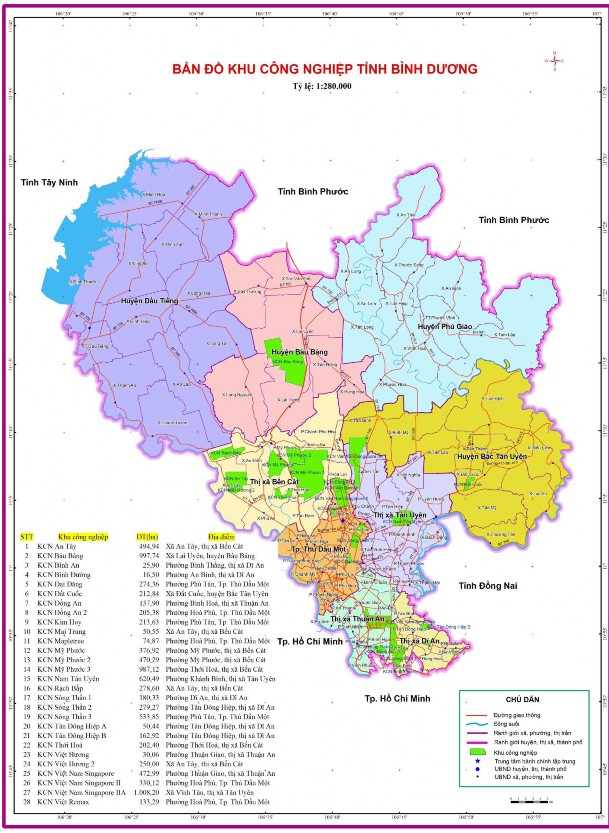
Figure 2.1: Map of Industrial Parks in Binh Duong province
(Source: http://udkhcnbinhduong.vn/upload/fckeditor/upload_55b9664cc8d0a_113.1
82.172.70_BandoKCNBinhDuongA3.jpg)
Maybe you are interested!
-

 Research on accounting policy choices of foreign invested enterprises in Binh Duong province - 2
 -
 Managing teaching capacity building activities for teachers of high schools in Binh Giang district, Hai Duong province to meet the requirements of educational innovation - 16
 -
 Recommendations and Solutions to Improve the Exploitation of Intangible Cultural Heritage Activities "Hat Boi", "Bai Choi" to Serve Tourism in Binh Duong Province
 -
 Human resource development in the process of industrialization and modernization of Binh Duong province from 2011 to 2020 - 13
 -
 Administrative Changes Of Binh Duong Province From 1997 To 2017
By June 2015, the total investment capital for infrastructure of industrial parks was about
9,316 billion VND, reaching 72% of the total approved capital. The form of investment in infrastructure construction is diverse and suitable to the actual conditions of the province. In particular, the province does not use state budget capital to invest in industrial parks. (Binh Duong Industrial Park Management Board, 2015). After 20 years of construction, a system of industrial parks has been formed on the basis of socio-economic development planning and a team of industrial park infrastructure development enterprises with financial and management capacity, prestige and experience in the field of construction and business of industrial park infrastructure. Industrial parks approved according to the planning and infrastructure construction put into operation as shown on the Industrial Park Map of Binh Duong province are recorded as 2.1.
In the development strategy until 2020 and 2025, Binh Duong prioritizes the development of a modern transportation system connecting with Tan Son Nhat and Long Thanh international airports; connecting with the Saigon seaport cluster, the Thi Vai - Vung Tau deep-water port cluster and other technical infrastructure systems in the Southeast region (Tran Khoa, 2015). Transportation development is the key for Binh Duong to create advantages in attracting FDI.
* Electricity, water, traffic and transportation infrastructure
From the policy of promoting investment in transport infrastructure to create an environment to attract investment, Binh Duong has created breakthrough roads as leverage. The leading project is the BOT project of National Highway 13 (Binh Duong Boulevard), with a total length of 62 km (bordering Ho Chi Minh City, running through the main industrial parks of Binh Duong province, bordering Binh Phuoc province), with an investment of 683 billion VND in phase one (according to Becamex Industrial Development and Investment Corporation - One Member Co., Ltd.). After more than 10 years of operation, National Highway 13 has facilitated VSIP I and Dong An I Industrial Parks in Thuan An town to quickly attract investment. Specifically, VSIP I Industrial Park was built in 1996 with a scale of 500 hectares. After more than 15 years of development, it has attracted more than 240 international investors from many countries with a total investment of 2.4 billion USD and has become one of the model industrial parks in the country.
The most obvious effect that National Highway 13 brings is contributing to the formation of the policy of bringing industry to the northern districts of the province and this policy has been effectively implemented. Ben Cat District, where National Highway 13 passes through, has now formed
Many industrial parks such as My Phuoc and Bau Bang have been established with large and modern scale. Along with National Highway 13, Ben Cat also has DT744 road. Thanks to this route, Viet Huong 2, An Tay and Rach Bap industrial parks were formed and have attracted investors. In particular, Viet Huong 2 industrial park has attracted 40 domestic and foreign investment projects with registered capital of 85 billion VND and more than 330 million USD (Mai Xuan, 2015).
In Tan Uyen, where routes such as DT746, DT747B and DT742... pass through, it has contributed to bringing industry to the countryside. Here, factories of companies are springing up more and more, especially in Dat Cuoc and Nam Tan Uyen Industrial Parks, contributing to turning a locality with a purely agricultural economy like Tan Uyen into a district with a developed industrial economy. At Dat Cuoc Industrial Park, after only 5 years of operation, it has attracted nearly 30 domestic and foreign investment projects with a total registered capital of more than 54 million USD and more than 704 billion VND. After 7 years, Nam Tan Uyen Industrial Park has also attracted 88 investment projects of domestic and foreign enterprises (Mai Xuan, 2015).
Regarding electricity and water services, the survey results of the study show that many opinions give good reviews on the electricity and water supply services, ensuring to serve the needs of enterprises. Besides, there are also opinions that the supply of electricity, water, and internet is unstable, and the security of industrial parks is not really guaranteed.
“Electricity and water are relatively stable. However, our electricity prices are high and constantly increasing, and my boss keeps complaining. Water prices are okay, but there are also some places where the industrial park investors have monopolized them” (Administrative Manager of an FDI company, 32 years old)
Regarding the power supply for industrial parks in Binh Duong, a leader said that Binh Duong has not been able to take the initiative in energy sources (electricity), so although the power supply for businesses is guaranteed, the electricity price is still high.
“Regarding electricity, Binh Duong province currently has no self-generated power source (hydroelectricity, thermal power, etc.), we only use electricity from other sources. Binh Duong’s energy source is not proactive.” (Leader of a state management agency, 42 years old)
Also from the research results, many opinions highly appreciate the location of Binh Duong which is convenient for connecting with Ho Chi Minh City and Ba Ria - Vung Tau. Road traffic
and waterways are both developed. However, there are concerns about road traffic, when traffic intersections at the gateways to industrial parks are often congested, especially traffic intersections bordering Ho Chi Minh City and Dong Nai province. Regarding waterway traffic, ports on the two main rivers (Dong Nai River and Saigon River) are both small ports, affected by reefs (in Dong Nai River) and the height of bridges across the river (Binh Loi Bridge - Saigon River), due to the water pressure, water volume in the rivers... so waterway traffic has not yet fully exploited its potential, large ships cannot enter.
In addition, some businesses have reported that it is difficult to find directions to addresses in the province, and even when using electronic maps (google maps), mistakes often occur. In particular, businesses with a large number of customers have to pay additional costs to design and print their own maps to send to their customers.
Most of the interviewed opinions said that Binh Duong has good infrastructure conditions, favorable for business investment.
“In terms of infrastructure, our industrial parks are well-organized and operate well. The infrastructure connection between Binh Duong and Ho Chi Minh City or Binh Duong and Ba Ria – Vung Tau, Dong Nai, to the airport... is very good, so in terms of infrastructure in general, including traffic infrastructure, electricity and water supply,... Binh Duong is very good and can meet the demand” (State agency leader, 44 years old).
Along with the rapid development of industry, social infrastructure has always been of interest to the province. The social housing development program has been focused on by the province, especially housing for low-income people, attracting economic sectors to participate in investment. Up to now, 84 social housing projects have been invested, with a total of 85,073 apartments, meeting the needs of hundreds of thousands of people, of which 22 projects have been put into use, with a total of 9,330 apartments; Health care has been improved in all aspects. Up to now, the whole province has 128 medical facilities, including 19 hospitals (5 provincial public hospitals), 9 district-level medical centers, 17 regional polyclinics, 1 maternity home, 91 commune and ward health stations, 26 production facilities and 18 drug distribution facilities meeting the standards prescribed by the Ministry of Health and nearly 2,000 other medical and pharmaceutical establishments meeting the medical examination and treatment needs of all classes of people in the province; Cultural, Information, Physical Education and Sports activities have received comprehensive attention. By 2015, the rate of communes and wards with institutions
Culture and sports reached 90%; cultural boarding house model reached 80.46% of the total number of boarding houses registered in the province. (Bui Thanh Xuan, 2016)
Despite many advances, research results show that the social infrastructure system in Binh Duong has not developed at the same pace as the economic infrastructure system, limiting the balanced development between the economy and society.
“There are many schools, but they cannot meet the needs of the children of young workers” (A state management leader, 44 years old)
2.2.1.3. Human resources
In the process of exploring new lands, Binh Duong residents have together created and built a new economy with many industries. From the end of the 16th century to the present, Binh Duong's economy has made many positive steps forward, contributing to making this land one of the localities with strong economic development in the country. Also on the basis of potential and strong development, Binh Duong has increasingly attracted many residents to live and work. This is the result of a long-term development process and has a great contribution from economic resources from outside (Binh Duong Provincial Library, 2010).
* About quantity
According to NGTK Binh Duong, the province's population increased quite rapidly (8.11%/year) in the period 2000-2010 from 743 thousand people to 1,620 thousand people in 2010 (an increase of 877 thousand people); in 2015 it increased to 1,947 thousand people (an increase of 327 thousand people) with an average growth rate of 4.31%/year in the period 2011-2015 (author's calculation), the highest increase was in the central urban areas (Thu Dau Mot - Ben Cat Town - Tan Uyen Town), the main reason being mechanical growth. Natural population growth tends to decrease gradually, from 1.38% in 2000 to 1.14% in 2005 and 1.01% in 2010, and 0.9% in 2014. Binh Duong's population development situation is shown in chart 2.1.
The main reason for the mechanical population growth is the attraction of young workers to industrial parks and economic sectors in the province. Being a developed land with social characteristics and open mechanisms is an advantage of Binh Duong in attracting workers and
settlement of people from other provinces and cities. Binh Duong's population has tended to increase rapidly over the years because it attracts many workers from other provinces and cities.
Unit: person
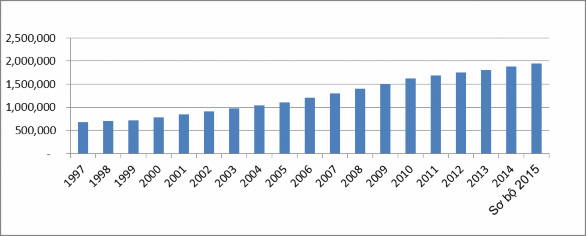
Chart 2.1: Average population of Binh Duong province from 1997 to 2015
(Source: Binh Duong Province Statistical Yearbook)
The working-age population has increased rapidly in both quantity and proportion, in 2010 it was 1,237,455 thousand people, accounting for 76.4% of the population, meeting almost 100% of investors' needs (Nguyen Hoang, 2015). The total number of workers working in economic sectors accounts for a fairly high proportion, in 2000 it was 83.2% and in 2010 it was 84%. Every year, a large number of workers from rural areas of Binh Duong province and other provinces come to work in the industrial sector, in the industrial parks alone, 80-90% of workers come from outside the province. In addition, Binh Duong also has its own attractiveness because there is no distinction in access to public services such as health care, education, etc. between people in Binh Duong province and immigrants without a household registration. It is estimated that by 2020, Binh Duong's population will increase to 2.5 million people and approximately 3 million by 2025, an increase of nearly 1 million people compared to 2015. (Nguyen Hoang, 2015).
The migration of labor from other provinces to Binh Duong has supplemented the labor force for the province, meeting the needs of investors, but also increasing the pressure on vocational training and housing for workers. In addition, rapid population growth is a matter of concern, if considered in long-term development in many socio-economic aspects because it can affect planning.
overall, urban structure and social security. This issue is causing many difficulties for Binh Duong in terms of stabilizing the workforce, lack of housing and infrastructure, affecting public order and security in the whole area. The majority of the interviewed opinions feel favorable about the number of workers in Binh Duong.
“Human resources are abundant and recruitment is also very fast. But there is currently a particular disadvantage, which is the foreign language problem.” (HR manager of an FDI enterprise, 33 years old).
In addition, the research results also show that the problem of labor resource fluctuations in recent years has occurred, especially after the Lunar New Year, when a series of industrial parks are continuously opening in the Central provinces and the Long An Delta provinces - the places that mainly supply labor for the industry of Binh Duong province.
* About quality
Currently, the quality of human resources in Binh Duong province has improved significantly compared to the period when the province was re-established. As of 2015, the proportion of trained laborers in the province accounted for 24.85%. The recent establishment of higher education institutions in the province such as Thu Dau Mot University and Eastern International University has increased the competitiveness in training high-quality human resources in the province.
Unit: %
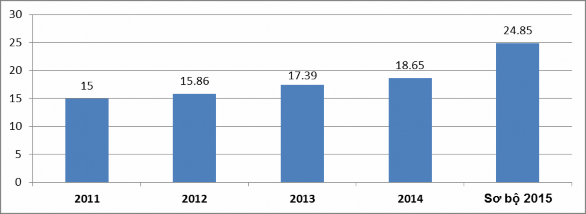
Chart 2.2: Rate of trained workers in Binh Duong in the period 2011-2015
(Source: Binh Duong Province Statistical Yearbook 2015)
Meanwhile, according to forecasts, the quality of human resources is increasingly improved as the province has been focusing on opening training facilities, especially vocational training. By 2020, the number of trained workers in Binh Duong is expected to reach over 85% (Approval of the adjustment of the master plan for socio-economic development of Binh Duong province to 2020, supplementing the plan to 2025), in order to meet the labor resource requirements of enterprises when they come to invest.
In April 2016, the breakthrough program “Improving the quality of human resources in Binh Duong province for the period 2016 - 2020” was approved. The program focuses on building human resources with reasonable quantity and occupational structure, in line with the economic restructuring towards prioritizing service - industrial development associated with the urbanization process (Thuy Duong, 2016). This is the right step and in line with the new situation in the context of investors increasingly demanding human resources, both at the leadership and management level and the workforce.
The interview results show that most businesses believe that Binh Duong has a limited supply of high-quality human resources. Most of the business managers must be recruited from other places, concentrated in Ho Chi Minh City.
“High-quality human resources in Binh Duong and the southern provinces are still lacking. The quantity is sufficient, but workers’ awareness is poor, which affects work and makes management very difficult and can easily lead to strikes. Salaries are increasing, but workers’ qualifications and skills cannot keep up.” (HR manager of an FDI enterprise, 33 years old)
2.2.1.4. Supporting industry
Binh Duong province has identified 05 groups of industries to develop supporting industries, including textile - garment, leather - footwear, mechanical engineering, electronics - information technology and wood processing. Binh Duong has formed industries producing raw materials for the textile industry (industry producing fibers, weaving fabrics, sewing threads, buttons, zippers, dyeing, finishing textile products...), leather and footwear (tanning, manufacturing shoe soles, shoe uppers...), mechanics (metal production, manufacturing metal products, manufacturing machinery, equipment and spare parts for the automobile, motorbike and other transport industries).