
+ Ask students to conduct an experiment to determine the electric spectrum of a system of two identical spheres placed at two fixed points in oil with hair particles, give comments and compare with figure 3.6a in the textbook.
+ Ask students to sketch vector ⃗ at some points on a power line and show how to draw vector ⃗
+ Inform students: the electric spectrum line on which the direction at a given point is drawn in the same direction as the vector ⃗ at that point is called the electric field line.
+ Ask students to speak in the prayer hall
electric power and illustration
+ Do experiments and give comments and comparisons + Sketch the vector ⃗ at some points on a spectrum line and show how to draw the vector ⃗ + Listen + Draw and state the concept of electric field lines |
Maybe you are interested!
-

 Analyze Lesson Content and Requirements (Step C2: Analyze Lesson Content and Requirements)
 -
 Car body electrical practice - 8
zt2i3t4l5ee
zt2a3gs
zt2a3ge
zc2o3n4t5e6n7ts
If the voltage is out of specification, replace the wire or connector.
If the voltage is within specification, install the front fog light relay and follow step 5.
Step 5 Check the front fog light switch
- Remove the D4 connector of the fog light switch
- Use a multimeter to measure the resistance of the front fog light switch.
Measurement location
Condition
Standard
D4-3 (BFG) -D4-4 (LFG)
Light switchFront Fog OFF
>10kΩ
D4-3 (BFG) -D4-4 (LFG)
Front fog light switchON
<1 Ω
- Standard resistor
D4 connector is located on the combination switch assembly.
If the resistance is out of specification, replace the combination switch (the fog light switch is located in the combination switch).
If the resistance is within specification, follow step 6.
Step 6 Check wiring and connectors (front fog light relay-light selector switch)
- Disconnect connector D4 of the combination switch assembly
- Use a voltmeter to measure the voltage value of jack D4 on the wire side.
Measurement location
Control modecontrol
Standard
D4-3 (BFG) - (-) AQ
TAIL
11 to 14 V
D4 connector for the wiring of the combination switch assembly
If the voltage does not meet the standard, replace the wire or connector.
If the voltage is within standard, there may have been an error in the previous measurements.
Step 7 Check the front fog lights
- Remove the front fog light electrical connector.
- Supply battery voltage to the fog lamp terminals
Jack 8, B9 of front fog lamp on the electrical side
blind first.
Power supply location
Terms and Conditions
Battery positive terminal - Terminal 2Battery negative terminal - Terminal 1
Fog lightsbefore morning
- If the light does not come on, replace the bulb.
If the light is on, re-plug the jack and continue to step 8.
Step 8 Check wiring and connectors (relay and front fog lights)
- Disconnect the B8 and B9 connectors of the front fog lights.
- Use a voltmeter to measure voltage at the following locations:
Measurement location
Switch location
Terms and Conditions
B8-2 - (-) AQ
Electric lock ON TAIL size switchFog switch ON
11 to 14 V
B9-2 - (-) AQ
Electric lock ONTAIL size switch Fog switch ON
11 to 14 V
B8 and B9 connectors on the front fog lamp wiring side
Voltage is not up to standard, repair or replace the jack. If up to standard, there may have been an error in the measurement process.
2.2.4. Procedure for removing, installing and adjusting fog lights 1. Procedure for removing
- Remove the front inner ear pads
Use a screwdriver to remove the 3 screws and remove the front part of the front inner ear liner
-Remove the fog light assembly
+ Disconnect the connector.
+ Use a screwdriver to remove 3 screws to remove the fog light cover
2. Installation sequence
-Rotate the fog lamp bulb in the direction indicated by the arrow as shown in the figure and remove the fog lamp from the fog lamp assembly.
-Rotate the fog light bulb in the direction indicated by the arrow as shown in the figure and install the light into the fog light assembly.
- Use a screwdriver to install the fog light cover
-Install the electrical connector
Attention: Be careful not to damage the plastic thread on the lamp assembly.
- Install the front inner ear pads
Use a screwdriver to install the front inner bumper with 3 screws.
3. Prepare the vehicle to adjust the fog light convergence. Prepare the vehicle:
- Make sure there is no damage or deformation to the vehicle body around the fog lights.
- Add fuel to the fuel tank
- Add oil to standard level.
- Add engine coolant to standard level.
- Inflate the tire to standard pressure.
- Place spare tire, tools and jack in original design position
- Do not leave any load in the luggage compartment.
- Let a person weighing about 75 kg sit in the driver's seat.
4. Prepare to check the fog light convergence
a/ Prepare the vehicle status as follows:
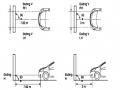
- Place the car in a dark enough place to see the lines. The lines are the dividing line, below which the light from the fog lights can be seen but above which it cannot.
- Place the car perpendicular to the wall.
- Keep a distance of 7.62 m between the center of the fog lamp and the wall.
- Park the car on level ground.
- Press the car down a few times to stabilize the suspension.
Note: A distance of approximately 7.62 m is required between the vehicle (fog lamp center) and the wall to adjust the convergence correctly. If the distance of 7.62 m cannot be achieved, set the correct distance of 3 m to check and adjust the fog lamp convergence. (Since the target area varies with the distance, please follow the instructions as shown in the figure.)
b/ Prepare a piece of thick white paper about 2 m high and 4 m wide to use as a screen.
c/ Draw a vertical line through the center of the screen (line V).
d/ Set the screen as shown in the picture. Note:
- Keep the screen perpendicular to the ground.
- Align the V line on the screen with the center of the vehicle.
e/Draw the reference lines (H, V LH and V RH lines) on the screen as shown in the figure.HINT:
Mark the center of the fog lamp on the screen. If the center mark cannot be seen on the fog lamp, use the center of the fog lamp or the manufacturer's name mark on the fog lamp as the center mark.
H line (fog light height):
Draw a line across the screen so that it passes through the center mark. Line H should be at the same height as the center mark of the fog light bulb.
Line V LH, V RH (center mark position of left fog lamp LH and right fog lamp RH):
Draw two lines so that they intersect line H at the center marks.
5. Check the fog light convergence
a/ Cover the fog lamp or remove the connector of the other side fog lamp to prevent light from the unchecked fog lamp from affecting the fog lamp convergence test.
b/ Start the engine.
c/ Turn on the fog lights and make sure that the dividing line is outside the standard area as shown in the drawing.
6. Adjust the fog light convergence
Use a screwdriver to adjust the fog light to the standard area by turning the toe adjustment screw.
Note: If the screw is adjusted too far, loosen it and then tighten it again, so that the last rotation of the light adjustment screw is clockwise.
3. Self-study questions
1. Describe the operating principle of the lighting system with automatic headlight function
2. Describe the operating principle of the lighting system with the function of rotating headlights when turning
3. Draw diagram and connect lighting system on Hyundai Porter car
4. Draw diagram and connect lighting system on Honda Accord 1992
5. Draw the lighting circuit on a 1993 Toyota Lexus
LESSON 3 MAINTENANCE AND REPAIR OF SIGNAL SYSTEM
I. IMPLEMENTATION GOAL
After completing this lesson, students will be able to:
- Distinguish between types of signals on cars
- Correctly describe common symptoms and suspected areas causing damage.
- Connecting signal circuits ensures technical requirements
- Disassemble, install, check, maintain and repair the signal system to ensure technical requirements.
- Ensure safety in work and industrial hygiene
II. LESSON CONTENT
1. General description
The signal system equipped on cars aims to create signals to notify other vehicles participating in traffic about the vehicle's operating status such as: stopping, parking, braking, reversing, turning...
Signals are used either by light such as headlamps, brake lights, turn signals….. or by sound such as horns, reverse music….
Just like the lighting system. A signal system circuit usually consists of: battery, fuse, wire, relay, electrical load and control switch. Only some switches of the signal system are on the combination switch. The switches of other signals are usually located in different locations such as in the gearbox or brake pedal……
2. Maintenance and repair
2.1. Turn signals and hazard lights
The installation location of the turn signal is shown in Figure 3.1. The turn signal control switch is located in the combination switch under the steering wheel. Turning this switch to the right or left will make the turn signal turn right or left.
The hazard light switch is used when the vehicle has a problem while participating in traffic. When the hazard light switch is turned on, all the turn signals on the vehicle will light up at a certain frequency. The hazard light switch is usually placed separately from the turn signal switch (some old cars integrate the hazard and turn signal switches on the same combination switch cluster).
Figure 3.1 Turn signal switch Figure 3.2 Hazard switch
The part that generates the flashing frequency for the lights is called a turn signal relay. The turn signal relay usually has 3 terminals: B (positive power supply); E (negative power supply); L (providing the turn signal switch to distribute to the
lamp)
2.1.1. Circuit diagram
To generate the frequency for the turn signal, a turn signal relay is used in the turn signal circuit. The current from the turn signal relay will be sent to the turn signal switch assembly to distribute the current to the turn signal lights for the driver's purpose.
Figure 3.3. Schematic diagram of a turn signal circuit without a hazard switch
1. Battery; 2. Electric lock; 3. Turn signal relay; 4. Turn signal switch; 5. Turn signal lamp; 6. Turn signal lamp; 7. Hazard switch
Figure 3.4 Schematic diagram of turn signal circuit with hazard switch
1. Battery; 2. Combination switch cluster; 3. Turn signal;
4. Turn signal light; 5. Turn signal relay
Today's cars no longer use three-pin turn signal relays (B, L, E) but use eight-pin turn signal relays (figure 3.5) (pin number 8 is used for hazard lights).
For this type, the current supplying the turn signal lights is supplied directly from the turn signal relay to the lights.
div.maincontent .p { color: black; font-family:"Times New Roman", serif; font-style: normal; font-weight: normal; text-decoration: none; font-size: 14pt; margin:0pt; } div.maincontent p { color: black; font-family:"Times New Roman", serif; font-style: normal; font-weight: normal; text-decoration: none; font-size: 14pt; margin:0pt; } div.maincontent .s1 { color: black; font-family:"Times New Roman", serif; font-style: normal; font-weight: normal; text-decoration: none; font-size: 13pt; } div.maincontent .s2 { color: black; font-family:"Times New Roman", serif; font-style: italic; font-weight: normal; text-decoration: none; font-size: 14pt; } div.maincontent .s3 { color: black; font-family:"Times New Roman", serif; font-style: normal; font-weight: normal; text-decoration: none; font-size: 14pt; } div.maincontent .s4 { color: black; font-family:"Times New Roman", serif; font-style: normal; font-weight: normal; text-decoration: none; font-size: 13pt; } div.maincontent .s5 { color: black; font-family:"Times New Roman", serif; font-style: normal; font-weight: normal; text-decoration: none; font-size: 13pt; vertical-align: 1pt; } div.maincontent .s6 { color: black; font-family:"Times New Roman", serif; font-style: normal; font-weight: normal; text-decoration: none; font-size: 11pt; } div.maincontent .s7 { color: black; font-family:"Times New Roman", serif; font-style: normal; font-weight: normal; text-decoration: none; font-size: 14pt; vertical-align: -9pt; } div.maincontent .s8 { color: black; font-family:"Times New Roman", serif; font-style: normal; font-weight: normal; text-decoration: none; font-size: 11pt; } div.maincontent .s9 { color: #008000; font-family:"Times New Roman", serif; font-style: normal; font-weight: normal; text-decoration: none; font-size: 14pt; } div.maincontent .s10 { color: black; font-family:"Times New Roman", serif; font-style: italic; font-weight: normal; te
Car body electrical practice - 8
zt2i3t4l5ee
zt2a3gs
zt2a3ge
zc2o3n4t5e6n7ts
If the voltage is out of specification, replace the wire or connector.
If the voltage is within specification, install the front fog light relay and follow step 5.
Step 5 Check the front fog light switch
- Remove the D4 connector of the fog light switch
- Use a multimeter to measure the resistance of the front fog light switch.
Measurement location
Condition
Standard
D4-3 (BFG) -D4-4 (LFG)
Light switchFront Fog OFF
>10kΩ
D4-3 (BFG) -D4-4 (LFG)
Front fog light switchON
<1 Ω
- Standard resistor
D4 connector is located on the combination switch assembly.
If the resistance is out of specification, replace the combination switch (the fog light switch is located in the combination switch).
If the resistance is within specification, follow step 6.
Step 6 Check wiring and connectors (front fog light relay-light selector switch)
- Disconnect connector D4 of the combination switch assembly
- Use a voltmeter to measure the voltage value of jack D4 on the wire side.
Measurement location
Control modecontrol
Standard
D4-3 (BFG) - (-) AQ
TAIL
11 to 14 V
D4 connector for the wiring of the combination switch assembly
If the voltage does not meet the standard, replace the wire or connector.
If the voltage is within standard, there may have been an error in the previous measurements.
Step 7 Check the front fog lights
- Remove the front fog light electrical connector.
- Supply battery voltage to the fog lamp terminals
Jack 8, B9 of front fog lamp on the electrical side
blind first.
Power supply location
Terms and Conditions
Battery positive terminal - Terminal 2Battery negative terminal - Terminal 1
Fog lightsbefore morning
- If the light does not come on, replace the bulb.
If the light is on, re-plug the jack and continue to step 8.
Step 8 Check wiring and connectors (relay and front fog lights)
- Disconnect the B8 and B9 connectors of the front fog lights.
- Use a voltmeter to measure voltage at the following locations:
Measurement location
Switch location
Terms and Conditions
B8-2 - (-) AQ
Electric lock ON TAIL size switchFog switch ON
11 to 14 V
B9-2 - (-) AQ
Electric lock ONTAIL size switch Fog switch ON
11 to 14 V
B8 and B9 connectors on the front fog lamp wiring side
Voltage is not up to standard, repair or replace the jack. If up to standard, there may have been an error in the measurement process.
2.2.4. Procedure for removing, installing and adjusting fog lights 1. Procedure for removing
- Remove the front inner ear pads
Use a screwdriver to remove the 3 screws and remove the front part of the front inner ear liner
-Remove the fog light assembly
+ Disconnect the connector.
+ Use a screwdriver to remove 3 screws to remove the fog light cover
2. Installation sequence
-Rotate the fog lamp bulb in the direction indicated by the arrow as shown in the figure and remove the fog lamp from the fog lamp assembly.
-Rotate the fog light bulb in the direction indicated by the arrow as shown in the figure and install the light into the fog light assembly.
- Use a screwdriver to install the fog light cover
-Install the electrical connector
Attention: Be careful not to damage the plastic thread on the lamp assembly.
- Install the front inner ear pads
Use a screwdriver to install the front inner bumper with 3 screws.
3. Prepare the vehicle to adjust the fog light convergence. Prepare the vehicle:
- Make sure there is no damage or deformation to the vehicle body around the fog lights.
- Add fuel to the fuel tank
- Add oil to standard level.
- Add engine coolant to standard level.
- Inflate the tire to standard pressure.
- Place spare tire, tools and jack in original design position
- Do not leave any load in the luggage compartment.
- Let a person weighing about 75 kg sit in the driver's seat.
4. Prepare to check the fog light convergence
a/ Prepare the vehicle status as follows:
- Place the car in a dark enough place to see the lines. The lines are the dividing line, below which the light from the fog lights can be seen but above which it cannot.
- Place the car perpendicular to the wall.
- Keep a distance of 7.62 m between the center of the fog lamp and the wall.
- Park the car on level ground.
- Press the car down a few times to stabilize the suspension.
Note: A distance of approximately 7.62 m is required between the vehicle (fog lamp center) and the wall to adjust the convergence correctly. If the distance of 7.62 m cannot be achieved, set the correct distance of 3 m to check and adjust the fog lamp convergence. (Since the target area varies with the distance, please follow the instructions as shown in the figure.)
b/ Prepare a piece of thick white paper about 2 m high and 4 m wide to use as a screen.
c/ Draw a vertical line through the center of the screen (line V).
d/ Set the screen as shown in the picture. Note:
- Keep the screen perpendicular to the ground.
- Align the V line on the screen with the center of the vehicle.
e/Draw the reference lines (H, V LH and V RH lines) on the screen as shown in the figure.HINT:
Mark the center of the fog lamp on the screen. If the center mark cannot be seen on the fog lamp, use the center of the fog lamp or the manufacturer's name mark on the fog lamp as the center mark.
H line (fog light height):
Draw a line across the screen so that it passes through the center mark. Line H should be at the same height as the center mark of the fog light bulb.
Line V LH, V RH (center mark position of left fog lamp LH and right fog lamp RH):
Draw two lines so that they intersect line H at the center marks.
5. Check the fog light convergence
a/ Cover the fog lamp or remove the connector of the other side fog lamp to prevent light from the unchecked fog lamp from affecting the fog lamp convergence test.
b/ Start the engine.
c/ Turn on the fog lights and make sure that the dividing line is outside the standard area as shown in the drawing.
6. Adjust the fog light convergence
Use a screwdriver to adjust the fog light to the standard area by turning the toe adjustment screw.
Note: If the screw is adjusted too far, loosen it and then tighten it again, so that the last rotation of the light adjustment screw is clockwise.
3. Self-study questions
1. Describe the operating principle of the lighting system with automatic headlight function
2. Describe the operating principle of the lighting system with the function of rotating headlights when turning
3. Draw diagram and connect lighting system on Hyundai Porter car
4. Draw diagram and connect lighting system on Honda Accord 1992
5. Draw the lighting circuit on a 1993 Toyota Lexus
LESSON 3 MAINTENANCE AND REPAIR OF SIGNAL SYSTEM
I. IMPLEMENTATION GOAL
After completing this lesson, students will be able to:
- Distinguish between types of signals on cars
- Correctly describe common symptoms and suspected areas causing damage.
- Connecting signal circuits ensures technical requirements
- Disassemble, install, check, maintain and repair the signal system to ensure technical requirements.
- Ensure safety in work and industrial hygiene
II. LESSON CONTENT
1. General description
The signal system equipped on cars aims to create signals to notify other vehicles participating in traffic about the vehicle's operating status such as: stopping, parking, braking, reversing, turning...
Signals are used either by light such as headlamps, brake lights, turn signals….. or by sound such as horns, reverse music….
Just like the lighting system. A signal system circuit usually consists of: battery, fuse, wire, relay, electrical load and control switch. Only some switches of the signal system are on the combination switch. The switches of other signals are usually located in different locations such as in the gearbox or brake pedal……
2. Maintenance and repair
2.1. Turn signals and hazard lights
The installation location of the turn signal is shown in Figure 3.1. The turn signal control switch is located in the combination switch under the steering wheel. Turning this switch to the right or left will make the turn signal turn right or left.
The hazard light switch is used when the vehicle has a problem while participating in traffic. When the hazard light switch is turned on, all the turn signals on the vehicle will light up at a certain frequency. The hazard light switch is usually placed separately from the turn signal switch (some old cars integrate the hazard and turn signal switches on the same combination switch cluster).
Figure 3.1 Turn signal switch Figure 3.2 Hazard switch
The part that generates the flashing frequency for the lights is called a turn signal relay. The turn signal relay usually has 3 terminals: B (positive power supply); E (negative power supply); L (providing the turn signal switch to distribute to the
lamp)
2.1.1. Circuit diagram
To generate the frequency for the turn signal, a turn signal relay is used in the turn signal circuit. The current from the turn signal relay will be sent to the turn signal switch assembly to distribute the current to the turn signal lights for the driver's purpose.
Figure 3.3. Schematic diagram of a turn signal circuit without a hazard switch
1. Battery; 2. Electric lock; 3. Turn signal relay; 4. Turn signal switch; 5. Turn signal lamp; 6. Turn signal lamp; 7. Hazard switch
Figure 3.4 Schematic diagram of turn signal circuit with hazard switch
1. Battery; 2. Combination switch cluster; 3. Turn signal;
4. Turn signal light; 5. Turn signal relay
Today's cars no longer use three-pin turn signal relays (B, L, E) but use eight-pin turn signal relays (figure 3.5) (pin number 8 is used for hazard lights).
For this type, the current supplying the turn signal lights is supplied directly from the turn signal relay to the lights.
div.maincontent .p { color: black; font-family:"Times New Roman", serif; font-style: normal; font-weight: normal; text-decoration: none; font-size: 14pt; margin:0pt; } div.maincontent p { color: black; font-family:"Times New Roman", serif; font-style: normal; font-weight: normal; text-decoration: none; font-size: 14pt; margin:0pt; } div.maincontent .s1 { color: black; font-family:"Times New Roman", serif; font-style: normal; font-weight: normal; text-decoration: none; font-size: 13pt; } div.maincontent .s2 { color: black; font-family:"Times New Roman", serif; font-style: italic; font-weight: normal; text-decoration: none; font-size: 14pt; } div.maincontent .s3 { color: black; font-family:"Times New Roman", serif; font-style: normal; font-weight: normal; text-decoration: none; font-size: 14pt; } div.maincontent .s4 { color: black; font-family:"Times New Roman", serif; font-style: normal; font-weight: normal; text-decoration: none; font-size: 13pt; } div.maincontent .s5 { color: black; font-family:"Times New Roman", serif; font-style: normal; font-weight: normal; text-decoration: none; font-size: 13pt; vertical-align: 1pt; } div.maincontent .s6 { color: black; font-family:"Times New Roman", serif; font-style: normal; font-weight: normal; text-decoration: none; font-size: 11pt; } div.maincontent .s7 { color: black; font-family:"Times New Roman", serif; font-style: normal; font-weight: normal; text-decoration: none; font-size: 14pt; vertical-align: -9pt; } div.maincontent .s8 { color: black; font-family:"Times New Roman", serif; font-style: normal; font-weight: normal; text-decoration: none; font-size: 11pt; } div.maincontent .s9 { color: #008000; font-family:"Times New Roman", serif; font-style: normal; font-weight: normal; text-decoration: none; font-size: 14pt; } div.maincontent .s10 { color: black; font-family:"Times New Roman", serif; font-style: italic; font-weight: normal; te -
 Management Ensures the Requirements for Teaching Cultural Heritage Education Content in Social Science Subjects in Secondary Schools
 -
 Innovation in the Content and Leadership Methods of Provincial Party Committees in the Red River Delta to Meet the Requirements of Building Defense Areas in the Current Stage
 -
 Purpose, Requirements, Tasks, Organizing Principles, Experimental Content

Activity 5 (8 minutes): Learn about the properties of electric lines of force (level 3 main idea finding skills and working with images and drawings level 2)
Teacher's activities
Game Activities | |
+ Ask students to briefly state the properties of electric lines of force. + Require students to form groups of 4-6 students. + Issue and display 3HT1 ballots Step T1: Orientation + Assignment: Ask students to read the section 3b. Properties of electric lines of force”, observe drawings 3.4a, 3.4b and 3.6a, 3.6b and complete worksheet 3HT1 + No instructions or examples when students work with text, only a little guidance when students work with drawings and images. Step 2: Students work with textbooks | + Briefly state the properties of electric lines of force + Create a group + Receive and view 3HT1 vouchers + Read, observe and complete form 3HT1 + Listen |
+ Observe and help student groups
Step T3: Discussion
+ Show 3HT1 ballots of groups
+ Ask two groups of students to present their group's 3HT1 worksheet.
+ Ask student groups and individual students to give their opinions.
discussion variables
+ Observe and record discussion results
Step T4: Summary
+ Comment on how students present, argue, explain and contribute to students' discussions
+ Summarize the discussion content and project the content of section 3b. Properties of electric lines of force" using a summary diagram
+ Change item
+ Read, observe and complete form 3HT1 + Observe the 3HT1 ticket being shown + Present content according to form 3HT1 + Listen and give comments + Listen and respond + Listen and take notes + Listen |
Activity 6 (3 minutes): Learning about uniform electric fields
Teacher's activities
Game Activities | |
+ Require students to base on the properties of electric lines of force to state the concept of uniform electric field. + Notice of uniform electric field concept + Ask students to point out the uniform electric field between the two metal plates in figure 3.8 page 16 of the textbook and observe the electric spectrum in figure 3.7 page 16 of the textbook. + Change item | + Think and state the concept of electric field according to your own understanding. + Listen and take notes + Specify the request content + Listen |
Activity 7 (3 minutes): Study the electric field of a point charge
Teacher's activities
Game Activities | |
+ Problem statement: There are two point charges Q and q placed in a vacuum at a distance r apart. Write an expression to calculate the electric field strength of Q at the point q is placed. + Ask students to comment on the relationship between the sign of Q and the direction of the electric field strength, and draw an illustration. + Ask students to solve exercise 4 page 18 Textbook | + Listen and write an expression to calculate the electric field strength at a point caused by Q + Draw pictures and give comments + Solve exercise 4 page 18 Textbook |
Activity 8 (2 minutes): Learn the principle of electric field superposition
Teacher's activities
Game Activities | |
+ Problem statement: Suppose there are many electric charges placed around a fixed point, how is the electric field at that fixed point determined? + Notice of superposition principle content electric field | + Listen and respond + Listen and take notes |
Activity 8 (2 minutes): Lesson consolidation
Teacher's activities
Game Activities | |
+ Require students to solve exercise 1 page 17 textbook, exercise 7 page 18 textbook + Comments, summary | + Summary and solution + Receive and adjust |
VI. EXPERIENCE DRAWING, SUPPLEMENTATION, ASSIGNMENT OF TASKS
VI.1. Assign learning tasks and guide students to perform them (1 minute)
At home, you do the following tasks:
+ Answer the questions and solve the remaining exercises after the lesson,
+ Read and summarize the content of the information "Near and far interactions",
+ Review the formula for calculating mechanical work, the characteristics of gravity and the formula for calculating gravity and gravitational potential energy.
VI.2. Lessons learned and additions LESSON 4
Date prepared: Lesson according to PPCT: 04
Lesson 4: WORK OF ELECTRIC FORCE. ELECTRIC VOLTAGE
I. GOAL (Step C1: Determine the goal)
I.1. Knowledge
+ State the characteristics of the work of electric force and understand the formula for calculating the work of electric force
+ Understand that the electrostatic field is a potential field.
+ Present the concept of voltage and the formula for calculating voltage
+ State the relationship between voltage and electric field strength
I.2. Skills
+ Apply the formula for calculating electric force and the formula for calculating electric potential
+ Apply the formula relating electric potential and electric field strength
+ Apply information from level 2 text
I.3. Attitude
Initially forming a positive, proactive and cooperative learning attitude in the group. Consciously practicing learning skills with textbooks and physics in learning.
II. ANALYZE THE CONTENT AND REQUIREMENTS OF THE LESSON (Step C2: Analyze the content and requirements of the lesson)
Lesson 4 "Work of electric force. Electric potential difference" is the fourth theoretical lesson of the advanced Physics 11 program. This lesson is presented immediately after the lesson "Electric field", which means that students already know about electric field, uniform electric field. This lesson is required to be taught in one class period. The knowledge mentioned in the lesson "Work of electric force. Electric potential difference" is presented in three sections in order: Work of electric force, Concept of electric potential difference, Relationship between electric field and electric potential difference. Most of the lesson content is presented in text channels with the support of 06 drawings, 10 questions and 08 exercises, occupying 06 pages of the textbook. The lesson content is presented from the perspective of inheriting the knowledge that students have learned in the advanced Physics 11 program. For example: when presenting the content about the work of electric force and the characteristics of the work of electric force, the authors of the advanced Physics 11 textbook have
Apply the analogy between the work of electric force and the work of gravity, thereby affirming the characteristics of the electrostatic field as a potential field like a gravitational field. After concluding about the characteristics of the electrostatic field, the authors apply the analogy of the relationship between the work of gravity and the gravitational potential difference to introduce the concept of electric potential difference, thereby introducing the concept of electric potential difference and electric potential. Therefore, when teaching this lesson, teachers should take advantage of the analogy between the gravitational field and the electrostatic field to organize students to learn the lesson content, and can further exploit the analogy in calculating the quantities mentioned in the lesson, such as writing the expression to calculate the electric potential at a point in the electric field when choosing the origin of the electric potential difference at infinity.
III. STEP C3: Identify skills for working with textbooks
Using information from level 2 text channels
IV. PREPARATION (Step C4: Plan to organize students to work with textbooks)
IV.1. Teacher's preparation
+ Duration, time, and form of working with textbooks for students: 10 minutes, in class, students work in groups of 4-6 students/group
+ Students read the section "Voltage, electric potential" and write the expression to calculate the electric potential at point M in the electric field when choosing the origin to calculate the electric potential at infinity. The teacher uses the skill training process at level 2.
+ Show the steps to practice the skill of applying information from the text channel
IV.2. Game preparation
+ Review the formula for calculating mechanical work, the characteristics of gravity and the formula for calculating gravity and gravitational potential energy.
+ Advanced Physics textbook for grade 11 high school and writing tools, scrap paper
V. TEACHING PROCESS
Activity 1 (10 minutes): Review old knowledge and start new lesson
Teacher's activities
Game Activities | |
+ Ask students to review the following knowledge: Formula for calculating mechanical work Characteristics of gravity work Characteristics of gravity field (gravitational field) | + Review knowledge as required by the teacher |
+ Require students to base on the drawing below, write the expression to calculate the work of gravity when the object moves from M to N and the expression to calculate the difference in gravitational potential energy at M and N. Given:
Hi what should be noted when calculating potential energy?
M
h M
N
h N
Land
+ Comment and emphasize the content of students' answers.
+ Go to new post
+ Write expressions as required by the teacher + Listen and absorb + Listen |
Activity 2 (7 minutes): Learn about the work of electric force
Teacher's activities
Game Activities | |
+ Ask students to observe the two drawings below and calculate the work of the electric force when q > 0 moves from M to N in a uniform electric field between two metal plates with equal and opposite charges M h M N h N Land | + Calculate the work of electric force according to the drawing |
O M d N x |
+ Ask students to comment on the characteristics of the electric force, thereby determining the properties of the electrostatic field.
+ Comments and conclusions on section 1. Work of electric force", emphasizing some notes when calculating work of electric force
+ Change item
+ Comment and state the properties of the electrostatic field + Listen and take notes |
Activity 3 (15 minutes): Learn the concept of electric potential
Teacher's activities
Game Activities | |
+ Guide students to give expressions relating the work of electric force and the potential energy of electric charge, expressions (4.2), (4.3) + Ask students to state the concept of voltage, definition and unit of measurement of voltage. + Conclusion and emphasis on notes on expressions (4.2), (4.3) + Ask students to work with item 2b. "Electric potential, electric potential" to write on paper the expression to calculate the electric potential at point M in the electric field when choosing the electric potential origin at infinity. Step T1: Orientation + Assignment: read section 2b. "Electric potential, electric potential" and write down the expression to calculate the electric potential at point M in the electric field when choosing the electric potential origin at infinity + Guide students to apply information from the channel letters for students to perform the following general steps: Step 1: Determine the goal of applying information | + Listen and follow + State the concept of voltage, define what 1 Volt is + Listen and take notes + Work with item 2b and write out the expression for the electric potential at M + Receive mission + Listen to instructions and ask questions if any |
Step 2: Show the connection between information and cognitive requirements
Step 3: Solve the cognitive problem
Step 2: Students work with textbooks
+ Observe and help students
Step T3: Discussion
+ Ask a few students to go to the board to write the assigned expression, other students observe and compare with their expression.
+ Ask students to comment and correct the expressions written on the board.
Step T4: Summary
+ Comments, conclusions about correct expressions, comments on working methods, presentation and discussion of students in class
+ Praise, criticism (if any)
+ Ask students to answer question C 4 page 21 Textbook
+ Change item
+ Working with textbooks + Write the expression on the board and present it. + Comments and additional ideas + Listen and take notes |
Activity 4 (7 minutes): Explore the relationship between electric field strength and electric potential
Teacher's activities
Game Activities | |
+ Ask students to use formulas (4.1) and (4.2) to write down the relationship between electric field strength and voltage. + Ask some students to write expressions on the board, other students follow and comment. + Comment, confirm the expression and press strong in the unit of electric field strength learned in the previous lesson | + Write an expression showing the relationship between electric field strength and electric potential. + Write the expression on the board and comment. + Listen, take notes and respond if any |