
+Manage training methods
Training is an educational method in which teachers organize various types of activities according to certain educational content to create conditions and environments for students to experience their own awareness and feelings about ethical, cultural, aesthetic standards... in specific situations and diverse life practices.
+ Manage training methods
Practice is a method to consolidate and stabilize behaviors and habits that have been formed and trained in practical educational activities. It is a process of organizing systematic, regular, and planned review of actions and behavioral habits, turning them into personality attributes and indispensable needs in the daily life of each individual.
+ Organize extracurricular activities by subject related to dominant subjects.
Maybe you are interested!
-

 New Requirements for Management of Teaching Capacity Development for Secondary School Teachers
 -
 Measure 2: Establish a Steering Committee for Educational Management to Educate Students on the Value of Tangible Cultural Heritage
 -
 The Necessity and Feasibility of Proposed Measures to Improve the Effectiveness of Teaching the Value of Tangible Cultural Heritage to Students
 -
 Using the cultural heritage of Hoa Lu Ancient Capital in teaching local history in grade 10 high school in Ninh Binh province - 2
 -
 Car body electrical practice - 8
zt2i3t4l5ee
zt2a3gs
zt2a3ge
zc2o3n4t5e6n7ts
If the voltage is out of specification, replace the wire or connector.
If the voltage is within specification, install the front fog light relay and follow step 5.
Step 5 Check the front fog light switch
- Remove the D4 connector of the fog light switch
- Use a multimeter to measure the resistance of the front fog light switch.
Measurement location
Condition
Standard
D4-3 (BFG) -D4-4 (LFG)
Light switchFront Fog OFF
>10kΩ
D4-3 (BFG) -D4-4 (LFG)
Front fog light switchON
<1 Ω
- Standard resistor
D4 connector is located on the combination switch assembly.
If the resistance is out of specification, replace the combination switch (the fog light switch is located in the combination switch).
If the resistance is within specification, follow step 6.
Step 6 Check wiring and connectors (front fog light relay-light selector switch)
- Disconnect connector D4 of the combination switch assembly
- Use a voltmeter to measure the voltage value of jack D4 on the wire side.
Measurement location
Control modecontrol
Standard
D4-3 (BFG) - (-) AQ
TAIL
11 to 14 V
D4 connector for the wiring of the combination switch assembly
If the voltage does not meet the standard, replace the wire or connector.
If the voltage is within standard, there may have been an error in the previous measurements.
Step 7 Check the front fog lights
- Remove the front fog light electrical connector.
- Supply battery voltage to the fog lamp terminals
Jack 8, B9 of front fog lamp on the electrical side
blind first.
Power supply location
Terms and Conditions
Battery positive terminal - Terminal 2Battery negative terminal - Terminal 1
Fog lightsbefore morning
- If the light does not come on, replace the bulb.
If the light is on, re-plug the jack and continue to step 8.
Step 8 Check wiring and connectors (relay and front fog lights)
- Disconnect the B8 and B9 connectors of the front fog lights.
- Use a voltmeter to measure voltage at the following locations:
Measurement location
Switch location
Terms and Conditions
B8-2 - (-) AQ
Electric lock ON TAIL size switchFog switch ON
11 to 14 V
B9-2 - (-) AQ
Electric lock ONTAIL size switch Fog switch ON
11 to 14 V
B8 and B9 connectors on the front fog lamp wiring side
Voltage is not up to standard, repair or replace the jack. If up to standard, there may have been an error in the measurement process.
2.2.4. Procedure for removing, installing and adjusting fog lights 1. Procedure for removing
- Remove the front inner ear pads
Use a screwdriver to remove the 3 screws and remove the front part of the front inner ear liner
-Remove the fog light assembly
+ Disconnect the connector.
+ Use a screwdriver to remove 3 screws to remove the fog light cover
2. Installation sequence
-Rotate the fog lamp bulb in the direction indicated by the arrow as shown in the figure and remove the fog lamp from the fog lamp assembly.
-Rotate the fog light bulb in the direction indicated by the arrow as shown in the figure and install the light into the fog light assembly.
- Use a screwdriver to install the fog light cover
-Install the electrical connector
Attention: Be careful not to damage the plastic thread on the lamp assembly.
- Install the front inner ear pads
Use a screwdriver to install the front inner bumper with 3 screws.
3. Prepare the vehicle to adjust the fog light convergence. Prepare the vehicle:
- Make sure there is no damage or deformation to the vehicle body around the fog lights.
- Add fuel to the fuel tank
- Add oil to standard level.
- Add engine coolant to standard level.
- Inflate the tire to standard pressure.
- Place spare tire, tools and jack in original design position
- Do not leave any load in the luggage compartment.
- Let a person weighing about 75 kg sit in the driver's seat.
4. Prepare to check the fog light convergence
a/ Prepare the vehicle status as follows:
- Place the car in a dark enough place to see the lines. The lines are the dividing line, below which the light from the fog lights can be seen but above which it cannot.
- Place the car perpendicular to the wall.
- Keep a distance of 7.62 m between the center of the fog lamp and the wall.
- Park the car on level ground.
- Press the car down a few times to stabilize the suspension.
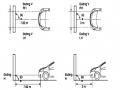
Note: A distance of approximately 7.62 m is required between the vehicle (fog lamp center) and the wall to adjust the convergence correctly. If the distance of 7.62 m cannot be achieved, set the correct distance of 3 m to check and adjust the fog lamp convergence. (Since the target area varies with the distance, please follow the instructions as shown in the figure.)
b/ Prepare a piece of thick white paper about 2 m high and 4 m wide to use as a screen.
c/ Draw a vertical line through the center of the screen (line V).
d/ Set the screen as shown in the picture. Note:
- Keep the screen perpendicular to the ground.
- Align the V line on the screen with the center of the vehicle.
e/Draw the reference lines (H, V LH and V RH lines) on the screen as shown in the figure.HINT:
Mark the center of the fog lamp on the screen. If the center mark cannot be seen on the fog lamp, use the center of the fog lamp or the manufacturer's name mark on the fog lamp as the center mark.
H line (fog light height):
Draw a line across the screen so that it passes through the center mark. Line H should be at the same height as the center mark of the fog light bulb.
Line V LH, V RH (center mark position of left fog lamp LH and right fog lamp RH):
Draw two lines so that they intersect line H at the center marks.
5. Check the fog light convergence
a/ Cover the fog lamp or remove the connector of the other side fog lamp to prevent light from the unchecked fog lamp from affecting the fog lamp convergence test.
b/ Start the engine.
c/ Turn on the fog lights and make sure that the dividing line is outside the standard area as shown in the drawing.
6. Adjust the fog light convergence
Use a screwdriver to adjust the fog light to the standard area by turning the toe adjustment screw.
Note: If the screw is adjusted too far, loosen it and then tighten it again, so that the last rotation of the light adjustment screw is clockwise.
3. Self-study questions
1. Describe the operating principle of the lighting system with automatic headlight function
2. Describe the operating principle of the lighting system with the function of rotating headlights when turning
3. Draw diagram and connect lighting system on Hyundai Porter car
4. Draw diagram and connect lighting system on Honda Accord 1992
5. Draw the lighting circuit on a 1993 Toyota Lexus
LESSON 3 MAINTENANCE AND REPAIR OF SIGNAL SYSTEM
I. IMPLEMENTATION GOAL
After completing this lesson, students will be able to:
- Distinguish between types of signals on cars
- Correctly describe common symptoms and suspected areas causing damage.
- Connecting signal circuits ensures technical requirements
- Disassemble, install, check, maintain and repair the signal system to ensure technical requirements.
- Ensure safety in work and industrial hygiene
II. LESSON CONTENT
1. General description
The signal system equipped on cars aims to create signals to notify other vehicles participating in traffic about the vehicle's operating status such as: stopping, parking, braking, reversing, turning...
Signals are used either by light such as headlamps, brake lights, turn signals….. or by sound such as horns, reverse music….
Just like the lighting system. A signal system circuit usually consists of: battery, fuse, wire, relay, electrical load and control switch. Only some switches of the signal system are on the combination switch. The switches of other signals are usually located in different locations such as in the gearbox or brake pedal……
2. Maintenance and repair
2.1. Turn signals and hazard lights
The installation location of the turn signal is shown in Figure 3.1. The turn signal control switch is located in the combination switch under the steering wheel. Turning this switch to the right or left will make the turn signal turn right or left.
The hazard light switch is used when the vehicle has a problem while participating in traffic. When the hazard light switch is turned on, all the turn signals on the vehicle will light up at a certain frequency. The hazard light switch is usually placed separately from the turn signal switch (some old cars integrate the hazard and turn signal switches on the same combination switch cluster).
Figure 3.1 Turn signal switch Figure 3.2 Hazard switch
The part that generates the flashing frequency for the lights is called a turn signal relay. The turn signal relay usually has 3 terminals: B (positive power supply); E (negative power supply); L (providing the turn signal switch to distribute to the
lamp)
2.1.1. Circuit diagram
To generate the frequency for the turn signal, a turn signal relay is used in the turn signal circuit. The current from the turn signal relay will be sent to the turn signal switch assembly to distribute the current to the turn signal lights for the driver's purpose.
Figure 3.3. Schematic diagram of a turn signal circuit without a hazard switch
1. Battery; 2. Electric lock; 3. Turn signal relay; 4. Turn signal switch; 5. Turn signal lamp; 6. Turn signal lamp; 7. Hazard switch
Figure 3.4 Schematic diagram of turn signal circuit with hazard switch
1. Battery; 2. Combination switch cluster; 3. Turn signal;
4. Turn signal light; 5. Turn signal relay
Today's cars no longer use three-pin turn signal relays (B, L, E) but use eight-pin turn signal relays (figure 3.5) (pin number 8 is used for hazard lights).
For this type, the current supplying the turn signal lights is supplied directly from the turn signal relay to the lights.
div.maincontent .p { color: black; font-family:"Times New Roman", serif; font-style: normal; font-weight: normal; text-decoration: none; font-size: 14pt; margin:0pt; } div.maincontent p { color: black; font-family:"Times New Roman", serif; font-style: normal; font-weight: normal; text-decoration: none; font-size: 14pt; margin:0pt; } div.maincontent .s1 { color: black; font-family:"Times New Roman", serif; font-style: normal; font-weight: normal; text-decoration: none; font-size: 13pt; } div.maincontent .s2 { color: black; font-family:"Times New Roman", serif; font-style: italic; font-weight: normal; text-decoration: none; font-size: 14pt; } div.maincontent .s3 { color: black; font-family:"Times New Roman", serif; font-style: normal; font-weight: normal; text-decoration: none; font-size: 14pt; } div.maincontent .s4 { color: black; font-family:"Times New Roman", serif; font-style: normal; font-weight: normal; text-decoration: none; font-size: 13pt; } div.maincontent .s5 { color: black; font-family:"Times New Roman", serif; font-style: normal; font-weight: normal; text-decoration: none; font-size: 13pt; vertical-align: 1pt; } div.maincontent .s6 { color: black; font-family:"Times New Roman", serif; font-style: normal; font-weight: normal; text-decoration: none; font-size: 11pt; } div.maincontent .s7 { color: black; font-family:"Times New Roman", serif; font-style: normal; font-weight: normal; text-decoration: none; font-size: 14pt; vertical-align: -9pt; } div.maincontent .s8 { color: black; font-family:"Times New Roman", serif; font-style: normal; font-weight: normal; text-decoration: none; font-size: 11pt; } div.maincontent .s9 { color: #008000; font-family:"Times New Roman", serif; font-style: normal; font-weight: normal; text-decoration: none; font-size: 14pt; } div.maincontent .s10 { color: black; font-family:"Times New Roman", serif; font-style: italic; font-weight: normal; te
Car body electrical practice - 8
zt2i3t4l5ee
zt2a3gs
zt2a3ge
zc2o3n4t5e6n7ts
If the voltage is out of specification, replace the wire or connector.
If the voltage is within specification, install the front fog light relay and follow step 5.
Step 5 Check the front fog light switch
- Remove the D4 connector of the fog light switch
- Use a multimeter to measure the resistance of the front fog light switch.
Measurement location
Condition
Standard
D4-3 (BFG) -D4-4 (LFG)
Light switchFront Fog OFF
>10kΩ
D4-3 (BFG) -D4-4 (LFG)
Front fog light switchON
<1 Ω
- Standard resistor
D4 connector is located on the combination switch assembly.
If the resistance is out of specification, replace the combination switch (the fog light switch is located in the combination switch).
If the resistance is within specification, follow step 6.
Step 6 Check wiring and connectors (front fog light relay-light selector switch)
- Disconnect connector D4 of the combination switch assembly
- Use a voltmeter to measure the voltage value of jack D4 on the wire side.
Measurement location
Control modecontrol
Standard
D4-3 (BFG) - (-) AQ
TAIL
11 to 14 V
D4 connector for the wiring of the combination switch assembly
If the voltage does not meet the standard, replace the wire or connector.
If the voltage is within standard, there may have been an error in the previous measurements.
Step 7 Check the front fog lights
- Remove the front fog light electrical connector.
- Supply battery voltage to the fog lamp terminals
Jack 8, B9 of front fog lamp on the electrical side
blind first.
Power supply location
Terms and Conditions
Battery positive terminal - Terminal 2Battery negative terminal - Terminal 1
Fog lightsbefore morning
- If the light does not come on, replace the bulb.
If the light is on, re-plug the jack and continue to step 8.
Step 8 Check wiring and connectors (relay and front fog lights)
- Disconnect the B8 and B9 connectors of the front fog lights.
- Use a voltmeter to measure voltage at the following locations:
Measurement location
Switch location
Terms and Conditions
B8-2 - (-) AQ
Electric lock ON TAIL size switchFog switch ON
11 to 14 V
B9-2 - (-) AQ
Electric lock ONTAIL size switch Fog switch ON
11 to 14 V
B8 and B9 connectors on the front fog lamp wiring side
Voltage is not up to standard, repair or replace the jack. If up to standard, there may have been an error in the measurement process.
2.2.4. Procedure for removing, installing and adjusting fog lights 1. Procedure for removing
- Remove the front inner ear pads
Use a screwdriver to remove the 3 screws and remove the front part of the front inner ear liner
-Remove the fog light assembly
+ Disconnect the connector.
+ Use a screwdriver to remove 3 screws to remove the fog light cover
2. Installation sequence
-Rotate the fog lamp bulb in the direction indicated by the arrow as shown in the figure and remove the fog lamp from the fog lamp assembly.
-Rotate the fog light bulb in the direction indicated by the arrow as shown in the figure and install the light into the fog light assembly.
- Use a screwdriver to install the fog light cover
-Install the electrical connector
Attention: Be careful not to damage the plastic thread on the lamp assembly.
- Install the front inner ear pads
Use a screwdriver to install the front inner bumper with 3 screws.
3. Prepare the vehicle to adjust the fog light convergence. Prepare the vehicle:
- Make sure there is no damage or deformation to the vehicle body around the fog lights.
- Add fuel to the fuel tank
- Add oil to standard level.
- Add engine coolant to standard level.
- Inflate the tire to standard pressure.
- Place spare tire, tools and jack in original design position
- Do not leave any load in the luggage compartment.
- Let a person weighing about 75 kg sit in the driver's seat.
4. Prepare to check the fog light convergence
a/ Prepare the vehicle status as follows:
- Place the car in a dark enough place to see the lines. The lines are the dividing line, below which the light from the fog lights can be seen but above which it cannot.
- Place the car perpendicular to the wall.
- Keep a distance of 7.62 m between the center of the fog lamp and the wall.
- Park the car on level ground.
- Press the car down a few times to stabilize the suspension.
Note: A distance of approximately 7.62 m is required between the vehicle (fog lamp center) and the wall to adjust the convergence correctly. If the distance of 7.62 m cannot be achieved, set the correct distance of 3 m to check and adjust the fog lamp convergence. (Since the target area varies with the distance, please follow the instructions as shown in the figure.)
b/ Prepare a piece of thick white paper about 2 m high and 4 m wide to use as a screen.
c/ Draw a vertical line through the center of the screen (line V).
d/ Set the screen as shown in the picture. Note:
- Keep the screen perpendicular to the ground.
- Align the V line on the screen with the center of the vehicle.
e/Draw the reference lines (H, V LH and V RH lines) on the screen as shown in the figure.HINT:
Mark the center of the fog lamp on the screen. If the center mark cannot be seen on the fog lamp, use the center of the fog lamp or the manufacturer's name mark on the fog lamp as the center mark.
H line (fog light height):
Draw a line across the screen so that it passes through the center mark. Line H should be at the same height as the center mark of the fog light bulb.
Line V LH, V RH (center mark position of left fog lamp LH and right fog lamp RH):
Draw two lines so that they intersect line H at the center marks.
5. Check the fog light convergence
a/ Cover the fog lamp or remove the connector of the other side fog lamp to prevent light from the unchecked fog lamp from affecting the fog lamp convergence test.
b/ Start the engine.
c/ Turn on the fog lights and make sure that the dividing line is outside the standard area as shown in the drawing.
6. Adjust the fog light convergence
Use a screwdriver to adjust the fog light to the standard area by turning the toe adjustment screw.
Note: If the screw is adjusted too far, loosen it and then tighten it again, so that the last rotation of the light adjustment screw is clockwise.
3. Self-study questions
1. Describe the operating principle of the lighting system with automatic headlight function
2. Describe the operating principle of the lighting system with the function of rotating headlights when turning
3. Draw diagram and connect lighting system on Hyundai Porter car
4. Draw diagram and connect lighting system on Honda Accord 1992
5. Draw the lighting circuit on a 1993 Toyota Lexus
LESSON 3 MAINTENANCE AND REPAIR OF SIGNAL SYSTEM
I. IMPLEMENTATION GOAL
After completing this lesson, students will be able to:
- Distinguish between types of signals on cars
- Correctly describe common symptoms and suspected areas causing damage.
- Connecting signal circuits ensures technical requirements
- Disassemble, install, check, maintain and repair the signal system to ensure technical requirements.
- Ensure safety in work and industrial hygiene
II. LESSON CONTENT
1. General description
The signal system equipped on cars aims to create signals to notify other vehicles participating in traffic about the vehicle's operating status such as: stopping, parking, braking, reversing, turning...
Signals are used either by light such as headlamps, brake lights, turn signals….. or by sound such as horns, reverse music….
Just like the lighting system. A signal system circuit usually consists of: battery, fuse, wire, relay, electrical load and control switch. Only some switches of the signal system are on the combination switch. The switches of other signals are usually located in different locations such as in the gearbox or brake pedal……
2. Maintenance and repair
2.1. Turn signals and hazard lights
The installation location of the turn signal is shown in Figure 3.1. The turn signal control switch is located in the combination switch under the steering wheel. Turning this switch to the right or left will make the turn signal turn right or left.
The hazard light switch is used when the vehicle has a problem while participating in traffic. When the hazard light switch is turned on, all the turn signals on the vehicle will light up at a certain frequency. The hazard light switch is usually placed separately from the turn signal switch (some old cars integrate the hazard and turn signal switches on the same combination switch cluster).
Figure 3.1 Turn signal switch Figure 3.2 Hazard switch
The part that generates the flashing frequency for the lights is called a turn signal relay. The turn signal relay usually has 3 terminals: B (positive power supply); E (negative power supply); L (providing the turn signal switch to distribute to the
lamp)
2.1.1. Circuit diagram
To generate the frequency for the turn signal, a turn signal relay is used in the turn signal circuit. The current from the turn signal relay will be sent to the turn signal switch assembly to distribute the current to the turn signal lights for the driver's purpose.
Figure 3.3. Schematic diagram of a turn signal circuit without a hazard switch
1. Battery; 2. Electric lock; 3. Turn signal relay; 4. Turn signal switch; 5. Turn signal lamp; 6. Turn signal lamp; 7. Hazard switch
Figure 3.4 Schematic diagram of turn signal circuit with hazard switch
1. Battery; 2. Combination switch cluster; 3. Turn signal;
4. Turn signal light; 5. Turn signal relay
Today's cars no longer use three-pin turn signal relays (B, L, E) but use eight-pin turn signal relays (figure 3.5) (pin number 8 is used for hazard lights).
For this type, the current supplying the turn signal lights is supplied directly from the turn signal relay to the lights.
div.maincontent .p { color: black; font-family:"Times New Roman", serif; font-style: normal; font-weight: normal; text-decoration: none; font-size: 14pt; margin:0pt; } div.maincontent p { color: black; font-family:"Times New Roman", serif; font-style: normal; font-weight: normal; text-decoration: none; font-size: 14pt; margin:0pt; } div.maincontent .s1 { color: black; font-family:"Times New Roman", serif; font-style: normal; font-weight: normal; text-decoration: none; font-size: 13pt; } div.maincontent .s2 { color: black; font-family:"Times New Roman", serif; font-style: italic; font-weight: normal; text-decoration: none; font-size: 14pt; } div.maincontent .s3 { color: black; font-family:"Times New Roman", serif; font-style: normal; font-weight: normal; text-decoration: none; font-size: 14pt; } div.maincontent .s4 { color: black; font-family:"Times New Roman", serif; font-style: normal; font-weight: normal; text-decoration: none; font-size: 13pt; } div.maincontent .s5 { color: black; font-family:"Times New Roman", serif; font-style: normal; font-weight: normal; text-decoration: none; font-size: 13pt; vertical-align: 1pt; } div.maincontent .s6 { color: black; font-family:"Times New Roman", serif; font-style: normal; font-weight: normal; text-decoration: none; font-size: 11pt; } div.maincontent .s7 { color: black; font-family:"Times New Roman", serif; font-style: normal; font-weight: normal; text-decoration: none; font-size: 14pt; vertical-align: -9pt; } div.maincontent .s8 { color: black; font-family:"Times New Roman", serif; font-style: normal; font-weight: normal; text-decoration: none; font-size: 11pt; } div.maincontent .s9 { color: #008000; font-family:"Times New Roman", serif; font-style: normal; font-weight: normal; text-decoration: none; font-size: 14pt; } div.maincontent .s10 { color: black; font-family:"Times New Roman", serif; font-style: italic; font-weight: normal; te
The characteristic of extracurricular activities is the close connection and combination of goals and content with the main lessons in class. With forms of expression such as discussions, forums, thematic talks; collecting documents, materials...
+ Organize educational activities for the elderly according to the program of the Ministry of Education and Training

Through the monthly thematic NGLL educational activities, especially the topics of November, January, February, and May in grades 6, 7, 8, and 9, these are the dominant topics in integrating the educational content of the nation's cultural heritage values.
In addition to teaching in class, depending on the conditions of the school, teachers can combine many different forms of teaching organization to consolidate knowledge and form practical skills for learners such as:
+ Through types of labor activities:
Organize and guide students to care for and protect local historical relics, collect and preserve cultural values in community life, etc.
+ Through social and political activities, celebrating major holidays (November 20, December 22, March 10...).
+ The school organizes competitions to learn about local cultural heritage.
+ Through thematic activities on cultural values, educating the cultural traditions of the nation and the locality, with forms such as : clubs, exchanges, seminars, competitions, tours, organizing games, storytelling, speaking... Organizing education for students to learn about historical relics, revolutionary relics, educating the tradition of "remembering the source when drinking water", "repaying gratitude", taking care of martyrs' cemeteries, visiting and helping families of war invalids, martyrs, and families with meritorious services to the revolution.
+ Organize collective activities such as weekly flag-raising activities, weekend class activities, and experiential activities.
Educating cultural values through implementing the emulation movement "Building friendly schools, active students", the campaign "Studying and following the moral example and style of Ho Chi Minh".
+ Organize for students to participate in traditional cultural festivals, healthy customs, traditional crafts, ethnic culinary culture, folk games, and ethnic musical instruments.
+ Increase the use of spoken language, writing, folk literature and art forms, and traditional arts of the nation.
+ Select some local addresses, where there are rich and unique healthy customs, traditional handicrafts, culinary culture... to organize for students to visit, learn and study.
+ Organize cultural, artistic and sports activities to maintain the beauty of the nation's culture, physical education and sports.
Every year, the school develops a plan to organize extracurricular activities according to the themes of the school year to gradually form and develop the skills to learn and discover traditional cultural values, cultural characteristics, and national cultural identity through activities.
1.3.5. Management ensures the requirements for teaching cultural heritage education content in social science subjects in secondary schools.
+ Managers create all conditions for teachers to have the necessary capacity to teach cultural heritage.
First of all, it must be affirmed that the competencies that teachers need to have to teach integrated cultural heritage will not be outside the competencies prescribed in the issued professional standards for teachers. However, teachers need to foster and supplement the following competencies:
Having deep professional capacity and knowledge of cultural heritage. This is a very important fundamental factor, because without it, teachers will not be able to connect knowledge related to teaching content.
Have a deep understanding of teaching cultural heritage values: Teachers clearly understand the nature of teaching cultural heritage integratedly; integration methods, integration levels (vertical, horizontal; by content/topic; interdisciplinary, cross-disciplinary, multi-disciplinary...) to suit the characteristics of the subject taught.
Understand and know how to build topics/ or content that integrates cultural heritage values; know how to exploit content and elements that have close connections with the lesson content.
Design teaching plans that integrate cultural heritage values (content, activities, etc.)
Know the teaching methods and approaches that integrate cultural heritage values to help students update and renew their knowledge, develop their creativity and solve complex problems, and at the same time convey educational content to students in a lively, natural, gentle and attractive way;
Implement well the teaching process integrating cultural heritage values in the classroom as well as outside the classroom (library, school yard, park, museum, historical and cultural relics...) with diverse and rich teaching methods, techniques, teaching aids and teaching organization forms.
Have the ability to exploit and use information channels effectively, especially through the Internet to enrich and diversify lecture content. Create conditions for students to learn through diverse and abundant learning resources in society. Thereby developing self-study capacity and preparing students' mindset for lifelong learning.
Teachers need to have the ability to solve problems and situations that arise during the teaching process.
Ability to combine theory with practice. The nature of integrated teaching is to organize teaching that combines theory and practice in one lesson content.
+ Conditions of teaching aids and school facilities
In the process of managing the teaching of cultural heritage values in schools to achieve the best results, teachers need to identify and use the maximum combination of time frames: extracurricular activities, after-school programs, local programs, flag-raising periods, and collective activities for heritage education activities.
The purpose of training students to become well-rounded people in terms of: Morality
- Intelligence - Body - Aesthetics... in addition to the teacher having real ability, objective factors, external factors, campus, and environment are the things that have a great impact on students.
Provide adequate teaching facilities for teachers such as visual aids:
- Visual aids and artifacts: Including cultural relics, historical and revolutionary relics, archaeological relics or relics from historical eras.
Visual aids: drawings, films, pictures, projectors...
- Using discussion and dialogue: When using pictures and photos of Heritage in the lesson, the teacher guides students to observe, asks open-ended questions to help students learn the lesson content, and finally the teacher evaluates and concludes the knowledge.
When visiting and studying at Xoan singing guilds, students will have the opportunity to learn about Xoan singing art through artists, watch performances of Xoan singing melodies, and participate in performances with artists.
When learning about the Hung King worship belief, teachers and students experience going to the Hung King museum, being introduced by tour guides to the origin and meaning of the belief, seeing with their own eyes the Hung King era artifacts...
Using computers and Powerpoint software helps ensure visuality in teaching. The school has close coordination with research staff and cultural heritage management agencies to access heritage, identify cultural heritage values and exploit cultural heritage appropriately and effectively.
1.4. Managing cultural heritage value education through teaching social sciences in secondary schools
1.4.1. Education management, school management
Educational management is a specialized management science, researchers on the basis of general management science, just like the concept of management, the concept of educational management also has many different approaches.
According to author Nguyen Ngoc Quang: "Educational management is essentially influencing the school, making it optimally organize the teaching and learning process, physical education according to the Party's educational principles, thoroughly grasping the characteristics of Vietnamese socialist high schools, thereby moving towards the expected goal of moving towards a new state of quality in terms of quality" [23, p.68]
According to author Pham Minh Hac: "Educational management is a system of purposeful, planned, and lawful impacts of the management subject (educational system) to make the system operate according to the Party's educational guidelines and principles to realize the characteristics of Vietnamese socialist schools, whose focal point is the process of teaching and educating the young generation, bringing the educational system to the expected goal of advancing to a new state of quality." [11, p.89]
In educational management, the management subject at all levels is the educational management apparatus from the Central to the Local level, and the main management object is human resources, technical facilities and activities to perform the functions of education and training. Specifically understood as:
Educational management is a system of planned, intentional, and purposeful impact of the management subject on the managed object.
Educational management is the impact on the collective of teachers, students and educational forces inside and outside the school, aiming to mobilize them to coordinate and participate in the school's educational activities to achieve the set goals.
On the basis of general theory, we see that the essence of the content of managing teachers' teaching activities and students' learning activities is to achieve the highest efficiency in forming students' personalities.
In short, “Educational management is a system of conscious, lawful impacts of management subjects at different levels on all stages of the system to ensure the normal operation of agencies in the educational system, ensuring the development and expansion of the system in both quantity and quality” [11, p.89].
School management is the management of teachers' educational activities, students' learning activities, human resources, facilities, equipment, and conditions for teaching and learning activities. According to Pham Minh Hac: "School management is the implementation of the Party's educational guidelines within the scope of one's responsibilities, that is, to operate the school according to the Party's educational principles to achieve educational goals and training objectives for the education sector, for the young generation, and for each student" [11, p.71].
Thus, school management is the management of all people, educational activities and service conditions; mobilizing, coordinating and promoting all resources to realize the goals and missions of the school.
1.4.2. Teaching management and educational management of cultural heritage values through teaching in schools
Teaching management is essentially the impact of the management subject on the teaching process (carried out by the collective of teachers and students, with the effective support of social forces) to contribute to the formation and comprehensive development of students' personalities according to the training goals of the school.
Managing cultural heritage value education is to promote measures to plan, organize, direct, and inspect traditional cultural education activities that are suitable for the psychology and feelings of each age group through extracurricular activities, competitions, cultural performances, traditional folk arts; promote movements towards the origin, gratitude, etc. to create a favorable environment for students to absorb, understand and voluntarily participate, thereby becoming interested in activities to learn about traditional cultural values.
Managing cultural heritage value education through teaching and learning are measures of impact of school management staff on the teaching and learning processes and cultural heritage value education, teachers, students, and related forces to preserve and promote traditional and cultural values of the nation and locality.
School management is a part of education management. Schools are the places that directly implement all educational policies, guidelines, methods, principles, and principles within their scope of responsibility to achieve educational and training goals prescribed for each level and field of study.
1.4.3. The role of the Principal of a secondary school in managing teaching and educational activities of the school
The school principal is an important subject in disseminating and educating the Law on Cultural Heritage and documents guiding the exploitation and use of cultural heritage in schools to managers, teachers and students:
The principal is also the person who makes management decisions related to support and investment in funding, facilities, means and equipment for teachers and students to access and use cultural heritage in research and study; contributing to raising students' awareness of cultural heritage, sense of responsibility in protecting, preserving and promoting the cultural heritage values of the homeland and country.
Towards the outside of the school, the principal is the one who proactively connects and orients towards cultural institutions and diverse types such as museums, tangible heritages (cultural, natural, historical, revolutionary, resistance relics, etc.), natural heritages, intangible heritages, especially those heritages and living witnesses around and close to the school, contributing to the creation, enrichment and development of cultural heritage in new conditions according to the provisions of law.
The principal has a certain role in guiding the exploitation and use of heritage in accordance with the law and for the right purpose. It is necessary to determine the use of heritage as a source of learning materials to improve understanding of heritage and train learning methods and life skills for students, contributing to the development of learners' capacity.
To carry out their duties, principals need to develop plans, have close coordination between the school and agencies and units managing cultural heritage; clearly define teaching topics, diversify forms of expression in extracurricular hours at school, in each visit to relics, to museums... School leaders need to orient and implement innovative approaches to heritage through in-class and extracurricular activities to help students be autonomous, dynamic, creative, and exploratory - not following the model of memorization, questions and answers, and grading exams. Teachers are the ones who play a role in the process of designing activities, coordinating, and helping to organize activities for students.
In schools, the level of "using" cultural heritage, considering cultural heritage as a means and teaching materials, supporting lessons to be more lively, students' interest, thereby educating students to love their homeland and country; educating traditions, ethics, forming personality, life skills for students contributes to preserving and promoting cultural values of national identity.
The purpose of cultural education in schools is to enhance practicality, consolidate and perfect the knowledge learned in class, contributing to supplementing and improving knowledge.
awareness and solving problems arising in practice, helping each individual and community understand heritage, know how to protect, propagate to the community, protect heritage; have the right attitude towards cultural heritage.
Schools continue to improve the quality and effectiveness of the emulation movement "Building friendly schools, active students", taking care of local historical and cultural relics; building websites and advanced libraries with many documents on cultural heritage; doing a good job of training and coaching teachers in the process of exploiting and using cultural heritage in teaching and organizing educational activities in high schools.
1.4.4. Management content of the Principal
1.4.4.1. Directing the integration of cultural heritage value education into the social science curriculum in secondary schools
Right from the beginning of the school year, the school principal develops a plan to educate cultural values through teaching social sciences in the secondary school curriculum and submits it to superiors for approval.
The bases for planning include:
Pursuant to inter-sectoral instruction No. 73/HD - BGD&DT-BVHTTDL dated January 16, 2013 of the Ministry of Education and Training, Ministry of Culture, Sports and Tourism on "Using cultural heritage in teaching in general schools and continuing education centers";
Action Program No. 382/CTr-UBND dated February 13, 2012 of the People's Committee of Phu Tho province on protecting and promoting intangible cultural values in need of urgent protection - Phu Tho Xoan singing (2012-2015 period);
Based on the content of the textbook program of each subject and level, heritage values are used in teaching.
Conditions of schools when using cultural heritage in teaching such as qualifications of teaching staff, facilities for teaching, funding for learning experiences of cultural heritage values for students.
Actual conditions of local cultural heritage, exploiting information on mass media.
In implementing the training program, each teacher must be able to integrate knowledge areas related to the content in the same lesson or subject; integrate theory and practice, integrate methods, forms of organization, and teaching aids.
The Board of Directors directed the Social Science group to guide teachers in designing a number of lesson plans integrating cultural heritage education, and illustrative lessons demonstrating integrated teaching methods for teachers to learn and apply.
1.4.4.2. Organize training on cultural heritage knowledge and improve integrated teaching capacity for teachers teaching social science subjects.
First of all, it is necessary to direct the compilation or collection of documents on integrated teaching of cultural heritage education to train and equip teachers with theories and practices on integrated teaching. These documents need to be written in the form of handbooks for teachers to easily apply, avoiding academic and theoretical content.
Organize training courses for all teachers and educational management staff on teaching and learning integrating cultural heritage values. Training should be specific and practical, meeting the requirements of teachers, and enhancing practicality.
Focus on teacher training at school, in which teachers are guided to self-study and self-research to be able to apply teaching integrating cultural heritage values in their subjects. This is one of the important measures, which has a direct impact on teachers' teaching capacity.
Enhance online training with rich learning resources such as connected schools...
Promote the function of schools in teacher training and consider them as the core and main force in teacher training.
To train teachers to integrate cultural heritage values through social science subjects in secondary schools in the current context, it is necessary to have a teacher training program that meets the requirements of integrated teaching of cultural heritage values. Teachers who integrate cultural heritage values need to have deep professional knowledge and broad social knowledge, so it is still necessary to equip them with knowledge of scientific subjects, but at the same time, there are interdisciplinary topics. This requires scientific subjects to be deeply linked in building programs and compiling subject content. In addition, it is also necessary to synchronously innovate content, teaching methods, testing and assessment in the direction of developing learners' capacity. Diversify the forms of teaching organization for students, increase practicality, practice, strengthen the organization of learning, research in the field, participate in social activities, organize teaching according to active methods, project teaching, ... Testing and evaluation focus on both results and processes, combining many forms of testing and evaluation such as observation, questioning, written tests, essays.
Schools need to organize training courses on integrated teaching of cultural heritage values and training in integrated teaching capacity for secondary school teachers. Teachers in secondary schools can organize training courses on content, methods and forms of organizing integrated teaching according to groups of social science subjects.