
■ The school's tasks and functions are:
+ Training teachers to teach at Secondary Schools, Primary Schools, and Kindergartens.
+ Teaching Lao language to ethnic minority students.
+ Organize students to participate in scientific research activities.
+ Organize for the school's lecturers to carry out the task of providing additional professional training and pedagogical skills for secondary school and primary school lecturers and preschool teachers in the locality and provinces.
+ Provide training for teachers who have not been trained in NVSP and are teaching and working at the school.
+ Training NVSP for lecturers who graduated from Pedagogical Colleges to stay at the school to work and teach.
+ Manage lecturers, staff, build a team of lecturers of the school with sufficient quantity, qualification structure, lecturer structure, age and gender structure at the Pedagogical College.
+ Organize for lecturers and learners to participate in social activities according to the requirements of the education sector and the needs of society. Aiming towards the following goals:
- Create for students good political and ideological learning, knowing how to sacrifice, having the right attitude, having a sense of organization and discipline, knowing how to protect and preserve good local customs and practices.
- Students have good knowledge of SP, have good teaching ability at all levels and each person can teach all subjects in the program.
- Create for ethnic minority students to love their profession and children to meet the requirements of teachers in remote areas, with ethical standards according to social requirements.
- Make students aware of the value of the environment and always want to protect the surrounding environment, keeping their locality green - clean - beautiful.
- Reform and innovate teaching and learning activities in schools, cooperate with the Department of Education to train primary school teachers to help them consolidate their knowledge of teaching information technology and other professional knowledge.
- Research and support policies that benefit society. Currently, Khang Khay College of Education is urgently carrying out 4 competitions: so sa ath (cleanliness), so sa ngop (security), so sy khieu (green trees) and so sa mak khy (solidarity).
2.1.2. About the school's organizational structure
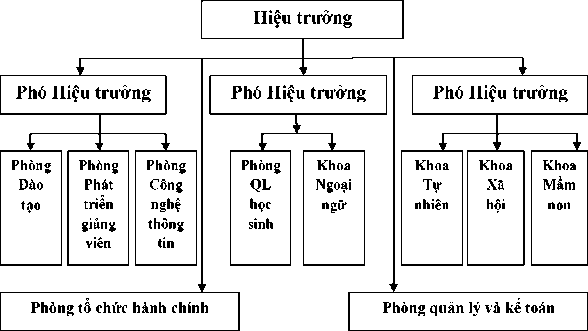
Figure 2.1. School organizational chart
2.1.3. About the school's teaching staff
Table 2.1. Statistics of lecturers in the past 5 years
Target
Year 2016 | Year 2017 | Year 2018 | Year 2019 | Year 2020 | ||
Total labor | ||||||
By gender | Male | 138 | 145 | 152 | 158 | 155 |
Female | 74 | 76 | 78 | 80 | 79 | |
By level | Level One | 0 | 0 | 0 | 0 | 0 |
Intermediate | 12 | 11 | 9 | 8 | 9 | |
College | 34 | 35 | 25 | 19 | 19 | |
University | 73 | 77 | 92 | 93 | 89 | |
Master | 19 | 22 | 26 | 38 | 38 | |
PhD | 0 | 0 | 0 | 0 | 0 | |
Maybe you are interested!
-
 Organizing Capacity Training to Develop School Education Programs According to the New General Education Program for Management and Teaching Staff
 -
 Current Status of Teaching Staff of Inspectorate Cadre School.
 -
 Basic Factors in the Subjective Factors of the Teaching Staff of Lao People's Army Academies
 -
 Teaching Method of Literature Subject Based on Student's Ability in Secondary School
 -
 Teaching Math in English in High School Based on Student Capacity Development Orientation
(Source: administrative organization)
Over the past 5 years, the number of lecturers at Khang Khay College of Education has fluctuated a lot, gradually increasing over the past 4 years (2016 - 2020). The 2018 - 2019 school year had the largest number of lecturers, 158 lecturers, and in the 2019 - 2020 school year, it decreased to 155 lecturers.
Table 2.2. About the educational level of the school's teaching staff
Department, affiliated group
Total number of lectures pill | Level | |||||||||||
PhD | Master | University | High class | Central grant | ||||||||
SL | Female | SL | Female | SL | Female | SL | Female | SL | Female | SL | Female | |
Nature | 39 | 16 | 0 | 0 | 16 | 7 | 23 | 9 | 0 | 0 | 0 | 0 |
Society | 37 | 19 | 0 | 0 | 13 | 8 | 16 | 7 | 8 | 4 | 0 | 0 |
Foreign language | 24 | 12 | 0 | 0 | 9 | 5 | 15 | 7 | 0 | 0 | 0 | 0 |
Primary and Kindergarten | 55 | 32 | 0 | 0 | 1 | 1 | 33 | 17 | 15 | 10 | 6 | 4 |
Total | 155 | 79 | 0 | 0 | 39 | 21 | 87 | 40 | 23 | 14 | 6 | 4 |
(Source: administrative organization)
The quality of the school's teaching staff in faculties and training fields such as the Faculty of Natural Sciences, the Faculty of Social Sciences, the Faculty of Foreign Languages no longer has lecturers at the intermediate level, the College level is 8/100 = 8.00%, the number with University, Master's, and Doctoral degrees is 92.00%. Thus, there are still a few lecturers who have not met the standards (Master's, Doctorate) is 8, reaching a rate of 8.00%.3%; there are 87 lecturers with University training level, the rate is 56.12%. In a part of English lecturers, NLCM is still limited, not meeting practical requirements. Based on the analysis of the data in the table above, we see that the training level of lecturers of the Faculty of Foreign Languages is uneven, needing further training and development.
2.2. Purpose, content and survey methods
2.2.1. Survey purpose
Investigation and survey to collect specific, accurate and complete information and data on training and management of NLCM training for English teachers in
Khang Khay College of Education, on that basis, proposes optimal management measures, suitable for practice and highly feasible.
2.2.2. Survey content
- Reality of English teachers' professional competence at Khang Khay Pedagogical College.
- Reality of training NLCM for English teachers at Khang Khay Pedagogical College.
- Reality of management of training NLCM for English teachers at Khang Khay Pedagogical College.
- The current status of factors affecting the management of professional development for English teachers at Khang Khay Pedagogical College.
2.2.3. Survey method and data processing method
2.2.3.1.Survey method
- Use a combination of research methods such as: Questionnaire surveys; interviews, observations, expert opinions...
- The questionnaires are designed in 2 forms (Appendix):
+ Appendix 1: Survey form for English teachers at Khang Khay Pedagogical College and surveyed schools.
+ Appendix 2: Survey form for managers at Khang Khay Pedagogical College and surveyed schools.
- Number of survey subjects: 85 people, including 35 managers and 25 English teachers of Khang Khay Pedagogical College; In addition, to have more objective information about the competence of English teachers of the School, we surveyed 25 English teachers of some high schools which are the recruitment facilities of the School's students and also the teacher internship facilities.
violations for students of the School (Khang Khay High School, Phoeavanh High School, Sybounhueang High School, Phonsavanh High School).
2.2.3.2. Criteria and assessment scale
The survey questions are designed with 03 options with the following evaluation scores: Often (Highly influential; Very suitable; Very difficult; Very necessary; Very feasible): 3 points; sometimes (Lowly influential; Suitable; Difficult; Necessary; Feasible): 2 points; not implemented (No influential; Not suitable; Not difficult; Not necessary; Not feasible): 1 point.
- Rating scale: Research results are selected in 2 ways: Calculating average score and calculating frequency (%).
- The tool to process data in the current research of this thesis is
Percentage calculation method by formula:

In there:
- a is the number of comments on each level of achievement of each criterion corresponding to each level that needs to be evaluated.
- b total number of ballots issued.
And the method of calculating the weighted average value is according to the formula:
n
fix i
n
X j =i 1
f
i 1i
In there:
- j is the criterion to be evaluated;
- x 1 , x 2 ,..., x n are the levels evaluated for a criterion to be evaluated (there are n levels evaluated, in this case n = 3);
- f 1 , f 2 ,...,f n is the number of comments on each level of achievement of
Each criterion corresponds to each level that needs to be evaluated ( x 1 , x 2 ,..., x n ); average.
Based on the average score, we assume:
+ If 1.00 ≤ X ≤ 1.67: Low rating;
+ If 1.68 ≤ X ≤ 2.34: Average rating level;
+ If 2.35 ≤ X ≤ 3: High rating.
- The average score is shown in the following table:
Table 2.3. Evaluation criteria and scale
X j is the value
Evaluation criteria
Rating Score | Midpoint vase ( X ) | |
Very important, regular, good, photo very beneficial, very necessary, very feasible. | 3 | From 2.35 - 3 |
Important, Sometimes, Achieve, Influence, Need necessary, feasible. | 2 | From 1.68 - 2.34 |
Not important, not done, not yet achieve, not use, not affect, not necessary, not feasible. | 1 | From 1 - 1.67 |
2.3. Results of the current situation survey
2.3.1. Current status of professional capacity development for English teachers at Khang Khay Pedagogical College
2.3.1.1. Current status of awareness of the importance of professional capacity development for English teachers at Khang Khay Pedagogical College To survey the awareness of the management staff and teachers about the importance of professional capacity development for English teachers at Khang Khay Pedagogical College.
of professional development for English teachers at school
Khang Khay College of Education, we used question number 1 of appendix number 1, 2, the results are shown in table 2.4.
Table 2.4. Perceptions of respondents on the importance of professional capacity building for English teachers at Khang Khay Pedagogical College
STT
Review content | Rating Level | Total point | Average value | ||||||
Very important | Important | Not important | |||||||
SL | % | SL | % | SL | % | ||||
1 | Help English teachers He improved his professional knowledge. | 85 | 100 | 0 | 0.00 | 0 | 0.00 | 255 | 3.00 |
2 | Help English teachers perfect their teaching skills subject | 71 | 83.53 | 14 | 16.47 | 0 | 0.00 | 241 | 2.84 |
3 | Help English teachers improve their ability to use teaching aids and equipment; apply information technology in teaching | 34 | 40.00 | 51 | 60.00 | 0 | 0.00 | 204 | 2.40 |
4 | Help English teachers innovate teaching methods; testing methods, and evaluating results student learning | 73 | 85.88 | 12 | 14.12 | 0 | 0.00 | 243 | 2.86 |
5 | Help English teachers develop their professional skills personal offense | 67 | 78.82 | 18 | 21.18 | 0 | 0.00 | 237 | 2.79 |
Average | 2.77 | ||||||||
Table 2.4 shows:
The survey subjects generally rated the importance of professional development for English teachers at a high level ( X = 2.77). Although the assessment scores for the contents in the table were slightly different, no content reached the average or low level. The assessment scores for the contents ranged from 2.40 to 3.
For example : "Help English teachers improve their professional knowledge ", average score X = 3.00, "Help English teachers perfect their subject teaching skills" , average score X = 2.84 , "Help English teachers improve their ability to use teaching aids and equipment; apply information technology in teaching" , average score X = 2.40 , "Help English teachers innovate teaching methods; methods of testing and evaluating students' learning outcomes" , average score X = 2.86, "Help English teachers develop their own pedagogical skills" , average score X = 2.79 .
Survey results show that: Most managers and teachers are clearly aware of the importance of
importance of training NLCM for English teachers. However, when interviewing directly with some other English teachers, there are still a few teachers who do not appreciate the importance of training. For example, teacher PM (Khang Khay Pedagogical College) said: "I find that sometimes the training is not very effective, not meeting my expectations when going for training. I want to learn more things like that"...
The above survey results are a practical basis for the School Principal to pay more attention to enhancing the training of professional competence for English teachers, especially paying more attention to the training methods to bring high efficiency.
2.3.1.2. Current status of English teachers' competence at Khang Khay Pedagogical College
To survey the current situation of English teachers at Khang Khay Pedagogical College, we used question number 2 (Appendix 1,2). The results are as follows: