
then seek special education facilities for intervention. However, when arriving at the intervention facilities, the child must be assessed again. Therefore, there needs to be consistency between these facilities to save time, resources and finances for both the facilities and the child's family [135].
Currently, DSM-IV and ICD-10 are the two main guidelines for doctors in diagnosing autism, in which DSM-IV is applied in diagnosing autism at the National Children's Hospital, but there has not been a national guideline or an official guideline issued by the Ministry of Health on the process and tools used for assessment [137]. Guidelines and regulations on official medical diagnosis and treatment methods play an important role in helping service providers rely on standard regulations to practice providing accurate and appropriate medical services in the context of extremely diverse medical services [132].
Each facility has a different assessment process and tools, and the application of assessment tools for screening and diagnosis is still not accurate. Currently, there are many diverse intervention services for children with developmental delays in general and autism in particular, but some services have not been proven through valid scientific evidence. For example, in the US, the US Food and Drug Administration (FDA) has issued a warning about some "treatment" measures for autism that have not been scientifically proven, and can even be harmful to autistic people such as the Chelation method (detoxification by injecting artificial EDTA into the bloodstream to remove heavy metals such as lead and mercury), hyperbaric oxygen therapy or clay baths for detoxification [110].
Without a standard set of rules, administrators have difficulty managing the services provided. Parents of children with autism may also have to use expensive services without knowing whether the services are effective or not. These standard procedures play an important role in improving the quality of services, changing the way services are delivered, and giving patients a better chance of recovery.
1.6.3. Theoretical framework
One of the current theoretical frameworks on access to health services is the Health Access Livelihood Framework developed by Obrist et al. [243]. This is a theoretical framework that includes all components related to the process of accessing health services. The five elements of service access in this theoretical framework include service availability, accessibility, affordability, adequacy and acceptability.
In addition, the highlight of this theoretical framework is that it not only focuses on service delivery factors, but also includes factors affecting access to health services, including service types (such as public health facilities, private health facilities, traditional medicine, etc.), health systems (such as policies and procedures) and resources (such as human, financial, social, etc.). These factors affect the process of accessing health services, with particular attention paid to the characteristics of service seekers. This theoretical framework has been applied to understand and improve access to health services in Africa [147].
Based on an overview of documents on access to health services, applying the Health Access Livelihood Framework of Obrist et al. (2007), a theoretical framework of barriers to access to autism diagnosis and intervention services was developed to address the objective: analyzing barriers in providing and accessing autism diagnosis and intervention services in the socio-cultural context in Vietnam. The theoretical framework is built on 2 aspects: 1) autism diagnosis and intervention services including 5 access factors (availability, accessibility, affordability, adequacy and acceptability of services); 2) individual, family, community and social factors.
RLPTK DIAGNOSIS AND INTERVENTION SERVICES
USE
SERVICE
Service Availability
Acceptability of service
Service accessibility
Completeness and suitability of services
Cost of service
SEARCH AND ACCESS SERVICES
INDIVIDUAL, FAMILY, COMMUNITY AND SOCIETY
Young parents personally RLPK - Awareness of RLPTK - Family economics, work - Sharing of life partner | Grandparents, paternal relatives foreign - Awareness of RLPTK - Support and sharing | Community and society - Awareness of RLPTK - Sympathy/Discrimination - RLPTK organizations |
Maybe you are interested!
-
 Epidemiology of autism spectrum disorder in children aged 18 - 30 months and barriers to accessing autism spectrum disorder diagnosis and intervention services in Vietnam, 2017 - 2019 - 2
 -
 Theoretical Research Method: Collecting Documents Related to the Thesis, Analyzing, Synthesizing to Build a Theoretical Framework
 -
 Improving the law on gender equality in the civil, marriage and family fields - Theoretical and practical issues - 1
 -
 General Theoretical Basis of Corporate Finance and Corporate Financial Analysis.
 -
 Theoretical Basis of Lending to Corporate Customers at Commercial Banks
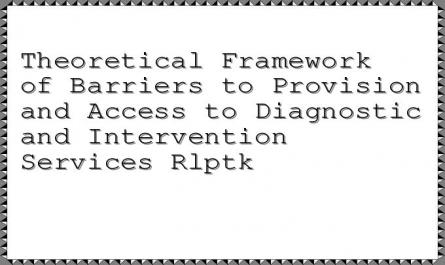
Diagram 1. 2. Theoretical framework of barriers to provision and access to diagnostic and intervention services for RLPTK
1.7. Introduction to the original topic - state-level topic "Research on epidemiological characteristics, diagnostic methods and early intervention for autism spectrum disorder in children in the community"
The state research project "Research on epidemiological characteristics, methods of diagnosis and early intervention of autism spectrum disorder in children in the community, Vietnam" jointly implemented by the University of Public Health, the National Children's Hospital, and the Faculty of Medicine and Pharmacy - National University, was approved by the Ministry of Science and Technology under contract No. 26/16 - DTĐL: CN - CNN dated September 30, 2016 between the Office of State-level key programs; Department of Science and Technology of economic and technical sectors and the University of Public Health.
The research outline clearly states: Autism spectrum disorder (ASD) full name is
"autism spectrum disorder" (ASD), however, for brevity, in the national topic, the term ASD is used instead of ASD.
Objective of the topic
1) Evaluation of epidemiological characteristics of RLTK in children in the community.
2) Develop a process for early diagnosis and intervention of RLTK in children in the community.
3) Building a model for managing RLTK in children in the community .
Main content of the study
(1) Content 1: Investigation of epidemiological characteristics of RLTK in children in the community
- Epidemiological investigation of autism spectrum disorder in children aged 18-30 months in 7 provinces/cities in Vietnam (based on the modified autism screening checklist in children M-CHAT).
- Analyze some demographic, economic, cultural and social factors related to the status of RLTK in children.
(2) Content 2: Building a process for early diagnosis of RLTK in children in the community
- Develop a draft process for early diagnosis of RLTK in children in the community
(3) Content 3: Building a process for early intervention for children with autism spectrum disorder in the community
- Develop a draft process for early intervention for RLTK in children in the community
(4) Content 4: Building a model for managing RLTK in children in the community
- Building a model for managing RLTK in children in the community (Organizational and management model)
management, monitoring, supervision) including implementation guidance documents for relevant individuals/units to deploy the model.
Research implementation agency
- Host: University of Public Health
- Project leader: Prof. Dr. Bui Thi Thu Ha - Principal
- In charge of research content 1: Epidemiological investigation of RLTK in children in 7 provinces/cities : Associate Professor, Dr. Hoang Van Minh - Vice Principal - University of Public Health.
- In charge of research content 2: Building a process for early diagnosis of RLTK in children in the community : Associate Professor, Dr. Pham Trung Kien - Head of Department - Faculty of Medicine and Pharmacy, National University.
- In charge of research content 3: Building an early intervention process for RLTK in children in the community
- Associate Professor, Dr. Le Thi Minh Huong - Deputy Director - National Children's Hospital.
- In charge of research content 4: Building a model for managing RLTK in children in the community : Associate Professor, Dr. Nguyen Thanh Huong - Vice Principal - University of Public Health
Research content 01 of the topic " Epidemiological investigation of RLTK in children in 7 provinces/cities " Project leader Prof. Dr. Bui Thi Thu Ha and content 1 leader Assoc. Prof. Dr. Hoang Van Minh assigned PhD student Le Thi Vui from the University of Public Health to directly carry out research content 01 for the doctoral thesis (see Appendix No. 11).
CHAPTER 2: RESEARCH METHODOLOGY
2.1. Research subjects
Quantitative research
Children aged 18 - 30 months living in the study area during the data collection period.
Parent or primary caregiver of a child 18 - 30 months old.
- Selection criteria: Children aged 18 - 30 months living in the study area. The child's parent or primary caregiver currently lives with the child on a daily basis and is able to answer the interview.
- Exclusion criteria: Children aged 18 - 30 months were absent from the study area at the time of data collection.
Qualitative research
- Parents or grandparents of children with autism who have used autism diagnosis and/or intervention services, living in Thai Binh province or Hanoi city at the time of data collection.
- Medical/educational staff providing autism diagnosis and intervention services in Thai Binh province or Hanoi city.
2.2. Time and place of research
- Research period: January 2017 – September 2019
- Quantitative research location: In 01 big city and 6 provinces representing 6 ecological regions in Vietnam (Hanoi, Thai Binh, Hoa Binh, Quang Nam, Dong Thap, Dong Nai, Dak Lak).
- Qualitative research location: In 2 provinces/cities representing two urban (Hanoi) and rural (Thai Binh) areas.
2.3. Research design
The research design combines quantitative and qualitative research methods.
Quantitative research : Applying a cross-sectional research design with analysis. Direct interviews with parents or primary caregivers based on the M-CHAT childhood autism screening checklist and a questionnaire investigating autism risk factors. Children will then be diagnosed with autism using DSM-IV, determine the level of autism using CARS and evaluate development using the Denver test.
Qualitative research: Applying phenomenological research design. In-depth interviews with target subjects to explore barriers in accessing autism diagnosis and intervention services.
2.4. Sample size
Quantitative research sample
The study sample size (number of children aged 18 - 30 months selected for the study) was calculated using the World Health Organization formula for estimating a proportion in the population.
In which: n = sample size in each province/city or region α = 0.05 (95% confidence level)
Z (1-α/2)= 1.96
ε: relative accuracy = 40%
p = estimated prevalence of autism (4.6‰) [3]
The estimated sample size from the above formula is n = 5160 children/province. The estimated rate of refusal to participate in the study and inaccessibility is about 15%. The total sample size required for a province is 5934 children/province, rounded to 6,000 children/province. This study was conducted in 01 large city and 6 ecological regions (1 province/ecological region), so the total number of screening samples is about 42,000 children aged 18-30 months, equivalent to 42,000 parents or primary caregivers. The study conducted an epidemiological survey and screened 40,243 children and their parents in 7 provinces/cities.
Qualitative research sample (In-depth interviews ): we conduct qualitative research until the collected information is saturated, sampling according to table 2.1
Table 2.1. Subjects and samples of qualitative research
Object
Selection method | Quantity | ||
Do health/educational staff provide diagnostic and intervention services for ASD? | National Children's Hospital; Rehabilitation Department - Thai Nguyen Children's Hospital Jar | Select purpose: 2 people/unit *2 units | 04 people |
Private center for diagnosis and treatment autism card | Select purpose: 2 people/unit *2 units | 04 people | |
Parents with children with autism | Select the target based on the parents' club of autistic children in each province to reach the target audience who are willing to participate and able to provide a lot of information: 8 people/unit *2 unit | 16 people | |
You have a grandchild with autism | Select the target based on the parents' club of autistic children in each province to reach the target audience who are willing to participate and able to provide a lot of information: 2 people/unit * 2 unit | 04 people | |
Total | 28 people | ||
2.5. Sampling method
Select quantitative research sample
The study was conducted in 01 major city and 06 ecological regions in Vietnam. The sampling process was carried out in 3 steps as shown in the following diagram.