
3. Japanese consumer trends [51]
3.1. Basic trends in Japanese society
3.1.1. Falling birth rate and aging population
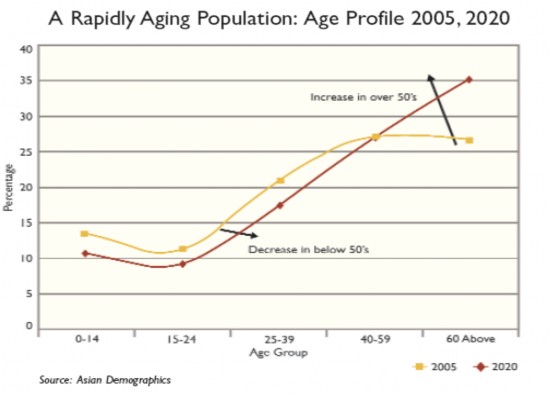
Japan is a country with the world's oldest population and this trend is increasingly becoming a social issue for Japan. Currently, 1/5 of Japanese people are over 65 years old and the proportion of this age group is expected to exceed 35% by 2020 (as shown in the chart below). Along with the aging population is a low birth rate (in 2007 this figure was 7.78% 0 ) and a decreasing population (in 2007 Japan's population growth rate was -0.139%). This trend has greatly affected all aspects of Japanese life from the economy, society to consumption.
Figure 6: Japan's population projections for 2020
Maybe you are interested!
-

 Procedures for Trial of Cases Involving Minor Defendants
 -
 Situation of Information Technology Application in Enterprises
 -
 Summary of Information on the Subject's Capacity and Training Level
 -
 The Impact of Accounting Information System Quality on Operational Performance
 -
 Standards on Competency of Information Officers in Vietnam in the New Era
51 Refer to information from:
1. Insights, Women consumer market in Japan – the super aging society , MasterCard International, 3rd quarter
2005
www.masterintelligence.com/upload/181/116/China_Affluent-Lifestyles-S.pdf
2. Trends among Japanese consumers and promising targets, http://www.hawaiitourismauthority.org/pdf/Japan%20Cnsmr%20Trends.pdf
3. http://www.kilian-nakamura.com/blog-english/index.php/trendspotting-coolhunting-tokyo-japan/
3.1.2. The spread of lifestyles associated with information technology
Information technology has changed the way of life of the Japanese people. The ratio of Internet users to the total population in Japan reached 70% in 2004, up to 77.3% in 2006 and this number continues to increase. New communication and consumption styles are increasingly widespread with the spread of the Internet, the blogosphere and mobile phones. Nowadays, Japanese people not only use mobile phones for communication purposes but also use them mainly for accessing the Internet (Websites such as Youtube or Nico Nico Douga are attracting a large number of viewers although these sites are still full of illegal copies of TV shows or music rather than original content created by Japanese users), blogs are used not only as a form of personal diary but also as a place for bloggers to exchange information about product usage. Websites have also become an indispensable part for Japanese companies to provide information or provide services to customers as an online shopping channel. Cryptocurrency is also a modern payment method that is being applied with the number of customers using cryptocurrency to date being more than 15 million people, cryptocurrency is likely to become a consumer trend in the future.
3.1.3. The development of hedonistic lifestyle and individualism
Talking about hedonistic lifestyle and individualism here is not for the purpose of criticism, but the author wants to mention a trend in Japanese society. The proportion of elderly people in Japanese society is one of the reasons leading to this trend. Elderly consumers are those with very high incomes in Japanese society (from many different sources such as pensions, savings, inheritance, etc.) and use them for the purpose of enjoying life such as shopping or traveling. Besides, there is an increasing number of single people in Japanese society, single life has changed the traditional family values in Japan, thereby leading to changes in consumption. Hedonism also appears among young Japanese people, who are not married and often follow new trends.
3.2. Consumption trends of Japanese consumers
3.2.1. The growth of individual consumerism and the trend of shifting from demand to
functional demand for products to sensory demand
Traditional marketing always emphasizes the consumer’s situation, i.e. wife, husband, children, etc., for example, “use our products and you will give your children the best!” but today that slogan must change to “I am important and I deserve it” because personal consumption is legitimate and this trend is growing strongly in Japan. Japanese consumers now buy because they like the product and they buy for themselves.
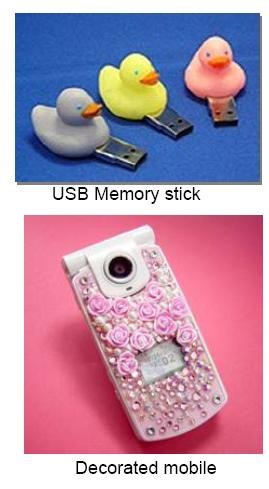
Although Japanese consumers do not ignore the function of the product, they have begun to pay special attention to the feeling that the product brings. Now they not only require good quality products but also require them to bring a comfortable feeling to the user. The following two products are an example (picture). Japanese consumers today do not rely on a certain standard to evaluate products but they rely on their own standards of value and have their own tastes in products. Due to the increasingly high living standards, Japanese people do not only pay for the product because it is necessary for their needs but also because it suits their lifestyle and affirms the consumer's self-worth. For Japanese people now, "style" is
My lifestyle – My taste. Therefore, they will value the feel of the material, shape and color of the product more.
3.2.2. Trend of consumption in an environmentally friendly style
Japanese people are highly conscious of the living environment and increasingly favor environmentally friendly products. Nowadays, Japanese consumers consume products to serve the “LOHAS” life, which means “Lifestyles Of Health And Sustainability” . Therefore, “green” products are a popular trend in Japan. The idea of carrying “personal chopsticks” with you to avoid using disposable chopsticks has begun to appear. Stores in Japan also encourage customers to bring their own bags to carry when shopping or sell items with bags made of easily degradable, recyclable materials called “eco-bags” and limit the use of nylon and plastic bags.
3.2.3. The trend of seeking harmony in consumption
More and more Japanese consumers are looking for a balance between price and product quality. In addition to “branded” products like Louis Vuitton, Japanese consumers have also begun to pay attention to “second hand” products, especially young Japanese and single people. A large room with a sofa, a small table, a TV, a wooden floor, walls combining red and yellow, etc., but nothing is “brand new” or completely new. This is also a consumer trend among young Japanese people today. They are less interested in brands than the previous generation, but look for products that satisfy their preferences and can decorate the product themselves. Products and customer service are also two factors that need to be harmoniously combined when wanting to sell to Japanese customers. Shopping channels are increasingly rich and diverse, so Japanese consumers today value “where to go to buy and how to buy” more than the issue of “what to buy”. Therefore, the service attitude of the salesperson is also an important factor in attracting Japanese consumers. Japanese consumers want to communicate with salespeople who gain their trust and if they are satisfied, the possibility of selling the goods is very high.
3.2.4.Consumption trends of functional products
Simply put, “functional products” are products that are beneficial to health and this is also a very popular product in Japan because Japanese people are very concerned about their health. That is also one of the reasons why they have very high requirements for product quality, especially food. Along with
With the aging population, the trend of consuming functional products is also growing in Japan. Japanese children are very well cared for, so these products are also one of the indispensable foods in a family with children. Therefore, products such as vegetables, cereal powder, ... and other products rich in calcium, low in fat and low in cholesterol are very popular in Japan. Currently, vegetable juice is a new consumption trend in Japan. Vegetable juice is both good for health and suitable for the busy life of Japanese people, so this will be a great opportunity for Vietnamese businesses if they can take advantage of this trend.
II. SOME SOLUTIONS TO PROMOTE THE EXPORT OF VIETNAMESE GOODS TO THE JAPANESE MARKET
1. Macro solutions [52]
According to the analysis, consumer behavior has a great influence on the operations of enterprises, creating invisible barriers that enterprises have to face when exporting their goods beyond national borders. The State can only play a supporting role for enterprises to create a favorable environment to help enterprises fully develop their potential, proactively research consumer behavior in international markets, thereby building effective business strategies to penetrate these markets. It can be said that the role of the State is like a lubricant for the operating machinery of enterprises, helping their business operations run more smoothly.
1.1. Organize research and collect information about the Japanese market
As mentioned, although consumer behavior is not new to foreign enterprises, it is still strange to Vietnamese enterprises and has not received due attention. Therefore, the Government and ministries and sectors play an important role in raising awareness of Vietnamese enterprises about consumer culture in general and the importance of researching consumer behavior in particular. Specifically, the Ministry of Trade or the Vietnam Chamber of Commerce and Industry can organize
52 Refer to the following documents:
1. MSc. Do Cuong Thanh - Hai Phong Department of Trade, Achievements and limitations in Vietnam's exports - Recommendations on key solutions to implement export strategies in the process of international economic integration , Journal of Economic and Social Information and Forecast, No. 9/2006
2. Nguyen Thi Nhieu (2004), Main solutions to develop the export of agricultural, aquatic and handicraft products to the Japanese market, Trade Research Institute, Ministry of Trade.
Seminars on the topic of consumer behavior research in different markets, with a special focus on the Japanese market because it is a demanding market with high demands for products and services. In these seminars, businesses can exchange practical experiences, successes or failures related to consumer behavior when entering a new market.
Second, the Vietnamese Trade Office in Japan needs to actively research and collect information about the Japanese market, especially the behavior of Japanese consumers. The Trade Office located in Japan should have the opportunity to have daily contact with consumer activities in Japan. Therefore, it can regularly update changes in values, attitudes, lifestyles, habits, and consumer tastes of the Japanese. In addition, the Trade Office needs to regularly approach business partners, focusing on industry associations, chambers of commerce, and some corporations that have many business relationships with Vietnam to learn about and grasp market demand. Based on the information collected, the Trade Office promptly reports to the Ministry of Trade to provide information to Vietnamese enterprises when they want to penetrate the Japanese market.
Third, research institutes such as the Institute of World Economics need to conduct research on consumer behavior in general and Japanese consumers in particular. Such research will have practical effects in helping businesses orient their business strategies when entering new markets. In addition, academies and universities should organize in-depth courses on consumer behavior, consumer culture, etc.
1.2. Promote the State's export promotion activities for the Japanese market
According to economic experts, up to now, the success of Vietnamese enterprises has mainly been due to factors such as cheap labor costs, financial support from the Government... but now these advantages are gradually disappearing. Specifically, according to the market research company TNS - Vietnam, Vietnam's labor costs have increased by about 20% from 2003 to 2005 and will continue to increase, especially when Vietnam has joined the WTO, implementing the roadmap of commitments to open up industries and services. At the same time, with increasing labor costs, the Government's financial support must also gradually be reduced according to international commitments. Therefore, the State needs to create new competitiveness for enterprises.
businesses through trade promotion activities, especially export promotion activities for the Japanese market. Specifically:
Regarding the organization of information channels on the Japanese market to serve businesses, the Ministry of Trade can introduce the Japanese market and Japanese importers of Vietnam's key export products through its website. Industry associations such as the Vietnam Fisheries Association, the Vietnam Textile and Apparel Association, etc. also need to publish specific and updated information on the Japanese market in particular and the industry's export markets in general to support businesses in finding information. Currently, the websites of the Associations have provided information on export markets, but the information is often general and outdated (for example, the information posted by the Vietnam Textile and Apparel Association was from 2003). In addition, the Vietnam Trade Promotion Agency also needs to closely coordinate and make the most of the support from the Japanese Embassy, JETRO Japan, etc. to support Vietnamese enterprises in finding information about Japan, Japanese importers, and potential Vietnamese export products to Japan.
Regarding participation in fairs and exhibitions in Japan, the Trade Promotion Agency needs to publish a list of annual fairs and exhibitions held in Japan, and at the same time guide businesses to register to participate and may propose partial financial support for businesses participating in Japanese fairs. The State also needs to research and deploy a number of Vietnamese Trade Centers in Japan as places to display, introduce and sell Vietnamese products to Japanese people. These Centers will be under the direct management of the Vietnamese Trade Office in Japan. Initially, the Trade Office may send staff on secondment to work at the Center. These staff will be responsible for guiding and training business representatives on how to display and introduce products, or introducing and recruiting Japanese workers to work at the centers for businesses, etc. In fact, a form of Vietnamese Trade Center was born, the "Vietnam House" in Tokyo in 2002, with the help of the Vietnamese Embassy in Japan.
"Vietnam House" in Tokyo has a dedicated area to introduce Vietnamese products, an area to introduce Vietnamese tourism and especially there is an area
culinary area for visitors. Although still limited in the number of displayed items, mainly focusing on some types of products related to lacquerware, handicrafts, tourism... - items that can be said to be causing a "fever" for young Japanese people today, has been quite successful in the role of trade promoter. Mr. Seiji, director of a handicraft business in Shizuoka province (Japan), during his visit to Vietnam to pick up goods in early August 2003, recounted: "Last year, by chance, while eating with a friend in Ebisu street, Tokyo, when we stopped by the Vietnam house, we were quite surprised to learn that there were not only Vietnamese dishes but also goods from Vietnam. Especially, there were zakka (handicrafts) made from brocade, the type of goods I was looking for. Here, they not only provided us with the addresses, phone numbers, fax numbers... of the production facilities but also showed us how to do business with Vietnamese people... Immediately after that, I decided to go to Vietnam, find this facility in Thu Duc and now they have officially become the supplier of this handicraft for our company". [53] Thus, the establishment of Centers such as "Vietnam House" has actively contributed to promoting the image of Vietnam to the Japanese people, while also helping to bring Vietnamese goods into this market.
The State can also support businesses by supporting the implementation of programs to promote product design for export to Japan, especially for handicraft products. For example, the Design Inspection Program to limit design theft and copyright infringement; the Vietnam Export Design Exhibition Program to Japan; programs to promote the export of beautiful Vietnamese goods, etc. State support can include support for training artisans, product designers, organizing competitions to select unique products for export, etc.
1.3. Orientation for developing export products to Japan
Based on the information collected, the State identifies Vietnamese products with competitive advantages and suitable for Japanese consumers' consumption behavior to orient and encourage Vietnamese enterprises to export to the Japanese market. In fact, the State has approved Vietnam's import-export strategy.
53 http://www.vysa.jp/modules.php?op=modload&name=News&file=article&sid=478&mode=thread&order=0&thold=0