
1, Article 124 "Forms of civil transactions" have data messages as valuable as documents: "Civil transactions via electronic means in the form of data messages are considered written transactions." ."
In addition to regulations on civil transactions, property and forms of ownership, the Civil Code devotes an important content to civil contracts. Civil contract regulations are the foundation for contract law in general, including commercial contracts.
The Civil Code provides specific regulations on cases of entering into, modifying, performing, and canceling contracts. Accordingly, the time of contract conclusion is the time the offeror receives a reply accepting the contract. For written contracts, the time of conclusion is the time the last party signs the document. The place for entering into a civil contract is agreed upon by the parties. If there is no agreement, the place for entering into a civil contract is the residence of the individual or the headquarters of the legal entity that has proposed to enter into the contract. . These are important concepts to take into account when developing legal documents related to entering into contracts in the electronic environment.
* Customs Law
The Customs Law (amended) was passed by the National Assembly on June 14, 2005 and took effect from January 1, 2006. Compared to the 2001 Customs Law, this law adds a number of regulations paving the way for the application of electronic customs (electronic customs declaration order, declaration location, electronic customs records). Article 39 regulates customs procedures for goods imported and exported by e-commerce.
The Customs Law is a legal document that makes a positive contribution to the implementation of e-government and e-commerce in the current period.
* Intellectual Property Law
Passed by the 11th National Assembly, 8th session, on November 29, 2005 and effective on July 1, 2006, the Intellectual Property Law represents a step forward in perfecting the system of legal documents. law protecting intellectual property rights.
The Intellectual Property Law has a number of provisions related to e-commerce, for example regulations on acts considered to infringe copyright and related rights.
in the electronic environment: intentionally canceling or invalidating technical measures implemented by copyright and related rights owners to protect their rights; intentionally deleting or changing rights management information in electronic form contained in the work; remove or change rights management information in electronic form without the permission of the relevant rights owner. Although there are no specific regulations related to the field of e-commerce, the principles in the Intellectual Property Law can apply to this new environment. For example, the act of illegally using a trademark on the Internet is still considered a violation of the owner's exclusive rights to the trademark like a violation in a traditional environment.
However, with the rapid development of e-commerce in Vietnam in the near future, along with the difference in the nature of intellectual property objects in the electronic environment, for example: copies ( works protected under copyright law) in the electronic environment have no difference from the original, the use of meta tags is another person's trademark...) may cause the application Laws of judicial agencies will face difficulties. Therefore, in the coming time, the promulgation of a number of legal documents regulating intellectual property relations in e-commerce is essential to create transparency and promote the development of commerce. electronics.
* Information Technology Law
Article 23 "Establishment of websites" stipulates that organizations and individuals have the right to establish websites and must register with competent state agencies. While a similar regulation previously issued by the Ministry of Culture and Information has not been lifted, this regulation (even though it is only "registration" and not "permission") is still an annoying procedure. worthy and difficult to apply in practice, especially when the need to set up websites for business activities is increasing.
In particular, the Law on Information Technology devotes an entire section on e-commerce, including Articles 32 to 40, including regulations on the rights and responsibilities of organizations and individuals providing information and products. products and services in the network environment (Article 34), sales websites (Article 35), responsibility for providing information to customers.
entering into contracts in the internet environment (Article 36), placing orders in the internet environment (Article 37), advertising in the internet environment (Article 39).
The above regulations have content directly referring to e-commerce activities, but are still incomplete because they cannot cover all issues of e-commerce while there are contents related to the scope of e-commerce. regulation of other legal documents, for example on advertising, payment, or personal information protection (Article 17). Regarding this issue, at a number of meetings and seminars, representatives of the Ministry of Trade as well as a number of other agencies said that the Information Technology Law should not regulate in too much detail each application field such as e-commerce. suicide, remote medical treatment, and online training, but only general regulations should be introduced to encourage the development of these activities.
* Other legal documents
+ Decree on e-commerce
+ Decree on digital signatures and electronic authentication
+ Documents on electronic payments
+ Decree 101/2001/ND-CP dated June 31, 2001 detailing a number of articles of the Customs Law
6. 2.2. Situation of information technology application in businesses
* Internet connection
In a survey of more than 500 businesses across Vietnam by the Ministry of Commerce, 89% of businesses surveyed said they had an Internet connection. Among businesses connected to the Internet, the rate of broadband service usage continues to increase (99% compared to 66% in 2004). In particular, the proportion of businesses accessing the Internet using ADSL accounts for over 92%, a significant increase compared to 54% in 2004, showing that the development of ADSL services continues to be one of the driving forces promoting the application of ADSL services. Using the Internet in business. With costs decreasing and quality improving, ADSL is being chosen more and more as an effective method to serve the information and transaction needs of businesses.
However, there still exist a number of factors that hinder the deployment of Internet applications in businesses such as technology issues, costs, transmission line quality, safety and security...
* IT investment
The results of an overview of the IT application situation in businesses show that the proportion of IT investment in total annual operating costs is still relatively low: 70% of surveyed companies spend less than 5% on IT investment. IT application deployment, including telecommunications costs, software investment, system maintenance, and IT application training. Only about 6% of companies said they are spending more than 15% of annual operating costs to invest in IT, but this number has not increased compared to 2004. Results of interviews with businesses show a trend In the next 1-2 years, there will be no change, most businesses choose to allocate about 5% of their regular operating costs to IT application investment.
Analyzing more deeply the IT investment structure in the surveyed businesses, it can be seen that the situation has not improved much compared to 2003 and 2004. Investment in hardware still accounts for an overwhelming proportion of total investment. Enterprise IT, on average, reaches approximately 77%, compared to 23% for software and 12.4% for training. Compared with the world, this investment structure heavy on hardware and light on software still has many unreasonable points, requiring a change in management thinking as well as awareness of business IT applications. .
Table 1.4. Structure of IT investment in enterprises
Investment item
Average density army | Minimum | Max | |
Hardware | 76.8% | 25% | 100% |
Software | 22.9% | 0% | 65% |
Train | 12.4% | 0% | 20% |
Maybe you are interested!
-
 Solutions to promote the application of information technology in the tax industry in Vietnam - 30
 -
 Strengthening the application of information technology to improve the competitiveness of small and medium enterprises in Vietnam - 1
 -
 Application of Information Technology in Database Construction
 -
 Application of Information Technology in Teaching at Secondary Schools
 -
 Assessment of the Current Status of IT Application Investment Project Management at the Department of Information Technology and Customs Statistics
Source: Vietnam e-commerce report, Ministry of Industry and Trade Looking at the survey results, one of the reasons explaining the
The low investment ratio in software means that businesses are not really interested in developing it
Deploy specialized applications to serve production and business activities in your unit. Survey results show that the amount of operational software being used by businesses is still very limited. The most popular today is accounting software, with nearly 80% of businesses surveyed saying they have deployed the application at different levels. Human resource management, goods management and customer management software, although initially receiving attention from businesses (over 20% of surveyed businesses said they were researching and implementing it), Specialized software accounts for a small amount.
Table 1.5. Rate of use of operational software
Dispatch Management
Human Resources Management | Finance Accounting | Commodity Management | Guest Management row | Establishment software Plan | Other | |
17.1% | 25.8% | 78.9% | 26.4% | 21.8% | 10.5% | 13.1% |
Source: Vietnam e-commerce report, Ministry of Industry and Trade This investigation result is also consistent with Vietnam's current reality. Part
Accounting software is currently the leading type of operational software that software service and IT solution companies deploy, research, commercialize and put into business effectively. Some companies specializing in accounting software such as MISA, FAST, Bravo,... have established a solid foothold in the market, built a network of regular partners and have stable revenue. Many businesses have begun to expand research to build comprehensive suites of enterprise management (ERP) solutions. From the supply side, the demand development prospects can be relatively positive. In the next 1-2 years, when the benefits of operational software for management problems have been clearly recognized by businesses, when business management software becomes more popular and more suitable for current conditions. In Vietnam, more and more businesses will choose to deploy professional software products from official sources. Investment in software will therefore increase, more in line with the general level of the world.
* Developing human resources for IT and e-commerce
Although the general level of investment in IT training by businesses in 2005 has not changed much (the average proportion of training in total IT investment in 2005 was 12.4%, compared to 12.3% of IT training in 2005). % of 2004), but business awareness of this issue has made significant progress. In 2004, nearly 30% of businesses surveyed said they did not apply any form of IT training for their staff. This year this number has dropped to 20%. Although the training method is still not really professional (nearly 60% of businesses surveyed choose on-site training, meaning employees learn and guide each other when problems arise at work). , but the proportion of businesses that methodically combine different training methods has also increased compared to 2004. Compared to 30% of businesses sending employees to participate in short-term IT training courses in 2004, the figure of 40% in 2005 shows an encouraging sign of the development of IT training needs in businesses.
6. 2.3. The situation of e-commerce applications in businesses
E-commerce has appeared in Vietnam for about 10 years since the internet was deployed in 1997. However, e-commerce applications have only become really popular in the past 4 years. since the electronic transaction law was promulgated in December 2005 and took effect in March 2006. The promulgation of the Electronic Transactions Law is considered a turning point for the development of e-commerce in our country. This shows that the Vietnamese government has truly seen the role of e-commerce in economic and social development. In addition to promulgating the law, the government also launched the "Master plan for e-commerce development for the period 2006-2010". The goals of the plan are:
- 60% of large-scale enterprises conduct business-to-business (B2B) e-commerce transactions;
- 80% of small and medium enterprises know the benefits of e-commerce and conduct business-to-consumer (B2C) or business-to-business (B2B) e-commerce transactions;
- 10% of households conduct business-to-consumer (B2C) or consumer-to-consumer (C2C) e-commerce transactions;
- Government procurement bids are published on the websites of government agencies and e-commerce transaction applications in government procurement (B2G).
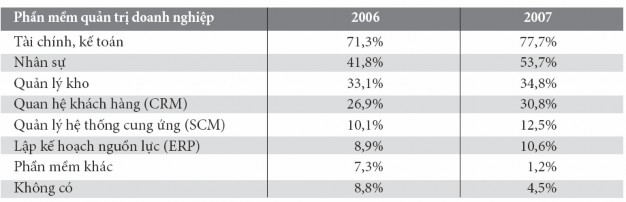
After 4 years of promulgating the law as well as the master plan for e-commerce development, in our country e-commerce has been applied in many fields such as manufacturing; buying and selling goods and services; financial and banking services; transportation services; travel services; public services and in the field of training on a large scale across the country. In the manufacturing and service sectors, businesses have deployed e-commerce software into business management such as: accounting management software, enterprise resource management software, management software. supply source, customer database management software.
Table 1.6. Situation of software application in businesses
Source: Vietnam e-commerce report, Ministry of Industry and Trade
Looking at the table above, we see that the application of e-commerce software in businesses increases year by year, each year more than the previous year. Vinamilk Company is one of the few businesses that has deployed a SAP CRM customer relationship management system and Oracle supply management system. The deployment of these applications has helped the company's management board have accurate and online information about business activities nationwide. In addition, these software also help company employees improve their capacity, professionalism and ability to grasp the best market information. In addition, these software also help the company manage price and promotion policies throughout the distribution system.
In the field of online shopping, the number of trading floors, or virtual markets, is increasing rapidly. According to research by the Department of E-commerce and Information Technology - Ministry of Industry and Trade, by the end of 2007, the number of B2B e-commerce floors in our country was 40 floors, B2C floors were 100 floors. C2C e-commerce platform is also growing rapidly. The pace of development of C2C e-commerce platforms in 2006-2007 was slower than in 2003-2004. However, the quality of C2C exchanges has improved greatly. The number of B2B e-commerce platforms is less than B2C, but the revenue growth rate from B2B trading platforms is higher. Participating in e-commerce trading floors has helped businesses sign more contracts. In 2008, among businesses participating in e-commerce platforms, 69.7% of businesses signed contracts from e-commerce platforms, higher than the rate of 63% in 2007. Revenue B2B e-commerce activities account for 67% of total revenue from e-commerce activities, C2C accounts for 33%. Looking at the structure of goods and services introduced on business websites, it can be seen that the most popular groups of goods today are still electronic - telecommunications equipment, tourism services and consumer goods. 2008 is considered a hot year of development for retail activities of electronics and telecommunications products, reflected in the fact that electronics and telecommunications supermarkets are springing up like mushrooms. Following the development trend of the electronics and telecommunications industry, the number of websites selling this item also increased sharply in 2008. This is a new shopping channel for consumers besides traditional shopping channels. In 2006, the number of websites selling electronic and telecommunications products accounted for only 13.4% of the total number of e-commerce websites; In 2007 it was 12.6% but by 2008 this number was 17.4%.
In the field of financial services and banking, our country has deployed electronic banking and electronic securities activities. Utilities that consumers benefit from e-banking activities include querying account information, banking information, printing statements, transferring money within and outside the system, and paying bills. Consumers can access electronic banking services via the internet (internet banking) or mobile network (SMSbanking). In the field of electronic securities, consumers can