
1.2.3.1 Traditional information resources
● By type
The Center's traditional document sources, divided by type, include books, newspapers, reference books, reference materials, textbooks, teaching materials, domestic and foreign newspapers and magazines, etc. Currently, the Center's total document capital has 14,838 document titles, including 9,059 book titles, 51,848 copies; 114 newspaper and magazine titles with 10,000 copies; and endogenous documents with over 5,500 specific titles:
STT
Document format | Document name | Documentation | |||
SL (Name) | Rate (%) | SL (version) | Rate (%) | ||
1 | Course | 724 | 4.88 | 6,944 | 9.83 |
2 | Reference books | 8,335 | 56.17 | 44,904 | 63.58 |
5 | Reference documents | 155 | 1.04 | 200 | 0.28 |
4 | Internal documents | 5.510 | 37.13 | 5,557 | 7.87 |
3 | Newspapers, magazines | 114 | 0.78 | 10,000 | 14.16 |
Total | 14,838 | 100 | 67,605 | 100 | |
Maybe you are interested!
-
 Solutions for tourism development in Tien Lang - 10
zt2i3t4l5ee
zt2a3gstourism, tourism development
zt2a3ge
zc2o3n4t5e6n7ts
- District People's Committees and authorities of communes with tourist attractions should support, promote, and provide necessary information to people, helping them improve their knowledge about tourism. Raise tourism awareness for local people.
*
* *
Due to limited knowledge and research time, the thesis inevitably has shortcomings. Therefore, I look forward to receiving guidance from teachers, experts as well as your comments to make the thesis more complete.
Chapter III Conclusion
Through the issues presented in Chapter II, we can come to some conclusions:
Based on the strengths of available tourism resources, the types of tourism in Tien Lang that need to be promoted in the coming time are sightseeing and resort tourism, discovery tourism, weekend tourism. To improve the quality and diversify tourism products, Tien Lang district needs to combine with local cultural tourism resources, at the same time combine with surrounding areas, build rich tourism products. The strengths of Tien Lang tourism are eco-tourism and cultural tourism, so developing Tien Lang tourism must always go hand in hand with restoring and preserving types of cultural tourism resources. Some necessary measures to support and improve the efficiency of exploiting tourism resources in Tien Lang are: strengthening the construction of technical facilities and labor force serving tourism, actively promoting and advertising tourism, and expanding forms of capital mobilization for tourism development.
CONCLUDE
I Conclusion
1. Based on the results achieved within the framework of the thesis's needs, some basic conclusions can be drawn as follows:
Tien Lang is a locality with great potential for tourism development. The relatively abundant cultural tourism resources and ecological tourism resources have great appeal to tourists. Based on this potential, Tien Lang can build a unique tourism industry that is competitive enough with other localities within Hai Phong city and neighboring areas.
In recent years, the exploitation of the advantages of resources to develop tourism and build tourist routes in Tien Lang has not been commensurate with the available potential. In terms of quantity, many resource objects have not been brought into the purpose of tourism development. In terms of time, the regular service time has not been extended to attract more visitors. Infrastructure and technical facilities are still weak. The labor force is still thin and weak in terms of expertise. Tourism programs and routes have not been organized properly, the exploitation content is still monotonous, so it has not attracted many visitors. Although resources have not been mobilized much for tourism development, they are facing the risk of destruction and degradation.
2. Based on the results of investigation, analysis, synthesis, evaluation and selective absorption of research results of related topics, the thesis has proposed a number of necessary solutions to improve the efficiency of exploiting tourism resources in Tien Lang such as: promoting the restoration and conservation of tourism resources, focusing on investment and key exploitation of ecotourism resources, strengthening the construction of infrastructure and tourism workforce. Expanding forms of capital mobilization. In addition, the thesis has built a number of tourist routes of Hai Phong in which Tien Lang tourism resources play an important role.
Exploiting Tien Lang tourism resources for tourism development is currently facing many difficulties. The above measures, if applied synchronously, will likely bring new prospects for the local tourism industry, contributing to making Tien Lang tourism an important economic sector in the district's economic structure.
REFERENCES
1. Nhuan Ha, Trinh Minh Hien, Tran Phuong, Hai Phong - Historical and cultural relics, Hai Phong Publishing House, 1993
2. Hai Phong City History Council, Hai Phong Gazetteer, Hai Phong Publishing House, 1990.
3. Hai Phong City History Council, History of Tien Lang District Party Committee, Hai Phong Publishing House, 1990.
4. Hai Phong City History Council, University of Social Sciences and Humanities, VNU, Hai Phong Place Names Encyclopedia, Hai Phong Publishing House. 2001.
5. Law on Cultural Heritage and documents guiding its implementation, National Political Publishing House, Hanoi, 2003.
6. Tran Duc Thanh, Lecture on Tourism Geography, Faculty of Tourism, University of Social Sciences and Humanities, VNU, 2006
7. Hai Phong Center for Social Sciences and Humanities, Some typical cultural heritages of Hai Phong, Hai Phong Publishing House, 2001
8. Nguyen Ngoc Thao (editor-in-chief, Tourism Geography, Hai Phong Publishing House, two volumes (2001-2002)
9. Nguyen Minh Tue and group of authors, Hai Phong Tourism Geography, Ho Chi Minh City Publishing House, 1997.
10. Nguyen Thanh Son, Hai Phong Tourism Territory Organization, Associate Doctoral Thesis in Geological Geography, Hanoi, 1996.
11. Decision No. 2033/QD – UB on detailed planning of Tien Lang town, Hai Phong city until 2020.
12. Department of Culture, Information, Hai Phong Museum, Hai Phong relics
- National ranked scenic spot, Hai Phong Publishing House, 2005. 13. Tien Lang District People's Committee, Economic Development Planning -
Culture - Society of Tien Lang district to 2010.
14.Website www.HaiPhong.gov.vn
APPENDIX 1
List of national ranked monuments
STT
Name of the monument
Number, year of decisiondetermine
Location
1
Gam Temple
938 VH/QĐ04/08/1992
Cam Khe Village- Toan Thang commune
2
Doc Hau Temple
9381 VH/QĐ04/08/1992
Doc Hau Village –Toan Thang commune
3
Cuu Doi Communal House
3207 VH/QĐDecember 30, 1991
Zone II of townTien Lang
4
Ha Dai Temple
938 VH/QĐ04/08/1992
Ha Dai Village –Tien Thanh commune
APPENDIX II
STT
Name of the monument
Number, year of decision
Location
1
Phu Ke Pagoda Temple
178/QD-UBJanuary 28, 2005
Zone 1 - townTien Lang
2
Trung Lang Temple
178/QD-UBJanuary 28, 2005
Zone 4 – townTien Lang
3
Bao Khanh Pagoda
1900/QD-UBAugust 24, 2006
Nam Tu Village -Kien Thiet commune
4
Bach Da Pagoda
1792/QD-UB11/11/2002
Hung Thang Commune
5
Ngoc Dong Temple
177/QD-UBNovember 27, 2005
Tien Thanh Commune
6
Tomb of Minister TSNhu Van Lan
2848/QD-UBSeptember 19, 2003
Nam Tu Village -Kien Thiet commune
7
Canh Son Stone Temple
2160/QD-UBSeptember 19, 2003
Van Doi Commune –Doan Lap
8
Meiji Temple
2259/QD-UBSeptember 19, 2002
Toan Thang Commune
9
Tien Doi Noi Temple
477/QD-UBSeptember 19, 2005
Doan Lap Commune
10
Tu Doi Temple
177/QD-UBJanuary 28, 2005
Doan Lap Commune
11
Duyen Lao Temple
177/QD-UBJanuary 28, 2005
Tien Minh Commune
12
Dinh Xuan Uc Pagoda
177/QD-UBJanuary 28, 2005
Bac Hung Commune
13
Chu Khe Pagoda
177/QD-UBJanuary 28, 2005
Hung Thang Commune
14
Dong Dinh
2848/QD-UBNovember 21, 2002
Vinh Quang Commune
15
President's Memorial HouseTon Duc Thang
177/QD-UBJanuary 28, 2005
NT Quy Cao
Ha Dai Temple
Ben Vua Temple
Tien Lang hot spring
div.maincontent .p { color: black; font-family:"Times New Roman", serif; font-style: normal; font-weight: normal; text-decoration: none; font-size: 14pt; margin:0pt; } div.maincontent p { color: black; font-family:"Times New Roman", serif; font-style: normal; font-weight: normal; text-decoration: none; font-size: 14pt; margin:0pt; } div.maincontent .s1 { color: black; font-family:"Times New Roman", serif; font-style: normal; font-weight: normal; font-size: 16pt; } div.maincontent .s2 { color: black; font-family:"Times New Roman", serif; font-style: italic; font-weight: bold; text-decoration: none; font-size: 14pt; } div.maincontent .s3 { color: black; font-family:"Times New Roman", serif; font-style: italic; font-weight: normal; text-decoration: none; font-size: 14pt; } div.maincontent .s4 { color: black; font-family:"Times New Roman", serif; font-style: normal; font-weight: normal; font-size: 14pt; } div.maincontent .s5 { color: black; font-family:"Times New Roman", serif; font-style: normal; font-weight: bold; font-size: 14pt; } div.maincontent .s6 { color: black; font-family:"Times New Roman", serif; font-style: normal; font-weight: normal; text-decoration: none; font-size: 14pt; } div.maincontent .s7 { color: black; font-family:"Times New Roman", serif; font-style: normal; font-weight: bold; text-decoration: none; font-size: 14pt; } div.maincontent .s8 { color: black; font-family:"Times New Roman", serif; font-style: normal; font-weight: normal; text-decoration: none; font-size: 9pt; vertical-align: 6pt; } div.maincontent .s9 { color: black; font-family:"Times New Roman", serif; font-style: normal; font-weight: bold; text-decoration: none; font-size: 12pt; } div.maincontent .s11 { color: black; font-family:"Times New Roman", serif; font-style: normal; font-weight: normal; tex
Solutions for tourism development in Tien Lang - 10
zt2i3t4l5ee
zt2a3gstourism, tourism development
zt2a3ge
zc2o3n4t5e6n7ts
- District People's Committees and authorities of communes with tourist attractions should support, promote, and provide necessary information to people, helping them improve their knowledge about tourism. Raise tourism awareness for local people.
*
* *
Due to limited knowledge and research time, the thesis inevitably has shortcomings. Therefore, I look forward to receiving guidance from teachers, experts as well as your comments to make the thesis more complete.
Chapter III Conclusion
Through the issues presented in Chapter II, we can come to some conclusions:
Based on the strengths of available tourism resources, the types of tourism in Tien Lang that need to be promoted in the coming time are sightseeing and resort tourism, discovery tourism, weekend tourism. To improve the quality and diversify tourism products, Tien Lang district needs to combine with local cultural tourism resources, at the same time combine with surrounding areas, build rich tourism products. The strengths of Tien Lang tourism are eco-tourism and cultural tourism, so developing Tien Lang tourism must always go hand in hand with restoring and preserving types of cultural tourism resources. Some necessary measures to support and improve the efficiency of exploiting tourism resources in Tien Lang are: strengthening the construction of technical facilities and labor force serving tourism, actively promoting and advertising tourism, and expanding forms of capital mobilization for tourism development.
CONCLUDE
I Conclusion
1. Based on the results achieved within the framework of the thesis's needs, some basic conclusions can be drawn as follows:
Tien Lang is a locality with great potential for tourism development. The relatively abundant cultural tourism resources and ecological tourism resources have great appeal to tourists. Based on this potential, Tien Lang can build a unique tourism industry that is competitive enough with other localities within Hai Phong city and neighboring areas.
In recent years, the exploitation of the advantages of resources to develop tourism and build tourist routes in Tien Lang has not been commensurate with the available potential. In terms of quantity, many resource objects have not been brought into the purpose of tourism development. In terms of time, the regular service time has not been extended to attract more visitors. Infrastructure and technical facilities are still weak. The labor force is still thin and weak in terms of expertise. Tourism programs and routes have not been organized properly, the exploitation content is still monotonous, so it has not attracted many visitors. Although resources have not been mobilized much for tourism development, they are facing the risk of destruction and degradation.
2. Based on the results of investigation, analysis, synthesis, evaluation and selective absorption of research results of related topics, the thesis has proposed a number of necessary solutions to improve the efficiency of exploiting tourism resources in Tien Lang such as: promoting the restoration and conservation of tourism resources, focusing on investment and key exploitation of ecotourism resources, strengthening the construction of infrastructure and tourism workforce. Expanding forms of capital mobilization. In addition, the thesis has built a number of tourist routes of Hai Phong in which Tien Lang tourism resources play an important role.
Exploiting Tien Lang tourism resources for tourism development is currently facing many difficulties. The above measures, if applied synchronously, will likely bring new prospects for the local tourism industry, contributing to making Tien Lang tourism an important economic sector in the district's economic structure.
REFERENCES
1. Nhuan Ha, Trinh Minh Hien, Tran Phuong, Hai Phong - Historical and cultural relics, Hai Phong Publishing House, 1993
2. Hai Phong City History Council, Hai Phong Gazetteer, Hai Phong Publishing House, 1990.
3. Hai Phong City History Council, History of Tien Lang District Party Committee, Hai Phong Publishing House, 1990.
4. Hai Phong City History Council, University of Social Sciences and Humanities, VNU, Hai Phong Place Names Encyclopedia, Hai Phong Publishing House. 2001.
5. Law on Cultural Heritage and documents guiding its implementation, National Political Publishing House, Hanoi, 2003.
6. Tran Duc Thanh, Lecture on Tourism Geography, Faculty of Tourism, University of Social Sciences and Humanities, VNU, 2006
7. Hai Phong Center for Social Sciences and Humanities, Some typical cultural heritages of Hai Phong, Hai Phong Publishing House, 2001
8. Nguyen Ngoc Thao (editor-in-chief, Tourism Geography, Hai Phong Publishing House, two volumes (2001-2002)
9. Nguyen Minh Tue and group of authors, Hai Phong Tourism Geography, Ho Chi Minh City Publishing House, 1997.
10. Nguyen Thanh Son, Hai Phong Tourism Territory Organization, Associate Doctoral Thesis in Geological Geography, Hanoi, 1996.
11. Decision No. 2033/QD – UB on detailed planning of Tien Lang town, Hai Phong city until 2020.
12. Department of Culture, Information, Hai Phong Museum, Hai Phong relics
- National ranked scenic spot, Hai Phong Publishing House, 2005. 13. Tien Lang District People's Committee, Economic Development Planning -
Culture - Society of Tien Lang district to 2010.
14.Website www.HaiPhong.gov.vn
APPENDIX 1
List of national ranked monuments
STT
Name of the monument
Number, year of decisiondetermine
Location
1
Gam Temple
938 VH/QĐ04/08/1992
Cam Khe Village- Toan Thang commune
2
Doc Hau Temple
9381 VH/QĐ04/08/1992
Doc Hau Village –Toan Thang commune
3
Cuu Doi Communal House
3207 VH/QĐDecember 30, 1991
Zone II of townTien Lang
4
Ha Dai Temple
938 VH/QĐ04/08/1992
Ha Dai Village –Tien Thanh commune
APPENDIX II
STT
Name of the monument
Number, year of decision
Location
1
Phu Ke Pagoda Temple
178/QD-UBJanuary 28, 2005
Zone 1 - townTien Lang
2
Trung Lang Temple
178/QD-UBJanuary 28, 2005
Zone 4 – townTien Lang
3
Bao Khanh Pagoda
1900/QD-UBAugust 24, 2006
Nam Tu Village -Kien Thiet commune
4
Bach Da Pagoda
1792/QD-UB11/11/2002
Hung Thang Commune
5
Ngoc Dong Temple
177/QD-UBNovember 27, 2005
Tien Thanh Commune
6
Tomb of Minister TSNhu Van Lan
2848/QD-UBSeptember 19, 2003
Nam Tu Village -Kien Thiet commune
7
Canh Son Stone Temple
2160/QD-UBSeptember 19, 2003
Van Doi Commune –Doan Lap
8
Meiji Temple
2259/QD-UBSeptember 19, 2002
Toan Thang Commune
9
Tien Doi Noi Temple
477/QD-UBSeptember 19, 2005
Doan Lap Commune
10
Tu Doi Temple
177/QD-UBJanuary 28, 2005
Doan Lap Commune
11
Duyen Lao Temple
177/QD-UBJanuary 28, 2005
Tien Minh Commune
12
Dinh Xuan Uc Pagoda
177/QD-UBJanuary 28, 2005
Bac Hung Commune
13
Chu Khe Pagoda
177/QD-UBJanuary 28, 2005
Hung Thang Commune
14
Dong Dinh
2848/QD-UBNovember 21, 2002
Vinh Quang Commune
15
President's Memorial HouseTon Duc Thang
177/QD-UBJanuary 28, 2005
NT Quy Cao
Ha Dai Temple
Ben Vua Temple
Tien Lang hot spring
div.maincontent .p { color: black; font-family:"Times New Roman", serif; font-style: normal; font-weight: normal; text-decoration: none; font-size: 14pt; margin:0pt; } div.maincontent p { color: black; font-family:"Times New Roman", serif; font-style: normal; font-weight: normal; text-decoration: none; font-size: 14pt; margin:0pt; } div.maincontent .s1 { color: black; font-family:"Times New Roman", serif; font-style: normal; font-weight: normal; font-size: 16pt; } div.maincontent .s2 { color: black; font-family:"Times New Roman", serif; font-style: italic; font-weight: bold; text-decoration: none; font-size: 14pt; } div.maincontent .s3 { color: black; font-family:"Times New Roman", serif; font-style: italic; font-weight: normal; text-decoration: none; font-size: 14pt; } div.maincontent .s4 { color: black; font-family:"Times New Roman", serif; font-style: normal; font-weight: normal; font-size: 14pt; } div.maincontent .s5 { color: black; font-family:"Times New Roman", serif; font-style: normal; font-weight: bold; font-size: 14pt; } div.maincontent .s6 { color: black; font-family:"Times New Roman", serif; font-style: normal; font-weight: normal; text-decoration: none; font-size: 14pt; } div.maincontent .s7 { color: black; font-family:"Times New Roman", serif; font-style: normal; font-weight: bold; text-decoration: none; font-size: 14pt; } div.maincontent .s8 { color: black; font-family:"Times New Roman", serif; font-style: normal; font-weight: normal; text-decoration: none; font-size: 9pt; vertical-align: 6pt; } div.maincontent .s9 { color: black; font-family:"Times New Roman", serif; font-style: normal; font-weight: bold; text-decoration: none; font-size: 12pt; } div.maincontent .s11 { color: black; font-family:"Times New Roman", serif; font-style: normal; font-weight: normal; tex -
 Current Status of Organizing and Preserving Document Capital at the Information Center - Library of the University of Transport
 -
 Marketing activities of James Hardiman Library, National University of Ireland, Galway and the possibility of application at the Information Center - Library of Vietnam National University, Hanoi - 1
 -
 Managing information technology projects at the Department of Customs Information and Statistics - 11
 -
 Assessment of the Current Status of IT Application Investment Project Management at the Department of Information Technology and Customs Statistics
Table 1.2: Statistics of traditional information resources of the Center
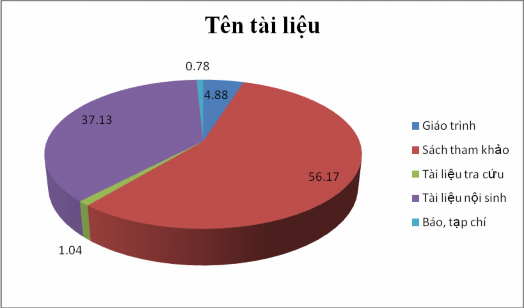
Figure 1.1: Structure of traditional information resources of the Center
Book:
+ Textbooks: The Center currently has 724 titles (accounting for 4.88% of the total number of titles in the warehouse) corresponding to 6,944 textbooks (accounting for 9.83% of the total number of textbooks in the warehouse). This type of document is compiled by the teaching staff of the Academy. These are specialized documents trained by the Academy: banking, finance, management, accounting, auditing, etc. In addition to the textbooks compiled by the school, the Center also supplements textbooks from publishers such as: National Economics University Publishing House, Labor, Education, National Politics, etc.
+ Reference documents: are quite abundant and play a very important role in the research, teaching and learning of the Academy's staff, teachers and students. Currently, the total number of reference documents of the Center is 8,335 document titles (accounting for 56.17% of the total number of document titles in the warehouse) corresponding to 44,904 books (accounting for 63.58% of the total number of documents in the warehouse). In addition to reference documents written in Vietnamese, the Center also has reference documents written in foreign languages, mainly English.
+ Reference documents: are a special type of document in the Center's book warehouse system, including books: Encyclopedias, dictionaries, specialized reference handbooks,... Currently, there are 155 names of these documents (accounting for 1.04% of document names, with more than 200 copies, accounting for 0.28% of the total number of document copies.
Internal documents : Including theses, dissertations, graduation theses, research topics, etc. are research works of staff, lecturers, trainees, and students in the Academy. Currently, there are 5,510 document names (accounting for 37.13% of document names) corresponding to 5,557 copies (accounting for 7.87% of document copies).
Newspapers and Magazines : including 114 types of newspapers and magazines, with 10,000 copies, accounting for 14.16% of the total number of documents, including 112 types of Vietnamese newspapers and magazines, 02 types of English magazines. All types of newspapers and magazines are fully preserved, magazines from 2013 and earlier are bound in hardcover.
● By language
Information resources divided by language at the Center include: Vietnamese and English documents. The Center's additional English documents are purchased from the Academy, donated by the Asia Foundation, CIM Project, and foreign teachers.
In addition to teaching for the Academy's International Cooperation Program, overseas training staff,...
TT
Language | Document name | Rate (%) | Documentation | Rate (%) | |
1 | English documents Vietnamese | 13,230 | 89.16 | 63,722 | 95.12 |
2 | English documents Older brother | 1,608 | 10.84 | 3,883 | 4.88 |
Total | 14,838 | 100 | 67,605 | 100 |
Table 1.3: Document statistics by language
Through the document language structure table, we see that the document capital at the Center is mainly in Vietnamese, accounting for 89.16%, and English documents account for 10.84%. Thus, the language structure of the document capital has a huge difference between Vietnamese and English documents because the demand for English documents is not high and the additional funding is large.
● By subject (of document type: books and internal documents, reference documents)
Banking Academy is the leading training institution in the country in the fields of finance, banking, accounting, and management, so the types of documents only in the fields of social sciences and science and technology account for a very large proportion of 77.96%, while other documents on languages, natural sciences, literature and arts, etc. account for 22.04%, specifically:
STT
Field | Document name | Documentation | |||
SL (Name) | Rate (%) | SL (version) | Rate (%) | ||
1 | Social science | 8,647 | 58.73 | 31,637 | 54.92 |
2 | Science and applications | 2,832 | 19.23 | 14,954 | 25.96 |
3 | Other | 3.245 | 22.04 | 11,014 | 19.12 |
Total | 14,724 | 100 | 57,605 | 100 | |
Table 1.4: Document statistics by major
In the field of Social Sciences, the economics - finance - banking major accounts for a large volume with more than 6,500 document titles, accounting for 75.17%. In the entire database, economics, finance and banking documents account for 44.14% of the Center's traditional information resource structure.
1.2.3.2 Electronic information resources
Electronic information resources at the Center include directory databases and full-text databases:
● Directory database : Is the basic information resource of the Center today. This database system reflects the composition and scale of the Center's document capital, and is the basis for automating information and library activities: building an electronic catalog system, compiling book introduction directories, serving information search, exchanging directory information, etc.
Currently, the Center has established 03 bibliographic databases with 14,724 records, specifically: Vietnamese book database with nearly 7,600 records, English book database with more than 1,600 records, and endogenous document database with more than 5,500 records.
This entire database is a bibliographic database containing level 2 information, including bibliographic data such as: author, title, publication elements, data characteristics, classification indices, abstracts, subject designations, etc. The bibliographic database includes a search for original documents, along with instructions to help users obtain original documents in the library.
● Full-text database: The Center has 3,020 electronic documents stored in file or CD-ROM format including:
Book database : Includes textbooks, reference materials, monographs mainly in English with 859 electronic files stored on CD-ROM.
Full text database of theses, dissertations, graduation theses: includes approximately
2,000 full-text files of theses, dissertations, and graduation theses were collected from the source of deposited Thesis, Dissertation, Theses, and scientific research topics... Although not complete, with the number of theses, dissertations, and theses that have been basically digitized, the Center is currently organizing them into digital collections in PDF file format using the open source management software Dspace, moving towards serving
service to meet the diverse needs of this gray information to NDT in the Academy. Specifically, the Center is storing (in PDF and DOC file format), including: 77 Theses, 615 Dissertations, 852 Graduation Theses.
Full text database of scientific research topics and conference proceedings : includes 258 documents with 02 State-level scientific research topics, 36 State Bank-level scientific research topics, 70 grassroots-level scientific research topics... and 150 student research topics.
Database of articles and magazines: Includes many articles and specialized magazines by the Academy's lecturers and articles with typical content on economics, finance and banking.
1.2.4 Information user characteristics and information needs
1.2.4.1 User characteristics
Users are the fundamental element of information activities, both as customers of information service activities and as creators of new information.
The Center's NDTs are very diverse and have different levels of qualifications, so their information needs are also diverse. The Center's NDTs are mainly students in the regular training system and those studying other training programs of the University such as College, bridging, second degree; graduate students, researchers... In addition, the Center's NDTs are also scientists, leaders, and managers.
Based on the requirements and tasks of training and scientific research of the Academy in the current period, the NDTs in the Library can be divided into 4 main groups: Group of leaders and managers, Group of lecturers and researchers, Group of postgraduate students and students. The specific numbers of the NDT groups of the Library are as follows:
User group
Quantity | Rate (%) | |
Management staff | 139 | 0.78 |
Lecturers and research staff, service | 721 | 4.03 |
Graduate and postgraduate students | 1,184 | 6.63 |
Student Group | 15,824 | 88.56 |
Total | 17,868 | 100 |
Table 1.5: Statistics of the Center's number of employees according to 4 groups of subjects
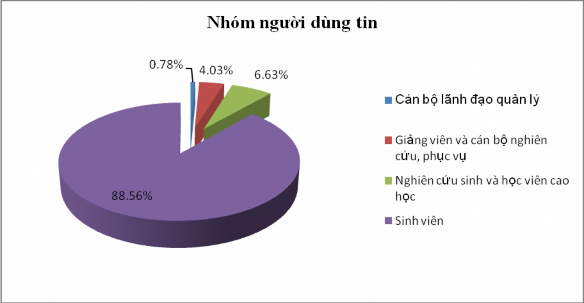
Chart 1.2: NDT structure of the Center
Group 1 - Leaders and managers
This group includes the Board of Directors, Heads and Deputy Heads of Faculties, Departments, Centers, Subject Groups, Party, government and mass organization leaders. Although this group accounts for a small proportion (0.78%) of the number of employees at the Academy, it plays an important role in the development of the Academy due to the nature of leaders and managers who make decisions, set goals, directions and development strategies for the school, faculty, department, etc., plan and organize the implementation of the set goals.
In this group, there is also a group of NDTs who are both leaders, managers and part-time lecturers. This group consists of about 29 staff, accounting for 3.4% of the total number of staff of the Academy.[13, p.3]
The labor intensity of this group is very high. Therefore, they have very little time to exploit the library but mainly use the services of borrowing documents to take home, multimedia or copying original documents.
Group 2 - Lecturers and researchers
This group accounts for a small proportion (4.03%), however, this is a group of people with post-graduate degrees and high foreign language proficiency. They are also the creators of information through lectures, textbooks, research works and projects.
projects, ... and are also regular NDTs of the Center. Because they participate in teaching, they must regularly update new knowledge, new technology and expertise directly related to the fields they teach and research. Therefore, this group of NDTs always spends a certain amount of time looking for reference materials in the library.
Group 3 - Graduate students
With a rate of 6.63% of the total number of NDT of the Center, the characteristic of this group is using the library with high intensity, especially during the time of implementing topics, research projects, graduation defense, etc.
These are university graduates. They have library skills and know how to effectively exploit information products and services (SP & DV) to serve their research and study. However, because most of them are both students and employees, the time spent in the library is limited.
Group 4 - Students
Among all the groups of NDT, the group of NDT who are students accounts for the highest proportion (88.56%). Along with the innovation of teaching and learning methods, especially the conversion to credit form, students no longer study passively as before but have researched, learned, and supplemented knowledge from outside. At this time, the library is considered as the "second lecture hall", a place that provides human knowledge through its system of products and services. Therefore, after school hours, the library and laboratory are where students spend a lot of time researching and using.
1.2.4.2 Characteristics of information needs
NCT is the characteristic of an individual, collective or a system that shows the need for information appropriate to the behavior or work that the subject is performing. In other words, NCT is the need for information necessary for users to help them solve a problem or a task. Researching the characteristics of NCT is to identify the information and document needs of users, on that basis finding specific and appropriate measures to provide information or documents to them. The innovation of education, especially the innovation of higher education (innovation in curriculum, training methods and training scale) has had a great impact and changed
NCT of NDT in school. Information/documents have become an indispensable element in the teaching, research and learning process with new training methods focusing on learners as the center to help learners and students increase their initiative, positivity, self-study and self-research.
Information needs of group 1 - Leaders and managers
Due to the nature and nature of the work of leaders and managers, which is to make decisions, information for them is a management tool. They work at a very high intensity. Therefore, information for this group of people must be deep, broad, authentic and sustainable. The forms of information are diverse and rich (including traditional documents and electronic documents). The information they need is the latest information, current events. The group of leaders and managers is able to use many different languages. However, due to time constraints, they only use foreign documents (mainly English) that have been processed for information such as numbers, tables, overviews, summaries, and selected newsletters.
Information needs of group 2 - Lecturers and researchers
This is a group of high-level NDT. In response to the requirements of educational innovation, teachers must find and introduce to students necessary documents related to the subject so that students can explore and supplement new knowledge, stimulate the creative process, and bring high efficiency in learning and research. Therefore, information for this group is in-depth, current information on science and technology in the fields that the School trains. The form of information service for this group is the catalog of new or upcoming specialized documents, specialized directory information, selected information on science and technology, specialized documents are books as well as foreign scientific and technical journals, databases and electronic documents, etc.
Information needs of group 3 - PhD students, graduate students
They are university graduates who are now doing in-depth research in a specific field. The information they need is mainly specialized documents that are relevant to their study program or research topic or project such as: reference books, specialized journals, theses, dissertations, etc.