
Table 4.1: Comparison of TA learning behavior in class between 2 groups of students
BEHAVIOR
Mean | p (2- tailed) | ||
PASSIVE PP | POSITIVE PP | ||
1. Go to school on time | 6.14 | 6.13 | 0.93 |
2. Be present in class | 6.22 | 6.37 | 0.15 |
3. Take full lesson notes | 5.8 | 5.9 | 0.5 |
4. Listen to the teacher lecture | 5.82 | 5.86 | 0.7 |
5. Learn well in class | 4.63 | 4.46 | 0.35 |
6. Focus on learning English in class | 5.02 | 5.02 | 0.99 |
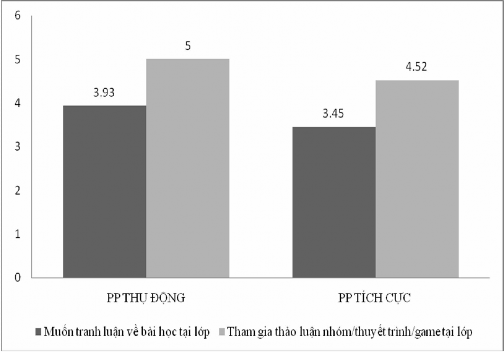
7. Want to discuss the lesson at class | 3.93 | 3.45 | 0.01 |
8. Express your opinion in class | 3.98 | 3.74 | 0.24 |
9. Participate in group discussion/lecture class presentation/game | 5 | 4.52 | 0.01 |
10. Discuss further with your teacher/friends if there is anything you do not understand. | 4.2 | 4.03 | 0.38 |
Maybe you are interested!
-

 Teaching Methods of English in Secondary Schools According to the New General Education Program
 -
 Illustration of Teaching Organization Model Using M-Learning
 -
 The Relationship Between English Teaching Activities and English Competency Development
 -
 Learn active learning methods and apply them to spam filtering problems - 1
 -
 Proposal and Implementation of Measures to Foster Learning Methods for Students at Military Universities Based on the Idea of "Self-Study as the Core"
The survey results in Table 4.1 show that there is no difference between the two groups in terms of punctuality (p=0.93), attendance in class (p=0.15), taking notes (p=0.5), listening to lectures (p=0.7), absorbing lessons in class (p=0.35), concentrating on studying (p=0.99), expressing opinions (p=0.24), and further discussion (p=0.38). Thus, the English teaching method surveyed does not affect these behaviors. However, for the behavior of wanting to debate about the lesson, participating in group discussions/presentations/games in class, there is a significant difference between the two groups.
The English teaching method investigated had an impact on students' willingness to debate about the lesson (p=0.01, t=2.38, df=268). The mean values of the two groups showed that the group of students taught by passive method (M=3.93) often wanted to debate more than the group of students taught by active method (M=3.45). The difference between these two mean values was 0.48.
The English teaching method investigated had an impact on students' behavior of participating in group discussions/presentations/games in class (p=0.01, t=2.57, df=198.4). The mean values of the two groups showed that the group of students taught by passive methods (M=5) often participated in discussions/games/presentations more than the group of students taught by active methods (M=4.52). The difference between these two mean values was 0.48.
Chart 4.1: Comparison of TA learning behavior in class between 2 groups of students
Conclude:
In the group of 10 English learning behaviors in class, the teaching method surveyed only had an impact on two behaviors: wanting to debate about the lesson in class and participating in discussions/presentations/games in class. The group of students taught by passive methods had a higher level of wanting to debate and participating in discussions/presentations/games in class.
4.1.2. Teaching methods and English learning behavior outside the classroom
To investigate the relationship between teaching methods and out-of-class English learning behaviors, a two-tailed t -test with a confidence level of 95% was used to compare the levels of these behaviors between two groups of students taught using two different methods (passive and active). In this study, I included the following six behaviors in the out-of-class English learning behavior group:
Do homework/prepare lessons before coming to class (Sentence 5)
Study additional reference materials outside of the textbook (Question 6)
Review the lesson when you have free time (Sentence 7)
Join the English club (Question 8)
Listen to music/watch TV/watch movies in English (Question 9)
Invest a lot of time learning English (Question 10)
Table 4.2: Comparison of TA learning behavior outside the classroom between 2 groups of students
BEHAVIOR
Mean | p (2- tailed) | ||
PP RECEIVING ACTION | PP PROFILE POLE | ||
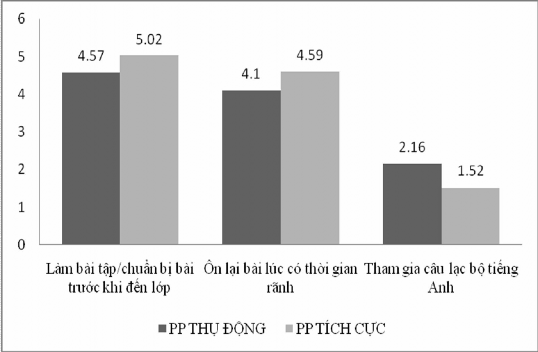
1. Do your homework/prepare your lesson in advance when coming to class | 4.57 | 5.02 | 0.00 |
2. Research more documents | 3.55 | 3.63 | 0.66 |
3. Review the lesson when you have time. | 4.1 | 4.59 | 0.00 |
4. Join an English club | 2.16 | 1.52 | 0.00 |
5. Listen to music/watch TV/watch movies TA | 4.88 | 4.64 | 0.25 |
6. Invest a lot of time learning TA | 4.19 | 4.2 | 0.95 |
The survey results in Table 4.2 show that there is no difference between the two groups in terms of the level of document research (p=0.66), listening to music/watching TV/watching English movies (p=0.25), and investing time in learning English (p=0.95). Thus, the English teaching method surveyed does not affect these behaviors. However, there are significant differences between the two groups in terms of doing homework/preparing lessons before class, reviewing lessons when there is time, and participating in clubs.
The English teaching method investigated had an impact on students' homework/preparation behavior before class (p=0.00, t=-2.76, df=269). The mean values of the two groups showed that the group of students taught by active methods (M=5.02) often did homework/preparation before class more often than the group of students taught by passive methods (M=4.57). The difference between these two mean values was 0.45.
The English teaching method investigated had an effect on the behavior of reviewing lessons when there was time (p=0.00, t=-2.75, df=269). The mean values of the two groups showed that the group of students taught by active methods (M=4.59) reviewed lessons more often than the group of students taught by passive methods (M=4.1). The difference between these two mean values was 0.5.
The English teaching method investigated had an impact on club participation behavior (p=0.00, t=3.47, df=267). The mean values of the two groups showed that the group of students taught by passive method (M=2.16) were more likely to participate in English clubs than the group of students taught by active method (M=1.52). The difference between these two mean values was 0.64.
Chart 4.2: Comparison of TA learning behavior outside of class between 2 groups of students
Conclude:
In the group of 6 English learning behaviors during non-class time, the teaching method surveyed only affected three behaviors: doing homework, preparing lessons; reviewing lessons; participating in English clubs. However, the group of students taught by passive methods had a higher level of club participation than the other group. The group of students taught by active methods often did homework, prepared lessons, and reviewed lessons more often.
4.1.3. Teaching methods and attitudes towards learning English
To investigate the relationship between teaching methods and English learning attitudes, a two-tailed t -test with a confidence level of 95% was used to compare these learning attitudes between two groups of students taught by two different methods (passive and active). In this study, I included the following four learning attitudes:
Think about English lessons/lectures outside of class (Question 17)
Like to go to English class (Question 18)
Regret if you miss class time (Question 19)
I like English more (Question 11)
Table 4.3: Comparison of TA learning attitudes between 2 groups of students
ATTITUDE
Mean | p (2- tailed) | ||
PP RECEIVING ACTION | PP PROFILE POLE | ||
1. Think about the lesson/lecture TA outside the classroom | 3.94 | 3.88 | 0.7 |
2. Like to go to English class | 5.18 | 4.99 | 0.32 |
3. Regret if you miss class time | 4.47 | 4.52 | 0.81 |
4. Like English more | 5.28 | 4.91 | 0.07 |
The survey results in Table 4.3 show that there is no difference between the two groups in terms of attitudes towards learning English. Thus, the English teaching method surveyed does not affect these attitudes.
Conclude:
The teaching method surveyed did not affect attitudes.
students learning english
The results of the study showed that the teaching methods surveyed had an impact on some of the students' learning behaviors. In the group of 16 learning behaviors and 4 learning attitudes surveyed, the teaching method only had an impact on 5 learning behaviors, the teaching method did not affect learning attitudes. Comparing the level of implementation of these behaviors in the two groups, it is not possible to confirm whether the active or passive teaching method is better. While the active method is more effective for some behaviors in the group of learning behaviors during non-class time (doing homework, reviewing lessons)
The passive method has a more positive impact on some behaviors belonging to two groups of learning behaviors in class (wanting to debate, participate in discussions/presentations/games) and out of class (participating in clubs). Therefore, it is not possible to conclude whether the teaching method surveyed has an impact on students' motivation to learn English or not.