
3. Curves in polar coordinates
a) Polar coordinate system
In the plane, choose a fixed point O, called the pole ( polar origin ) and a unit vector OP , the ray carrying OP is called the polar axis . The coordinate system determined by the pole and the polar axis is called the polar coordinate system . The position of point M in the plane is determined by the vector OM , that is,
OP OM
determined by the polar angle φ = ,
and polar radius r = OM
b) The relationship between the polar coordinate system and the rectangular Cartesian coordinate system:
x r cos , 0 ≤ φ ≤ 2π; r ≥ 0, and r 2 = x 2 + y 2 ; tgφ = y
y r sin x
c) Extended polar coordinate system
The generalized polar coordinate system is the polar coordinate system, in which one can take:
r ≤ 0 and φ ≤ 0, or φ ≥ 2π.
c) Survey the curve in the polar coordinate system r = f(φ)
i) Find the domain of f(φ)
ii) Identify some special points of the graph
iii) Make a variation table, consider the variation of f(φ)
iv) Let V be the angle between OM and the tangent vector of the curve, then:
tgV = r
r '
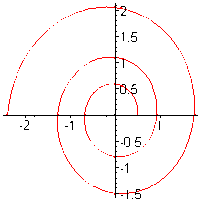
For example: Survey and draw the curve r = ae bφ (a, b > 0),
logarithmic spiral
r is defined for all φ, monotonically increasing in φ:
φ = 0 => r = a, lim
r = +∞, lim
r = 0.
tgV = 1 , the angle between the tangent and the polar radius is zero
a
change.
Example: Survey and draw the curve r = asin3φ (a > 0), the three-petal rose curve
r is a periodic function with period 2 , r is an odd function of φ so we only need to examine the segment
3
[0,
].
3
r' = 3acos3φ => r' = 0 when φ =
6
tgV = tg3
3
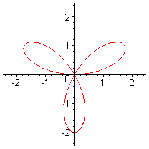
Variation table
φ
0 | 6 | 3 | |||
r' | 3a | + | 0 | - | -3a |
r | 0 | a | 0 | ||
tgV | 0 | ∞ | 0 |
Maybe you are interested!
-

 Example Illustrating a Summary of an English Text
 -
 Summary Table of Data Illustrating the Contents of the Thesis
 -
 Summary of Land Revenues 2005 - 2014
 -
 Summary of Sem Linear Structural Model Data
 -
 Summary Table of Characteristics of Similar Studies Around the World
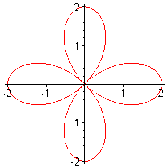
Example: Survey and draw the curve r = acos2φ (a > 0)
Perform the same steps as above, with the note that the function is periodic.
complete period π, r is an odd function of φ, r(φ) = -r(
curve:
-φ). We have
2
Note: If we consider the curve in the polar coordinate system (r ≥
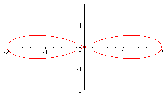
0), then r is only defined for - ≤ φ ≤ and 3 ≤ φ ≤ 5 ,
4 4 4 4
we get the curve:
Example: Survey and draw the curve r = 2a(1 + cosφ) (a > 0)
r is defined for all φ, periodic with period 2π, r is an even function, we only need to examine on [0,π].
r' = -2asinφ, r' = 0 when φ = 0 and φ = π
tgV = -cotg
2
, tgV = -∞ when φ = 0, tgV = 0 when φ = π
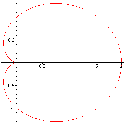
Variation table
φ r' r
0
0
4a
-
π
0
0
tgV -∞ 0
Example: Survey and draw the curve r 2 = a 2 cos2φ (a > 0)
We have a function a 2 cos2φ periodic with period π, on the other hand the curve will be determined if
cos2φ ≥ 0, which means - ≤ φ ≤
4
, we also only consider with r ≥ 0 (r ≤ 0 corresponds to
4
rotation of the curve by an angle π), that is:
cos 2
r = a
, r' =
a sin 2 , r' = 0 when φ = 0, tgV = -cotgφ, tgV = ∞ when φ = 0.
cos 2

Variation table
φ
- 4 | 0 | 4 | |||
r' | + | 0 | - | 0 | |
r | 0 | a | 0 | ||
tgV | 1 | ∞ | -1 |
C. Exercises
1. Find the limit
1
e x cos 1
time x
x sin x
arctgx
a) lim x
b) lim 2
c) lim
d) limit
x
1
1 1
x 2
x 1 ln(1 x)
x 0
x tgx
x
ln 1
1
x
e) limit
e x e x
f) limit
e tgx e x
g) lim
time x 2
h) limit
ex e a
x 0
i)
x tgx
a x b x
x 0
tgx x
x 1 ln(1 x)
1 sin x
3 x 1
x 1
x a
x a
x x x
iron
x 0 c x
d x
j) limit
x 0
k) lim
x
2
2x
l) lim
x 1 ln x x 1
n) limit
2arctgx
o) lim
x cot gx 1
p) lim
1 cos 3 x
q) limit
sin x tgx
x 0
ln 1 1
x
x x 1
x 0
x 2
ln(1 x) tg x
x 0
x sin x
ln x 1
2
x 0
1 cos x
(a x) x a x
r) lim
s) lim 2
t) limit
u) lim
x 1 ln x x 1
x 0
column g x
x
2
cos x
x 0 x 2
2. Find the limit
1
a) lim e x 2 x 100 x 0
b) lim [(π - 2arctgx)lnx] c)
x
lim (ln x 1) ln | x e |
x e
3. Find the limit
1 1
1
1 1
a) lim
b) lim cot gx
c) lim
x 0 x
e x 1
1
x 0
1
x
3 3
x 0 ln x
2
1 x 2
2
ln(1 x)
ln(e x x)
d) lim
x 0 ln( x
1 x 2 )
ln(1
x)
e ) limit
x
x x
x 1
x x 1
x
4. Find the limit
x
x x 1
x x 1
sin x
1
sin x x 2
a) lim x
c) lim x
d) lim
e) lim | x |
f) lim
x 0
x 0
x 0 tgx
x 0
x 0 x
1
g) x x
2x-π
tgx
2arctgx x
1
arctgx x 2
lim(e
x 0
x)
h) lim (tgx)
x
2
i) lim (sinx)
x
2
j ) limit
x
k)
iron
x 0 x
1
1 arcsin x x 2
1
2 arccos x x
l) lim (x 2 x ) x x
m) lim (1 cos x) tgx x 0
n) lim
x 0 x
o) lim
x 0
1
1
x x
1
a x x ln a x 2 1
p) lim(arccos x) x 2
q) lim tg
r)
iron
S)
lim(1 arctg 2 x) x sin x
x 0
x
2x 1
x 0 b x x ln b
x 0
1 2x x 2
31 3x x 2
5. Write the Mac-Laurin expansion of the function f(x)
a) (1 x) 100
(1 2x) 40 (1 2x) 60
to x 2 b)
- up to x 3
2
c) tgx to x 3 d)
e 2x x
to x 5 e) 1 x x 2
to x 4 f) x(e x -1) -1 to x 4
1 x x 2
3 sin x 3
g) to x 13 h) lncosx to x 6 i) sin(sinx) to x 3 j) ln sin x
x
up to x 6
6. Find the limit
a) lim
x 0
1 cos 3 xx sin x
b) lim
x 1
c) lim
x 0
e x sin x x(1 x) x 3
3 2x x 4 3 x
1 4x 3
7. Find the limit
a) lim 1
1
b) lim 1
1
c) lim x 2
3
3
x 0 sin x
x
2
x 0 sin 2 x
x 1
x
1 1
x
x ln 1
x
d) limit
x 3 x 2
e x
x 6 1
e) limit
cot gx
x 2 x 0 x x
8. Determine a,b so that the following expression has a finite limit when x → 0
f(x) =
1
sin 3 x
- 1-
x 3
a - b
x 2x
9. Examine the monotonicity of the following function y = f(x)
a) x 3 + xb) arctgx - xc) x + |sin2x|
10. Prove the inequality
a) 2xarctgx ≥ ln(1 + x 2 ) x R b) x -
11. Find the extreme value of the function
3x 2 4x 4
x 2 ≤ ln(1+x) ≤ x x ≥ 0
2
a) y =
x 2 x 1
b) y = x - ln(1 + x) c) y =
3 (1 x)(x 2) 2
31 x 3
d) y = (x - 2) 2/3 (2x + 1) e) y =
f) y =
ln x
g) y = x 2 lnx h) y =
x 2 2arctgx 2
xx
2
i) y = x 2 + 2arccotgx 2
x 3
x a
12. Find the asymptotes of the following functions.
a) x 2 e -x b) xlg 1
x
10 c)
x 2
d) x 3 e x e)
x 2 1
13. Find the extreme values and asymptotes of the following functions.
a) y = x + arccotg2x b) y = x 2 e -x c) y =
d) y = e x lnx e) y = x - arctg2x f) y =
ln xx
x 1 x
(1 x) x
14. Suppose f is a convex function on the interval [a,b]. Prove that c (a,b), we have
f (c) f (a) c a
≤ f (b) f (a)
b a
≤ f (b) f (c)
b c
15. Given x, y > 0, prove the following inequalities
x n y n
x y n
ex x e y
x y
x y
a) ≥
2 2
b) ≥ e 2
2
c) xlnx + ylny ≥ (x + y)ln
2
16. Find the asymptotes of the following curves.
a) x =
3t 4 t 2
y = 2t 2
4 t 2
b) x =
t 2
t 1
y = t
t 2 1
c) x = t 3 - 3π y = t 3 - 6 arctgt d) x = ty = t + 2arctgt
17. Calculate y' x and y'' xx knowing that x = tsin2t y = t + cost
d) x = acost y = asint e) x = a(t - sint) y = a(1-cost)
f) x = a(t - sint) y = a(1 - cost) g) x = t 3 + 3t + 1 y = t 3 - 3t + 1
18. Examine and draw the graph of the function y = f(x) with f(x) below
2 x 2
x 4 8
1 2 2
2 1 x
1
e 1 x 2
a) 1 x 4
b) x 3 1
c) + 4x
x
d) x lnx e) sin xf) x 1
x
g) 1 x 2
3x 3 x 2 x 1
h) arcsin(cosx) i) arccos(cosx) j) arctg(tgx) k)
19. Examine and graph the following functions.
a) x =
t 2
1 t
y = t
t 2 1
b) x = t + e -t y = 2t + e -2t c) x = 2t - t 2 y = 3t - t 3
d) x = 2acost - acos2t y = 2asint - asin2t
e) x = at - hsint y = a - hcost (0 < h < a)
f) x = at - acos2t y = 2asint - asin2t g) x = te t y = te -t
20. Examine and graph the following functions.
a) x 2 + y 2 = x 4 + x 4 b) x 2 y 2 = x 3 - y 3 c) x 2 - xy + y 2 = 1
21. Examine and graph the following functions in polar coordinates.
a) r = a + bcosφ (0 < a ≤ b) b) r =
a (a > 0) c) r = a(1 - cosφ)
cos 3
d) r = φ e) r =
f) r = 2 2
g) r 2 = 2a 2 cos2φ h) r = acos4φ i) r =
Week VI. Antiderivatives and indefinite integrals
A. Overview
1. Summary: Antiderivatives and indefinite integrals.
2. Objective: Provide students with concepts of antiderivatives, families of antiderivatives, indefinite integrals, tables of integrals of common functions, rules for calculating indefinite integrals: integration by parts, change of variables, integration of rational and irrational fractional functions, trigonometry, Euler's method of changing variables.
3. Prerequisite knowledge: Knowledge about functions, continuity, derivatives of functions.