
Author
Factors affecting student satisfaction | |
Zineldin et al. (2011) | Technical quality; Functional quality; Physical evidence |
Thomas (2011) | Academic; Admin; Infrastructure; Social life; Support service; Reputation |
Farahmandian et al. (2013) | advising; teaching quality; curriculum (program); Facilities; Financial assistance and tuition cost. |
Yusoff et al. (2015) | Professional comfortable environment; Student assessments and learning experiences; Classroom environment; Lecture and tutorial facilitating good; Textbooks and tuition fees; Student support facilities; Business procedures; Relationship with teaching staff; Knowledgeable and responsive faculty; Feedback; Staff helpfulness); Class size |
Hanssen and Solvoll (2015) | Reputation; Cost of studying; Job prospects; Host city; Facilities |
Ali et al. (2016) | Lecturers; Training programs; Support services; Facilities |
Oliveira et al. (2020) | Service quality; Learning outcome; Employability; Value; Image; |
Maybe you are interested!
-

 Detailed Results of Factors Affecting Commercial Banking Service Quality from 30 Managers
 -
 Factors affecting tourists' satisfaction with tourism service quality in Ca Mau province - 2
 -
 Analysis of factors affecting customer satisfaction with the quality of FiberVNN fiber optic internet service of Can Tho Telecom - 2
 -
 Factors That Create a Good Impression for Guest Service:
 -
 Scale of Measuring Tourism Service Quality Factors
Source: Author's synthesis
2.1.3. Service quality
2.1.3.1. Concept of service quality
Conceptually, service quality has been a topic that has attracted much attention from researchers over the past decades. Clarifying the concept and nature of service quality is not only to solve academic problems but also has implications for practical business activities. The relationship between service quality and customer satisfaction, loyalty and behavior has been verified in many studies and recognized in many different industries (Sureshchandar et al., 2002; Ribbink et al., 2004). Service quality is considered as a factor that creates competitive advantage for businesses (Ghobadian et al., 1994). Most studies approach service quality as a measurement framework, with this approach, service quality is described on the basis of its constituent elements. Quality is considered as the units of good quality packaged in a product or service (Ghobadian et al., 1994). Meanwhile, Parasuraman et al. (1985) argued that service quality is a measure of how well the service provided meets the expectations of customers. Gronroos (1984) argued that service quality is made up of technical quality and functional quality . Lehtinen and Lehtinen (1982) proposed that service quality assessment should be based on both the service delivery process and the service outcome . Parasuraman et al. (1988) proposed that service quality should be considered with two fundamental factors.
The expectation - performance framework is widely accepted and commonly applied in research to explain the nature of service quality. However, Cronin and Taylor (1992) argued that for some services with long experience periods, issues related to expectations will not have a clear impact on service quality and will be confusing to customers. Therefore, service quality should only be considered based on service completion instead of the gap framework. Similarly, O”Neill and Palmer (2004) used the premise of Abercrombie (1967) that perception changes over time , so the gap framework views of Parasuraman et al. (1988) are not accurate for some services such as finance, insurance, etc. The view of Cronin and Taylor (1992) supports the view of SQ=P instead of SQ=PE (SQ: Service quality; P: Perceived performance; E: Expectation). In summary, from the above synthesis and analysis, it can be conceptualized that “service quality is the totality of characteristics and features of a service that affect the ability to satisfy customer needs.”
2.1.3.2 Elements of service quality
During the development of research on service quality, in addition to the views related to the definition and nature, the scale for evaluation has also attracted great attention from researchers. Measuring service quality is of great significance to evaluating the business performance of enterprises. Due to disagreements in views on the definition and nature, the measurement and identification of factors affecting service quality are very diverse (Yildiz and Kara, 2009). Most of the studies on service quality consider the factors that make up the scale, which is closely related to identifying factors that affect service quality. Some prominent factors that make up service quality and are commonly applied in the construction of the scale include.
Reliability
Reliability is considered an important factor affecting overall service quality. Unlike other products and goods, services are intangible and inseparable. That is, suppliers and customers need to interact throughout the process of providing and experiencing the service. Therefore, service suppliers need to meet their commitments to customers. Reliability refers to the ability to perform the promised service reliably and consistently ( Presbury , 2009; Giannakos et al., 2012; Shafiq et al., 2019). Many famous scales used to measure service quality such as SERVQUAL, SERVPERF consider reliability as an important factor. Especially in some service industries related to health care, education, retail, the impact of trust plays an important role in customers' assessment of overall service quality (Oliveira and Ferreira, 2009; Yousapronpaiboon, 2014; Dabholkar and Thorpe, 2016; Jain and Aggarwal, 2018). According to Parasuraman et al. (1988), trust reflects issues including: Is the service provided correctly?
as promised the first time; Customer issues are handled reliably; Ability to maintain quality without fail; Service is delivered on time as promised.
Assurance
While reliability emphasizes the ability to deliver the service as promised, assurance focuses on the ability to create trust for customers during the process of using and experiencing the service. Assurance is related to the knowledge and courtesy of employees and the ability to inspire and inspire confidence in customers (Ladhari, 2009; Meesala and Paul, 2018). Similar to reliability, assurance is known as one of the five main factors commonly used to measure service quality in the SERVQUAL and SERVPERF scales with many different service industries such as banking services (Shanka, 2012), accommodation services (Rao and Sahu, 2013); Education services (Hasan et al., 2008) ... In popular scales, assurance is assessed through issues including: Employee confidence; Ability to bring peace of mind to customers; Politeness; Understanding to answer customer questions (Parasuraman et al., 1988; Cronin and Taylor, 1992, Chen et al., 2015).
Responsiveness
Responsiveness refers to the willingness to assist customers and the ability to provide services quickly (Parasuraman et al., 1985). Services are unlike conventional goods in that most of them do not transfer ownership. That is, after the customer decides to purchase the service, the provision process begins. This process takes place throughout the customer's usage time. Therefore, the service provider always needs to be ready to assist customers. In addition, according to Ho and Lee (2007), responsiveness is also understood in a number of other meanings in the context of e-service quality research. Responsiveness is the speed and efficiency in answering customer questions in an online service environment (Madu and Madu, 2002; Zeithaml et al., 2002). The application of responsiveness to assess service quality is also popular in studies on specific service industries such as e-commerce (Lee et al., 2005; Lin, 2007), telecommunication services (Akbar and Parvez, 2009).
Empathy
Empathy is the ability to provide personal attention and care to customers through understanding and providing convenience to customers (Parasuraman et al., 1988). When empathy is well implemented, it creates a connection and a lasting relationship between the service provider and the customer. Empathy plays an important role in most studies evaluating service quality (Wong and Sohal, 2003; Boshoff and Gray, 2004). In many services such as healthcare, retail, finance, and e-commerce, empathy not only affects overall service quality but is also an important factor affecting customer loyalty and commitment (Shanka, 2012; Ahmed and Arif, 2017).
Tangibility
Intangibility is considered one of the four outstanding characteristics of services. However, to create services, tangible factors play an important role. Tangible factors here are understood as raw materials and facilities to create services. According to Parasuraman et al. (1988), tangibles refer to the appearance of facilities, equipment, personnel and communication materials. Some studies use the phrase physical aspects/physical facilities to represent tangible factors (Dabholkar et al., 1996). Normally, in scales to measure service quality, statements about tangibles often revolve around issues including: Modernity of equipment; Appearance of facilities; Appearance and uniform of staff; Attractiveness of related documents.
Technical Quality
In addition to the approach to explaining service quality according to the gap framework of Parasuraman et al. (1988), some studies explain the nature of services through factors related to the service provision process. Specifically, Gronroos (1984) proposed to consider service quality based on technical quality and functional quality. In which, technical quality is the value that the supplier brings to customers . Compared with the five constituent elements in the gap framework approach, technical quality has a broader implication. Therefore, in many studies when wanting to clarify the ability to satisfy customer needs, technical quality is used in measuring service quality (Holdford and Schulz, 1999; Boucher et al., 2002). In Vietnam, Nguyen Hoang Viet and Nguyen Bach Khoa (2014) proposed using technical quality through assessments of customer service solutions, customer costs, customer convenience and customer communication to evaluate service quality.
Functional Quality
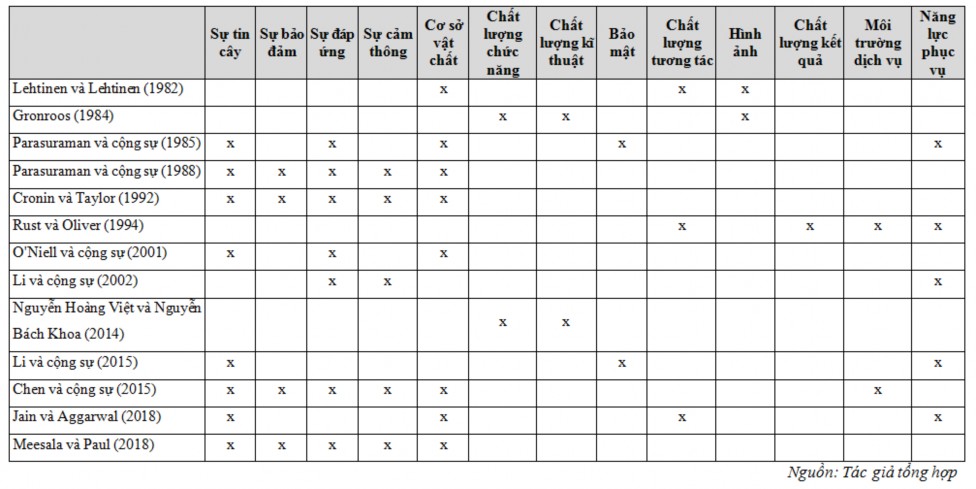
Functional quality is the way a service provider delivers services to consumers (Gronroos, 1984). While technical quality refers to the value customers receive, functional value describes the process by which a service provider delivers services to customers. Functional quality and technical quality are two factors chosen to measure service quality in many studies (Ferguson et al., 1999; Ali et al., 2017). Functional quality is related to the ability to satisfy service choices and the way the service is organized (Nguyen Hoang Viet and Nguyen Bach Khoa, 2014). In addition to the factors mentioned above, depending on the specific characteristics of each specific service, the service quality scale is different. In particular, in recent years, the development of e-services and other types of services with technological elements has created other factors that affect service quality such as: Interface; Security; Interaction, Image, Outcome Quality; Service Environment; Competence... A summary of factors affecting service quality is described in Table 2.2.
33
Table 2.2. Some studies on the factors that make up service quality
2.1.4. Service value
2.1.4.1. Concept of service value
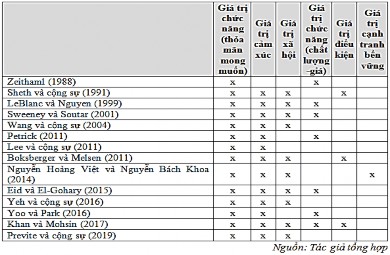
In the 20th century, compared to service quality, service value is a somewhat less popular concept. However, in the current business trend, customers are increasingly interested in the value of products/services rather than the basic quality of products/services. Nguyen Hoang Viet and Nguyen Bach Khoa (2014) believe that product/service quality represents basic characteristics and helps customers satisfy basic needs . However, product/service value can do better when satisfying customer desires . Quality refers more to standards but value focuses more on customer perception . Therefore, value can be a factor that makes a big difference in products/services and affects customers' willingness to pay. Several studies have shown the effects of service value on customer satisfaction, loyalty and repurchase behavior (Tam, 2004; Dölarslan, 2014; Lee et al., 2005). Although the concept of service value has not received as much attention as service quality, the number of approaches is also very diverse. Service value is a function of monetary and non-monetary costs , service value is related to issues of cost perception and received values (Doyle, 1984). Zeithaml (1988) clearly divided service value according to the aspects that customers perceive, including 4 statements: Value is low price; Value is quality received from the price paid; Value is desired satisfaction; Value is what is received from what is paid. In agreement with Zeithaml's (1988) study on the detailed division of service value components, Sweeney and Soutar (2001) argued that service value is created by functional value (wants satisfaction), emotional value , social value , and price value (functional value/price-quality). Meanwhile, Sheth et al. (1991a) pointed out that service value has an impact on customer choice .
In summary, based on the perspectives of research, in this study Service value is understood as the difference/ratio between the monetary and non-monetary costs that customers pay and the benefits customers perceive to create the ability to satisfy customers' needs with that type of service".
2.1.4.2. Elements that make up service value
Functional Value/want satisfaction
In service value theory, functional value is the most commonly used factor (Lee et al., 2011). Most studies suggest that functional value represents the correlation between cost and quality and value (Sanchez et al.,
2006; Fernandez and Bonillo, 2007). Meanwhile, Sweeney and Soutar (2001) divided functional value based on customers' perceptions of quality and price with product performance . According to Nguyen Hoang Viet and Nguyen Bach Khoa (2014), functional value reflects the ability to meet customers' service expectations . In general, functional value is a factor with diverse definitions. But most views agree that the functional value of a service describes the correlation between cost and quality and performance of the service. Functional value is closely related to the ability to satisfy customers' basic needs with the service.
Emotional Value
Some studies have suggested that assessing service value should not be based solely on the ability to deliver value to satisfy basic customer needs, which does not fully capture the meaning of the concept of “value” (Holbrook, 1999; Sinha and DeSarbo, 1998; Sweeney and Soutar, 2001; Previte et al., 2019). Therefore, developing a scale that includes many constituent elements is necessary for assessing service value. According to Sweeney and Soutar (2001), emotional value is the ability to bring comfort and positive state to customers when using products/services and make customers feel interested and want to continue using products/services. If functional attributes are equivalent, emotional factors play a decisive role in customers' product selection behavior. Many studies have shown that emotional value has the potential to enhance customer satisfaction and loyalty (Lee et al., 2011).
Social Value
Image, social status, and community recognition are among the basic human needs (Maslow, 1958). According to Sheth et al. (1991), social value is the perceived benefits of association with demographic, socioeconomic, and cultural/ethical groups that are positively or negatively stereotyped. Meanwhile, Sweeney and Soutar (2001) argue that social value is the benefits that products/services provide to enhance social aspects such as image, recognition . The role of social value on overall service value and customer satisfaction has been verified in many studies (Hoang Thi Phuong Thao and Hoang Trong, 2006; Bowen, 2018; Previte et al., 2019).
Table 2.3. Some studies on the elements that make up service value
Functional Value/price-quality
Throughout the research on service value, most scholars have mentioned monetary cost as a factor that has a great influence on the perception of service value (Zeithaml, 1988; Sweeney and Soutar, 2001, Khan and Mohsin, 2017). The statements to measure this factor focus on the values from the reasonableness of the price brought to customers. Petrick (2002) proposed to consider the value of price not only based on monetary values but also need to evaluate the cost that customers pay to use the product . Therefore, it is possible to conceptualize "Functional value/price-quality is the utility that customers feel from pricing policies and is closely related to product/service quality ".
Conditional Value
Conditional value is a concept that originated from the theories of contingency, situational characteristics, ex ante states, and physical environment proposed by Belk (1975). Sheth et al. (1991) developed the above theories and pointed out that short-term contexts have an impact on product/service value and customer purchase behavior. Accordingly, conditio nal value is the extrinsic benefits derived from its ability to provide functional or social value in the context of a specific and transient set of circumstances or situations related to the pre-existing situation. Conditional value has also been considered and evaluated with many different types of services and is considered a constituent element of service value (Pura, 2005; Roig et al., 2006; Khan and Mohsin, 2017).
2.2. Concept, content and relationship between quality and value of higher education services and student satisfaction
2.2.1. Concept and content of higher education service quality
2.2.1.1 Concept of quality of higher education services
Higher education service quality is a specific case of service quality so the development of this concept is based on the foundations from the views of