
Therefore, pollination and fertilization fail, resulting in seedless fruit. To obtain seeds, pollination by insects or artificial pollination is required.
2.3.3. External conditions
2.3.3.1. Temperature
Temperature is one of the important factors determining the growth, development, flowering and flower quality of Solanna Golden SPHERE 17.
Maybe you are interested!
-
 Evaluation of Research Situation and Issues Raised for the Thesis
 -
 Research on selecting a model to evaluate resources and original gold reserves in Phuoc Son area - Quang Nam - 1
 -
 Research on resources, current situation, and solutions to exploit the humanistic ecological tourism route in Hai Duong. Building the route Hanoi - Cam Giang - Thanh Mien - Ninh Giang - Chi Linh - Hai Duong City - 8
 -
 Overview of Research Works in the Overview of Research Situation and Issues to be Solved in the Thesis
 -
 Building Vinawind's Situation Analysis and Research Process
- 25 °C.
2.3.3.2. Light
Light has two main effects on Solanna Golden SPHERE : It is a very necessary factor for the growth and development of plants, it provides energy for photosynthesis to create organic matter for plants and greatly affects the differentiation of flower buds and flowering. Solanna Golden SPHERE is classified as a short-day plant. The light is completely natural. The best lighting time for the flower bud differentiation period is 10 hours with a suitable temperature of 20 degrees Celsius. The longer the lighting time, the longer the flower growth, the taller the stem, the larger the leaves, the later the flowers bloom, and the quality of the flowers increases. The lighting time is 11 hours for the best flower quality. With these characteristics, in cultivation, people can grow flowers in the hot season by using a shade net to reduce the intensity of sunlight for good growth and using artificial light or darkness to control the flowering process, serving commercial purposes.
2.3.3.3. Humidity
Solanna Golden SPHERE is an upland plant, requiring moderate humidity, not tolerant of waterlogging but at the same time has a large biomass, large leaves consume a lot of water, so it is also not drought tolerant. Soil humidity from 60-70%, air humidity 55-65% is favorable for growth. Especially during harvest time, moderate humidity is needed to avoid water stagnating on the honey glands causing rot.
2.3.4. Pest and disease components
The Solanna Golden SPHERE flower itself is resistant to pests and diseases. Moreover, it is grown in greenhouses with strict control conditions for all processes from cutting buds, cuttings to potting, caring for and watering the flowers. Combined with the use of preventive measures such as using 100% sunlight, not sharing gloves when cutting buds, cuttings, potting and caring for all flowers, using disposable gloves when working with each flower, using separate plastic bags to hold buds for each flower, cleaning tools such as flower cutters, flower tables, cutting tables, cutting trays, hole making sticks by soaking in 60 ⁰ alcohol for 7 days and people working with flowers must wear separate protective clothing, to ensure that the plants are not infected with any source of disease. This helps the Solanna Golden SPHERE flower not be infected with pests and diseases, maintaining the productivity and quality of the flower, as well as reducing the cost of plant protection in production. Thereby increasing economic efficiency for farmers.
2.4. Practical basis
2.4.1. Overview of the research area
2.4.1.1. Natural conditions of the research area
* Geographical location
DANZIGER FLOWER FARM Company is located at Eliyahu Shamir 8, Mishma Hashiv A, Tel Aviv, Israel. The geographical location has the following adjacent sides:
- North borders Haifa district
- South borders Jerusalem district
- East borders Petah Tiqwa district
- West borders the Mediterranean Sea
* Topography, geomorphology
Tel Aviv is a city on the Mediterranean coastal plain, belonging to
northern part of Israel. This plain is crossed by many rivers, and only two, the Yarqon and the Qishon, have permanent water flows. The terrain is relatively flat, but is also heavily dissected by distinctive landforms in the form of low rocky hills interspersed with scrub grasslands.
* Geology, soil
Although Tel Aviv, Israel is located in the Mediterranean coastal plain, the land is semi-desert, sandy, barren and saline, not suitable for agricultural cultivation.
Total natural land area is 20,330 km 2 , of which agricultural land accounts for 17.02%, about 3.46 km 2 . However, the area of land for regular agricultural cultivation is very limited, accounting for only 4.17%.
* Climate characteristics
Tel Aviv, Israel has a Mediterranean climate characterized by long, hot, dry summers and short, cold, rainy winters, varying with latitude and altitude. January is the coldest month, with average temperatures ranging from 5℃ to 12℃, and August is the hottest month with temperatures ranging from 18℃ to 38℃.
Rainfall is unevenly distributed, decreasing towards the south. In the north, the average annual rainfall is 900mm. Rainfall is often concentrated in strong storms, causing erosion and flooding. In January and February, there may be snow, the temperature drops and the climate becomes colder.
* Hydrological regime
The Tel Aviv area has a relatively poor hydrological regime. There are many rivers crossing the area, and only two rivers, the Yarqon and the Qishon, have regular flows, and their water levels are not abundant. There is not enough water for agricultural activities.
* Current status of vegetation
Due to the harsh climate and semi-desert terrain, the vegetation
In Tel Aviv the vegetation is mainly pine and low desert and semi-desert shrubs.
2.4.1.2. Socio-economic conditions of the research area
* Population, ethnicity
Tel Aviv's population as of 2018 was 1.2 million people, of which the Jewish community accounted for 99%, the remaining 1% of the population were Arabs (0.7% Muslim, 0.3% Christian).
* Economy
Tel Aviv is considered the center of Israel's globally oriented economy, and is home to an area known as the "Sillicon Wadi." It is the country's financial capital, high-tech industrial activities, technology, telecommunications and is also home to major technology corporations such as Google and Facebook.
The terrain and climate in Israel are extremely harsh for agricultural cultivation. But with intelligence, creativity and hard work, the Jews have made the "sand bloom". The proof is that in recent years, Israel has continuously researched and promoted the application of high technology in agriculture. Currently, agriculture accounts for 2.5% of total GDP and 3.6% of export value. Although agricultural labor accounts for only 3.7% of the total domestic workforce, it has met 95% of the people's food needs. GDP per capita reached 42,823 dollars. Israeli agricultural products are a combination of many high technologies, typically Israel, which is modern greenhouses with smart drip irrigation systems. It can be said that greenhouse farming is considered a technological solution, the key in developing high-tech agriculture, a breakthrough in modern agricultural civilization. In addition to the goal of producing clean, safe products for users, greenhouse farming has created a productivity revolution for crops, especially flowers.
To date, Israel has become one of the largest flower exporters to the European Union, second only to the Netherlands and Kenya. Israel's flower export value reaches $200 million/year and as of 2017, this country holds 1% of the world's market share in cut flower exports. The total area of greenhouses and net houses has grown from 900 hectares in the 1980s to 6,800 hectares in 2002, accounting for an average growth rate of 5-8%/year, of which the area of greenhouses for growing flowers reaches 2,800 hectares. The average size of a farm is 1.2 hectares.
In recent years, greenhouse technology in Israel has been continuously improved in more detail and diversified to meet the needs of developing high-tech agricultural production. High-tech greenhouses in Israel not only ensure the requirements of sustainable structure and the highest level of mechanization of production stages, but also allow to meet the highest level of needs for controlling "greenhouse microclimate", controlling "greenhouse biology", controlling "pests" and implementing computational measures to adjust greenhouse ecological environmental factors.
DANZIGER FLOWER FARM is a leading flower research, production and export company in Israel. Founded in 1953 by Ernest and Zehava Danzige, from a small family flower farm in Israel, DANZIGER FLOWER FARM now has representative offices and flower farms in 4 countries: Israel, Guatemala, Kenya and Cambodia. With more than 700 hectares of flower fields and 150 hectares of greenhouses, along with thousands of managers, employees and workers of DANZIGER FLOWER FARM, hundreds of thousands of flower varieties are researched and produced each year with over a thousand global customers, more than 500 million cutting flower buds of the company are planted around the world each year.
Solanna Golden SPHERE flower is grown in the greenhouse of
DANZIGER FLOWER FARM with a large quantity of about 2000 m2 in mainly coconut fiber substrate. This flower species is still in the process of research and development, every year only cutting sprouts are exported, not potted flowers.
2.4.2. Research and cultivation status of Solanna Golden SPHERE flower in the world and in Vietnam
Currently, research on the Solanna Golden SPHERE flower has only been researched and developed at DANZIGER FLOWER FARM, Israel. In Vietnam, the Solanna Golden SPHERE flower has not been widely grown on a farm scale. The few Coreopsis seeds imported and sold online on the market today are not the Solanna Golden SPHERE flower but only a small variety of Solanna.
2.5. Summary
Currently, research, research documents, planting and development of this flower species are still very few and limited, there are only a few studies by DANZIGER FLOWER FARM on the Solanna Golden SPHERE flower species . Therefore, conducting research and implementing the topic will contribute to improving the productivity as well as the quality of the flower species with high commercial value, as well as adding more research documents for other topics related to Solanna.
PART 3
OBJECTS, CONTENT AND METHODS OF RESEARCH
3.1. Research objects, materials and scope
3.1.1. Research subjects
Solanna GoldenSPHERE flower is grown from the sprout of the mother plant of Solanna Golden SPHERE flower , provided by DANZIGER FLOWER FARM, Israel.
3.1.2. Research materials
a) Flower growing medium:
+ Coconut fiber substrate: Processed and supplied by DANZIGER FLOWER FARM. Coconut fiber substrate is very popular for hydroponic agriculture and it is always in the top 5 best hydroponic substrates on the market in all aspects. Hydroponic coconut fiber substrate is very important, it replaces the role of soil to help plants grow and develop healthily, with high productivity and quality. According to the analysis of agricultural engineers, the main components of coconut fiber substrate are 80% cellulose, 18% lignin, tannin, ... containing nutrients including 67.8% humus, 0.294% N, 0.064% P 2 O 5 , 0.063% K 2 O, 5.07% pH - H 2 O, 4.42% pH-KCl, Specific gravity (d) 1.266. Maintains moisture
Good moisture for plants thanks to its good water absorption capacity. Increases ventilation for the roots of plants. Plants will increase their ability to absorb nutrients and have high stability. Ensure an average pH of 4.5 - 6.9, without changing the pH of the hydroponic nutrient solution. Coconut fiber also has a very light density, very suitable for hydroponics, at the same time, coconut fiber substrate is also highly stable, slow to decompose, medium - high CEC, moderate C/N ratio ensures the durability of the substrate.
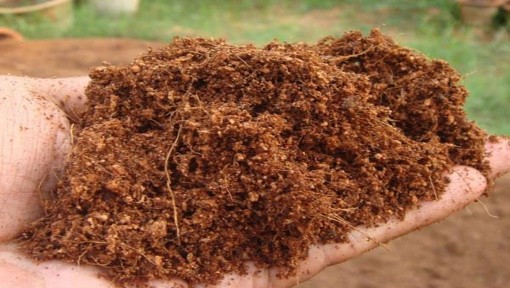
Figure 3.1. a) Coconut fiber
+ Perlite substrate: Perlite is also known as pearl stone. It is an inert rock containing high silica content, formed at high temperatures naturally in volcanic lava flows or artificially produced through thermal reactions to create perlite. Perlite is in the form of cavities (porous form), so perlite has a large volume but is extremely light, melting point is 1260 degrees Celsius and in cavities. Therefore, the ability to apply in agriculture is extremely effective. Most nursery growers in the US use perlite mixed at a ratio of 30% - 50% (depending on the type of plant) with nutritious soil to grow common plants, or mixed with other types of inert, hydrated substrates such as rockwool or soft white coir. In Vietnam, it is often mixed with tannin-treated coconut bran. Because perlite has a cavernous structure, it can absorb water, nutrients, regulate temperature and humidity for the growing medium, making the soil loose and airy, helping the roots to develop very strongly. From there, the tree will produce fruit with high yield, more flowers and more beautiful. Especially for projects of planting trees and flowers on roofs or high-rise buildings, perlite will help reduce the weight of the growing medium by 30-50%.