performance: are they truly linked in SMEs? , International Journal of Innovation Science, 11(1), pp. 48–62.
83. March, JG & Sutton, RI (1997), Organizational Performance as a Dependent Variable , Organization Science, 8(6), pp. 563-578.
84. Menon, A. & Yao. D (2017), Elevating Repositioning Costs: Strategic Dynamics and Competitive Interactions in Grand Strategy , Strategic Management Journal, 38 (10), pp. 1953-1963.
85. Merrilees, B. & associates (2011), Marketing Capabilities: Antecedents and Implications for B2B SME Performance , Industrial Marketing Management, 40(3), pp. 368–375.
86. Morgan, N. & associates (2009), Market orientation, marketing capabilities, and firm performance, Strategic Management Journal, 30(8), pp. 909–920.
87. Murray, J. & colleagues (2011), Market orientation and performance of export ventures: The process through marketing capabilities and competitive advantages, Journal of the Academy of Marketing Science, 39(2), pp. 252–269.
88. Najafi-Tavani, S. & associates (2016), Market orientation, marketing capability, and new product performance: The moderating role of absorptive capacity, Journal of Business Research, 69(11), pp. 5059–5064.
89. Neely, A. & associates (2002), The Performance Prism: The Scorecard for Measuring and Managing Business Success. London, UK: Pearson Education Ltd.,.
90. Ni, N. & Wan, F. (2008), A Configurational Perspective of Branding Capabilities Development in Emerging Economies: The Case of the Chinese Cellular Phone Industry , Journal of Brand Management, 15(6), pp. 433–451.
91. O'Sullivan, D. & Dooley, L. (2009), Applying Innovation. CA: SAGE Publications Inc; Thousand Oaks.
92. Odoom, R. & associates (2017), Branding capabilities and SME performance in an emerging market: The moderating effect of brand regulations , Marketing Intelligence and Planning, 35(4), pp. 473–487.
93. Oh, L. & associates (2012), The effects of retail channel integration through the use of information technologies on firm performance, Journal of Operations Management, 30(5), pp. 368–381.
94. Pan, W. & associates (2019), PESTEL Analysis of Construction Productivity Enhancement Strategies: A Case Study of Three Economies , Journal of Management in Engineering, 35(1).
95. Paswan, A. & associates (2020), Innovation-branding: Should all firms be equally ambidextrous? , Journal of Product and Brand Management.
96. Pentina, I. & Hasty, R. (2009), Effects of Multichannel Coordination and E-Commerce Outsourcing on Online Retail Performance , Journal of Marketing Channels, 16(4), pp. 359–374.
97. Porter, M. (1985), Competitive advantage: creating and sustaining superior performance. The Free P. New York, NY.
98. Protogerou, A. & associates (2012), Dynamic capabilities and their indirect impact on firm performance , Industrial and Corporate Change, 21(3), pp. 615–647.
99. Rehman, K. & Saeed, Z. (2015), Impact of Dynamic Capabilities on Firm Performance : Moderating Role of Organizational Competencies , Journal of Management and Business, 2(2), pp. 20–42.
100. Rothaermel, FT (2016), Strategic management , 3rd ed. New York, USA: McGraw-Hill.
101. Rufaidah, P. (2016), Dynamic capability in branding strategy development , International Journal of Economics and Management, 10(Special Issue), pp. 183– 196.
102. Salvato, C. (2009), Capabilities Unveiled: The Role of Ordinary Activities in the Evolution of Product Development Processes, Organization Science, 20(2), pp. 384–409.
103. Saunila, M. & al.(2014), The relationship between innovation capability and performance: The moderating effect of measurement , International Journal of Productivity and Performance management, 63(2), pp. 234–249.
104. Schreiber, J.B. & associates (2010), Reporting Structural Equation Modeling and Confirmatory Factor Analysis Results: A Review , The journal of Educational Research, 99(6), pp. 323–338.
105. Sekaran, U. & Bougi, R. (2010), Research Methods for Business: A skill building approach. 5th edition. New Delhi: Wiley India (Pvt), Ltd.
106. Simons, R. (1995), Levers of Control: How Managers use Innovative Control Systems to Drive Strategic Renewal , Boston, MA: Harvard Business School Press.
107. Tagashira, T. & Minami, C. (2019), The Effect of Cross-Channel Integration on Cost Efficiency , Journal of Interactive Marketing, 47, pp. 68–83.
108. Tavani, S. & associates (2014), A study of contingency relationships between supplier involvement, absorptive capacity and agile product innovation, International Journal of Operations and Production Management, 34(1), pp. 65–92.
109. Teece, D. & Pisano, G. (1994), The dynamic capabilities of firms: an introduction, Industrial and corporate change, 3(3), pp. 537–556.
110. Teece, D. & associates (1997), Dynamic capabilities and strategy
management, Strategic Management Journal, 18(7), pp. 509–533.
111. Teece, D. (2007), Explicating dynamic capabilities: the nature and microfundations of (sustainable), enterprise performance, Strategic Management Journal, 28(13), pp. 1819–1350.
112. Teece, D. (2009), Dynamic capabilities and strategic management . Oxford: Oxford University Press.
113. Teece, DJ (2017), Business models and dynamic capabilities , Long Range Planning.
114. Terziovski, M. (2010), Innovation practice and its performance implications in small and medium enterprises (SMEs), in the manufacturing sector: A resource based view, Strategic Management Journal, 31(8), pp. 892–902.
115. Todorova, G. & Durisin, B. (2007), Absorptive capacity: valuing a reconceptualization , Academy of management review, 32(3), pp. 774–786.
116. Torres, R. & associates (2018), Enabling firm performance through business intelligence and analytics: A dynamic capabilities perspective , Information and Management. Elsevier BV, 55(7), pp. 822–839.
117. Tsai, SP (2015), Dynamic Marketing Capabilities and Radical Innovation Commercialization , International Journal of Technology Management, 67(2–4), pp. 174–195.
118. Tseng, SM & Lee, PS (2014), The effect of knowledge management capability and dynamic capability on organizational performance , Journal of Enterprise Information Management, 27(2), pp. 158–179.
119. Tu, Q. & associates (2006), Absorptive capacity: Enhancing the assimilation of time-based manufacturing practices , Journal of Operations Management, 24(5), pp. 692–710.
120. Tzokas, N. & associates (2015), Absorptive capacity and performance: The role of customer relationship and technological capabilities in high-tech SMEs , Industrial Marketing Management, 47, p. 134–142.
121. Urbach, N. & Ahlemann, R. (2010), Structural Equation Modeling in Information Systems Research Using Partial Least Squares , Journal of information technology theory and applications, 11(2), pp. 5–40.
122. Victorino, L. & associates (2005), Service innovation and customer choices in the hospitality industry , Managing Service Quality, 15(6), pp. 555–576.
123. Vijaya, S. & colleagues (2017), Dynamic capabilities: a morphological analysis framework and agenda for future research , European Business Review, 29(6), pp. 6–19.
124. Wang, C. & Ahmed, PK (2004), The development and validation of the organizational innovation construct using confirmatory factor analysis , European Journal of Innovation Management, 7(4), pp. 303–313.
125. Wang, C. & Ahmed, P.K. (2007), Dynamic capabilities: a review and research agenda, International Journal of Management Review, 9(1), pp. 31–51.
126. Wang, H. & Sengupta, S. (2016), Stakeholder relationships, brand equity, firm performance: A resource-based perspective, Journal of Business Research, 69(12), pp. 5561–5568.
127. Wernerfelt, B (1984), A Resource-Based View of the Firm , Strategic Management Journal, 5(2), pp. 171–180.
128. Wilden, R. & associates (2013), Dynamic capabilities and performance: strategy, structure and environment, Long Range Planning, 46(1), pp. 72–96.
129. Williamson, PJ (2016), Building and Leveraging Dynamic Capabilities: Insights from Accelerated Innovation in China , Global Strategy Journal, 6(3), pp. 197–210.
130. Wilson, H. & Daniel, E. (2007), The multi-channel challenge: A dynamic capability approach, Industrial Marketing Management, 36(1), pp. 10–20.
131. Winter, SG (2003), Understanding dynamic capabilities, Strategic Management Journal, 24 (10 special issues), pp. 991–995.
132. Wong, HY & Merrilees, B. (2008), The performance benefits of being brand-oriented, Journal of Product and Brand Management, 17(6), pp. 372–383 .
133. Wu, WY & Nguyen, PT (2019), The antecedents of dynamic service innovation capabilities: The moderating roles of market dynamism and market orientation , International Journal of Innovation Management, 23(7), pp. 1–30.
134. Xia, Y. & Zhang, G.P. (2010), The Impact of the Online Channel on Retailers Performances: An Empirical Evaluation , Decision Sciences, 41(3), pp. 517–546.
135. Yan, R. & associates (2010), Channel integration and profit sharing in the dynamics of multi-channel firms , Journal of Retailing and Consumer Services, 17(5), pp. 430–440.
136. Zahra, S. & George, G. (2002), Absorptive Capacity: A Review, Reconceptualization, and Extension, The Academy of Management Review, 27(2), pp. 185–203.
137. Zahra, S. & colleagues (2006), Entrepreneurship and Dynamic Capabilities: A Review, Model and Research Agenda , Journal of management studies, 43(3), pp. 917–954.
138. Zhang, M. & colleagues (2018), The impact of channel integration on consumer responses in omni-channel retailing: The mediating effect of consumer empowerment , Electronic Commerce Research and Applications, 28, pp. 181–193.
139. Zollo, M. & Winter, S. (2002), Deliberate learning and the evolution of dynamic capabilities , Organization Science, 13(3), pp. 339–351.
APPENDIX
APPENDIX 1: RESEARCH MODEL FROM OVERVIEW OF RELATED RESEARCH SITUATION
Author
Research model | |
Research model of Fang & Zou (2009) |
|
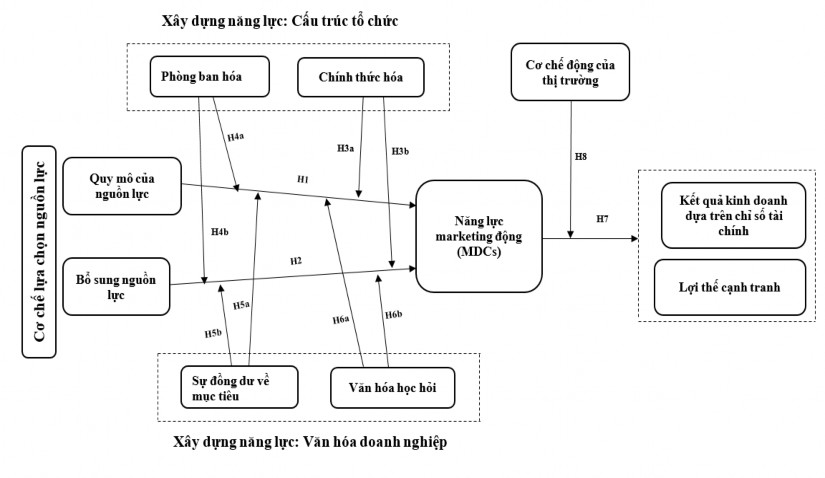
Maybe you are interested!
-

 Building a Research Model of Factors Affecting Agribank's Brand Value
 -
 Research on EBAY's online auction model and recommendations for Vietnam - 1
 -
 Overview of Research Status of Previous Year's Projects
 -
 Overview of Research Works Related to the Topic
 -
 Research Model (Source: Author's Proposal)
Research model of Chien & Tsai (2012)
|