
Occupational safety and industrial hygiene techniques are therefore closely related. When manufacturing equipment and assembling refrigeration systems, special attention must be paid to safety and industrial hygiene techniques, because occupational safety conditions also depend on design solutions and selection of system equipment.
All machines and equipment of the refrigeration system must be manufactured, installed and maintained in accordance with the standard documents on labor safety and the regulations on fire prevention and fighting in force.
In our country, on March 11, 1986, the State Committee for Science and Technology (now the Ministry of Science, Technology and Environment) issued the Vietnamese standard on refrigeration system safety techniques: TCVN 4206 - 86, effective from January 1, 1987. This standard specifies the requirements to be implemented in the design, manufacture, installation, operation and repair of refrigeration systems.
1.2. General terms
Only the following persons are allowed to operate the machine and refrigeration system who have been legally certified through a specialized training course in refrigeration operation.
Maybe you are interested!
-

 Solutions for Security and Travel Safety
 -
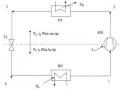 Basic Refrigeration Refrigeration and Air Conditioning Engineering - Intermediate - Ha Nam Vocational College 2020 - 1
 -
 Evaluation of anesthetic efficacy and safety of target-controlled propofol anesthesia for retrograde ureteroscopy in outpatients - 2
 -
 Electrical safety textbook for industrial electricity at college level - Vietnam - Korea Vocational College, Hanoi city - 4
 -
 Food safety and commodities Restaurant Management - Dalat College of Technology - 2
- For electricians: Must have a professional certificate at the level of electrical equipment operator.
Machine operators must master:
- Basic knowledge of processes in refrigeration.
- Properties of refrigerant.
- Rules for equipment repair and refrigerant charging.
- How to keep a log and minutes of air conditioner operation.
Every year, the refrigeration factory needs to organize a check on employees' awareness of safety techniques in general and air conditioning system safety and hygiene in particular.
All employees in the factory must clearly understand safety techniques and first aid in case of accidents.
Must register with the State Inspectorate for occupational safety inspection of pressure equipment and electrical safety.
Air conditioning operating procedures must be posted in the machine operating room. Unauthorized persons are prohibited from entering the machine room.
The engine room must have fire fighting equipment and means in case of fire. All fire fighting equipment must be ready, have a person in charge and regularly maintain the equipment.
Do not pour gasoline, kerosene and other flammable liquids in the machine room. Do not allow machine operators to drink alcohol during machine operating hours.
Refrigeration enterprises must establish an agency labor safety committee headed by the agency head to inspect and remind the implementation of labor safety regulations and work with superior agencies when necessary.
In order for the technical safety inspection agency to allow the use of machinery, equipment and refrigeration systems, the following preparation steps are required:
- There is a written request from the head of the using unit. The document must clearly state the purpose, requirements for using the machine and equipment, and the operating parameters of the equipment.
- Have a registration application with full technical documents: equipment layout drawings. System schematic diagram, testing, measuring and protection tools. Machine and equipment structure drawings. Acceptance and installation documents in accordance with design and technical requirements. Machine operation and troubleshooting procedures. Inspection report of technical safety inspector after installation.
1.3. Circulars promulgating national technical regulations on labor safety for refrigeration systems
Pursuant to Decree No. 106/2012/ND-CP dated December 20, 2012 of the Government stipulating the functions, tasks, powers and organizational structure of the Ministry of Labor - Invalids and Social Affairs;
Pursuant to Decree No. 127/2007/ND-CP dated August 1, 2007 of the Government detailing the implementation of a number of articles of the Law on Technical Standards and Regulations;
Pursuant to Decree No. 132/2008/ND-CP dated December 31, 2008 of the Government detailing the implementation of a number of articles of the Law on Product and Goods Quality;
At the request of the Director of the Department of Labor Safety;
The Minister of Labor, War Invalids and Social Affairs issued a Circular stipulating National Technical Regulations on labor safety for Refrigeration Systems.
Article 1. Promulgated together with this Circular is the National Technical Regulation on labor safety for Refrigeration systems.
Symbol: QCVN 21:2015/BLDTBXH.
Article 2. This Circular takes effect from January 25, 2016.
Article 3. Ministries, ministerial-level agencies, Government agencies, People's Committees of provinces and centrally run cities and relevant organizations and individuals are responsible for implementation.
1.3.1. General provisions
1.3.1.1. Scope of regulation
a. This regulation specifies safety requirements for people and equipment during the production, import, circulation, installation and operation of refrigeration systems.
b. This standard applies to refrigeration systems in which the refrigerant evaporates and condenses in a closed circuit, including heat pumps and absorption systems, except systems using water or air as the refrigerant.
c. This standard applies to newly installed refrigeration systems and refrigeration systems that are moved from one operating position to another, except for refrigeration systems designed for moving vehicles such as refrigerated trucks or refrigeration systems on ships.
This standard also applies to cases where the refrigeration system changes from one refrigerant to another.
1.3.1.2. Applicable subjects
This standard applies to:
a. Organizations and individuals that manufacture, import, circulate, install and use refrigeration systems;
b. Other relevant agencies, organizations and individuals.
c. Machinery room: A room containing the components of the refrigeration system (for safety reasons) but excluding rooms containing evaporators, condensers or piping.
d. Piping: Pipes that connect different parts of the refrigeration system.
e. Safety device: A valve or bursting disc is designed to automatically relieve pressure when the pressure is too high.
f. Refrigerant: is a medium used in the reverse thermodynamic cycle to absorb heat from the environment that needs to be cooled and transfer heat to the environment with a higher temperature.
g. Welded joints: Sealed joints are made by joining metal parts together in a plastic or molten state.
h. In this Regulation, in addition to the above terms, the terms defined in TCVN 6104:1996 (ISO 5149:1993) Refrigeration and heating systems - Safety requirements also apply.
1.3.2. Technical regulations
1.3.2.1. General provisions
Refrigeration systems subject to the subject and scope of Section 1 must ensure minimum technical characteristics according to technical requirements of TCVN 6104:1996 (ISO 5149:1993).
1.3.2.2. Specific regulations
Safety requirements and measures for refrigeration systems are established based on the following factors: refrigeration space, refrigeration method, and refrigerant.
Apply the refrigeration system classification according to Chapter 2 - Classification of TCVN 6104:1996 (ISO 5149:1993).
Classification by refrigerant does not apply to: R11, R12, R13, R502 which are now banned.
1.4. Labor safety standards in construction and installation of refrigeration systems
Labor safety standards in the construction and installation of industrial air conditioners in particular and refrigeration systems in general have been specifically regulated in the "National technical regulations on labor safety for refrigeration systems" - QCVN 21: 2015/BLDTBXH.
Based on this regulation, there are some most important points to pay attention to including:
Those involved in the installation of refrigeration systems must be fully trained in both technical skills, professional knowledge of the equipment, and occupational safety and hygiene standards related to the work. Technicians must complete training courses and receive such certification.
For each different system, the installer needs to understand the structure, operation and design. In addition, they also need to understand the factors that can affect health and safety.
This information should be compiled into a complete set of instructions and provided before the installation work is carried out. These should include safety instructions, electrical system diagrams, information about the machinery and equipment used, and blueprints.
Workers involved in the installation of refrigeration systems must be provided with appropriate protective equipment. These products must be suitable not only for the user but also for the type of refrigeration system and the refrigerant used in the system.
Necessary personal equipment includes protective clothing, gas masks, protective gloves, and safety helmets. Every time workers go to the construction site, they must comply with these clothing regulations to ensure safety.
The main system installation units are companies and service centers that provide services related to the installation of refrigeration systems. These units are responsible for providing quality labor and ensuring safety equipment for workers. Therefore, only units that meet certain requirements are capable of providing quality and safe services.
Required standards:
- Legal entity, registered to operate in the field of refrigeration systems
- Have enough technical staff who are well-trained in the field. Have enough skilled technical staff who have the required occupational safety and health certificates.
- Have sufficient technical and technological qualifications for the work of installing and adjusting the refrigeration system.
- Comply with the manufacturer's installation, operation and usage instructions and ensure the technical parameters of the refrigeration system according to the technical documents.
- After installation, complete documents on operating instructions, safe use of the refrigeration system and periodic maintenance and inspection must be prepared for the user unit.
- In addition to the above highlights, you can read in detail the requirements and other related issues in the "National technical regulations on labor safety for refrigeration systems". In addition to labor safety standards, this regulation also specifies basic technical issues to ensure safety in other jobs including repair, maintenance, and operation of refrigeration systems.
- First of all, cooperating with a unit that fully ensures labor safety standards will help you minimize the risks that the project may encounter. Risks to human safety can affect the efficiency and progress of the refrigeration system construction. Not only that, the concerns of companies besides profits are human issues. It is people who are the factor that helps the company achieve sustainable development. Therefore, ignoring the factor of human safety will be an unwise move.
2. REFRIGERANTS IN SAFETY TECHNIQUES
2.1. Definition
Refrigerant (also known as refrigerant, refrigerant gas or refrigerant) is a medium used in the reverse thermodynamic cycle to absorb heat from a low-temperature environment and release heat to a higher-temperature environment. The refrigerant circulates in the refrigeration system through the compression process. In a vapor compression air conditioner, heat is absorbed from a low-temperature environment through the evaporation process at low pressure and low temperature, heat is released to a high-temperature environment through the condensation process at high pressure and high temperature, the pressure is increased by the vapor compression process and the pressure is reduced by the throttling or liquid expansion process in a gas compression air conditioner, the refrigerant does not change state, always in the gaseous state.
2.2. Classification of media
Classification of refrigerant groups according to safety techniques
According to the technical safety perspective of refrigeration systems, refrigerants are divided into three groups 1, 2, 3 as in Appendix 1 TCVN 4206 - 86.
Group 1 includes refrigerants that are non-flammable, non-toxic or have negligible toxicity.
Group 2 includes less toxic refrigerants, with the lowest flammability and explosive limit in air volume not less than 3.5%.
Group 3 includes refrigerants that are relatively toxic, flammable and explosive.
The lowest flammability and explosive limit in volume is not less than 3.5%.
2.3. Freon destroys the ozone layer
Through many studies, German professor Paul Crutzen discovered the degradation and holes in the ozone layer. In 1974, two American professors Sherwood Powland and Mario Molina discovered that freon refrigerants destroy the ozone layer. Today, people confirm that freon is not only the culprit of destroying the ozone layer but also causes the greenhouse effect that warms the earth. In 1995, the three professors were awarded the Nobel Prize in Chemistry. This award emphasizes the importance of protecting the environment against freon substances that are harmful to the ecological environment. The discoveries of the three professors led to the 1985 Vienna Convention.
The Montreal Protocol of 1987 and the international conferences of 1990 in London, 1991 in Nairobi and 1992 in Copenhagen. The main content is to strictly control the production and use of harmful freons, leading to the suspension of their production and use worldwide. These substances are collectively called ODS (ozone Deplcption. Substances) or ozone-depleting substances.
The ozone layer is a layer of the atmosphere with a thickness of a few millimeters, 10 to 50 km above the surface of the earth. The ozone layer is considered the earth's shield, protecting the earth's creatures against the sun's harmful ultraviolet rays. The consequences will be unpredictable if the ozone layer is degraded and destroyed. At that time, harmful ultraviolet rays will reach the earth, burning the skin and causing skin cancer. People discovered the degradation of the ozone layer since 1950, but it was not until 1974 that the culprit was discovered to be freon substances containing chlorine, especially CFCs.
Although these freons are heavier than air, after many years they still climb to the stratosphere. Under the influence of sunlight, they decompose into chlorine atoms. Chlorine acts as a catalyst to destroy ozone molecules into
O 2 . Ozone O 3 has the ability to block ultraviolet rays, but O 2 does not have that ability. So when the ozone layer is destroyed, the ability to filter ultraviolet rays also disappears and living things are at risk of being destroyed by the sun's ultraviolet rays. Because chlorine exists for a long time in the atmosphere, the ability to destroy ozone is very large. It is estimated that each chlorine atom can destroy up to 100,000 ozone molecules.
HCFC freons (substances derived from mela, ether... containing do, fluorine and hydrogen) are less dangerous because their stability is less than that of CFCs. They usually decompose before reaching the stratosphere so their ability to destroy the ozone layer is smaller.
In particular, HFC freons (derivatives containing only Ao and hydrogen) do not have the effect of destroying the ozone layer. Thus, freons have different effects on the ozone layer. To evaluate the ozone layer destruction ability of different refrigerants, people use the ODP (Ozone Depletion Potential) index.
2.4. Vietnam's ODS elimination program
To date, about 176 countries have ratified the Vienna Convention and the Montreal Protocol, of which more than 100 are developing countries. Although the protocol stipulates that developing countries will not begin to consume ODS until 1999, more than 80 countries have national programs (NCPs) to eliminate ODS, including Vietnam. The program aims to eliminate about 50,000 tons of ODS, accounting for nearly 1/3 of the countries' consumption.
Vietnam joined the decree from January 1994 and assigned the General Department of Hydrometeorology to preside over the development of a national program to eliminate ODS and call on countries and international organizations for financial and technological support.
This is a very positive and timely action to meet the requirements of a party to the Protocol, and not only that, it also prevents Vietnam from becoming a dumping ground for outdated technologies. This is the time when companies in developed industrial countries eliminate and offer old technologies at low prices. Without understanding or prohibitive policies, this old technology can easily enter developing countries due to the attractiveness of prices, causing instability for the future.
Vietnam does not produce ODS but only imports it according to demand. According to the investigation of the General Department of Hydrometeorology, in 1993 Vietnam imported and used 409.86 tons, an average of 0.004 kg/person/year, belonging to group III of less than 0.3 kg/person, one of the five groups consuming the least ODS in the world. According to the UN regulations, the group