
The second form of franchising is the form of signing a contract between foreign fashion brands and domestic partners, which can be retailers or manufacturers, to establish a joint venture company to supply products under the brands of these brands. In this method, foreign fashion brands have another purpose, which is to create products that suit domestic consumption needs. For example, when participating in the domestic market, foreign brands always want to satisfy consumers' tastes in terms of design and style, and to suit their body shape. To do this, these brands often cooperate with domestic manufacturing companies to take advantage of these companies' understanding of domestic consumers. Therefore, the products produced will be more suitable and also to increase competitive advantage. On the contrary, domestic companies can use the reputation, brand, know-how, and design style of major fashion brands. Specifically, in the case of Kolon Fashion, one of the major Korean fashion companies, signed a franchise agreement with foreign fashion brand Christian Lacroix, a brand of Louis Vuitton. Accordingly, this company will use the brand and design style of Christian Lacroix for its line of men's suits. This product meets the needs of Korean male consumers in terms of design and body shape, so it is very popular in the domestic market.
2.2.3. Managed vertical integration (Administered VMS)
This is the main form of vertical integration in the Korean textile distribution network. In this form, distributors do not own the manufacturers, but the connection and unity in the distribution network are formed by the scale and the ability of one member to dominate the other members. For the Korean textile distribution network, the leading role belongs mainly to the retailers. As analyzed, the Korean garment market in general is dominated by a small number of retailers.
large retailers such as Lotte, Shinsegae, Cheil Industries, LG Corp. With their enormous size and potential, these retailers have the ability to influence the operations of small manufacturers. For example, in the case of Lotte, although this retailer does not own or operate any textile manufacturing companies. Instead, it has business relationships with nearly 200 domestic manufacturers and foreign fashion brands. The department store system of this retailer has provided more than 120 fashion brands. Among them are famous foreign fashion brands such as Channel, a French luxury fashion brand, Ferragamo, Fendi from Italy, or most recently, the Spanish brand Zara. 32
2.2.4. Horizontal Marketing System
Maybe you are interested!
-

 Illustration of Linkage Forms of Textile and Garment Enterprises in Textile and Garment Industry in China
 -
 The impact of social capital on business performance - a case study of the Textile and Garment industry in the Southern region of Vietnam - 36
 -
 Spillover effects of foreign direct investment on enterprises in Vietnam's textile and garment industry - 8
 -
 The problem of creating work motivation in the Vietnamese textile industry: current situation and solutions - 14
 -
 Training and development of technical workers in textile and garment enterprises in Hanoi - 2
To increase competitive advantage or improve operational efficiency, many Korean garment companies have merged to form groups of companies in the production, design and especially distribution stages. For example, the retail distribution system of E-land Group also includes many retailers merging together such as Homever, Kims Club, NC Department Store, NewCore Outlet and 2001 Outlet. In addition, domestic retailers have also linked up with foreign retailers in this form. For domestic companies, the benefit of linking up is to take advantage of scale and professional organization. On the contrary, domestic companies have the advantage of understanding and mastering the domestic market, which is a good basis for foreign companies to better implement marketing goals and meet the needs of the domestic market. In addition, retailers also link up with each other to expand scale and dominate the market. Such as the partnership between E-Land Group and Carrefour to build a large-scale discount store chain of 32 stores nationwide. This cooperation has made E-Land Group from the sixth place to the second largest retailer in Korea in terms of the number of stores. Carrefour is a French retailer and one of the largest retailers in the world.
32 Kim Chang Bo, Case Study – Retail , Lotte Department Store, www.fujitsu.com
world. Carrefour's experience and reputation, together with E-land Group's potential in the domestic market, have helped these two companies achieve significant success.
That is also the success of Tesco-Sumsung, one of the five largest retailers in Korea in terms of revenue. Tesco-Sumsung is the result of a joint venture between Samsung, the largest economic group (Chaebols) in Korea and Tesco, the largest retailer in the UK. Tesco-Samsung currently also owns one of the largest chains of discount stores selling apparel. Tesco's success is due to its correct marketing strategies, especially the "localization" strategy. Instead of using the same store model as in European countries, Tesco has built a style that suits the consumption habits of Koreans.
2.3. Wholesale system
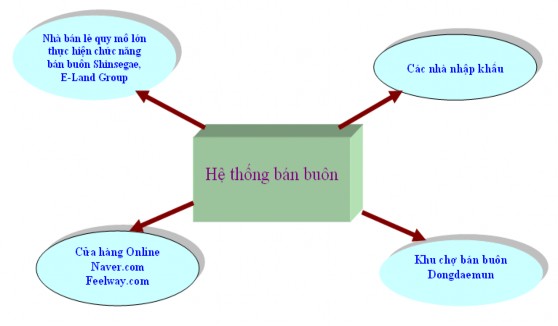
Figure 2.7: Textile wholesale system in Korea
2.3.1. Wholesalers are also large retailers
Although the textile distribution network in Korea has undergone profound changes over the years, the structure of the textile distribution network has remained the same.
In Korea, the textile industry is still dominated by retailers and a few manufacturers. The distribution channels that use wholesalers are mostly in the low- and medium-priced apparel market segments. Unlike in the US or Japan, where wholesalers play a central role in the distribution network, there are very few professional wholesalers in the Korean market. Many large Korean retailers also function as wholesalers, such as E-land Group, LG Fashion, or Samsung's Cheil Industries. These retailers build their own inventory facilities and organize their own logistics systems. Therefore, goods are requested from manufacturers according to a certain standard for each product type and are gathered in large quantities in the warehouses of these retailers. These shipments are then distributed in smaller volumes or by category or brand to the retail stores it operates or to the stores of other partners.
In addition, some of these retailers are also agents for some foreign luxury fashion brands. In this case, they do not directly own the goods but only organize and manage the distribution of these products through a chain of independent stores that specialize in selling the products of that brand. Their income in this case is commissions based on sales revenue. As in the case of Shinsegae, a member company of Samsung. Currently, Shinsegae is known as a retailer with a large department store chain in the area around Seoul, and the largest discount store chain in Korea 112 E-Mart. But besides that, Shinsegae also acts as an agent for luxury fashion brands including Armani, Coach, Dolce & Gabbana, Escada and St. Johnh. Shinsegae has distributed products of brands
This system has more than 250 stores nationwide, all under its control. 33
33 Yun-Jin Cho, Department stores as innovations in retail marketing , Journal of Macromarketing, August 2009.
2.3.2. Importers
Apparel wholesalers in Korea also include apparel importers from the United States, European countries, and Asia. Importers will distribute imported products to retailers and shopping malls. Imported products from the United States and some European countries, mainly France and Italy, are mainly product lines in the high-end fashion market segment. Therefore, these products will be distributed mainly in department stores or specialty stores.
For products from Asia, mainly China and some Southeast Asian countries, they are mainly in the low and medium price market segment. These products are often distributed in traditional markets and stalls. Imported products from these countries also tend to increase, creating competitive pressure on the domestic low and medium price product market. This makes the Korean garment market more vibrant and diverse in the race for design and price.
2.3.3. Wholesale markets
The Korean garment wholesale system in this form is relatively concentrated. In the markets, or large shopping areas, there are many small wholesalers. The most famous of which is Dongdaemun market, with the wholesale volume accounting for 80%. However, this market is known as the largest clothing retail market in Korea and in the world. Dongdaemooon is a complex of many small markets and shopping centers with an extremely large scale with more than 27,700 shops and small stalls. Every day, this market attracts more than 300,000 visitors, with an annual revenue of nearly 9 billion USD. Dongdaemun is divided into 3 main areas. In which, wholesalers are mostly concentrated in the traditional market including 19 wholesale markets with more than 15,200 separate shops. The other two areas are
mainly for retail stores and export products. Located in the traditional market area, Gwangjang Market and Pyunghwa Market are known as the two largest textile wholesale markets in Korea. The wholesale products in this market are very diverse, ranging from textile materials to clothing for men and women. Some stores specialize in selling inventory from domestic manufacturers or from other stalls in the center. Some even offer fake branded goods, mainly from China. Most small retailers prefer to source their goods from this market because of the variety of types, rich designs, and cheaper prices compared to other places.
Dongdaemun’s logistics and warehousing systems are specially designed to suit the structure of the market and the trading habits. The means of transporting goods from the production site to the area for consumption is mainly by motorbike. The motorbike transport fleets with large quantities usually operate around 9pm or later. The goods are transported in batches to the collection point and then distributed to each stall by porters.
The biggest characteristic of Dongdaemun wholesalers is that they are small in scale but distribute a wide variety of products. These wholesalers will consolidate the goods collected from different stalls into warehouses in each shopping complex. The consolidated goods will be distributed to small retailers in other localities. Some of these retailers form a retail cooperative and use the cooperative's fleet of trucks to transport goods from Dongdaemun. The costs will then be divided among the members.
The logistics system in Dongdaemun is managed in a systematic and strict manner, and the goods are preserved intact. The stages are coordinated in a rhythmic manner.
gentle and simple. That is one of the reasons why this market is increasingly attracting many garment wholesalers across the country. 34
2.3.4. Online wholesale store system
In addition, the system of online clothing wholesale stores in Korea is increasing. The benefits of online wholesale can be seen in the increase in customer value. Customers only need to order on the website and the goods will be delivered to their doorstep. In addition, when buying in large quantities via the Internet, customers also enjoy preferential prices . And another benefit is that online stores often offer designs with the most popular fashion trends. Therefore, online wholesale has become an effective method applied by many Korean textile and garment enterprises, including for export products. Famous online wholesale stores in Korea include: EC21.com, Naver.com or Feelway.com.
In general, the Korean textile wholesale system is facing increasingly serious challenges. Retailers and consumers of apparel place great importance on brand, price, and design. Manufacturers and retailers will not want to buy from wholesalers if they cannot create meaningful added value. Therefore, in the long run, to survive, wholesalers must continuously improve their services and reduce operating costs, while creating added value for products by increasing productivity and efficiency of the entire distribution system.
2.4. Retail distribution system
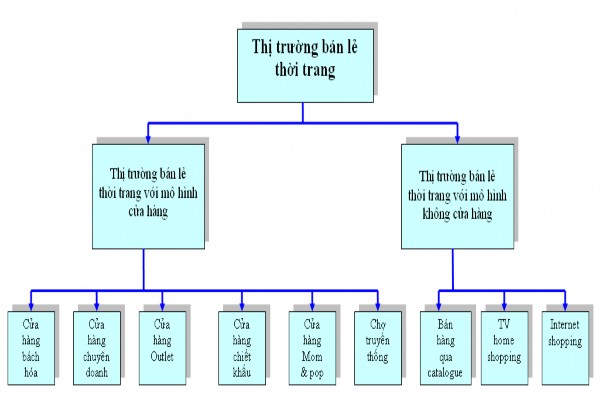
The Korean textile retail distribution system has exploded rapidly, with retail businesses playing a leading role in the distribution network. Retail forms are diverse, but mainly include the following main forms:
34 Se-ho Kyong, Textile Fahion Korea, Annua l , Korea Federation of Textile Industries, March 2008.
Figure 2.8: Forms of textile retail distribution in Korea
2.4.1. Department stores
This is an important textile distribution channel in Korea, and mainly targets the high-end fashion market. Department stores in Korea are very large in scale and are built in densely populated areas. These stores include many separate booths of different branded fashion brands. Department store owners do not directly participate in the process of purchasing and consuming goods, but receive commissions from renting booths at a rate of 15% to 35% of total sales revenue. Although department stores tend to decline, their revenue still accounts for the highest proportion among apparel retail types. In 2008, the retail revenue of apparel products through department stores accounted for the largest proportion compared to other retail forms at 34.5% (Figure 2.5).
In recent years, department stores have faced fierce competition from other types of retail such as discount stores and other distribution channels.