
DEPARTMENT OF LABOR, WAR INVALIDS AND SOCIAL AFFAIRS OF HA NAM PROVINCE
HA NAM VOCATIONAL COLLEGE
COURSE BOOK
SUBJECT: BASIC REFRIGERATION
OCCUPATION: REFRIGERATION AND AIR CONDITIONING TECHNICIAN QUALIFICATION: INTERMEDIATE VOCATIONAL COLLEGE
Issued with Decision No. 234 /QD - CDN dated August 5, 2020 of Ha Nam Vocational College
Ha Nam, 2020
COPYRIGHT STATEMENT
This document is a textbook and may be used in its entirety or excerpted for training and reference purposes.
Any other purpose that is deviant or used for unfair business purposes is strictly prohibited.
Based on this curriculum, it can be used to teach other levels or professions/occupations of the school.
INTRODUCTION
Along with the industrialization and modernization of the country, refrigeration technology is developing strongly in Vietnam. Refrigerators, commercial and industrial air conditioners, and air conditioners have become familiar in life and production. Refrigeration and air conditioning systems serving in life and production such as: processing, preserving food, beer, wine, printing, electronics, information, healthcare, sports, tourism... are playing a strong role in promoting the economy and improving life.
Along with the development of refrigeration technology, the training and development of a team of skilled technicians is of deep concern to the Party, the State, the School and every citizen so that they can master the machinery and equipment of the profession.
The textbook "Basic Refrigeration " is compiled for the vocational training program REFRIGERATION AND AIR CONDITIONING TECHNIQUE for the Intermediate Vocational level.
The content of the course provides the most basic knowledge about the use of refrigerants, coolants, refrigerant oils, insulation materials, dehumidifiers, knowledge about connection, assembly, operation of typical refrigeration system models; knowledge about testing equipment and models of refrigeration systems such as compressors, air conditioning systems, single-evaporator air conditioning systems, heat pumps...
Forming and practicing skills in processing pipes used in refrigeration and air conditioning engineering, identifying, checking, evaluating the status of equipment and accessories of refrigeration systems, installing, connecting, operating equipment and models of refrigeration and air conditioning systems with one or more evaporators, heat pumps... Skills in testing compressors, connecting, assembling, testing models of refrigeration systems, air conditioning systems with one evaporator, heat pumps... The textbooks used for teaching in Vocational Colleges and Vocational Secondary Schools can also be used as reference materials for schools with the same training system.
Because the curriculum outline closely follows the national framework program of the profession.
Certainly the course is not without shortcomings. We look forward to receiving your comments so that the course can be revised and improved.
Ha Nam, date month year 2020
Participate in editing
Tran Nhu Manh
INDEX
Page
COPYRIGHT STATEMENT 1
INTRODUCTION 2
TABLE OF CONTENTS 3
MODULE 5 COURSE BOOK
Module code: MD 20 5
Location, nature, meaning and role of module 5
Objectives of Module 5
Contents of module 5
LESSON 1: OVERVIEW OF COMMON TYPES OF AIR CONDITIONERS 6
Article code: MD20 - 01 6
1. Vapor compression air conditioner 6
2. Absorption air conditioner 11
3. Air compressor 16
4. EJECTO 21 air conditioner
5. Thermoelectric air conditioner 25
LESSON 2: TYPES OF REFRIGERATION COMPRESSOR 31
Article code: MD20 - 02 31
1. SLIDING PITTON COMPRESSOR 31
2. ROTARY PITTON COMPRESSOR 58
3. SCREW COMPRESSOR: 71
4. TURBINES 76
Lesson 3: CONDENSING EQUIPMENT 81
Article code: MD 20 - 03 81
1.WATER COOLED CONDENSER: 81
2. WATER AND AIR COOLED CONDENSER 93
3.AIR COOLED CONDENSER 100
Lesson 4: EVAPORATION 110
Article code: MD 20 – 04 110
1. LIQUID COOLING EVAPORATOR: 110
2. AIR COOLING EVAPORATOR: 121
Lesson 5: THROTTLE DEVICE 130
Article code: MD 20 - 05 130
1. Manual throttle 131
2.Capillary tube (spray cable): 131
3. TEV thermal expansion valve (also known as automatic expansion valve) 134
Lesson 6: AUXILIARY EQUIPMENT IN REFRIGERATION SYSTEM 143
Article code: MD 20- 06 143
1. COOLING TOWER: 143
2. OIL SEPARATOR, OIL CONTAINER: 149
3. CONTAINER: 159
4. LIQUID SEPARATOR 165
5. INTERMEDIATE TANK 174
6. HEAT RECOVERY EQUIPMENT: 179
7. NON-CONDENSABLE GAS SEPARATOR 184
8. FILTER DRYER: 190
9. PUMP, FAN: 195
Lesson 7: TOOLS IN REFRIGERATION SYSTEM 211
Article code: MD20 - 07 211
1.Stop valve 211
2. One-way valve: 212
3. Safety valve 213
4. Gas charging valve 214
5. Service valve 215
6. Pressure gauge 216
Lesson 8: AUTOMATIC EQUIPMENT FOR REFRIGERATION SYSTEMS 222
Article code: MD20 - 08 222
1. OIL PRESSURE RELAY 222
2. LOW PRESSURE RELAY: 224
3. HIGH PRESSURE RELAY 225
4. DUAL PRESSURE RELAY 226
5. TEMPERATURE CONVERTER 228
6. TWO-POSITION TEMPERATURE REGULATOR: 230
7. SOLENOID VALVE 236
8. EVAPORATOR PRESSURE REGULATOR: 241
9. KVC AND CPCE 242 HOT STEAM BYPASS COOLING CAPACITY ADJUSTMENT TOOL
10. SUCTION PRESSURE OR CRANKCASE PRESSURE ADJUSTMENT TOOL 243
11. REFRIGERATION COMPRESSOR AUTOMATION 244
12. CONDENSING EQUIPMENT AUTOMATION 255
13. AUTOMATION OF EVAPORATORS: 257
REFERENCES 264
MODULE COURSE
Module code: MD 20
Location, nature, meaning and role of module
The basic refrigeration module is a basic module of the profession for vocational secondary school students after completing basic engineering subjects, refrigeration measurement, electrical modules and cold modules, welding; On the basis of the basic subject of refrigeration and air conditioning engineering, other supporting modules of the Basic Refrigeration Module supplement and provide students with the most basic knowledge and skills of the profession before going into advanced modules of the profession such as: Air conditioning, refrigeration...
Module Objectives
Knowledge
Presents the most basic knowledge about the use of refrigerants, coolants, refrigerant oils, insulation materials, dehumidifiers, and provides knowledge about connection, assembly, and operation of typical refrigeration system models.
Present knowledge about testing equipment and models of refrigeration systems such as compressors, air conditioning systems, single evaporator air conditioning systems, heat pumps...
Skill
Process pipes used in refrigeration engineering, identify, inspect, and evaluate the condition of refrigeration system equipment and accessories, install, connect, and operate equipment and models of typical refrigeration systems.
Practice skills in processing pipes used in refrigeration engineering, identify, check, and evaluate the status of equipment and accessories of refrigeration systems, install, connect, and operate equipment and models of refrigeration and air conditioning systems with an evaporator, heat pump... Skills in testing compressors, connecting, assembling, and testing models of refrigeration systems, air conditioning systems with an evaporator, heat pump...
Self-control and responsibility
Careful, precise, safe. Love the job, eager to learn.
Module Contents
LESSON 1: OVERVIEW OF COMMON TYPES OF AIR CONDITIONERS
Article code: MD20 - 01
Introduce
This article gives us an overview of the types of air conditioners used in production practice as well as in life to get a general picture of these types of air conditioners in the profession of Refrigeration and Air Conditioning Engineering; at the same time, determine the practical application of vapor compression air conditioners as the air conditioners mainly studied because of their diversity and utility.
Target
Present basic knowledge about common types of air conditioners that have practical significance and are widely applied in production and life.
Identify types of air conditioners and main equipment of vapor compression air conditioners in real refrigeration systems;
Practice observation skills, love of learning, curiosity, logical thinking, and study discipline.
Main content
1. Vapor compression air conditioner
Target:
- Present the basic working principle of vapor compression refrigeration used in production and life;
- Analyze the differences in working principles between types of air conditioners used in production and life;
- Draw the schematic diagram of the vapor compression refrigeration machine used in production and life;
- Distinguish the parts of a vapor compression air conditioner;
- Careful, accurate, safe
- Love the job, eager to learn.
1.1. Definition, schematic diagram
1.1.1. Definition:
Vapor compression air conditioner is a type of air conditioner with a mechanical compressor to suck in low pressure and low temperature refrigerant vapor in the evaporator and compress it to high pressure and high temperature and push it into the condenser. The refrigerant in the vapor compression air conditioner has a phase change (evaporation in the evaporator and condensation in the condenser) during the refrigeration cycle.
1.1.2. Schematic diagram:
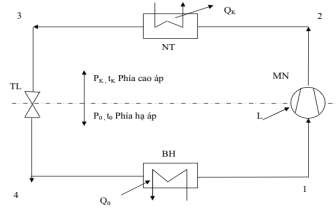
Figure 1.1. Schematic diagram of vapor compression air conditioner
MN: Compressor; NT: Condenser and heat recovery device Q K ; TL: Expansion valve; BH: Evaporator and cold recovery device Q 0 ;
These four parts are connected by pipes in the order shown in Figure 1.1.
1.2. Working principle and application:
In the evaporator, the liquid refrigerant boils at low pressure (P 0 ) and low temperature (t 0 ) due to heat absorption from the environment to be cooled, then is sucked back by the compressor and compressed to high pressure (P K ), high temperature (t K ), which is the adiabatic compression process 1–2.
The high pressure and high temperature refrigerant vapor is pushed by the compressor into the condenser. Here, the refrigerant vapor releases heat (Q K ) to the cooling medium and condenses, which is the condensation process of 2-3 refrigerants changing phase.
The high pressure, high temperature refrigerant liquid passes through the expansion valve to reduce the pressure (P 0 ) and temperature (t 0 ) to enter the evaporator, which is the throttling process 3–4.
The low pressure (P 0 ) and low temperature (t 0 ) refrigerant liquid in the heat-absorbing evaporator (Q 0 ) of the medium to be cooled boils and evaporates, creating a cooling effect, which is the 4-1 evaporation process.
* Application:
Vapor compression refrigeration is widely used in all economic sectors.
*Steps and how to do the job
1. EQUIPMENT, TOOLS, MATERIALS:
( Calculated for a practice session of 20 students)
TT
Equipment Type | Quantity | |
1 | Air conditioning model | 5 sets |
2 | Refrigerator model | 5 sets |
3 | Civil air conditioner model | 5 sets |
4 | Cold storage model | 2 sets |
5 | Pictures, drawings, catalogs of other types of air conditioners, other types of air conditioners | 3 sets |
Maybe you are interested!
-
 Power Electronics Refrigeration and Air Conditioning Engineering - College - Dong Thap Vocational College - 16
 -
 Power Electronics Air Conditioning and Refrigeration Engineering - College - Dong Thap Vocational College - 1
 -
 Refrigeration Safety Course Profession: Refrigeration and air conditioning engineering - College - Dong Thap Vocational College - 2
 -
 Basic electronic engineering - City College of Construction. HCM Part 1 - 1
 -
 Competing Competitive Advantages of Convenient Air and Sea Access
Power cord, electric pen, pliers, screwdriver | 5 sets |