
- About vocational training system.
The capital Vientiane is one of the earliest provinces to establish a system of vocational schools up to university. The capital Vientiane has the Department of Labor and Social Welfare with 19 vocational training centers; the training capacity is 3,000 people/year. Of which, 13 centers provide general training; 3 centers provide initial training to prepare for work. The capital manages 2 vocational training centers for youth and women according to each profession. These are the Vocational Skills Development Center and the Vientiane Friendship Vocational School.
- Hanoi trains in the fields of management - advanced accounting, business - accounting, office management, electrical skills, home electrical systems, air conditioning, agriculture, forestry and fishery, food processing, female and male hair styling, textile industry, aesthetics and information technology...
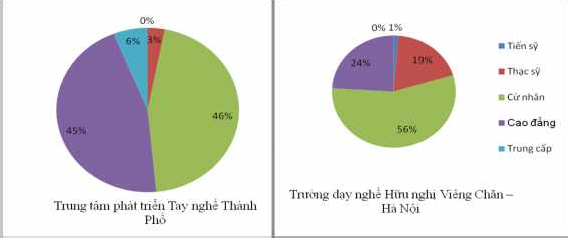
The number of vocational teachers at those two institutions has grown rapidly, and their technical expertise has changed a lot. As of 2013, there were 112 people, 60 of whom were female. In terms of qualifications: 17 people with post-graduate degrees, accounting for 15.18%; 93 people with university and college degrees, accounting for 83.03%, and 2 people with intermediate degrees, accounting for 1.78%.
To be more intuitive, the structure of the qualifications of the two above facilities can be shown in the following chart:
Chart 3.2 : Qualification structure of vocational teachers and staff in 2013
+ For the Vocational Skills Development Center: According to data from 2000 - 2005, 5,969 students were trained (3,053 female); 5,538 graduates were trained in 2006 - 2010, of which 3,647 were female; in 2011
- 2013: 1,458 students, 711 female. The center also organized training for local people and unemployed people in the fields of fish farming, frog farming, corn growing, mushroom growing, fruit trees..., motorbike, car and mobile phone repair... a total of 126 people (of which 51 are female).
+ Vientiane - Hanoi Friendship Vocational School, established in 2003, in 2004 - 2005 had 3 intermediate majors such as IT engineering (computer), accounting and office management with 210 vocational students, 89 of whom were female.
Up to now, the School has had college and university training programs with majors in computer business, information technology and IT finance - banking with the number of students in 2013 being 1,673 people (of which 696 are female).
Vocational training institutions have implemented the common goal of improving quality, expanding scale, ensuring conformity in occupational structure, training level, improving vocational training efficiency to meet the needs of technical human resources directly involved in production, business, services, etc.
Table 3.10: Number of workers receiving vocational training in Vientiane in the years 2005, 2010, 2013 [156], [157].
Unit: Person
Year
Branch
2005 | 2010 | 2013 | ||||
Total | Female | Total | Female | Total | Female | |
1. Electricity | 190 | 0 | 19 | 0 | 82 | 0 |
2. Computer IT Engineering | 170 | 78 | 56 | 21 | 16 | 5 |
3. Informatics Industry (accounting - business) | 184 | 128 | 148 | 113 | 183 | 153 |
4. Office management industry | 348 | 290 | 73 | 63 | 96 | 70 |
Maybe you are interested!
-
 Solutions for tourism development in Tien Lang - 10
zt2i3t4l5ee
zt2a3gstourism, tourism development
zt2a3ge
zc2o3n4t5e6n7ts
- District People's Committees and authorities of communes with tourist attractions should support, promote, and provide necessary information to people, helping them improve their knowledge about tourism. Raise tourism awareness for local people.
*
* *
Due to limited knowledge and research time, the thesis inevitably has shortcomings. Therefore, I look forward to receiving guidance from teachers, experts as well as your comments to make the thesis more complete.
Chapter III Conclusion
Through the issues presented in Chapter II, we can come to some conclusions:
Based on the strengths of available tourism resources, the types of tourism in Tien Lang that need to be promoted in the coming time are sightseeing and resort tourism, discovery tourism, weekend tourism. To improve the quality and diversify tourism products, Tien Lang district needs to combine with local cultural tourism resources, at the same time combine with surrounding areas, build rich tourism products. The strengths of Tien Lang tourism are eco-tourism and cultural tourism, so developing Tien Lang tourism must always go hand in hand with restoring and preserving types of cultural tourism resources. Some necessary measures to support and improve the efficiency of exploiting tourism resources in Tien Lang are: strengthening the construction of technical facilities and labor force serving tourism, actively promoting and advertising tourism, and expanding forms of capital mobilization for tourism development.
CONCLUDE
I Conclusion
1. Based on the results achieved within the framework of the thesis's needs, some basic conclusions can be drawn as follows:
Tien Lang is a locality with great potential for tourism development. The relatively abundant cultural tourism resources and ecological tourism resources have great appeal to tourists. Based on this potential, Tien Lang can build a unique tourism industry that is competitive enough with other localities within Hai Phong city and neighboring areas.
In recent years, the exploitation of the advantages of resources to develop tourism and build tourist routes in Tien Lang has not been commensurate with the available potential. In terms of quantity, many resource objects have not been brought into the purpose of tourism development. In terms of time, the regular service time has not been extended to attract more visitors. Infrastructure and technical facilities are still weak. The labor force is still thin and weak in terms of expertise. Tourism programs and routes have not been organized properly, the exploitation content is still monotonous, so it has not attracted many visitors. Although resources have not been mobilized much for tourism development, they are facing the risk of destruction and degradation.
2. Based on the results of investigation, analysis, synthesis, evaluation and selective absorption of research results of related topics, the thesis has proposed a number of necessary solutions to improve the efficiency of exploiting tourism resources in Tien Lang such as: promoting the restoration and conservation of tourism resources, focusing on investment and key exploitation of ecotourism resources, strengthening the construction of infrastructure and tourism workforce. Expanding forms of capital mobilization. In addition, the thesis has built a number of tourist routes of Hai Phong in which Tien Lang tourism resources play an important role.
Exploiting Tien Lang tourism resources for tourism development is currently facing many difficulties. The above measures, if applied synchronously, will likely bring new prospects for the local tourism industry, contributing to making Tien Lang tourism an important economic sector in the district's economic structure.
REFERENCES
1. Nhuan Ha, Trinh Minh Hien, Tran Phuong, Hai Phong - Historical and cultural relics, Hai Phong Publishing House, 1993
2. Hai Phong City History Council, Hai Phong Gazetteer, Hai Phong Publishing House, 1990.
3. Hai Phong City History Council, History of Tien Lang District Party Committee, Hai Phong Publishing House, 1990.
4. Hai Phong City History Council, University of Social Sciences and Humanities, VNU, Hai Phong Place Names Encyclopedia, Hai Phong Publishing House. 2001.
5. Law on Cultural Heritage and documents guiding its implementation, National Political Publishing House, Hanoi, 2003.
6. Tran Duc Thanh, Lecture on Tourism Geography, Faculty of Tourism, University of Social Sciences and Humanities, VNU, 2006
7. Hai Phong Center for Social Sciences and Humanities, Some typical cultural heritages of Hai Phong, Hai Phong Publishing House, 2001
8. Nguyen Ngoc Thao (editor-in-chief, Tourism Geography, Hai Phong Publishing House, two volumes (2001-2002)
9. Nguyen Minh Tue and group of authors, Hai Phong Tourism Geography, Ho Chi Minh City Publishing House, 1997.
10. Nguyen Thanh Son, Hai Phong Tourism Territory Organization, Associate Doctoral Thesis in Geological Geography, Hanoi, 1996.
11. Decision No. 2033/QD – UB on detailed planning of Tien Lang town, Hai Phong city until 2020.
12. Department of Culture, Information, Hai Phong Museum, Hai Phong relics
- National ranked scenic spot, Hai Phong Publishing House, 2005. 13. Tien Lang District People's Committee, Economic Development Planning -
Culture - Society of Tien Lang district to 2010.
14.Website www.HaiPhong.gov.vn
APPENDIX 1
List of national ranked monuments
STT
Name of the monument
Number, year of decisiondetermine
Location
1
Gam Temple
938 VH/QĐ04/08/1992
Cam Khe Village- Toan Thang commune
2
Doc Hau Temple
9381 VH/QĐ04/08/1992
Doc Hau Village –Toan Thang commune
3
Cuu Doi Communal House
3207 VH/QĐDecember 30, 1991
Zone II of townTien Lang
4
Ha Dai Temple
938 VH/QĐ04/08/1992
Ha Dai Village –Tien Thanh commune
APPENDIX II
STT
Name of the monument
Number, year of decision
Location
1
Phu Ke Pagoda Temple
178/QD-UBJanuary 28, 2005
Zone 1 - townTien Lang
2
Trung Lang Temple
178/QD-UBJanuary 28, 2005
Zone 4 – townTien Lang
3
Bao Khanh Pagoda
1900/QD-UBAugust 24, 2006
Nam Tu Village -Kien Thiet commune
4
Bach Da Pagoda
1792/QD-UB11/11/2002
Hung Thang Commune
5
Ngoc Dong Temple
177/QD-UBNovember 27, 2005
Tien Thanh Commune
6
Tomb of Minister TSNhu Van Lan
2848/QD-UBSeptember 19, 2003
Nam Tu Village -Kien Thiet commune
7
Canh Son Stone Temple
2160/QD-UBSeptember 19, 2003
Van Doi Commune –Doan Lap
8
Meiji Temple
2259/QD-UBSeptember 19, 2002
Toan Thang Commune
9
Tien Doi Noi Temple
477/QD-UBSeptember 19, 2005
Doan Lap Commune
10
Tu Doi Temple
177/QD-UBJanuary 28, 2005
Doan Lap Commune
11
Duyen Lao Temple
177/QD-UBJanuary 28, 2005
Tien Minh Commune
12
Dinh Xuan Uc Pagoda
177/QD-UBJanuary 28, 2005
Bac Hung Commune
13
Chu Khe Pagoda
177/QD-UBJanuary 28, 2005
Hung Thang Commune
14
Dong Dinh
2848/QD-UBNovember 21, 2002
Vinh Quang Commune
15
President's Memorial HouseTon Duc Thang
177/QD-UBJanuary 28, 2005
NT Quy Cao
Ha Dai Temple
Ben Vua Temple
Tien Lang hot spring
div.maincontent .p { color: black; font-family:"Times New Roman", serif; font-style: normal; font-weight: normal; text-decoration: none; font-size: 14pt; margin:0pt; } div.maincontent p { color: black; font-family:"Times New Roman", serif; font-style: normal; font-weight: normal; text-decoration: none; font-size: 14pt; margin:0pt; } div.maincontent .s1 { color: black; font-family:"Times New Roman", serif; font-style: normal; font-weight: normal; font-size: 16pt; } div.maincontent .s2 { color: black; font-family:"Times New Roman", serif; font-style: italic; font-weight: bold; text-decoration: none; font-size: 14pt; } div.maincontent .s3 { color: black; font-family:"Times New Roman", serif; font-style: italic; font-weight: normal; text-decoration: none; font-size: 14pt; } div.maincontent .s4 { color: black; font-family:"Times New Roman", serif; font-style: normal; font-weight: normal; font-size: 14pt; } div.maincontent .s5 { color: black; font-family:"Times New Roman", serif; font-style: normal; font-weight: bold; font-size: 14pt; } div.maincontent .s6 { color: black; font-family:"Times New Roman", serif; font-style: normal; font-weight: normal; text-decoration: none; font-size: 14pt; } div.maincontent .s7 { color: black; font-family:"Times New Roman", serif; font-style: normal; font-weight: bold; text-decoration: none; font-size: 14pt; } div.maincontent .s8 { color: black; font-family:"Times New Roman", serif; font-style: normal; font-weight: normal; text-decoration: none; font-size: 9pt; vertical-align: 6pt; } div.maincontent .s9 { color: black; font-family:"Times New Roman", serif; font-style: normal; font-weight: bold; text-decoration: none; font-size: 12pt; } div.maincontent .s11 { color: black; font-family:"Times New Roman", serif; font-style: normal; font-weight: normal; tex
Solutions for tourism development in Tien Lang - 10
zt2i3t4l5ee
zt2a3gstourism, tourism development
zt2a3ge
zc2o3n4t5e6n7ts
- District People's Committees and authorities of communes with tourist attractions should support, promote, and provide necessary information to people, helping them improve their knowledge about tourism. Raise tourism awareness for local people.
*
* *
Due to limited knowledge and research time, the thesis inevitably has shortcomings. Therefore, I look forward to receiving guidance from teachers, experts as well as your comments to make the thesis more complete.
Chapter III Conclusion
Through the issues presented in Chapter II, we can come to some conclusions:
Based on the strengths of available tourism resources, the types of tourism in Tien Lang that need to be promoted in the coming time are sightseeing and resort tourism, discovery tourism, weekend tourism. To improve the quality and diversify tourism products, Tien Lang district needs to combine with local cultural tourism resources, at the same time combine with surrounding areas, build rich tourism products. The strengths of Tien Lang tourism are eco-tourism and cultural tourism, so developing Tien Lang tourism must always go hand in hand with restoring and preserving types of cultural tourism resources. Some necessary measures to support and improve the efficiency of exploiting tourism resources in Tien Lang are: strengthening the construction of technical facilities and labor force serving tourism, actively promoting and advertising tourism, and expanding forms of capital mobilization for tourism development.
CONCLUDE
I Conclusion
1. Based on the results achieved within the framework of the thesis's needs, some basic conclusions can be drawn as follows:
Tien Lang is a locality with great potential for tourism development. The relatively abundant cultural tourism resources and ecological tourism resources have great appeal to tourists. Based on this potential, Tien Lang can build a unique tourism industry that is competitive enough with other localities within Hai Phong city and neighboring areas.
In recent years, the exploitation of the advantages of resources to develop tourism and build tourist routes in Tien Lang has not been commensurate with the available potential. In terms of quantity, many resource objects have not been brought into the purpose of tourism development. In terms of time, the regular service time has not been extended to attract more visitors. Infrastructure and technical facilities are still weak. The labor force is still thin and weak in terms of expertise. Tourism programs and routes have not been organized properly, the exploitation content is still monotonous, so it has not attracted many visitors. Although resources have not been mobilized much for tourism development, they are facing the risk of destruction and degradation.
2. Based on the results of investigation, analysis, synthesis, evaluation and selective absorption of research results of related topics, the thesis has proposed a number of necessary solutions to improve the efficiency of exploiting tourism resources in Tien Lang such as: promoting the restoration and conservation of tourism resources, focusing on investment and key exploitation of ecotourism resources, strengthening the construction of infrastructure and tourism workforce. Expanding forms of capital mobilization. In addition, the thesis has built a number of tourist routes of Hai Phong in which Tien Lang tourism resources play an important role.
Exploiting Tien Lang tourism resources for tourism development is currently facing many difficulties. The above measures, if applied synchronously, will likely bring new prospects for the local tourism industry, contributing to making Tien Lang tourism an important economic sector in the district's economic structure.
REFERENCES
1. Nhuan Ha, Trinh Minh Hien, Tran Phuong, Hai Phong - Historical and cultural relics, Hai Phong Publishing House, 1993
2. Hai Phong City History Council, Hai Phong Gazetteer, Hai Phong Publishing House, 1990.
3. Hai Phong City History Council, History of Tien Lang District Party Committee, Hai Phong Publishing House, 1990.
4. Hai Phong City History Council, University of Social Sciences and Humanities, VNU, Hai Phong Place Names Encyclopedia, Hai Phong Publishing House. 2001.
5. Law on Cultural Heritage and documents guiding its implementation, National Political Publishing House, Hanoi, 2003.
6. Tran Duc Thanh, Lecture on Tourism Geography, Faculty of Tourism, University of Social Sciences and Humanities, VNU, 2006
7. Hai Phong Center for Social Sciences and Humanities, Some typical cultural heritages of Hai Phong, Hai Phong Publishing House, 2001
8. Nguyen Ngoc Thao (editor-in-chief, Tourism Geography, Hai Phong Publishing House, two volumes (2001-2002)
9. Nguyen Minh Tue and group of authors, Hai Phong Tourism Geography, Ho Chi Minh City Publishing House, 1997.
10. Nguyen Thanh Son, Hai Phong Tourism Territory Organization, Associate Doctoral Thesis in Geological Geography, Hanoi, 1996.
11. Decision No. 2033/QD – UB on detailed planning of Tien Lang town, Hai Phong city until 2020.
12. Department of Culture, Information, Hai Phong Museum, Hai Phong relics
- National ranked scenic spot, Hai Phong Publishing House, 2005. 13. Tien Lang District People's Committee, Economic Development Planning -
Culture - Society of Tien Lang district to 2010.
14.Website www.HaiPhong.gov.vn
APPENDIX 1
List of national ranked monuments
STT
Name of the monument
Number, year of decisiondetermine
Location
1
Gam Temple
938 VH/QĐ04/08/1992
Cam Khe Village- Toan Thang commune
2
Doc Hau Temple
9381 VH/QĐ04/08/1992
Doc Hau Village –Toan Thang commune
3
Cuu Doi Communal House
3207 VH/QĐDecember 30, 1991
Zone II of townTien Lang
4
Ha Dai Temple
938 VH/QĐ04/08/1992
Ha Dai Village –Tien Thanh commune
APPENDIX II
STT
Name of the monument
Number, year of decision
Location
1
Phu Ke Pagoda Temple
178/QD-UBJanuary 28, 2005
Zone 1 - townTien Lang
2
Trung Lang Temple
178/QD-UBJanuary 28, 2005
Zone 4 – townTien Lang
3
Bao Khanh Pagoda
1900/QD-UBAugust 24, 2006
Nam Tu Village -Kien Thiet commune
4
Bach Da Pagoda
1792/QD-UB11/11/2002
Hung Thang Commune
5
Ngoc Dong Temple
177/QD-UBNovember 27, 2005
Tien Thanh Commune
6
Tomb of Minister TSNhu Van Lan
2848/QD-UBSeptember 19, 2003
Nam Tu Village -Kien Thiet commune
7
Canh Son Stone Temple
2160/QD-UBSeptember 19, 2003
Van Doi Commune –Doan Lap
8
Meiji Temple
2259/QD-UBSeptember 19, 2002
Toan Thang Commune
9
Tien Doi Noi Temple
477/QD-UBSeptember 19, 2005
Doan Lap Commune
10
Tu Doi Temple
177/QD-UBJanuary 28, 2005
Doan Lap Commune
11
Duyen Lao Temple
177/QD-UBJanuary 28, 2005
Tien Minh Commune
12
Dinh Xuan Uc Pagoda
177/QD-UBJanuary 28, 2005
Bac Hung Commune
13
Chu Khe Pagoda
177/QD-UBJanuary 28, 2005
Hung Thang Commune
14
Dong Dinh
2848/QD-UBNovember 21, 2002
Vinh Quang Commune
15
President's Memorial HouseTon Duc Thang
177/QD-UBJanuary 28, 2005
NT Quy Cao
Ha Dai Temple
Ben Vua Temple
Tien Lang hot spring
div.maincontent .p { color: black; font-family:"Times New Roman", serif; font-style: normal; font-weight: normal; text-decoration: none; font-size: 14pt; margin:0pt; } div.maincontent p { color: black; font-family:"Times New Roman", serif; font-style: normal; font-weight: normal; text-decoration: none; font-size: 14pt; margin:0pt; } div.maincontent .s1 { color: black; font-family:"Times New Roman", serif; font-style: normal; font-weight: normal; font-size: 16pt; } div.maincontent .s2 { color: black; font-family:"Times New Roman", serif; font-style: italic; font-weight: bold; text-decoration: none; font-size: 14pt; } div.maincontent .s3 { color: black; font-family:"Times New Roman", serif; font-style: italic; font-weight: normal; text-decoration: none; font-size: 14pt; } div.maincontent .s4 { color: black; font-family:"Times New Roman", serif; font-style: normal; font-weight: normal; font-size: 14pt; } div.maincontent .s5 { color: black; font-family:"Times New Roman", serif; font-style: normal; font-weight: bold; font-size: 14pt; } div.maincontent .s6 { color: black; font-family:"Times New Roman", serif; font-style: normal; font-weight: normal; text-decoration: none; font-size: 14pt; } div.maincontent .s7 { color: black; font-family:"Times New Roman", serif; font-style: normal; font-weight: bold; text-decoration: none; font-size: 14pt; } div.maincontent .s8 { color: black; font-family:"Times New Roman", serif; font-style: normal; font-weight: normal; text-decoration: none; font-size: 9pt; vertical-align: 6pt; } div.maincontent .s9 { color: black; font-family:"Times New Roman", serif; font-style: normal; font-weight: bold; text-decoration: none; font-size: 12pt; } div.maincontent .s11 { color: black; font-family:"Times New Roman", serif; font-style: normal; font-weight: normal; tex -
 The impact of financial market development on the capital structure of listed enterprises in the ASEAN Economic Community - 28
 -
 The impact of financial market development on the capital structure of listed enterprises in the ASEAN Economic Community - 2
 -
 Economic structure of the Northern key region from the perspective of sustainable development - 18
 -
 Economic structure of the Northern key region from the perspective of sustainable development - 9
To illustrate more clearly, see chart 3.3 below showing some of the
technical major in Vientiane Capital.
Chart 3.3 : Structure of vocational training at technical and professional level in Vientiane capital in 2005-2013
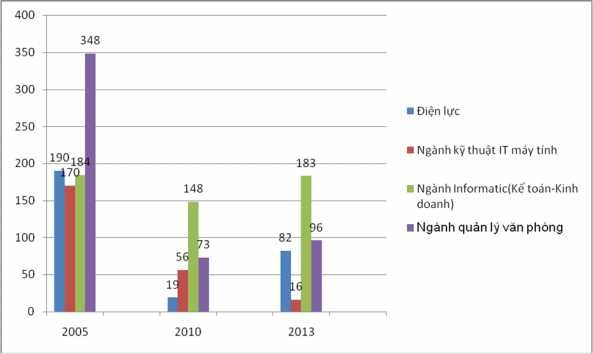
In general, the rate of skilled workers in the capital tends to decrease. The reason is that Lao people have not always liked to study vocational training at the elementary and intermediate levels; on the other hand, the State has not had a policy to encourage vocational training and employment.
In short, although there is development, vocational training facilities are still few, investment in vocational training facilities is still limited, the team of managers and vocational teachers is both lacking in quantity and weak in quality. In general, the State has not had an attractive policy to encourage vocational training and apprenticeship. Training programs and teaching materials have not kept up with new production technology. The quality of vocational training has not been improved, not meeting practical requirements; unemployment and underemployment are still common. The labor force concentrated in rural areas is mainly unskilled labor, not yet
through training more than 70%. Many poor households do not have the opportunity to access vocational training.
+ Regarding universities, currently in the capital there are many universities but none of them are managed by the capital. The National University of Laos is considered a prestigious university in the capital, connecting high schools and colleges in the national education system. In addition to university training, the school also conducts master's and doctoral training. The National University has 1,742 officials and civil servants. Of which, there are 1,315 lecturers and 427 state management officials; Regarding academic qualifications: 8 professors (0.45%); 92 associate professors (5.28%); 99 doctors.
(accounting for 5.68%); 694 masters (accounting for 39.84%) and 841 bachelors
(48.28)…
Thanks to the development of the education and training sector, the quality of teaching and learning has been significantly improved. In order to train and improve the quality of teachers and managers in the direction of synchronizing the structure and standardizing the training level, currently, teachers and staff are continuing to improve their qualifications abroad with 72 PhDs, 180 masters and 5 bachelors [137].
- On management system, policy mechanism and conditions to ensure human resource training
The capital has implemented a synchronous system of policies to develop human resources, create motivation for training institutions, teachers and trainees; innovated the policy mechanism on planning and finance, gradually implemented the bidding mechanism, ordered training targets from the state budget, thoroughly and reasonably decentralized to promote autonomy and self-responsibility of all levels and training institutions. Promoted the socialization of learning and vocational training, encouraged all organizations and individuals to invest in the field of human resource education and training.
The government has spent 6.51% of the total national education budget on education in the capital. In 2005-2006, the amount spent on education and training was 32.3 billion kip; in 2008-2009, it was 59.50 billion kip and in 2012-2013, it was 172,953 billion kip. Along with the state investment, in 2012-2013, the capital government, together with foreign organizations and individuals, invested 11,259 billion kip in the capital's education, of which foreign capital was 29.84% and the capital's capital was 70.16%.
The capital Vientiane also cooperates with the capitals of other countries and international organizations in the field of education, training and vocational training, such as training high-quality human resources with the capital Hanoi and Ho Chi Minh City (Vietnam) with 29 university students and 3 master's students. In addition, the capital also cooperates with the Russian Federation, Champuchia and Thailand.... Up to now, there are more than 70 students of the capital studying abroad.
- About the health care system
The capital Vientiane has attached importance to and created favorable conditions to improve the material and spiritual life for health care. The average life expectancy of the capital's people increased from 65 years old in the period 2000 - 2005 to 70 years old in the period 2006 - 2010, 73 years old in the period 2011 - 2013 and is expected to be 75 years old in the period 2016 - 2020.
Implement well the Program for prevention of social diseases, dangerous epidemics, HIV, AIDS; organize and direct the prevention of strange epidemics. Currently, the capital has 4 largest hospitals under the Central Government and 9 district hospitals, 42 medical stations, 108 private clinics and 493 drug stores; there are 542 doctors (an average of 6.8 doctors/10,000 people); the national rate is 59 doctors.
/100 thousand people. Doctors and nurses at the Central Hospitals also help the 9 district hospitals of the Capital in treatment, prevention and examination. For example, with dengue fever, the Department of Health coordinated with local authorities to propagate hygiene issues to the community, to each family in 9 cities with 760 villages, including 37,630 rows of houses.
Maternal and child health care in Vientiane is of interest. By 2011, "The mortality rate of children under 1 year old was only 10/1000 people (the national rate was 70/100,000 people); the mortality rate of children under 5 years old was only 20/1000 people (the national rate was 98/100,000 people); the maternal mortality rate was 25 people
/100,000 people (nationwide 405 people/10,000 people), the average life expectancy of the capital's people is 72 years old, and the clean water supply system meets 95.87% of the capital's people's consumption needs compared to the whole country's 74%. That indicator is shown: "in the period 2001 - 2005, the rate of clean water use of the capital's people was 85.77%, and 95.87% in the period 2006 - 2010" [158], [160].
Table 3.11: Quality of health services in the capital city during the period 2005-2010 [160].
Unit: Person
TT
Year Content | 2005 | 2006 | 2007 | 2008 | 2009 | 2010 | |
1 | Women's periodic examination pregnant | 40,996 | 56,755 | 63,631 | 76,124 | 81,051 | 89,422 |
2 | Born in hospital | 8,707 | 7,540 | 10,973 | 11,386 | 12,202 | 12,477 |
3 | Born in the village | 665 | 42 | 859 | 124 | 762 | 456 |
4 | Mother died during childbirth | 4 | 2 | 5 | 4 | 4 | 1 |
5 | stillbirth | 0 | 0 | 58 | 38 | 81 | 72 |
6 | Babies born under 2.5kg | 298 | 321 | 379 | 417 | 671 | 658 |
7 | Total: | 50,670 | 64,660 | 75,905 | 88,093 | 94,771 | 10.3086 |
The medical sector is a special sector that cares for, protects and improves people's health. Therefore, medical staff must be trained in a specialized field or profession. The capital has a relatively high-quality medical workforce.
Regarding the educational level of medical staff in Vientiane Capital as follows: Time
In the period 2001 - 2005, the number of cadres and employees of the Capital Health Department was 475 people (270 women), 9 post-graduates, accounting for 1.99%; 6 masters (accounting for 1.26%); high
95 people at the junior college level (20%); 165 people at the intermediate level (34.73%); 202 at the elementary level.
people (24.52%).
The period 2006 - 2010 included 542 people (333 women) increased by 67 people: 20 post-graduates, increased by 11 people; 2 PhDs; 8 Masters, increased by 2 people; 64 bachelors; 125 college, increased by 30 people; 225 intermediate, increased by 60 people and 171 primary, decreased by 30 people.
However, the health sector and public health care in the capital still have many limitations, failing to meet the needs of quality medical examination and treatment, especially in rural areas; The capacity and progress of investment in infrastructure for the health sector are still slow. Although medical equipment has been supplemented, it is still lacking compared to the needs, not synchronized and outdated, the quality of medical services is still low, not meeting the increasing health protection needs of the people.
- About the staff
The Party Committee and the Government of the Capital always pay attention to training and fostering cadres and civil servants in culture, expertise, and political theory at home and abroad. Domestic training: 8 masters (including 2 women); 14 university graduates (including 2 women); 492 college graduates (including 79 women); 215 intermediate graduates (including 30 women); 339 elementary graduates (including 60 women); 18 political theory graduates (including 3 women).
Training abroad in Vietnam, China, Singapore, New Zealand is 77 people, of which, 2 are PhDs, 6 are masters, 8 are university graduates and 11 are political theory in Vietnam, 5 are in China [102].
- In the period 2001 - 2005, the number of cadres and civil servants at the city and district levels was 8,007 people. Of which, at the city level, there were 1,815 people, 594 of whom were female; at the district level, there were 6,192 people, 3,117 of whom were female. The training level of the above team was as follows: College level: 1,245 people (accounting for 15.54%), university level: 1,375 people (accounting for
17.17%), master's degree 107 people (accounting for 1.33%), doctorate 6 people (accounting for 0.07%).
- In the period 2006 - 2010, the total number of cadres and civil servants of the Capital was
11,547 people (excluding armed forces), 5,517 women. Of which, the Central Government manages 33 people, the Capital manages 7,956 people and 3,558 people are managed by the district level. Regarding educational level: 12 PhDs, accounting for 0.11%, 231 masters, accounting for 2.1%, 2,372 university graduates, accounting for 21%, college graduates
2,010 people, accounting for 17.41%, intermediate 5,408 people, accounting for 46.83%, primary
1,084 people, accounting for 9.39%, the remaining 430 people, accounting for 3.72%.
- In the period of 2011 - 2013, the total number of cadres and civil servants was 15,081 people, 7,615 women; an increase of 3,534 people compared to the period of 2006 - 2010; of which the Central Government managed 30 people, the Capital 7,980 people, 4,190 women and the rest were managed by the district level. Educational level: 15 PhDs, an increase of 3 people; 355 Masters, an increase of 124 people; 4,882 University, an increase of 2,510 people; 2,842 College, an increase of 832 people; 5,705 Secondary School, an increase of 297 people and 1,282 Primary School, an increase of 200 people.
Table 3.12 : Qualifications of civil servants in Vientiane Capital in 2001 - 2013 [101], [102].
Unit: %
Level
Growth rate over stages | ||||||
2001 - 2005 | 2006 - 2010 | 2011 - 2013 | ||||
Quantity (People) | Proportion (%) | Quantity (People) | Proportion (%) | Quantity (People) | Proportion (%) | |
Dr. | 6 | 0.07 | 12 | 0.10 | 15 | 0.10 |
Master | 107 | 1.34 | 231 | 2.00 | 335 | 2.22 |
University | 1,375 | 17.17 | 2,372 | 20.54 | 4,882 | 32.37 |
College | 1,245 | 15.55 | 2.010 | 17.41 | 2,842 | 18.84 |
Below college | 5,274 | 65.87 | 6,922 | 59.95 | 7.007 | 46.46 |
Total | 8,007 | 100% | 11,547 | 100% | 15,081 | 100% |