
Basic skills and understanding of the principles of ecotourism, understanding of the nature and indigenous culture of the area... This requires organizing training courses, specialized training with the instruction of qualified and experienced experts in ecotourism before the tourist area comes into operation.
In addition, the Management Board of Lap Dien Bird Garden needs to maintain the inherent wild features of the garden. Only then can the bird garden create its own unique characteristics and attractions. From the available potentials, along with the attention and investment in the right direction of local authorities, Lap Dien Bird Garden will certainly become one of the attractive eco-tourism destinations for many domestic and foreign tourists to visit. From there, promoting the tourism industry, especially eco-tourism of Long Dien Tay commune in particular and Bac Lieu province in general, to develop in a sustainable direction.
14.5.Organizing the landscape of Lap Dien bird garden eco-tourism area:
Ecotourism is often formed and developed in areas with typical ecosystems. Therefore, organizing the KTCQ space is a very complicated task due to the sensitivity of the ecological environment, conservation issues and sustainable development, etc. of the area. Organizing the KTCQ space in an ecotourism area is influenced by factors such as:
- Tourism resources. - Tourists.
- Tourism industry. - Economic - cultural - social conditions.
- Population characteristics. - Technical infrastructure.
- Policy mechanism. - Regional relationship.
- The rules of organizing KTCQ space.
- Principles of zoning ecotourism activities.
14.5.1. Implementation solutions:
- Basic principles and requirements of ecotourism activities.
- Capacity of tourist attractions.
Option 1 : The State is responsible for investing in tourism infrastructure: investing in infrastructure, calling for investment and having regulations on sanctions and investment incentives at Lap Dien bird garden tourist area.
Option 2 : Establish Lap Dien Bird Garden Ecotourism Company
14. Development plan of Lap Dien Bird Garden tourist area:
+ Since 2007, planning and expanding the area, constructing tourism facilities, planting trees to create ecological zones, and completing 100% of the projects by 2010.
+ In 2007, complete attracting investment into the tourist area (by State budget, or self-investment by garden owners, or combined investment) and approve investment plans. By 2008, investors will invest at least 60% of the investment volume and start tourism business activities.
+ By 2010, investors will complete the approved plan.
+ Phase 2010 - 2015: Continue to focus on investing and taking care of the buffer zone (expanded area after 2007) to create habitats and develop bird shelters and habitats from the core zone to the buffer zone.
+ Phase 2015 - 2020: Continue to invest in developing tourism infrastructure and exploiting tourism in the buffer zone.
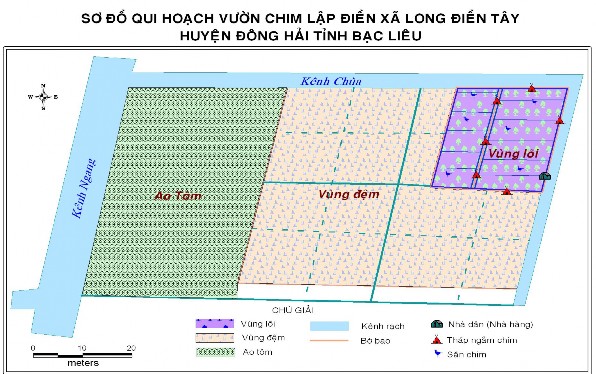
Building a planning map to develop Lap Dien bird garden into an eco-tourism area
Referring to Landsat images, locating coordinates and closely following practical conditions, building a planning map to best satisfy the factors to develop Lap Dien bird garden into an effective eco-tourism area while still preserving the precious natural resources bestowed by nature on the people of Long Dien Tay commune, Dong Hai district in particular and the people of Bac Lieu province in general. Location map of Lap Dien bird garden - Long Dien Tay - Dong Hai - Bac Lieu
Planning map of Lap Dien bird garden - Long Dien Tay - Dong Hai - Bac Lieu.
14.5.2. Proposed measures to protect Lap Dien Bird Garden:
- Active protection measures such as increased patrolling are needed.
around the bird garden. In addition, local authorities need to issue regulations prohibiting bird hunting. At the same time, provide rewards and penalties, helping people actively participate in bird conservation at Lap Dien Bird Garden.
- More detailed studies are needed on the plant species composition that birds consume.
or nest. From there, there are protective measures or more of these trees can be planted to create conditions to attract more birds to come here. Additional plants planted include: Thespesia populnea , Phoenix sp ,...
- There is a need to monitor the composition and quantity of bird species living here.
to create a database to facilitate better bird garden management.
- Research and plan to develop this place into an eco-tourism area, aiming to
increase income for local people. At the same time, conservation programs should be organized to raise people's awareness of bird conservation.
In order for Lap Dien bird garden to be planned and developed into an eco-tourism area that brings profit to the provincial economy and increases income, improving the lives of local people around the area, it is necessary to ensure:
Bird protection is a task that needs to be done immediately to limit the current situation of bird hunting. Bird protection work is only effective when there is the participation of people in the form of self-management.
In the process of planning Lap Dien bird garden, it is necessary to aim for comprehensive, strategic, and detailed management and planning measures;
Establish a strong tourism committee in Dong Hai district or surrounding communes to be able to quickly resolve daily problems.
Intervene in the tourism market – charge fees at the bird garden, limit resource exploitation, establish regulations and standards for the construction tourism industry to ensure no damage to the natural ecological landscape of Lap Dien bird garden.
Forming partnerships between stakeholders (neighbouring communes) and aiming to fully exploit local consulting activities as well as: encouraging economic and social diversity by integrating tourism into local community activities with their full participation.
Regularly conduct comprehensive environmental impact assessments with the participation of local people and all relevant levels of government to minimize environmental, social and cultural damage to local communities.
Responsible for maintaining and improving the environment because the environment is the place that directly receives waste sources and is also the place where tourism is developed. Ensure that environmental fees are included in the tourism project of Lap Dien bird garden.
Ensure safe disposal of waste generated by tourism. Use waste disposal facilities, including support for local infrastructure in the area surrounding Lap Dien Bird Garden.
The core and buffer zones of the bird garden need to have a clear policy framework on tourism; Develop and implement appropriate environmental policies in all stages of the Lap Dien bird garden eco-tourism area.
Prevent the destruction of natural biodiversity by respecting the carrying capacity of each area, taking measures to build capacity and applying the Precautionary Principle. Strengthen education.
Reallocate tourism profits back into educational programs to promote understanding of heritage and the environment and into the conservation of the biodiversity of Lap Dien Bird Park.
REVIEW QUESTIONS
1. Analyze the favorable natural - socio-economic conditions of Lap Dien to be able to develop eco-tourism?
2. What are the types of ecotourism development at Lap Dien bird garden?
3. What is the model and scale of development of Lap Dien bird garden ecotourism development model?
4. Analyze the impacts of tourism activities that may affect the ecological, social and human environment of the area? Propose solutions to minimize those impacts?
5. What is your proposal in the "research on planning to develop Lap Dien bird garden into an eco-tourism area by 2010"?
6. What is the significance of the proposed measures to protect Lap Dien bird garden?
CHAPTER 15
IMPROVING CAPACITY FOR SUSTAINABLE ECO-TOURISM DEVELOPMENT IN CHAU THANH DISTRICT - BEN TRE PROVINCE
15.1. OVERVIEW 15.1.1. Project objectives:
To improve the operational and management capacity of tourist attractions, create competitive advantages in the market, and attract more and more domestic and foreign tourists to Chau Thanh.
15.1.2. Natural and socio-economic characteristics of Chau Thanh district before project implementation
a. Geographical location : Chau Thanh is one of 8 districts - towns of Ben Tre Province, located on Cu Lao Bao, considered as the "gateway" of the Province. With a total natural area of 22,754.72 hectares, accounting for 10.05% of the natural area of the whole Province, Chau Thanh is located in the Northwest of Ben Tre Province.
The district center is Chau Thanh town, about 8km from Ben Tre town and about 3km from the current Rach Mieu ferry, located next to Ba Lai river, which is the political - economic - cultural - social center of the district.
This is a very favorable location for exploiting the tourist route of Chau Thanh district compared to other districts of Ben Tre province.
b. Natural conditions :
The terrain of Chau Thanh has characteristics similar to that of Ben Tre province. The terrain is flat, without hills or mountains, especially this is an area of crisscrossing rivers and canals, creating very favorable conditions for waterway transportation and can exploit the development of riverside landscape tourism. The amount of alluvium deposited by canals and canals is favorable for the development of fruit orchards.
The terrain of Ben Tre province is dynamic due to the rapid annual sedimentation rate, the coastal land gradually rises and becomes forested.
The land in Chau Thanh district is mostly fertile, popular and suitable for many types of crops and many forms of cultivation. Many fruit trees grow well and have the potential to expand to support tourism development.
As part of Ben Tre province, Chau Thanh district has a tropical monsoon climate near the equator and is influenced by the sea. In general, Chau Thanh's weather is favorable, with few natural disasters and no sudden, erratic changes, suitable for
many types of plants. Light, temperature, humidity are favorable for photosynthesis and development of plants and animals. These advantages will enrich natural resources, so it is very suitable for developing ecotourism here.
The climate conditions are favorable for the living, entertainment and relaxation of domestic and foreign tourists, creating a comfortable and cool feeling when staying and participating in village tourism and river tourism models.
With a dense network of rivers and canals, it has created a complete waterway traffic network, very convenient for traveling between localities in the district, beautifying the landscape, regulating the climate of an island land surrounded by water on three sides, rich and poetic. On the other hand, this is also a source of quite rich seafood for the locality, contributing to increasing tourism products. And especially with the amount of alluvium deposited by these rivers every year, making the soil fertile, providing water for growing plants. Besides, the floating islands (Con Phung, Con Qui, Con Thoi Son ...) on the big rivers are very attractive, can be exploited, and develop eco-tourism.
With a very favorable position as the "gateway" of the province both by river and road, with favorable characteristics of terrain, geology, soil, climate ... Chau Thanh district has conditions to develop industries and handicrafts and especially develop green tourism, eco-tourism. In the future, when Rach Mieu Bridge is more than 3km long across Tien River is completed, it will open up the future of economic - cultural - social development of this land. This is also the foundation to create momentum for development and economic - cultural - social exchange between Chau Thanh district in particular and Ben Tre province in general with other provinces, creating an effect to promote the development of Ben Tre tourism industry.
c. Population : There is an uneven distribution of labor among economic sectors, agriculture still accounts for a fairly high proportion while industry and services account for a fairly low proportion. This is one of the limitations and has more or less affected the tourism development of the project area.
d. Socio-economic situation of Chau Thanh district : The district's agricultural production focuses on the spearhead of garden economy, mainly growing high-value fruit trees such as: Durian (9 Hoa, Ri 6, Mong Thon), Longan with golden flesh, Mangosteen, Hoa Loc sand mango, green-skinned grapefruit, Sapo Meheco, guava... which have both high economic value and the ability to attract tourists. This is a great advantage for developing eco-tourism and garden tourism in the district. In addition, there are many coconut trees grown here, which is a large source of income for gardeners.
On the other hand, the locality also has many ornamental and bonsai gardens creating a beautiful, cool landscape that will help visitors feel the charming scenery of the peaceful countryside, enjoy the fresh and peaceful air of the village, and at the same time help people's lives get closer to nature.
e. Chau Thanh district's trade - services - tourism are relatively developed due to its geographical location bordering Tien Giang province and being a bridge to the center of Ben Tre town . In particular, tourism services are very developed thanks to the Con Bai (Con Quy, Con Phung, Con Tien), rivers and canals which are very favorable for the development of eco-tourism, attracting many foreign tourists to visit. Up to now, 21 eco-tourism establishments have been developed on Tien River, increasing annual revenue by 5.4 billion VND, attracting over 200 thousand visitors each year.
f. Landscape resources: Chau Thanh district is blessed with diverse natural landscapes with charming river banks, deep rows of coconut trees. After exciting moments floating on the Tien River, visitors can immerse themselves in the Qui Islet, Phung Islet... or the tourist areas nestled in the immense green river banks... Chau Thanh also makes visitors even more surprised with the gifts of nature such as delicious fruits, honey made by the gentle, hospitable people of Ben Tre... With all these factors, just mentioning Que Dua makes everyone eager to go see...
15.1.3. Current status of Chau Thanh tourism :
Since 2004, ecotourism has developed strongly in Chau Thanh. Many tourism businesses in Chau Thanh district have been newly invested with a fairly large scale and unique services (Hao Ai, Rach Xep...), some existing businesses continue to invest in upgrading and developing their business facilities (Tan Phu, Phong Phu, Que Dua, Thao Nhi, Diem Phuong...). Many new services have been put into service such as: visiting rice production models, rowing boats, horse carts, bicycles, fishing, catching fireflies,... which are increasingly attracting tourists. In general, tourism activities have had positive changes in terms of technical facilities, revenue, number of visitors, labor, and contribution to the State budget have all increased.
However, in recent times, tourism destinations have developed spontaneously, lacking management and support from the State. This has created unhealthy competition, uninnovative tourism models, duplication, and a heavy dependence on Tien Giang tourism companies.
The infrastructure serving the tourism development area is still not complete, not meeting the requirements of tourism development. The road system connecting the communes in the area has been invested but is not enough to transport tourists visiting the area, and still has to be used.
Using too many tourist boats is both time-consuming and boring for tourists. Many tourist destinations do not have clean water to serve the needs of tourists.
Postal and telecommunications services in many tourist areas are still limited, mobile phone networks are still weak, and many areas still lack coverage (Phu Tuc, An Khanh, Tan Phu).
Chau Thanh has main tourist attractions such as: Con Phung, Con Quy, Con Tien natural eco-tourism site, historical relics (Hoi Ton Co pagoda, ...) with main types of tourism: garden, sightseeing, tours in the project area...
The project's eco-tourism products include: handicrafts, Southern dishes (Ben Tre coconut rice, My Long rice paper, etc.)
a. Current status of environmental quality in the project area :
Rainwater is generally clean and can be used for daily life. According to some physical and chemical analysis indicators, surface water is slightly polluted with physical and chemical substances and organic matter. Groundwater has good reserves and quality.
The soil of the area has a mechanical composition from light to heavy loam, humus content greater than 2%, average nitrogen and phosphorus (N>0.15%; P2O5 > 0.08 %), rich in potassium (K2O > 1.5%), relatively low pH index (4.6 - 6.2). The soil is almost all polluted by pesticides and fertilizers from light to heavy.
Areas along traffic routes and market centers such as Tan Thach, Tam Phuoc Town, etc. have relatively high levels of air pollution. On the contrary, in rural areas, the air environment is still very clean.
b. Assessment of the sustainability of Chau Thanh eco-tourism
Tourism activities are still seasonal, uneven and unprofessional. The participation of local communities in ecotourism in particular and tourism in general is still limited, the number of guests staying is insignificant while the number of tourists is quite large.
Education of citizens' awareness in general, culture, law and business ethics in particular, needs to be given more importance.
The social efficiency of ecotourism activities in Chau Thanh is still not high, the contribution to local social welfare is not significant.
The following is a table of sustainability indicators of the project: Table: Statistics of sustainability indicators of the project
Criteria/Concept
General criteria | Specific indicators and corresponding values |
Maybe you are interested!
-
 Solutions for tourism development in Tien Lang - 10
zt2i3t4l5ee
zt2a3gstourism, tourism development
zt2a3ge
zc2o3n4t5e6n7ts
- District People's Committees and authorities of communes with tourist attractions should support, promote, and provide necessary information to people, helping them improve their knowledge about tourism. Raise tourism awareness for local people.
*
* *
Due to limited knowledge and research time, the thesis inevitably has shortcomings. Therefore, I look forward to receiving guidance from teachers, experts as well as your comments to make the thesis more complete.
Chapter III Conclusion
Through the issues presented in Chapter II, we can come to some conclusions:
Based on the strengths of available tourism resources, the types of tourism in Tien Lang that need to be promoted in the coming time are sightseeing and resort tourism, discovery tourism, weekend tourism. To improve the quality and diversify tourism products, Tien Lang district needs to combine with local cultural tourism resources, at the same time combine with surrounding areas, build rich tourism products. The strengths of Tien Lang tourism are eco-tourism and cultural tourism, so developing Tien Lang tourism must always go hand in hand with restoring and preserving types of cultural tourism resources. Some necessary measures to support and improve the efficiency of exploiting tourism resources in Tien Lang are: strengthening the construction of technical facilities and labor force serving tourism, actively promoting and advertising tourism, and expanding forms of capital mobilization for tourism development.
CONCLUDE
I Conclusion
1. Based on the results achieved within the framework of the thesis's needs, some basic conclusions can be drawn as follows:
Tien Lang is a locality with great potential for tourism development. The relatively abundant cultural tourism resources and ecological tourism resources have great appeal to tourists. Based on this potential, Tien Lang can build a unique tourism industry that is competitive enough with other localities within Hai Phong city and neighboring areas.
In recent years, the exploitation of the advantages of resources to develop tourism and build tourist routes in Tien Lang has not been commensurate with the available potential. In terms of quantity, many resource objects have not been brought into the purpose of tourism development. In terms of time, the regular service time has not been extended to attract more visitors. Infrastructure and technical facilities are still weak. The labor force is still thin and weak in terms of expertise. Tourism programs and routes have not been organized properly, the exploitation content is still monotonous, so it has not attracted many visitors. Although resources have not been mobilized much for tourism development, they are facing the risk of destruction and degradation.
2. Based on the results of investigation, analysis, synthesis, evaluation and selective absorption of research results of related topics, the thesis has proposed a number of necessary solutions to improve the efficiency of exploiting tourism resources in Tien Lang such as: promoting the restoration and conservation of tourism resources, focusing on investment and key exploitation of ecotourism resources, strengthening the construction of infrastructure and tourism workforce. Expanding forms of capital mobilization. In addition, the thesis has built a number of tourist routes of Hai Phong in which Tien Lang tourism resources play an important role.
Exploiting Tien Lang tourism resources for tourism development is currently facing many difficulties. The above measures, if applied synchronously, will likely bring new prospects for the local tourism industry, contributing to making Tien Lang tourism an important economic sector in the district's economic structure.
REFERENCES
1. Nhuan Ha, Trinh Minh Hien, Tran Phuong, Hai Phong - Historical and cultural relics, Hai Phong Publishing House, 1993
2. Hai Phong City History Council, Hai Phong Gazetteer, Hai Phong Publishing House, 1990.
3. Hai Phong City History Council, History of Tien Lang District Party Committee, Hai Phong Publishing House, 1990.
4. Hai Phong City History Council, University of Social Sciences and Humanities, VNU, Hai Phong Place Names Encyclopedia, Hai Phong Publishing House. 2001.
5. Law on Cultural Heritage and documents guiding its implementation, National Political Publishing House, Hanoi, 2003.
6. Tran Duc Thanh, Lecture on Tourism Geography, Faculty of Tourism, University of Social Sciences and Humanities, VNU, 2006
7. Hai Phong Center for Social Sciences and Humanities, Some typical cultural heritages of Hai Phong, Hai Phong Publishing House, 2001
8. Nguyen Ngoc Thao (editor-in-chief, Tourism Geography, Hai Phong Publishing House, two volumes (2001-2002)
9. Nguyen Minh Tue and group of authors, Hai Phong Tourism Geography, Ho Chi Minh City Publishing House, 1997.
10. Nguyen Thanh Son, Hai Phong Tourism Territory Organization, Associate Doctoral Thesis in Geological Geography, Hanoi, 1996.
11. Decision No. 2033/QD – UB on detailed planning of Tien Lang town, Hai Phong city until 2020.
12. Department of Culture, Information, Hai Phong Museum, Hai Phong relics
- National ranked scenic spot, Hai Phong Publishing House, 2005. 13. Tien Lang District People's Committee, Economic Development Planning -
Culture - Society of Tien Lang district to 2010.
14.Website www.HaiPhong.gov.vn
APPENDIX 1
List of national ranked monuments
STT
Name of the monument
Number, year of decisiondetermine
Location
1
Gam Temple
938 VH/QĐ04/08/1992
Cam Khe Village- Toan Thang commune
2
Doc Hau Temple
9381 VH/QĐ04/08/1992
Doc Hau Village –Toan Thang commune
3
Cuu Doi Communal House
3207 VH/QĐDecember 30, 1991
Zone II of townTien Lang
4
Ha Dai Temple
938 VH/QĐ04/08/1992
Ha Dai Village –Tien Thanh commune
APPENDIX II
STT
Name of the monument
Number, year of decision
Location
1
Phu Ke Pagoda Temple
178/QD-UBJanuary 28, 2005
Zone 1 - townTien Lang
2
Trung Lang Temple
178/QD-UBJanuary 28, 2005
Zone 4 – townTien Lang
3
Bao Khanh Pagoda
1900/QD-UBAugust 24, 2006
Nam Tu Village -Kien Thiet commune
4
Bach Da Pagoda
1792/QD-UB11/11/2002
Hung Thang Commune
5
Ngoc Dong Temple
177/QD-UBNovember 27, 2005
Tien Thanh Commune
6
Tomb of Minister TSNhu Van Lan
2848/QD-UBSeptember 19, 2003
Nam Tu Village -Kien Thiet commune
7
Canh Son Stone Temple
2160/QD-UBSeptember 19, 2003
Van Doi Commune –Doan Lap
8
Meiji Temple
2259/QD-UBSeptember 19, 2002
Toan Thang Commune
9
Tien Doi Noi Temple
477/QD-UBSeptember 19, 2005
Doan Lap Commune
10
Tu Doi Temple
177/QD-UBJanuary 28, 2005
Doan Lap Commune
11
Duyen Lao Temple
177/QD-UBJanuary 28, 2005
Tien Minh Commune
12
Dinh Xuan Uc Pagoda
177/QD-UBJanuary 28, 2005
Bac Hung Commune
13
Chu Khe Pagoda
177/QD-UBJanuary 28, 2005
Hung Thang Commune
14
Dong Dinh
2848/QD-UBNovember 21, 2002
Vinh Quang Commune
15
President's Memorial HouseTon Duc Thang
177/QD-UBJanuary 28, 2005
NT Quy Cao
Ha Dai Temple
Ben Vua Temple
Tien Lang hot spring
div.maincontent .p { color: black; font-family:"Times New Roman", serif; font-style: normal; font-weight: normal; text-decoration: none; font-size: 14pt; margin:0pt; } div.maincontent p { color: black; font-family:"Times New Roman", serif; font-style: normal; font-weight: normal; text-decoration: none; font-size: 14pt; margin:0pt; } div.maincontent .s1 { color: black; font-family:"Times New Roman", serif; font-style: normal; font-weight: normal; font-size: 16pt; } div.maincontent .s2 { color: black; font-family:"Times New Roman", serif; font-style: italic; font-weight: bold; text-decoration: none; font-size: 14pt; } div.maincontent .s3 { color: black; font-family:"Times New Roman", serif; font-style: italic; font-weight: normal; text-decoration: none; font-size: 14pt; } div.maincontent .s4 { color: black; font-family:"Times New Roman", serif; font-style: normal; font-weight: normal; font-size: 14pt; } div.maincontent .s5 { color: black; font-family:"Times New Roman", serif; font-style: normal; font-weight: bold; font-size: 14pt; } div.maincontent .s6 { color: black; font-family:"Times New Roman", serif; font-style: normal; font-weight: normal; text-decoration: none; font-size: 14pt; } div.maincontent .s7 { color: black; font-family:"Times New Roman", serif; font-style: normal; font-weight: bold; text-decoration: none; font-size: 14pt; } div.maincontent .s8 { color: black; font-family:"Times New Roman", serif; font-style: normal; font-weight: normal; text-decoration: none; font-size: 9pt; vertical-align: 6pt; } div.maincontent .s9 { color: black; font-family:"Times New Roman", serif; font-style: normal; font-weight: bold; text-decoration: none; font-size: 12pt; } div.maincontent .s11 { color: black; font-family:"Times New Roman", serif; font-style: normal; font-weight: normal; tex
Solutions for tourism development in Tien Lang - 10
zt2i3t4l5ee
zt2a3gstourism, tourism development
zt2a3ge
zc2o3n4t5e6n7ts
- District People's Committees and authorities of communes with tourist attractions should support, promote, and provide necessary information to people, helping them improve their knowledge about tourism. Raise tourism awareness for local people.
*
* *
Due to limited knowledge and research time, the thesis inevitably has shortcomings. Therefore, I look forward to receiving guidance from teachers, experts as well as your comments to make the thesis more complete.
Chapter III Conclusion
Through the issues presented in Chapter II, we can come to some conclusions:
Based on the strengths of available tourism resources, the types of tourism in Tien Lang that need to be promoted in the coming time are sightseeing and resort tourism, discovery tourism, weekend tourism. To improve the quality and diversify tourism products, Tien Lang district needs to combine with local cultural tourism resources, at the same time combine with surrounding areas, build rich tourism products. The strengths of Tien Lang tourism are eco-tourism and cultural tourism, so developing Tien Lang tourism must always go hand in hand with restoring and preserving types of cultural tourism resources. Some necessary measures to support and improve the efficiency of exploiting tourism resources in Tien Lang are: strengthening the construction of technical facilities and labor force serving tourism, actively promoting and advertising tourism, and expanding forms of capital mobilization for tourism development.
CONCLUDE
I Conclusion
1. Based on the results achieved within the framework of the thesis's needs, some basic conclusions can be drawn as follows:
Tien Lang is a locality with great potential for tourism development. The relatively abundant cultural tourism resources and ecological tourism resources have great appeal to tourists. Based on this potential, Tien Lang can build a unique tourism industry that is competitive enough with other localities within Hai Phong city and neighboring areas.
In recent years, the exploitation of the advantages of resources to develop tourism and build tourist routes in Tien Lang has not been commensurate with the available potential. In terms of quantity, many resource objects have not been brought into the purpose of tourism development. In terms of time, the regular service time has not been extended to attract more visitors. Infrastructure and technical facilities are still weak. The labor force is still thin and weak in terms of expertise. Tourism programs and routes have not been organized properly, the exploitation content is still monotonous, so it has not attracted many visitors. Although resources have not been mobilized much for tourism development, they are facing the risk of destruction and degradation.
2. Based on the results of investigation, analysis, synthesis, evaluation and selective absorption of research results of related topics, the thesis has proposed a number of necessary solutions to improve the efficiency of exploiting tourism resources in Tien Lang such as: promoting the restoration and conservation of tourism resources, focusing on investment and key exploitation of ecotourism resources, strengthening the construction of infrastructure and tourism workforce. Expanding forms of capital mobilization. In addition, the thesis has built a number of tourist routes of Hai Phong in which Tien Lang tourism resources play an important role.
Exploiting Tien Lang tourism resources for tourism development is currently facing many difficulties. The above measures, if applied synchronously, will likely bring new prospects for the local tourism industry, contributing to making Tien Lang tourism an important economic sector in the district's economic structure.
REFERENCES
1. Nhuan Ha, Trinh Minh Hien, Tran Phuong, Hai Phong - Historical and cultural relics, Hai Phong Publishing House, 1993
2. Hai Phong City History Council, Hai Phong Gazetteer, Hai Phong Publishing House, 1990.
3. Hai Phong City History Council, History of Tien Lang District Party Committee, Hai Phong Publishing House, 1990.
4. Hai Phong City History Council, University of Social Sciences and Humanities, VNU, Hai Phong Place Names Encyclopedia, Hai Phong Publishing House. 2001.
5. Law on Cultural Heritage and documents guiding its implementation, National Political Publishing House, Hanoi, 2003.
6. Tran Duc Thanh, Lecture on Tourism Geography, Faculty of Tourism, University of Social Sciences and Humanities, VNU, 2006
7. Hai Phong Center for Social Sciences and Humanities, Some typical cultural heritages of Hai Phong, Hai Phong Publishing House, 2001
8. Nguyen Ngoc Thao (editor-in-chief, Tourism Geography, Hai Phong Publishing House, two volumes (2001-2002)
9. Nguyen Minh Tue and group of authors, Hai Phong Tourism Geography, Ho Chi Minh City Publishing House, 1997.
10. Nguyen Thanh Son, Hai Phong Tourism Territory Organization, Associate Doctoral Thesis in Geological Geography, Hanoi, 1996.
11. Decision No. 2033/QD – UB on detailed planning of Tien Lang town, Hai Phong city until 2020.
12. Department of Culture, Information, Hai Phong Museum, Hai Phong relics
- National ranked scenic spot, Hai Phong Publishing House, 2005. 13. Tien Lang District People's Committee, Economic Development Planning -
Culture - Society of Tien Lang district to 2010.
14.Website www.HaiPhong.gov.vn
APPENDIX 1
List of national ranked monuments
STT
Name of the monument
Number, year of decisiondetermine
Location
1
Gam Temple
938 VH/QĐ04/08/1992
Cam Khe Village- Toan Thang commune
2
Doc Hau Temple
9381 VH/QĐ04/08/1992
Doc Hau Village –Toan Thang commune
3
Cuu Doi Communal House
3207 VH/QĐDecember 30, 1991
Zone II of townTien Lang
4
Ha Dai Temple
938 VH/QĐ04/08/1992
Ha Dai Village –Tien Thanh commune
APPENDIX II
STT
Name of the monument
Number, year of decision
Location
1
Phu Ke Pagoda Temple
178/QD-UBJanuary 28, 2005
Zone 1 - townTien Lang
2
Trung Lang Temple
178/QD-UBJanuary 28, 2005
Zone 4 – townTien Lang
3
Bao Khanh Pagoda
1900/QD-UBAugust 24, 2006
Nam Tu Village -Kien Thiet commune
4
Bach Da Pagoda
1792/QD-UB11/11/2002
Hung Thang Commune
5
Ngoc Dong Temple
177/QD-UBNovember 27, 2005
Tien Thanh Commune
6
Tomb of Minister TSNhu Van Lan
2848/QD-UBSeptember 19, 2003
Nam Tu Village -Kien Thiet commune
7
Canh Son Stone Temple
2160/QD-UBSeptember 19, 2003
Van Doi Commune –Doan Lap
8
Meiji Temple
2259/QD-UBSeptember 19, 2002
Toan Thang Commune
9
Tien Doi Noi Temple
477/QD-UBSeptember 19, 2005
Doan Lap Commune
10
Tu Doi Temple
177/QD-UBJanuary 28, 2005
Doan Lap Commune
11
Duyen Lao Temple
177/QD-UBJanuary 28, 2005
Tien Minh Commune
12
Dinh Xuan Uc Pagoda
177/QD-UBJanuary 28, 2005
Bac Hung Commune
13
Chu Khe Pagoda
177/QD-UBJanuary 28, 2005
Hung Thang Commune
14
Dong Dinh
2848/QD-UBNovember 21, 2002
Vinh Quang Commune
15
President's Memorial HouseTon Duc Thang
177/QD-UBJanuary 28, 2005
NT Quy Cao
Ha Dai Temple
Ben Vua Temple
Tien Lang hot spring
div.maincontent .p { color: black; font-family:"Times New Roman", serif; font-style: normal; font-weight: normal; text-decoration: none; font-size: 14pt; margin:0pt; } div.maincontent p { color: black; font-family:"Times New Roman", serif; font-style: normal; font-weight: normal; text-decoration: none; font-size: 14pt; margin:0pt; } div.maincontent .s1 { color: black; font-family:"Times New Roman", serif; font-style: normal; font-weight: normal; font-size: 16pt; } div.maincontent .s2 { color: black; font-family:"Times New Roman", serif; font-style: italic; font-weight: bold; text-decoration: none; font-size: 14pt; } div.maincontent .s3 { color: black; font-family:"Times New Roman", serif; font-style: italic; font-weight: normal; text-decoration: none; font-size: 14pt; } div.maincontent .s4 { color: black; font-family:"Times New Roman", serif; font-style: normal; font-weight: normal; font-size: 14pt; } div.maincontent .s5 { color: black; font-family:"Times New Roman", serif; font-style: normal; font-weight: bold; font-size: 14pt; } div.maincontent .s6 { color: black; font-family:"Times New Roman", serif; font-style: normal; font-weight: normal; text-decoration: none; font-size: 14pt; } div.maincontent .s7 { color: black; font-family:"Times New Roman", serif; font-style: normal; font-weight: bold; text-decoration: none; font-size: 14pt; } div.maincontent .s8 { color: black; font-family:"Times New Roman", serif; font-style: normal; font-weight: normal; text-decoration: none; font-size: 9pt; vertical-align: 6pt; } div.maincontent .s9 { color: black; font-family:"Times New Roman", serif; font-style: normal; font-weight: bold; text-decoration: none; font-size: 12pt; } div.maincontent .s11 { color: black; font-family:"Times New Roman", serif; font-style: normal; font-weight: normal; tex -
 Proposed Principles for Coordination Measures Between Trade Unions and Government in Managing Professional Activities at Some Universities of the University
 -
 Measures to Protect Property Rights Through Lawsuits in Court
 -
 Measures to Protect Industrial Property Rights for Trademarks
 -
 Survey on the Urgency and Feasibility of Proposed Management Measures