
Based on the issued policies and guidelines on employment, the provincial authorities have developed specific measures and organized the implementation of those measures in practice. Specifically:
+ Solving employment by attracting agricultural workers whose land is recovered to work in industrial zones. This is a very important content in solving employment for people whose land is recovered and plays a decisive role in shifting the economic structure and labor structure in the process of industrialization and urbanization in Nghe An.
Since 2001, due to the rapid increase in capital mobilized for infrastructure construction and investment support, the province's industrial and handicraft production has developed at a high speed. The industry structure has shifted rapidly towards increasing industries and attracting labor such as garment, footwear, food processing. Enterprises operating under the Enterprise Law and foreign-invested enterprises have increased rapidly. As of June 30, 2014, the province has 09 industrial parks and 32 industrial clusters attracting 16,620 workers.
The provincial agricultural promotion fund has also been active in promoting the development of industrial establishments, especially small-scale handicraft production establishments in the area. Up to now, the province has restored and newly established 150 craft villages, including 8 models: civil woodworking and fine art craft villages, bamboo and rattan weaving villages, brocade weaving villages, and villages for building and repairing wooden boats in the districts of Nghia Dan, Nghi Loc, Quynh Luu, Yen Thanh, Con Cuong, Thanh Chuong, and Que Phong. The localities with many craft villages registered for construction are: Dien Chau (6 villages), Quynh Luu (8 villages), Nghi Loc (6 villages). The most registered production and business occupations are: bamboo and rattan weaving (20 villages), seafood processing (5 villages), brocade weaving (5 villages), silk reeling and weaving (5 villages). Up to now, the province has 46 craft villages that meet the prescribed criteria. There are craft villages such as Trung Kien, Nghi Thiet, Nghi Loc specializing in building and repairing boats, attracting over 800 workers, accounting for over 50% of the village's workforce.
Thanks to the development of industrial and handicraft production, Nghe An province has attracted about 40 thousand workers, including many people who were previously farmers whose land was recovered.
+ Solving employment through developing service activities. In recent years in Nghe An, service activities have had positive changes, increasingly meeting the requirements of production and people's lives. In the period 2001 - 2013, the service industry's production value increased by an average of 9%/year (6.3% nationwide). Transportation services, postal and telecommunications services, credit, banking, insurance, consulting, services around concentrated industrial parks... developed quite well; trade - tourism promotion activities, brand building were enhanced. Total export turnover in the period 2001-2013 increased by an average of 20.2%/year. Total turnover of goods and social services increased by an average of 12.4%/year. Tourism activities increased quite well: the number of tourists increased by an average of 15.2%, tourism revenue increased by 17.2%/year.
The development of the service sector has created new jobs for over 30,000 workers, including thousands of workers whose land was confiscated by the State.
+ Solving employment through implementing loan projects to support employment
Providing loans to support job creation is a positive direction to solve employment. In 13 years (2001-2013), the whole province has implemented thousands of projects with an average total loan amount of 1,324 billion VND per year; 143,956 households have borrowed, an average of more than 9 million VND/household. The Charity Fund provides loans to women to develop the economy, an average of 6.5 million VND/household per year. Thanks to promoting lending activities to support job creation, it has contributed to creating jobs for over 15,000 workers. In fact, on average, every 5 million VND of State capital loan helps create jobs for 1 worker. In addition to the loan capital to support job creation, it is necessary to mention the active role of the Social Policy Bank, the Bank for Agriculture and Rural Development, and credit institutions that have mobilized a large amount of capital for businesses, production establishments, and households to borrow to develop production, eliminate hunger and reduce poverty, and contribute to creating new jobs for workers whose land has been recovered.
+ Solving employment for people whose land is recovered through labor export.
Nghe An has chosen the solution of exporting labor to support employment for people, including those whose land has been recovered. Implementing the Decision
Decree No. 71/2013/QD-UB dated April 14, 2013 of the Provincial People's Committee, Party committees and local authorities at all levels seek measures to overcome the situation of laxity or little attention to labor export, and overcome the situation of assigning a number of functional agencies. To implement the Provincial Decision, districts and cities have established Steering Committees for implementation, guiding communes and wards in the province to disseminate information so that people can prepare and respond.
The Labor Export Steering Committees of districts and cities have given specific instructions, resolved all difficulties, and closely coordinated with the activities of the Labor Export Steering Committees of communes and wards, with labor export companies from the preliminary selection stage, to the organization of vocational training, organization of sending laborers to work abroad, promptly detecting and preventing cases of brokers and fraud, and limiting damage to workers. Every year, the Labor Export Steering Committees of districts and cities have held a conference to review the results of their activities and propose measures to overcome limitations and difficulties. Party cell secretaries, village heads, and all social organizations participate in the labor export project and consider it their political task.
The provincial labor export steering committee also directly sent a delegation of officials to survey the situation of Vietnamese workers working in Malaysia, Taiwan, Japan, South Korea and Middle Eastern countries. Thanks to the close direction of the provincial labor export steering committee as well as the active activities of the labor export steering committees at all levels, the number of workers in Nghe An sent to work abroad is relatively large. From 2001-2013, the whole province sent nearly 100,000 workers. Most of Nghe An's workers were sent to work in Taiwan, Malaysia, South Korea, Japan and some Middle Eastern countries.
+ Solving employment through vocational training for people whose land is recovered.
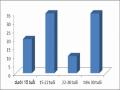
According to a survey in Nghe An, of the total number of people subject to land acquisition, only 1.85% have university and college degrees, 2.67% have intermediate degrees; the number who have completed vocational training and equivalent training courses is 10.68%; the number without technical expertise accounts for 84.8%. Due to the above situation, the opportunity for most workers to find jobs after their land is acquired is very difficult (Table 3.9).
Table 3.9: Professional qualifications of workers before land acquisition
Unit: %
Local
University | College | Intermediate | Apprentice | No expertise | |
Vinh City | 0 | 0 | 2.0 | 6.0 | 80 |
Cua Lo Town | 0 | 0.5 | 1.0 | 11.6 | 77.9 |
Nghi Loc | 0 | 0 | 0.6 | 4.2 | 95.2 |
Dien Chau | 0.3 | 0.7 | 6.7 | 13.4 | 75.5 |
Quynh Luu | 0.4 | 0 | 5.4 | 14.7 | 72.4 |
Hung Nguyen | 0 | 0 | 6.3 | 18.2 | 75.5 |
Nghia Dan | 0 | 0 | 3.4 | 9.9 | 86.7 |
Average | 0.7 | 1.15 | 2.67 | 10.68 | 84.8 |
Maybe you are interested!
-
 Qualifications and Professional Skills of Television Workers
 -
 Solving employment and ensuring livelihood for workers after land acquisition in the process of industrialization and urbanization in Nghe An province - 25
 -
 Experience of Some Localities in Solving Employment and Ensuring Livelihood for Workers After Land Revocation During Industrialization and Urbanization
 -
 Gaps in Employment and Life Assurance for Workers After Land Acquisition Need Further Research
 -
 Cultural and Technical Qualifications of Workers in the Investigated Household Groups

Source: Author's investigation summary in July 2013
University College Vocational school
No expertise
90
80
70
60
50
40
30
20
10
0
Average
Chart 2.1: Professional qualifications of workers before land acquisition
According to the above survey, before the land was recovered, 78.2% of the working-age population was engaged in agricultural and forestry production; 7% of the working-age population was engaged in industry and handicrafts; 14.8% was engaged in services and other jobs. Although the occupations of the people whose land was recovered were quite diverse, the majority were still engaged in agriculture.
If we go deeper into each locality (district, city, town), the above rates have different variations. For example, in Nghi Loc district, among the surveyed people, the labor structure by occupation for those before the land was recovered in 2013 was: the number of laborers working in agriculture and forestry accounted for 83.1%; the number of laborers working in industry and handicrafts accounted for 5%; the number of laborers working in services accounted for 11.9%.
The results of the above survey questionnaires show that in these three areas, before the land was recovered, the educational level and technical expertise of the workers whose land was recovered were as follows (Table 3.10).
Table 3.10: Educational level and technical expertise of land owners before the State recovered their land
TT
Cultural level and technology | Vinh City | Cua Lo Town | Nghi Loc District | Total | |||||
Number People | Proportion (%) | Number People | Proportion (%) | Number People | Proportion (%) | Number People | Proportion (%) | ||
1 | Cultural level | 50 | 100.0 | 86 | 100.0 | 162 | 100.0 | 298 | 100.0 |
Level 1 | 0 | 0.0 | 0 | 0 | 55 | 33.9 | 55 | 18.5 | |
Level 2 | 14 | 28.0 | 29 | 33.7 | 91 | 56.2 | 134 | 45.0 | |
Level 3 | 36 | 72.0 | 57 | 66.3 | 16 | 9.9 | 109 | 36.5 | |
2 | Technical level | 50 | 100.0 | 86 | 100.0 | 162 | 100.0 | 298 | 100.0 |
University, college | 2 | 4.0 | 7 | 8.1 | 0 | 0.0 | 9 | 3.0 | |
Professional TH | 2 | 4.0 | 2 | 2.4 | 1 | 0.6 | 5 | 1.7 | |
CNKT + elementary | 6 | 12.0 | 10 | 11.6 | 2 | 1.2 | 18 | 6.0 | |
Untrained | 40 | 80.0 | 67 | 77.9 | 159 | 98.2 | 266 | 89.3 | |
Source: Author's investigation (July 2013).
To solve the above situation and to implement the policy of diversifying vocational training activities, Nghe An has consolidated and expanded the training scale of Vinh University and expanded the training scale of Vinh University of Technical Education, Vinh University of Industry, upgraded Nghe An College of Economics and Technology to Nghe An University of Economics, upgraded Nghe An College of Medicine to Vinh University of Medicine, expanded the training scale of 6 colleges, bringing the total number of students to nearly 50,000. With 62 vocational training facilities, it has attracted about 20,000 students annually. In addition, 21 districts and towns have vocational training centers. The province also has policies to support schools and teachers to open many forms of vocational training, allowing the establishment of vocational training facilities in all economic sectors, restoring and developing craft villages, promoting vocational training and passing on skills, creating many jobs for workers, including preferential treatment for those whose land is recovered.
The province has socialized vocational training, diversified types of vocational training (public, semi-public, private, private), diversified levels of vocational training (long-term, short-term); diversified forms of vocational training (at schools, at enterprises, at craft villages, hamlets, communes ...) and diversified forms of enrollment. Thanks to that, the scale of training has increased rapidly, the vocational training structure has become more diverse. Long-term training occupations include: car driving, mechanics, information technology, electronics, industrial sewing, factory electricity, construction machine driving, bricklayer, gasoline delivery and preservation. Short-term training occupations include: embroidery, crochet, gasoline retail, household electricity, carpentry, wood carving, motorbike repair ...
Vocational training institutions have proactively innovated teaching content and methods, opened more easy-to-train, easy-to-find jobs, suitable for the needs of local economic restructuring such as: industrial sewing, small mechanical repair, civil electricity, embroidery, crocheting, rattan and bamboo weaving for export... mainly in recent years, vocational training institutions have provided short-term training associated with creating on-site jobs in the direction of accelerating the pace of labor restructuring towards reducing the proportion of agricultural labor and increasing the proportion of industrial and service labor.
Nghe An's vocational training scale is about 20,000 people/year, of which
6,000 long-term and 14,000 short-term. In addition, local businesses and craft villages
The province also organizes training and creates jobs for over 4,000 workers every year. To meet the need to expand vocational training, the province's vocational teaching staff has increased rapidly in both quantity and quality. To date, the province has over 1,281 vocational teachers. The state has partially supported tuition fees for vocational students.
+ Solving employment through employment service activities.
Because the legal regulations on job placement are increasingly improved in both content and form, the job service centers of Nghe An province are also gradually being improved in both organizational structure and operational organization, linking vocational training activities with job placement, creating the ability to arrange better jobs for workers.
The province also attaches importance to labor market information activities. The content of labor market information focuses on:
Socio-economic situation reports, Provincial Statistical Yearbook.
Information on labor fluctuations, employment, labor structure, employment, unemployment rate in urban areas, and labor time ratio used in rural areas of Nghe An province. This information is investigated every July according to Decision 385/TTg dated June 6, 1997 of the Prime Minister on labor and employment investigation.
Information on the employment situation of subjects whose land has been recovered for the construction of industrial parks, industrial clusters, urban areas... information on the capacity and training professions of the province's main vocational training institutions. Information on the activities of the annual job fair conducted by the province.
Thanks to these activities, the number of workers who found jobs increased significantly. According to the author's investigation (July 2013), from 2001 to June 30, 2014, Nghe An province had 45,027 households whose land was recovered, with an average of 1.5 workers per household, meaning 67,540 people had to change jobs. In the process of job creation from 2001 to present, about 80% of these workers have found jobs. The table below shows the situation of recruiting workers after land was recovered (Table 3.11).
Table 3.11: Situation of labor recruitment after land acquisition
Recruitment unit
Number | Percentage (%) | |
Land receiving unit | 8 | 2.68 |
State | 8 | 2.68 |
Private enterprise | 22 | 7.33 |
Self-employment | 172 | 57.72 |
Unknown | 90 | 30.21 |
Total | 300 | 100.00 |
Source: Author's investigation (July 2013)
The table above shows that most people after their land was recovered created jobs for themselves (57.72%); the jobs that the land recipients arranged for the people still accounted for a very small proportion. It seems that industrial development projects have not really paid attention to creating jobs for the locality, especially for farmers who lost their land.
+ The rate of full employment has decreased quite sharply:
Table 3.12: Employment status before and after land acquisition
Employment status
Before land acquisition | After land acquisition | |||
Number | Rate (%) | Number | Proportion | |
- Full of work | 127 | 42.62 | 97 | 32.55 |
- Lack of jobs | 129 | 43.29 | 141 | 47.32 |
- No Job | 44 | 14.67 | 62 | 20.66 |
Total | 300 | 100.00 | 300 | 100.00 |
Source: Author's investigation (July 2013)