
is in the process of completion. Therefore, BIDV headquarters needs to continue to research and develop an internal credit rating system. Through the program, build a number of indicators specific to each industry, so that when credit officers evaluate the financial capacity of customers, they can refer to the industry's indicators, and more accurately assess the customer's situation compared to businesses in the industry.
Build more criteria to limit subjective credit of data entry, accurately assess the business's rank.
Improve technology software to support credit work, related to the debt repayment ability of corporate customers, promptly update customer information such as financial reporting data, interest rates, customer debt repayment status, collateral value, minimize operational risks during data entry.
Consider combining the results of the assessment of the customer's KNTN using the logit model with the bank's internal credit rating results to assess the customer's debt capacity when granting credit.
5.4. Limitations of the thesis
Using the Logistic model, the research has identified factors affecting the debt repayment ability of corporate customers at Vietnam Joint Stock Commercial Bank for Investment and Development, Long An branch. However, the research still has many limitations:
The number of observations is still low so the sample needs to be increased.
Information about the business is often provided by the business itself, leading to inaccurate information. Information from financial statements may not accurately reflect the financial situation of the business at the time of assessment.
For the internal credit rating system, non-financial information is still largely based on the subjective assessment of credit officers, depending on the experience, qualifications and ethics of the credit officers.
Due to time and research data limitations, the study only presents some factors affecting the actual situation, some factors that are likely to be
Factors that affect the business performance of enterprises have been overlooked, such as: interest rates, experience, management capacity, etc. Factors related to the macroeconomic situation: inflation, economic policy, political policy, exchange rate, etc.
The results of the model have shown some basic factors that affect the KNTN of corporate customers, which can be added to the credit officer's appraisal process, helping the credit officer to assess the debt repayment ability of corporate customers more specifically, limiting risks for the bank. If there is a large enough and reliable database, the logistic regression model can be applied with more variables, helping to evaluate customers and make credit decisions.
5.5. Conclusion
In the context of increasingly fierce competition in the current banking system, the requirement for banks in general and BIDV in particular is that the credit growth target must focus on controlling credit risks, limiting overdue debts and newly arising bad debts. Identifying and measuring credit risks becomes an urgent task to help banks have appropriate responses to each specific customer, reducing losses and limiting risks. Correctly assessing the debt repayment capacity of corporate customers will help banks have the opportunity to screen and re-evaluate their customer base, thereby having appropriate credit policies for each customer.
The research topic: "Factors affecting the debt repayment ability of corporate customers at Vietnam Joint Stock Commercial Bank for Investment and Development - Long An Branch" has systematized the theories on debt repayment ability and factors affecting debt repayment ability, at the same time analyzed and evaluated the current status of credit activities for corporate customers, methods of assessing the debt repayment ability of corporate customers at BIDV Long An. By comparing with previous studies on factors affecting the debt repayment ability of corporate customers, the research topic proposed a new model based on the existing model and the current status of credit activities at BIDV Long An. The research has provided additional necessary solutions to reduce
Minimize credit risk through factors affecting the creditworthiness of corporate customers.
Chapter 5 Summary
Based on the model results and the current status of corporate customers' repayment capacity at BIDV Long An, the author has proposed a number of solutions to help credit officers, managers and operators improve the efficiency of assessing corporate customers' repayment capacity or more broadly, limit credit risks at the bank. The solutions proposed for BIDV Long An branch are only suggestions and support. Therefore, it is necessary to continue to research, supplement and amend to gradually improve credit risk management activities in lending to corporate customers to meet the bank's goals.
REFERENCES
Vietnamese Document Catalog
Hoang Trong – Chu Nguyen Mong Ngoc, (2008), “Analyzing research data with SPSS”, Hong Duc Publishing House .
Joint Stock Commercial Bank for Investment and Development of Vietnam, (2012), “Resolution No. 1155/NQ-HĐQT on Approval of BIDV's Development Strategy to 2020 and Business Plan for the period 2011-2020” .
Joint Stock Commercial Bank for Investment and Development of Vietnam - Long An Branch, (2016, 2017, 2018), "Balance sheet; Debt classification and risk provisioning report; BIDV Long An business performance report; BIDV Long An data system".
Joint Stock Commercial Bank for Investment and Development of Vietnam - Long An Branch, (2016), "Decision No. 10546/BIDV - QLTD dated December 15, 2016 on Guidance on implementing the new XHTDNB System for Corporate and Individual Customers".
Joint Stock Commercial Bank for Investment and Development of Vietnam - Long An Branch, (2014), "Decision 1126/QD-BIDV.LA on Establishing an organizational model at BIDV Long An Branch ".
State Bank of Vietnam, (2013), “Circular 02/2013/TT-NHNN Regulations on classification of assets, provision levels, methods of setting up risk provisions and use of provisions to handle risks in the operations of credit institutions and foreign bank branches ”.
National Assembly, (2010), “Law No. 17/2017/QH14 Law on Credit Institutions”.
English Document Catalog
AEG, “2004”, “Non – performing loans. Adversory Expert Group (AEG) Meeting [PDF]”, Available at:
Amato, L., H. & Amato, C., H. (2004), “Firm Size, Strategic Advantage, and Profit Rates in US Retailing”, Journal of Retailing and Consumer Services 11, pp. 181–193.
Andrea Ruth Coravos (2010), “Measuring the likelihood of Small Business Loan Default: Community development Financial Institutions (CDFIs) and the use of credit scoring to Minimize Default Risk”.
Basel Committee on Banking Supervison (2006), “International convergence of capital measurement and capital standards: a received framework – comprehensive version”, Bank for International Settlements .
Beattie, V., A. Goodacre and SJ Thomson (2006), "Corporate financing decisions: UK survey evidence", Journal of Business Finance Accounting, Vol. 33, No. 9, pp. 1402-1434.
Bessler, W., Drobetz, W. & Gruninger, M. (2011), “Information Asymmetry and Financing Decisions”, International Review of Finance , Vol 11, No.1, pp. 123– 154.
Bigelli, M. & Sanchez - Vidal, J. (2012), “Cash Holdings in Private Firms”,
Journal of Banking and Finance , Vol. 36, pp. 26–35.
Chiara Pederzoli, Costanza Torricelli, (2010), “A parsimonious default prediction model of Italian SMEs”, Bank and Bank System , Vol.5. pp. 5-9.
Fitch, (1997), “Dictionary of Banking Terms, 3rd ed”, Barron's Educational Series, Inc.
Fitzpatrick, (1931), “Symptoms of industrial failure. Washington DC, USA”
Catholic University of America Press.
Flannery, (1986), “Asymemetric information and risk debt maturity choice”,
Journal of Finance, Vol.XLI, No 1, Pp. 19-37.
Goyal, V., Nova, A. & Zanetti, (2011), Capital Market Access and Financing of Private Firms, International Review of Finance, Vol.11, No.2, pp. 155–179.
Greuning and Bratanovic, (2009), “Analyzing Banking Risk: A framework for Assessing Corporate Governance and Risk Management. 3rd ed”.
Jimenez and Saurina, (2003), “Collateral, type of lender and relationship banking as determinants of credit risk”, Journal of Banking & Finance , pp. 28.
Lally, (2003), “Time Varying Market Leverage, the Market Risk Premium and the Cost of Capital”, Journal of Business Finance and Accounting Vol. 29, No. 9- 10, pp. 1301–1318.
Petrunia, R. (2007), “Persistence of Initial Debt in the Long - term Employment Dynamics of New Firms”, Canadian Journal of Economics, Vol. 40, No. 3, pp. 861–880.
Watson, R. & Wilson, N. (2002), “Small and Medium Size Enterprise Financing: A Note on Some of the Empirical Implications of a Pecking Order”, Journal of Business and Accounting Vol. 39, No. 3-4, pp. 557–578.
APPENDIX 1
Regression analysis results via SPSS software
1. Descriptive statistics of variable data
Descriptive Statistics
N | Mini mom | Maxim m | Mean | Std. Deviation | ||
Statistic | Statistic | Statistics | Statistics | Std. Error | Statistics | |
EXPERIENCE | 318 | 0 | 20 | 9.22 | ,262 | 4,678 |
DONBAY | 318 | ,000 | 14,588 | 1.98218 | ,119511 | 2,131188 |
ROE | 318 | -,940 | 1,066 | ,1122 | ,00963725 | ,171856960 |
DUNO | 318 | 50 | 291432 | 16321.47 | 2032,678 | 36247,840 |
TLTSBD | 318 | ,16 | 13.60 | 1,2964 | ,08024 | 1.43090 |
THOIGIANVA Y | 318 | 1 | 195 | 21.66 | 1,586 | 28,289 |
Valid N (listwise) | 318 | |||||
Maybe you are interested!
-
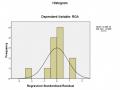
 Correlation Coefficient Results and Significance Level of Correlation Coefficient Test for Joint Stock Commercial Bank Group
 -
 Theoretical Basis of Lending to Corporate Customers at Commercial Banks
 -
 Factors affecting the debt repayment ability of corporate customers at Vietnam Joint Stock Commercial Bank for Investment and Development - Long An Branch - 1
 -
 Completing the appraisal of loans for additional working capital for corporate customers at Vietnam Joint Stock Commercial Bank for Industry and Trade - Dong Anh Branch - 5
 -
 Anova Test of Regression Model Fit

2. Results of testing the predictive ability of the Classification model Table a
Observed Predicted
Y Percentage
0 1 Correct
Step 1
Y 0 31 55 36.0
1 11 221 95.3
Overall Percentage
a. The cut value is ,500
3. Results of testing the model's explanatory power
Model Summary
79.2
Step
-2 Log likelihood | Cox & Snell R Square | Nagelkerke R Square | |
1 | 291,749 a | ,221 | ,321 |
a. Estimation terminated at iteration number 7 because parameter estimates changed by less than .001.
4. Testing the suitability of the regression model:
Omnibus Tests of Model Coefficients
Chi-square | df | Sig. | ||
Ste p | 79,482 | 6 | ,000 | |
Step 1 | Block | 79,482 | 6 | ,000 |
Model | 79,482 | 6 | ,000 |
5. Test the partial correlation of the regression coefficients :
Variables in the Equation
B | SE | Wald | Df | Sig. | Exp(B) | ||
EXPERIENCE | ,090 | ,032 | 8,043 | 1 | ,005 | 1,095 | |
DONBAY | ,072 | ,078 | ,855 | 1 | ,355 | 1,074 | |
Step 1 a | ROE | 12,666 | 2,234 | 32,135 | 1 | ,000 | 316742,865 |
DUNO | ,000 | ,000 | ,022 | 1 | ,882 | 1,000 | |
TLTSBD | ,046 | ,099 | ,220 | 1 | ,639 | 1,048 | |
TIME TO WRITE | -,010 | ,006 | 3,480 | 1 | ,062 | ,990 | |
Constant | -,680 | ,408 | 2,780 | 1 | ,095 | ,507 |
a. Variable(s) entered on step 1: KINHNGHIEM, DONBAY, ROE, DUNO, TLTSBD, THOIGIANVAY.