
D 0 J 0
T
Maybe you are interested!
-

 Research on the model of Vietnam-Czech friendship labor cultural clubs associated with tourism culture - 2
 -
 Training, Fostering, and Improving Labor Qualifications in the Tourism Industry
 -
 Tourism Industry Labor of Thanh Hoa Province, Period 2006-2010
 -
 Research on the model of Vietnam-Czech friendship labor cultural clubs associated with tourism culture - 7
 -
 Number and Structure of Labor at Do Son Tourism Joint Stock Company
t 1
K t J t
1 r t
Or:
NPV
K t J t D
J 0
T
t 1
1 r t0 0
Businesses need to consider this human resource investment carefully. Sending workers for training or opening skill improvement classes all cost a lot of money. But the return on this “investment” depends entirely on the workers, whether their skills have improved significantly or not? Will they stay with the business after being trained?... Some businesses benefit by not retraining workers but choosing to recruit people who already have skills and qualifications from other businesses or only opening training classes that are specific to the business.
Currently, in the tourism industry, there are many different forms of training with different contents, including professional courses and advanced management courses for both new recruits and those who are working. Statistics show that those without formal skills or qualifications account for about 50 - 85%, so the need for internal training is very large.
In addition, labor supply is closely related to workers' choices. If workers seek the highest return on their investments, they will consider factors such as occupations, industries and companies that can provide them with the greatest income and job satisfaction. First, workers consider the correlation between wages and job requirements. In addition, people also take into account non-material aspects, such as some jobs are dangerous or toxic, or have a low social status, while others are pleasant, have high status, and consider other unemployment risks... Workers will consider to get "net benefits" - combining both material and non-material factors, from which they choose a suitable workplace for themselves.
6.1.2.2. Labor demand
Long term demand
Businesses need factors of production such as labor, raw materials, and capital to produce goods and services. That is, the demand for factors of production is a derived demand that originates from the demand for goods and services.
In terms of long-term strategy, all factors of production are variable. Each enterprise can choose any technology to create its products: from production lines that require high labor intensity (using a lot of labor), to technologies that require high investment capital (using more machinery than human labor). If the enterprise is oriented to maximize profits, the enterprise will choose the type of technology with the lowest cost.
As the price of labor and the cost of capital change, the combinations of these two input factors will also change. If the price of labor increases relative to the cost of capital, many businesses may try to replace labor costs with investments in new machinery and technology. However, the ability to substitute one factor of production for another depends largely on the nature of the product and the state of technology. In tourism businesses, the ability to replace labor with capital is relatively limited compared to other manufacturing businesses due to the service nature of the industry. In other manufacturing businesses, with highly repetitive production lines and less sophisticated skills, the use of machines to replace humans can be easily implemented, such as in the food processing sector.
Short-term demand
In the short run, a firm can only adjust the quantity of some factors of production, not all (some factors of production are limited by supply). When the number of units of a factor
As production increases, profits fall - if the number of workers increases, profits fall. The additional output produced by adding one worker (the marginal product of labor) is shown in Figure 6.3.
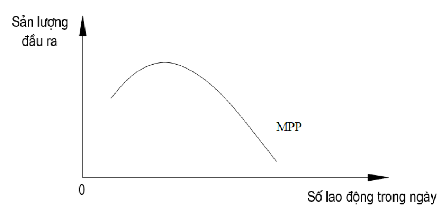
Figure 6.3. Marginal labor productivity (in units of output)
The additional output will be sold at a certain price and the additional revenue received is called marginal revenue. The value added to the firm by adding one more worker will be equal to the marginal product of labor in physical terms (marginal physical product) multiplied by the marginal revenue of one unit of output. This is also called the marginal revenue product (MRP = MPP x MR) and its graph is also curved as shown in Figure 6.3.
Profit-maximizing tourism businesses will not hire more workers if the cost of hiring more workers (marginal cost - MC) is higher than the marginal revenue product (MRP). Conversely, if the marginal revenue product is greater than the marginal cost, the business will gain more profit from increasing the number of workers. And when the marginal revenue product is even greater than the additional cost of the additional labor, the business will still earn profit.
Thus, a firm will hire more labor until marginal revenue product equals marginal labor cost. Profit is maximized at the point where MRP = MC. Suppose the firm pays wages according to
If the market price for labor is equal to the wage and there is no effect on that wage, then the marginal cost of hiring additional labor will be equal to that wage (MC = W). Therefore, the profit-maximizing condition is MRP = W (Figure 6.4).
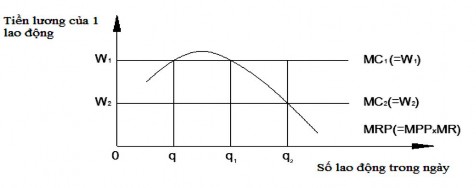
Figure 6.4. Maximizing profit from labor
At the wage rate 0W 2 , the quantity of labor required by the firm is 0q 2 , because at any other quantity of labor, profits will not be maximized. With a quantity of labor less than 0q 2 , the firm will have to pay a higher price to add labor, MRP is higher than MC and there is still room for profit. With a quantity of labor greater than 0q 2 , the additional cost of hiring more labor (MC 2 ) will be greater than the value of the additional product (MRP) and so profits will decline.
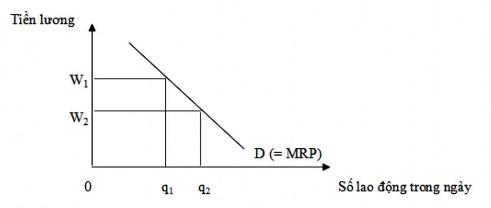
Figure 6.5. Labor demand curve
If the wage level is 0W 1 , the profit maximization condition MRP = MC is satisfied at two points indicating the number of workers 0q and 0q 1 . With the number of workers equal to 0q 1 , the enterprise will earn more profit, so moving the number of workers from 0q to 0q 1 will increase revenue (MRP) faster than increasing costs (MC 1 ) and profit will increase.
The quantity of labour required by a firm is represented by the MRP curve. The MRP curve (only the downward sloping part) is called the demand curve for labour (Figure 6.5). It can be assumed that, if all other factors remain constant, a firm will hire more labour only if the price of labour (wages) decreases, and if the price of labour increases, the firm will reduce its demand for this factor of production. The employer will move down or up the demand curve for labour, corresponding to the new wage level, and thus the quantity of labour hired will be greater or less than before. The demand curve for labour obeys the law of demand.
Like the demand curve for any other good or service, the demand curve for labor can shift, either up or down, to the right or to the left. Since the demand for factors of production is a derived demand, changes in demand in the market for consumer goods and services will shift the demand curve for labor. An increase in consumer income, a relatively low price of restaurant meals compared to other forms of food consumption, or a decrease in hotel room prices can create incentives to stimulate demand for tourism services and shift the demand for labor in the tourism industry.
The demand curve for labor can shift outward when the prices of other factors of production increase. Conversely, when the prices of other factors of production are cheap, the substitution for labor will cause the demand curve for labor to shift inward (towards the origin).
Labor productivity also shifts the demand curve for labor. The decision to increase or decrease labor is based on a comparison of marginal revenue product and the wage rate. If marginal revenue product
As the marginal cost of labor increases, the firm can hire a larger number of workers at a corresponding wage. The demand curve for labor will shift outward. Each worker will be worth more because of greater efficiency or because of higher revenue from the product.
The elasticity of demand for labor depends in part on its substitutability. The more important and difficult it is to replace human labor in a particular business process, the less elastic the demand for labor. Furthermore, if the demand for a good or service is inelastic, the labor required to produce it is also inelastic.
Labor demand is also inelastic if labor costs account for a small proportion of total production costs. For example, if labor costs account for 10% of total costs, a 50% increase in wages will only increase product prices by 5%. If labor costs account for 60% of total costs, the impact on final product prices will be much greater, increasing prices by up to 30%. This shows us why workers in capital-intensive technology industries often receive higher wages than workers in labor-intensive technology industries. Because labor costs account for a significant proportion of tourism businesses, it is difficult to increase wages for workers without affecting profits or increasing product prices.
The tourism industry's labor demand curve is aggregated based on the labor demand curves of individual firms. The industry's labor demand curve has the same shape as the individual firm's labor demand curve. However, the industry's total demand curve has a steeper slope (less elastic), and an increase in wages is likely to lead to a decrease in employment and output. When output falls, the price of the product may rise, causing the MRP of labor to shift outward.
Labor demand in the tourism industry exhibits large short-term fluctuations for certain occupations. This explains why part-time workers are typical of tourism workers, but also why
There are workers who are hired on a temporary basis to perform a special purpose or function.
6.1.3. Labor productivity
Labor productivity is an economic category that reflects the level of use of living labor in the production and business process. Therefore, it is also an economic efficiency indicator, reflecting the correlation between the results achieved and the costs of living labor spent to achieve those results.

In there:
The indicators showing the results can be determined in terms of value and in kind. In terms of value, labor productivity is determined by revenue and profit indicators. In terms of kind, labor productivity is determined depending on the business sector. For tourism business, it can be determined by the number of guests, guest days, etc. For food and beverage business: quantity of food and beverage products, number of tables served. For accommodation business: number of guests, number of rooms used, number of guest days, number of nights stayed.
Cost indicators are determined through the number of workers, wages, working days, and working time.
In the tourism business, labor productivity can often be measured by two types of indicators: physical indicators and value indicators.
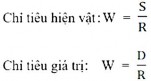
In which: W - Labor productivity D - Revenue S - Number of products R - Number of workers
Labor productivity, whether calculated by physical or value indicators, is determined by time in days, weeks, months, and years. Physical indicators accurately reflect the nature of labor productivity and labor efficiency. Labor productivity calculated by physical indicators does not depend on price fluctuations or other economic conditions. However, this indicator does not reflect the synthesis, cannot compare labor productivity between enterprises or between different business units, but is often only used to compare labor productivity between periods of the enterprise. Therefore, physical labor productivity indicators are rarely used in the tourism industry. Labor productivity calculated by value indicators is simple and easy to determine. Value indicators reflect the synthesis of labor productivity, so they can be used to compare labor productivity and economic efficiency between enterprises to determine the position of each enterprise. Value indicators also have certain limitations. This indicator is affected by price, so its accuracy is less than that of physical indicators. It is necessary to eliminate the influence of price as well as other objective factors when applying this indicator.
As an economic indicator, labor productivity is affected by many factors, including direct factors, indirect factors, subjective factors that need to be studied to find solutions to overcome limitations and promote positive aspects, and objective factors that need to be eliminated to accurately determine the business situation.
To create a product, in the labor process, we must use the labor factor as well as labor tools to impact the labor object. To increase labor productivity, we must improve the efficiency of using the above factors.
Labor force includes: Health of workers, number of workers, professional qualifications, cultural level, moral qualities of workers.