
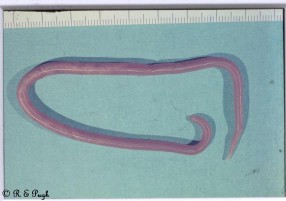
Figure 1.1. Adult roundworm
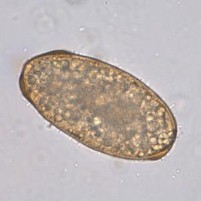
Figure 1.2. Ascaris eggs (x 400) |
Maybe you are interested!
-

 Life cycle rituals of the Dao Quan Chet people in Ba Vi district, Hanoi city - 26
 -
 Product Life Cycle Stages Model and Characteristics
 -
 Methods of Organizing Life Values Education Activities
 -
 Inspiration of worldly and personal life in Vietnamese poetry 1975-2000 - 13
 -
 Impact of tourism on the cultural and social life of Thai people in Mai Chau - Hoa Binh and development solutions Case study of 4 villages: Lac village, Pom Coong village, Van village, Nhot village - 1
(Source: http://cdc.gov/parasites/Ascariasis) [12]
- Development cycle
Adult roundworms live in the human small intestine. Adult male and female roundworms mate and lay eggs. Each day, females can lay 200,000 to 250,000 eggs. Fertilized roundworm eggs that are excreted in the feces and encounter favorable external conditions will develop into eggs with larvae, and only these eggs are capable of infecting humans.
When a person swallows eggs containing larvae, the eggs will go from the mouth through the digestive tract to the stomach. When entering the small intestine, the larvae escape the egg shell (stage I) and penetrate the capillaries in the intestine into the mesenteric vein to go to the liver (from 3-7 days) to develop into stage II larvae. Stage II larvae follow the blood into the vena cava, then into the right heart. From the right heart, the larvae follow the pulmonary artery to the lungs to develop into stage III and IV larvae in 10-15 days. Then the larvae follow the tracheal system to the pharynx, then down the esophagus to the digestive system to become adult roundworms and parasitize the small intestine.
The process from when a person eats roundworm eggs containing larvae to when they develop into adult roundworms in the small intestine, to be able to lay eggs, is about 60 days. Roundworms can live in the intestine for 10-13 months [2].
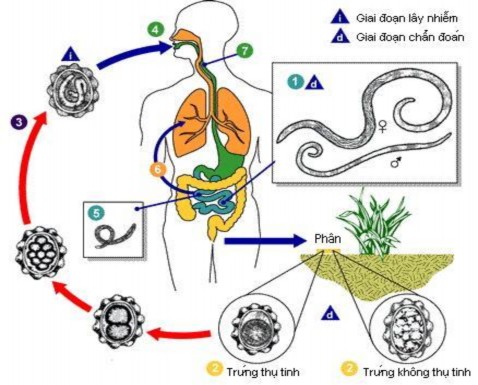
Figure 1.3. Life cycle of Ascaris lumbricoides roundworm
(Source: http://cdc.gov/parasites/Ascariasis) [12] Periodic notes:
(1) Adult roundworms live in the small intestine of humans.
(2) Roundworm eggs are released into the environment through feces.
(3) Fertilized roundworm eggs develop into eggs with larvae.
(4) People who eat eggs containing larvae
(5) Larvae hatch into stage I larvae.
(6) Larvae follow the venous blood to the heart and then to the lungs to develop into stage IV larvae.
(7) Stage IV larvae go up the throat and down the esophagus to the digestive system to become adult worms.
1.1.1.2. Whipworm (Trichuris trichiura)
- Physical characteristics
Whipworms belong to the class Nematoda, family Trichuridae.
The whipworm is a small, long worm with a thin, hair-like head and a swollen tail, and a light pink body. Females are 30-50mm long, while males are 30-45mm long. Distinguishing between male and female whipworms is based on the tail: the female worm's tail is straight, the male worm's tail is curved, and the end of the male worm's tail has a genital spine. The mouth of the whipworm has no lips, the esophagus runs through the head, and there are many secretory glands that destroy tissue. The genitals of both male and female worms are tubular, with the genital opening at the junction of the head and tail.
Location of parasitism: whipworms often parasitize in the colon and cecum, sometimes in the appendix. When parasitizing, the worm inserts its head into the intestinal wall to suck blood, the tail is inside the intestine.
The eggs of whipworms have a special shape like an areca nut, thick shell, two ends with two transparent, dark yellow mucus plugs, measuring 22 x 50 m [2].
Figure 1.4. Adult whipworm
Figure 1.5. Whipworm eggs (x400) | |
(Source: http://cdc.gov/parasites/whipworm) [13] | |
- Development cycle
The life cycle of the whipworm is very simple. The adult female whipworm can lay eggs.
3,000 - 20,000 eggs per day. Eggs are released into the environment through feces and when given suitable conditions (temperature 25-300C, humidity, oxygen), develop into eggs with larvae and are capable of infecting for a period of 17-30 days.
When a person swallows eggs containing larvae into the intestine, the larvae escape their shell in the small intestine, then gradually move down to the colon and cecum, developing into adult worms there. The time from infection with eggs until the pinworms start laying eggs
about a month. Adult pinworms live in the human intestine for about 5 - 6 years [2].

Figure 1.6. Life cycle of the whipworm Trichuris trichiura (Source: http://cdc.gov/parasites/whipworm) [13].
Periodic notes:
(1) Roundworm eggs are released into the environment through feces.
(2) Pinworm eggs develop into 2-celled eggs.
(3) Pinworm eggs develop to the morula stage.
(4) People who eat eggs containing larvae
(5) Larvae escape from the small intestine to become adult pinworms.
1.2.1.3 Hookworm (Ancylostoma duodenale/Necator americanus)
- Physical characteristics
Hookworms belong to the class Nematoda, family Ancylostomatidae.
Shape: Hookworm Ancylostoma duodenale is a small worm, female worms are 10-13mm long, male worms are 8-11mm long. The head has a bulging and curved mouth, the upper edge of the mouth has 2 pairs of hook-shaped teeth, arranged symmetrically, 1 pair on each side;
The lower edge of the mouth is a hard sheath that helps the hookworm grip the intestinal mucosa to suck blood. The hookworm Necator americanus is difficult to distinguish from the hookworm in general, but there are still differences such as: the hookworm is smaller and shorter; the hookworm does not have two pairs of hooks but two pairs of sharp semicircular teeth.
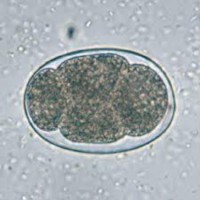
Hookworm eggs are oval in shape, measuring 40 x 60 m, with a thin, smooth, colorless outer shell containing a nucleus. Some authors believe that hookworm eggs have 4-8 nuclei while hookworm eggs have 2-4 nuclei.
Hookworms parasitize in the duodenum and the first part of the small intestine. The worms attach to the intestinal mucosa to suck blood and secrete anticoagulants that cause bleeding at the site of injury [2].
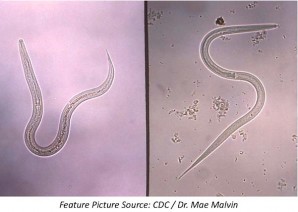
Figure 1.7. Hookworm/beak (x5)
Figure 1.8. Hookworm eggs (x400) | |
(Source cited http://cdc.gov/parasites/hookworm) [14] | |
- Development cycle
After copulation, female worms lay eggs in the small intestine, the eggs are excreted with the feces. Each day, a female hookworm/beakworm can lay about 30,000 eggs and a female beakworm can lay about 9,000 eggs. The eggs are excreted into the environment with the feces. Under favorable conditions (sufficient humidity, enough oxygen, temperature from 25-350C), the eggs hatch into larvae in 2-3 days (stage I larvae). After 5-10 days with 2 times of exoskeleton, the larvae develop into stage III larvae, which are larvae capable of penetrating the host's skin or mucosa. These larvae can live for 3-4 weeks under favorable climatic conditions and are motile towards the host.
When in contact with a human host, the larvae penetrate the skin and follow the veins to the right heart. The larvae follow the pulmonary artery to the lungs. Here, the larvae change their coat twice more to become stage IV and V larvae, then pass through the bronchi to the pharynx, down to the stomach, intestines and develop into adult worms. Adult worms attach to the wall of the duodenum and the first part of the small intestine to suck blood and cause chronic blood loss in the host. The time to complete a life cycle of hookworms/worms takes about 6 - 8 weeks. Hookworms have a lifespan of 4 - 5 years, and hookworms about 10 - 15 years [2].
In addition, hookworm larvae can also be transmitted through food or water and then enter the intestine without a traveling stage in the body. In this case, they do not move through the lungs but parasitize in the intestine. However, some larvae stop developing and remain in a latent state in the tissues for about 8 months before developing into adult worms.
Cycle notes:
(1): Hookworm eggs are excreted in the feces into the environment. (2): Eggs develop into stage I larvae.
(3): Eggs develop into stage III larvae. (4): Stage III larvae penetrate the skin
(5): Larvae follow the veins to the right heart, then follow the pulmonary artery to the lungs, where they change into stage IV and V larvae. Stage V larvae go up to the pharynx and are swallowed into the stomach and intestines, and develop into adult worms that live in the small intestine.
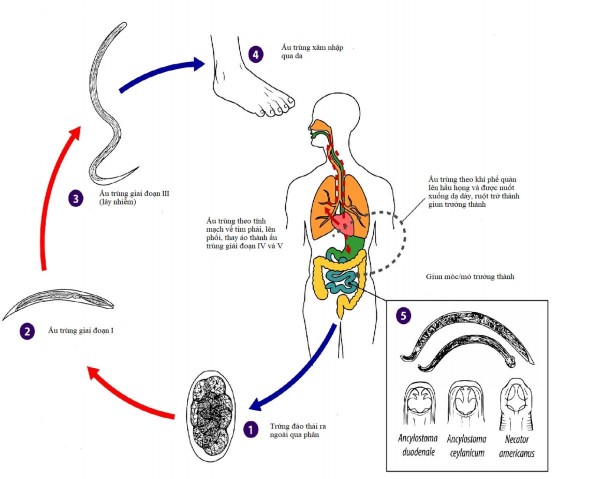
Figure 1.9. Developmental cycle of hookworm/worm
(Source cited http://cdc.gov/parasites/hookworm) [14]
1.1.2. Consequences of soil-transmitted helminth infection
The World Health Organization (WHO) considers worm disease to be a public health problem in many parts of the world, especially in tropical and subtropical climates, due to its prevalence and the consequences it causes. The disease occurs in all ages and has a great impact on physical and mental development, especially in children. Worms live in the intestines and multiply through the repetition of the cycle. It is very common for children to be infected with multiple types of worms at the same time. Worms living in the intestines of children can cause malnutrition because worms take food from the body, thereby reducing appetite, leading to children eating less or hindering the absorption of nutrients from the food they consume, causing a reduction in the absorption of essential nutrients. Infection with large numbers of worms in children can lead to malnutrition.
stunting or underweight. The study on the global burden of disease showed that the number of years of life lost due to STDs globally in 2010 was 5.18 million years, of which hookworm ranked first with the highest disease burden index of 3.23 million years of life, roundworm was 1.3 million years and whipworm was 0.64 million years [6], [15]. Pullan (2010) showed that severe roundworm and whipworm infection had a risk of malnutrition of 12.45%, and severe hookworm/whipworm infection had a risk of anemia of 16.15% [6].
Ascariasis is usually asymptomatic or has mild and nonspecific symptoms. The larval stage traveling through the lungs can cause symptoms of allergic pneumonia with eosinophilia. Gastrointestinal symptoms such as abdominal pain, appendicitis, digestive disorders, and liver abscesses are also common in moderate or severe ascariasis. In 2010, there were approximately 2824 deaths related to ascariasis, concentrated in Asia and Southeast Asia [6]. In 2015, there were approximately 761.9 million people infected with ascariasis, of which 2700 died [17]. Severe cases of ascariasis in children often lead to intussusception, intestinal obstruction, or bile duct involvement [18], [19].
Among the types of helminths, hookworms are the worms that have the greatest impact on human health. Hookworms feed by sucking blood from the human intestinal mucosa, causing chronic blood loss. To date, there have been no reports of deaths due to hookworms, however, the consequences of hookworms are often chronic and silent, leading to physical and mental effects, especially in children [6], [20].
Ta Thi Tinh (2006) conducted a study on 512 primary school students in Thanh Hoa and found that children infected with hookworm had a 1.9 times higher risk of anemia than uninfected children. Moderate hookworm infection had a 2.1 times higher risk of anemia and severe hookworm infection had a 10.1 times higher risk of anemia than normal children [4].