
Chapter 2: Current status of club activities at the Vietnam-Czech Republic Friendship Cultural Palace.
2.1 General overview of the Cultural Palace…………………………………...
2.2 Organizational model of Cultural Palace……………………………………...
2.3 Role, function, task……………………………………….
2.4 Achievements……………………………………………..
Maybe you are interested!
-
 Research on the model of Vietnam-Czech friendship labor cultural clubs associated with tourism culture - 7
 -
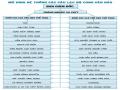 Organizational Model of the Vietnam-Czech Friendship Labor Cultural Palace
 -
 Research on EBAY's online auction model and recommendations for Vietnam - 1
 -
 Research Model to Evaluate the Effectiveness of the Ksnb System at Provincial Radio and Television Stations in Vietnam
 -
 Economic group model - operations of Vietnam Oil and Gas Group in the period 2006 - 2008 and development trends - 1
2.5 Club Activities……………………………………….. 2.6. General Assessment………………………………………………………
Chapter 3: Some proposals to link the organizational model of the activities of the Cultural Palace Clubs with Tourism Culture.
3.1 Cultural and Tourism Activities – Connection under the roof of the Cultural Palace
3.2 Cultural Tourism Club Cultural Palace - A gathering place for members who love cultural tourism activities…………………………………………………............
3.3 Proposed organizational model of some Cultural Palace Clubs with Cultural Tourism activities…………………………………………………..
3.1 Poetry Club – cultural exchange……………………………… 3.2 Calligraphy Club…………………………………………….
3.3 Sports Cycling Club……………………………………
3.4 Photography Club……………………………………………
Thanks!
In recent years, with the renovation policy of our Party and State, the economic potential of the country has been increasingly strengthened, politics has been stable. The country has escaped the economic crisis, improved the material and spiritual life of the people, and maintained the Socialist orientation. The 6th National Congress of the Party is a historical milestone marking the development period of the Vietnamese revolution, the period of promoting national strength, continuing to innovate and promote industrialization and modernization of the country. Along with that development process, the operating models of mass organizations have also been innovated to suit the progress of history and typically the organizational model of cultural palaces has been constantly improved, contributing positively to strengthening and improving the quality of operations of the State management model in general and the specific operations of the system of cultural palaces in particular.
In recent years, the system of clubs has been operating more and more effectively but has not yet fully exploited the potential of its own units. Many Cultural Palaces are still under the state's sponsorship and are not ready to operate independently and have their own policies. Take the lead in operating with
The revenue of the Cultural Palaces is extremely difficult but since the formation of
Established and developed over the past 20 years, the Vietnam-Czech Republic Friendship Labor Cultural Palace has always done well in that regard to actively contribute to Hai Phong's economic growth, while building a strong country and bringing the cultural and tourism industry to the forefront.
Tourism becomes a key economic sector.
During the internship at the Vietnam-Czech Republic Friendship Labor Cultural Palace, the writer learned a lot of information to serve the thesis well.
your career and decision
decided to choose the topic : "Research on the model of organizing activities of the Vietnam-Czech Friendship Labor Cultural Palace Clubs associated with Cultural Tourism".
The topic includes 3 chapters:
Chapter 1: General theoretical basis of Cultural Palace and Club.
Chapter 2: Current status of activities of Clubs at the Labor Culture Palace
Vietnam-Czech Republic friendship movement.
Chapter 3: Some proposals to link the operating model of Cultural Palace Clubs with Cultural Tourism.
During the process of writing the graduation thesis, the author was enthusiastically guided by Dr. Nguyen Van Binh and at the same time, Director Trinh Phuc Tue and the staff at the Vietnam-Czech Friendship Labor Cultural Palace provided many valuable documents for the thesis, so the author would like to sincerely thank him.
Hai Phong, April 10, 2011.
Student.
Nguyen Thi Hue.
Introduction.
1. Reason for choosing the topic.
Vietnam develops in a socialist orientation, so all industries must follow common rules and for each unit's operating model to be effective, not only must it comply with all state and legal regulations, but each agency also needs to have organizational models suitable to its situation to actively promote the potential strengths of each individual and separate organization.
The Viet Tiep Friendship Labor Cultural Palace was started on February 16, 1986 and put into operation on December 17, 1989. It has achieved many practical results. During the process of learning specifically about the unit from its formation and development to the present, the Cultural Palace has also encountered many difficulties and limitations.
To find ways to overcome difficulties and at the same time find solutions for development in the new period with the strengthening of the association of clubs associated with tourism culture, I decided to choose the topic "Research on the model of organizing activities of clubs of the Vietnam-Czech Friendship Labor Cultural Palace with tourism culture" as the topic of my graduation thesis and also made suggestions for the development of club models as follows:
 Build an organizational structure with full capacity and professional expertise in accordance with the specialized field of tourism culture.
 Clubs must be established to select and train members with deep understanding of culture and tourism.
 Actively organize cultural and tourism exchange programs to promote and attract more members to participate.
 Actively organize Game Show programs associated with tourism culture.
2. Research purpose.
 Plan for the development of clubs associated with many cultural and tourism activities.
 Survey and evaluate the cultural and tourism activities of the Cultural Palace in recent years and propose development strategies for the coming time.
 Research to organize new models with practical effectiveness to develop a stronger cultural palace, attracting many classes and working people to participate.
 Research the possibility of expanding the activities of Clubs as well as Cultural Tourism programs at many grassroots levels under the management of the Vietnam-Czech Republic Friendship Labor Cultural Palace.
3. Scope of research.  Research objects :
Model of organizing activities of tourism development support clubs at the Vietnam-Czech Republic Friendship Cultural Palace.
 Research space :
Vietnam-Czech Republic Friendship Cultural Palace and some locations in Hai Phong.
 Research period : The project was conducted from April 10, 2011 to June 26, 2011.
3. Research methods.
Interdisciplinary research method of cultural studies, sociology, and club studies.
Practical method of survey, analysis and synthesis to evaluate the activities of the Clubs associated with Cultural Tourism at the Cultural Palace.
4. Scientific and practical significance of the topic.
 Scientific significance: Researching the model of organizing activities of the Vietnam-Czech Friendship Labor Cultural Palace Club associated with Cultural Tourism is a positive direction and a feasible solution for the Cultural Palace to determine the development direction and exploit the hobby clubs to better serve the needs of all working people in Hai Phong and neighboring areas.
This is a document used in Cultural Palaces, a general reference document on the operating model of clubs associated with cultural tourism and the impact of cultural tourism activities on the development of clubs in Cultural Palaces.
 Practical value: Has practical significance in building an effective model of activities associated with tourism culture at the Cultural Palace.
Chapter 1: General theoretical basis of the Club
and Palace of Culture.
1.1 Cultural Palace.
1.1.1 Concept of Cultural Palace: Born from the 18th century until now, Cultural Palace has been defined by cultural scholars in many different ways . According to Lenin's ideology, the birth of Cultural Palace has attracted thousands, tens of thousands of participants and has been widely formed from urban to rural areas. Especially in cities, industrial zones with concentrated cultural houses have developed on a large scale in terms of technical materials, means of operation, professional staff and rich content of activities, so it has attracted a large number of working people to participate.
Krupxkaia defined " Cultural Palace is a place that contains the spiritual values of the locality, is a vestige of a step of civilization of that locality, and is also a place that connects the feelings and will of the leaders with the working people".
1.1.2 Palace of Culture - Formation and development.
The phrase Cultural Palace was born around the beginning of the 18th century in civilized Europe. In the early period, it was understood as an entertainment center, a place where hobby clubs serving the upper class were concentrated.
In the following years, the activities of the Cultural Palace became more and more diverse, thus attracting many participants. In addition to the aristocracy, there were also members from other classes such as merchants and officials.
By 1920, after 3 years of the successful October Revolution in Russia, the Cultural Palace had truly become a place for the working masses to live and gather many members to open clubs with large-scale operations and a cultural staff with rich professional expertise.
In Vietnam, in the early days, the concept of a Cultural Palace was very distant to the Vietnamese people, so almost no Cultural Palace was established.
In 1858, when the French invaded our country, the Vietnamese people's awareness of the Cultural Palace was expanded, but the establishment of large-scale Cultural Palaces had not yet been implemented. Instead, there were only entertainment centers established by the French to serve French officers.
In 1866, French officers occupied a large area of our land to build a sports complex and established the first clubs for athletics, shooting, horse racing, which were known as an early form of cultural and sports centers.
In the current period, the system of Cultural Palaces and Cultural Houses is built very richly and diversely. From small localities to large economic centers, there are always Cultural Palaces and Cultural Houses to serve the cultural needs of the working people.
Coming to the Cultural Palace, people will be educated to understand more about:
Political field.
Communication and behavior.
Cultural exchange.
Sightseeing
Production work experience.