
7 | Basic Science | 3,270 | 8 | ||
8 | Politics | 857 | 2 | ||
9 | Philosophy, Marxism | 4,197 | 10 | ||
10 | Foreign language | 45 | 0.1 | ||
11 | Law | 294 | 0.6 | ||
12 | Other fields | 5,828 | 13.6 | ||
Total | 42,643 | 100% |
Maybe you are interested!
-
 Testing Factors Affecting Customer Satisfaction With Savings Deposit Services At Dong A Bank
 -
 Factors affecting customer satisfaction with the quality of international money transfer services at Dong A Commercial Joint Stock Bank - 1
 -
 Factors affecting the development of public passenger transport services by bus in urban areas in Vietnam: a case study of Hanoi city - 2
 -
 Evaluation of the quality of savings deposit services for individual customers at Dong A Commercial Joint Stock Bank - Hue Branch - 14
 -
 Proposing Factors Affecting Customer Satisfaction With Savings Deposit Services At Dong A Bank
Figure 5: Table of textbooks and reference books by field of expertise.
Looking at the statistics table of documents by professional field, it can be seen that the University of Transport Engineering is a university that specializes in technical fields, in which the main training fields of the University are: Construction with the largest number of books accounting for 40% of the total number of books in the library, books in the field of Mechanics account for the second highest percentage of 11% of the total number of books in the library. Books on Foreign Languages account for 0.1%.
Besides, documents in the fields of Philosophy, Law, Basic Sciences (Mathematics, Physics, Chemistry), and Politics also account for a fair proportion, because these are the basic and fundamental fields that every student in the school must study to complete their course.
Documents in the fields of Economics, Information Technology, Electronics, and Electricity also account for a fairly large proportion in the data table, because these are also the school's key training fields, and these fields only account for a proportion after the fields of Construction and Mechanics.
CHAPTER 2
CURRENT STATUS OF INFORMATION-LIBRARY PRODUCTS AND SERVICES AT THE LIBRARY OF UNIVERSITY OF TRANSPORT TECHNOLOGY
2.1 Information products - library at the Library of University of Transport Technology
Information-library products are the result of information processing, carried out by an individual/group to satisfy the needs of information users.[5,p.21]
Information-library products are created to meet and satisfy the information needs of information users. Information-library products are closely dependent on information needs and their changing movements. During their existence and development, information-library products are constantly developing and improving to adapt to the information needs that information-library products aim for.
Typically, Information-Library products include:
Manual search system; Bibliography; Journal abstracts; Scientific citations; Catalogs; General reviews; Databases and some other online products.
Through the survey at the Library of the University of Transport Technology, the Library of the University of Transport Technology currently has the following 4 information and communication products:
1. Table of contents system:
- Table of contents in card form
- Online Public Access Catalog (OPAC)
2. Document list.
3. Directory database.
4. Home page.
Below is a presentation of each specific type of TT-TV product:
2.1.1 Table of contents system
2.1.1.1 Table of contents in card form (Classified table of contents)
A classified catalogue is a type of catalogue in which the catalogue cards are arranged according to classes in the logical order of a given book classification scheme (frame/table). [5, p.41]
The catalog in libraries is a very important reference tool when users want to search for documents. The catalog contains index cards, which are cards that describe bibliographic information about documents and create an access point to the reflected documents.
The catalog used at the University of Transport and Communications Library is a classified catalog, arranged by subject categories according to the DDC (Dewey Decimal Classification) Framework.
According to the publication form of the document, the catalog of the University Library
CNGTVT is a Book-type Classification Catalogue, presented in the form of a classification catalogue cabinet, with 30 catalogue card boxes.
The Library's catalog is used by many readers to find documents, because this is the main document search tool in the library. The Library of the University of Transport and Communications has not yet used the Libol software to search for documents because the data has not been fully updated.
Currently, the library has a catalog cabinet located in the reading room on the 3rd floor of the library. On average, about 150 readers use the catalog cabinet every day to look up library documents.
The structure of the Library's catalog consists of two parts: the main topics section and the alphabetical subject lookup boxes section.
- Main headings section: includes descriptive forms with classification symbols and separator forms, separator forms are designed with different colors from descriptive forms to help users distinguish more easily.
- The section of the alphabetical topic lookup boxes: includes descriptive sheets with the names of the topics, arranged in alphabetical order of the topic names.
- Topics are arranged based on the fields of study of the School such as: Engineering mechanics, construction, transport economics, banking, economics, law, statistics, politics, accounting,...
- Characteristics of the catalog cabinet at the University of Transport Engineering Library: cards with similar classification symbols are grouped; each group of similar cards is organized into a topic. In general, the library's catalog is easy to look up and simple.
Below is a list of subject names of the classification catalog at the Library of the University of Transport and Communications:
Topic Name
Social class; world history, judicial law |
Military and commercial law |
Economy |
Statistical probability; Tax; International economics |
Banking; Money; Auditing; Macroeconomics |
Manage |
Electricity |
Physics |
Road construction |
Bridge; Hydraulic Technology; Hydraulic Engineering |
Mathematical Mechanics; Kinematics; Iron Transport; Engineering Drawing |
Energy |
Machine engineering |
Finance | ||
Electronics | ||
Marketing | ||
Jurisprudence | ||
Dictionary | ||
Political parties; Criminal law | ||
Vehicles on the ground | ||
Standards; Construction | ||
Railway | ||
Construction activities | ||
Trade books (metal production technology) | ||
Construction structure | ||
Information technology | ||
Chemistry; Thermodynamics | ||
Engineering mechanics | ||
Accountant | ||
Vietnamese Literature |
Figure 6: List of topics on the Library catalog.
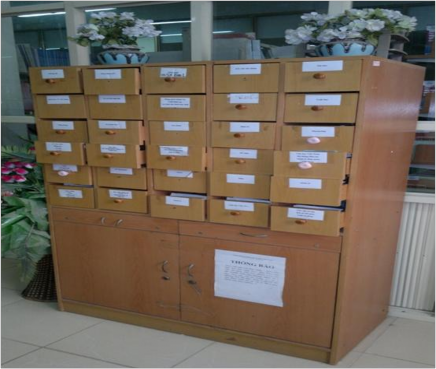
Figure 7: Library catalog cabinet
The catalog of the University of Transport and Communications Library helps users to quickly and accurately search for the documents they want. Through the catalog, librarians can list textbooks and reference books in the document warehouses, helping them to manage the library resources well.
2.1.1.2 Online Public Access Catalog (OPAC)
Online Public Access Catalog (OPAC) was born as a result of the development of cataloging standards and the rapid development of computer and communication technologies.
According to the Online Library Information Dictionary-ODILIS: “OPAC is a database of bibliographic records describing books or other materials owned by a library or library system that users can access through workstations or terminals usually located near the reference desk or reference service.
research to help them request help from the search officer easily.”
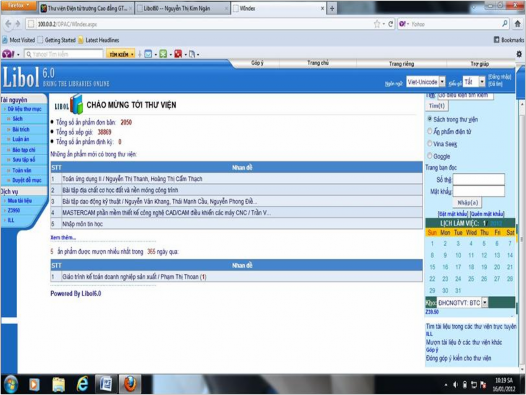
Figure 8: OPAC online catalog interface of the University of Transport and Communications Library .
Online OPAC catalog of the library of the University of Transport Technology:
- The online catalog OPAC is designed by Tinh Van Technology Joint Stock Company; OPAC is designed to suit the information needs of users, the organization and management of information-library products and services, and the training objectives of the University of Transport Engineering.
- The online catalog OPAC is managed by the library staff of the Professional Department and the Multimedia Department of the library. OPAC is not currently in use because it is in the process of updating the records, after which it can be put into service for readers.
- The database on the OPAC online catalog of the University of Transport and Communications Library is designed in the form of records, presented with the purpose of helping readers easily look up documents with the following sections:
RESOURCES include the following items: bibliographic data, books, excerpts, newspapers and magazines, reference books, digital collections, full text, and subject review.
SERVICES include items: Z39.50, purchase of documents, ILL.
- The entire OPAC database is a book database, including textbooks and reference books, allowing users to directly access these databases via the library's electronic computers; providing search assistance; displaying search results below.
easy-to-understand format; information about the community; allows access through different access points such as: author name, keywords, title name, year of publication, classification symbol, ISSN or ISBN index, ...
- Number of records: about 1088 records. This number of records is cataloged by the professional library staff.
- The library's OPAC provides 3 search interfaces: simple search, detailed search and advanced search, allowing searching for information in several different languages. Vietnamese in particular allows the use of different character sets (Unicode, VNI, TCVN), allows searching for information using Boolean operators (AND, OR, NOT), and has the ability to access according to the Z39.50 standard.
- OPAC displays output in a number of different results, concise, complete according to MARC cataloging format; can limit the number of records on the screen from 50, 100, 200,... or all records; can arrange records according to different criteria such as: title, year of publication, author,...; display records in a simple way or according to ISBD.
2.1.2 Document list
A catalogue is a list that allows information about a
/a group of subjects belonging to social fields of activity or/and geographical area.[4, p.72]
The objects reflected by the Catalog are the electronic documents of the Library.
Currently, the Library of the University of Transport and Communications uses the catalog to announce electronic documents of the faculties and departments in the school, in addition to other documents outside the school's training fields for readers to refer to.