
principles, correct procedures, and accuracy to ensure correct criminal identification, avoid wrongful convictions, and avoid criminals escaping in practice.
Second, determining the crime of rape of a person under 16 years old is a logical thinking activity, conducted by the Investigation Police, the Procuracy, the Court and a number of other agencies according to the provisions of law. Logical thinking is understood as the competent agencies conducting the proceedings conduct the activities of reviewing, analyzing, evaluating, comparing and contrasting the signs constituting the crime of rape of a person under 16 years old.
1.1.2.3 Subject of conviction for the crime of Rape of a person under 16 years old.
The activity of determining the crime is an activity carried out at all stages of criminal proceedings. From the time of handling crime reports, denunciations, and recommendations for prosecution to the stage of prosecution, indictment, and trial (at all levels of first instance, appeal, review, or retrial of criminal cases).
Determination of the crime begins when receiving a report, denunciation of a crime and a request for prosecution. The Head of the Investigation Agency, Deputy Head of the Investigation Agency, Investigator, and Investigator for the Investigation Agency and other Agencies with the authority to investigate; the Chief Prosecutor, Deputy Chief Prosecutor, Prosecutor, and Specialist for the Procuracy; the Chief Justice, Deputy Chief Justice, Judge, and People's Assessor for the Court, through their duties and powers, shall initiate a criminal case when detecting signs of a crime. The decision to initiate a criminal case must clearly state the time, basis for initiation and applicable provisions of the Penal Code.
Maybe you are interested!
-
 Distinguishing the Crime of Sexual Intercourse or Other Sexual Acts with a Person from 13 to Under 16 Years Old (Article 145) from the Crime of Rape
 -
 Determining the Objective Side of the Crime of Rape of a Person Under 16 Years Old.
 -
 Car body electrical practice - 8
zt2i3t4l5ee
zt2a3gs
zt2a3ge
zc2o3n4t5e6n7ts
If the voltage is out of specification, replace the wire or connector.
If the voltage is within specification, install the front fog light relay and follow step 5.
Step 5 Check the front fog light switch
- Remove the D4 connector of the fog light switch
- Use a multimeter to measure the resistance of the front fog light switch.
Measurement location
Condition
Standard
D4-3 (BFG) -D4-4 (LFG)
Light switchFront Fog OFF
>10kΩ
D4-3 (BFG) -D4-4 (LFG)
Front fog light switchON
<1 Ω
- Standard resistor
D4 connector is located on the combination switch assembly.
If the resistance is out of specification, replace the combination switch (the fog light switch is located in the combination switch).
If the resistance is within specification, follow step 6.
Step 6 Check wiring and connectors (front fog light relay-light selector switch)
- Disconnect connector D4 of the combination switch assembly
- Use a voltmeter to measure the voltage value of jack D4 on the wire side.
Measurement location
Control modecontrol
Standard
D4-3 (BFG) - (-) AQ
TAIL
11 to 14 V
D4 connector for the wiring of the combination switch assembly
If the voltage does not meet the standard, replace the wire or connector.
If the voltage is within standard, there may have been an error in the previous measurements.
Step 7 Check the front fog lights
- Remove the front fog light electrical connector.
- Supply battery voltage to the fog lamp terminals
Jack 8, B9 of front fog lamp on the electrical side
blind first.
Power supply location
Terms and Conditions
Battery positive terminal - Terminal 2Battery negative terminal - Terminal 1
Fog lightsbefore morning
- If the light does not come on, replace the bulb.
If the light is on, re-plug the jack and continue to step 8.
Step 8 Check wiring and connectors (relay and front fog lights)
- Disconnect the B8 and B9 connectors of the front fog lights.
- Use a voltmeter to measure voltage at the following locations:
Measurement location
Switch location
Terms and Conditions
B8-2 - (-) AQ
Electric lock ON TAIL size switchFog switch ON
11 to 14 V
B9-2 - (-) AQ
Electric lock ONTAIL size switch Fog switch ON
11 to 14 V
B8 and B9 connectors on the front fog lamp wiring side
Voltage is not up to standard, repair or replace the jack. If up to standard, there may have been an error in the measurement process.
2.2.4. Procedure for removing, installing and adjusting fog lights 1. Procedure for removing
- Remove the front inner ear pads
Use a screwdriver to remove the 3 screws and remove the front part of the front inner ear liner
-Remove the fog light assembly
+ Disconnect the connector.
+ Use a screwdriver to remove 3 screws to remove the fog light cover
2. Installation sequence
-Rotate the fog lamp bulb in the direction indicated by the arrow as shown in the figure and remove the fog lamp from the fog lamp assembly.
-Rotate the fog light bulb in the direction indicated by the arrow as shown in the figure and install the light into the fog light assembly.
- Use a screwdriver to install the fog light cover
-Install the electrical connector
Attention: Be careful not to damage the plastic thread on the lamp assembly.
- Install the front inner ear pads
Use a screwdriver to install the front inner bumper with 3 screws.
3. Prepare the vehicle to adjust the fog light convergence. Prepare the vehicle:
- Make sure there is no damage or deformation to the vehicle body around the fog lights.
- Add fuel to the fuel tank
- Add oil to standard level.
- Add engine coolant to standard level.
- Inflate the tire to standard pressure.
- Place spare tire, tools and jack in original design position
- Do not leave any load in the luggage compartment.
- Let a person weighing about 75 kg sit in the driver's seat.
4. Prepare to check the fog light convergence
a/ Prepare the vehicle status as follows:
- Place the car in a dark enough place to see the lines. The lines are the dividing line, below which the light from the fog lights can be seen but above which it cannot.
- Place the car perpendicular to the wall.
- Keep a distance of 7.62 m between the center of the fog lamp and the wall.
- Park the car on level ground.
- Press the car down a few times to stabilize the suspension.
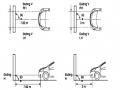
Note: A distance of approximately 7.62 m is required between the vehicle (fog lamp center) and the wall to adjust the convergence correctly. If the distance of 7.62 m cannot be achieved, set the correct distance of 3 m to check and adjust the fog lamp convergence. (Since the target area varies with the distance, please follow the instructions as shown in the figure.)
b/ Prepare a piece of thick white paper about 2 m high and 4 m wide to use as a screen.
c/ Draw a vertical line through the center of the screen (line V).
d/ Set the screen as shown in the picture. Note:
- Keep the screen perpendicular to the ground.
- Align the V line on the screen with the center of the vehicle.
e/Draw the reference lines (H, V LH and V RH lines) on the screen as shown in the figure.HINT:
Mark the center of the fog lamp on the screen. If the center mark cannot be seen on the fog lamp, use the center of the fog lamp or the manufacturer's name mark on the fog lamp as the center mark.
H line (fog light height):
Draw a line across the screen so that it passes through the center mark. Line H should be at the same height as the center mark of the fog light bulb.
Line V LH, V RH (center mark position of left fog lamp LH and right fog lamp RH):
Draw two lines so that they intersect line H at the center marks.
5. Check the fog light convergence
a/ Cover the fog lamp or remove the connector of the other side fog lamp to prevent light from the unchecked fog lamp from affecting the fog lamp convergence test.
b/ Start the engine.
c/ Turn on the fog lights and make sure that the dividing line is outside the standard area as shown in the drawing.
6. Adjust the fog light convergence
Use a screwdriver to adjust the fog light to the standard area by turning the toe adjustment screw.
Note: If the screw is adjusted too far, loosen it and then tighten it again, so that the last rotation of the light adjustment screw is clockwise.
3. Self-study questions
1. Describe the operating principle of the lighting system with automatic headlight function
2. Describe the operating principle of the lighting system with the function of rotating headlights when turning
3. Draw diagram and connect lighting system on Hyundai Porter car
4. Draw diagram and connect lighting system on Honda Accord 1992
5. Draw the lighting circuit on a 1993 Toyota Lexus
LESSON 3 MAINTENANCE AND REPAIR OF SIGNAL SYSTEM
I. IMPLEMENTATION GOAL
After completing this lesson, students will be able to:
- Distinguish between types of signals on cars
- Correctly describe common symptoms and suspected areas causing damage.
- Connecting signal circuits ensures technical requirements
- Disassemble, install, check, maintain and repair the signal system to ensure technical requirements.
- Ensure safety in work and industrial hygiene
II. LESSON CONTENT
1. General description
The signal system equipped on cars aims to create signals to notify other vehicles participating in traffic about the vehicle's operating status such as: stopping, parking, braking, reversing, turning...
Signals are used either by light such as headlamps, brake lights, turn signals….. or by sound such as horns, reverse music….
Just like the lighting system. A signal system circuit usually consists of: battery, fuse, wire, relay, electrical load and control switch. Only some switches of the signal system are on the combination switch. The switches of other signals are usually located in different locations such as in the gearbox or brake pedal……
2. Maintenance and repair
2.1. Turn signals and hazard lights
The installation location of the turn signal is shown in Figure 3.1. The turn signal control switch is located in the combination switch under the steering wheel. Turning this switch to the right or left will make the turn signal turn right or left.
The hazard light switch is used when the vehicle has a problem while participating in traffic. When the hazard light switch is turned on, all the turn signals on the vehicle will light up at a certain frequency. The hazard light switch is usually placed separately from the turn signal switch (some old cars integrate the hazard and turn signal switches on the same combination switch cluster).
Figure 3.1 Turn signal switch Figure 3.2 Hazard switch
The part that generates the flashing frequency for the lights is called a turn signal relay. The turn signal relay usually has 3 terminals: B (positive power supply); E (negative power supply); L (providing the turn signal switch to distribute to the
lamp)
2.1.1. Circuit diagram
To generate the frequency for the turn signal, a turn signal relay is used in the turn signal circuit. The current from the turn signal relay will be sent to the turn signal switch assembly to distribute the current to the turn signal lights for the driver's purpose.
Figure 3.3. Schematic diagram of a turn signal circuit without a hazard switch
1. Battery; 2. Electric lock; 3. Turn signal relay; 4. Turn signal switch; 5. Turn signal lamp; 6. Turn signal lamp; 7. Hazard switch
Figure 3.4 Schematic diagram of turn signal circuit with hazard switch
1. Battery; 2. Combination switch cluster; 3. Turn signal;
4. Turn signal light; 5. Turn signal relay
Today's cars no longer use three-pin turn signal relays (B, L, E) but use eight-pin turn signal relays (figure 3.5) (pin number 8 is used for hazard lights).
For this type, the current supplying the turn signal lights is supplied directly from the turn signal relay to the lights.
div.maincontent .p { color: black; font-family:"Times New Roman", serif; font-style: normal; font-weight: normal; text-decoration: none; font-size: 14pt; margin:0pt; } div.maincontent p { color: black; font-family:"Times New Roman", serif; font-style: normal; font-weight: normal; text-decoration: none; font-size: 14pt; margin:0pt; } div.maincontent .s1 { color: black; font-family:"Times New Roman", serif; font-style: normal; font-weight: normal; text-decoration: none; font-size: 13pt; } div.maincontent .s2 { color: black; font-family:"Times New Roman", serif; font-style: italic; font-weight: normal; text-decoration: none; font-size: 14pt; } div.maincontent .s3 { color: black; font-family:"Times New Roman", serif; font-style: normal; font-weight: normal; text-decoration: none; font-size: 14pt; } div.maincontent .s4 { color: black; font-family:"Times New Roman", serif; font-style: normal; font-weight: normal; text-decoration: none; font-size: 13pt; } div.maincontent .s5 { color: black; font-family:"Times New Roman", serif; font-style: normal; font-weight: normal; text-decoration: none; font-size: 13pt; vertical-align: 1pt; } div.maincontent .s6 { color: black; font-family:"Times New Roman", serif; font-style: normal; font-weight: normal; text-decoration: none; font-size: 11pt; } div.maincontent .s7 { color: black; font-family:"Times New Roman", serif; font-style: normal; font-weight: normal; text-decoration: none; font-size: 14pt; vertical-align: -9pt; } div.maincontent .s8 { color: black; font-family:"Times New Roman", serif; font-style: normal; font-weight: normal; text-decoration: none; font-size: 11pt; } div.maincontent .s9 { color: #008000; font-family:"Times New Roman", serif; font-style: normal; font-weight: normal; text-decoration: none; font-size: 14pt; } div.maincontent .s10 { color: black; font-family:"Times New Roman", serif; font-style: italic; font-weight: normal; te
Car body electrical practice - 8
zt2i3t4l5ee
zt2a3gs
zt2a3ge
zc2o3n4t5e6n7ts
If the voltage is out of specification, replace the wire or connector.
If the voltage is within specification, install the front fog light relay and follow step 5.
Step 5 Check the front fog light switch
- Remove the D4 connector of the fog light switch
- Use a multimeter to measure the resistance of the front fog light switch.
Measurement location
Condition
Standard
D4-3 (BFG) -D4-4 (LFG)
Light switchFront Fog OFF
>10kΩ
D4-3 (BFG) -D4-4 (LFG)
Front fog light switchON
<1 Ω
- Standard resistor
D4 connector is located on the combination switch assembly.
If the resistance is out of specification, replace the combination switch (the fog light switch is located in the combination switch).
If the resistance is within specification, follow step 6.
Step 6 Check wiring and connectors (front fog light relay-light selector switch)
- Disconnect connector D4 of the combination switch assembly
- Use a voltmeter to measure the voltage value of jack D4 on the wire side.
Measurement location
Control modecontrol
Standard
D4-3 (BFG) - (-) AQ
TAIL
11 to 14 V
D4 connector for the wiring of the combination switch assembly
If the voltage does not meet the standard, replace the wire or connector.
If the voltage is within standard, there may have been an error in the previous measurements.
Step 7 Check the front fog lights
- Remove the front fog light electrical connector.
- Supply battery voltage to the fog lamp terminals
Jack 8, B9 of front fog lamp on the electrical side
blind first.
Power supply location
Terms and Conditions
Battery positive terminal - Terminal 2Battery negative terminal - Terminal 1
Fog lightsbefore morning
- If the light does not come on, replace the bulb.
If the light is on, re-plug the jack and continue to step 8.
Step 8 Check wiring and connectors (relay and front fog lights)
- Disconnect the B8 and B9 connectors of the front fog lights.
- Use a voltmeter to measure voltage at the following locations:
Measurement location
Switch location
Terms and Conditions
B8-2 - (-) AQ
Electric lock ON TAIL size switchFog switch ON
11 to 14 V
B9-2 - (-) AQ
Electric lock ONTAIL size switch Fog switch ON
11 to 14 V
B8 and B9 connectors on the front fog lamp wiring side
Voltage is not up to standard, repair or replace the jack. If up to standard, there may have been an error in the measurement process.
2.2.4. Procedure for removing, installing and adjusting fog lights 1. Procedure for removing
- Remove the front inner ear pads
Use a screwdriver to remove the 3 screws and remove the front part of the front inner ear liner
-Remove the fog light assembly
+ Disconnect the connector.
+ Use a screwdriver to remove 3 screws to remove the fog light cover
2. Installation sequence
-Rotate the fog lamp bulb in the direction indicated by the arrow as shown in the figure and remove the fog lamp from the fog lamp assembly.
-Rotate the fog light bulb in the direction indicated by the arrow as shown in the figure and install the light into the fog light assembly.
- Use a screwdriver to install the fog light cover
-Install the electrical connector
Attention: Be careful not to damage the plastic thread on the lamp assembly.
- Install the front inner ear pads
Use a screwdriver to install the front inner bumper with 3 screws.
3. Prepare the vehicle to adjust the fog light convergence. Prepare the vehicle:
- Make sure there is no damage or deformation to the vehicle body around the fog lights.
- Add fuel to the fuel tank
- Add oil to standard level.
- Add engine coolant to standard level.
- Inflate the tire to standard pressure.
- Place spare tire, tools and jack in original design position
- Do not leave any load in the luggage compartment.
- Let a person weighing about 75 kg sit in the driver's seat.
4. Prepare to check the fog light convergence
a/ Prepare the vehicle status as follows:
- Place the car in a dark enough place to see the lines. The lines are the dividing line, below which the light from the fog lights can be seen but above which it cannot.
- Place the car perpendicular to the wall.
- Keep a distance of 7.62 m between the center of the fog lamp and the wall.
- Park the car on level ground.
- Press the car down a few times to stabilize the suspension.
Note: A distance of approximately 7.62 m is required between the vehicle (fog lamp center) and the wall to adjust the convergence correctly. If the distance of 7.62 m cannot be achieved, set the correct distance of 3 m to check and adjust the fog lamp convergence. (Since the target area varies with the distance, please follow the instructions as shown in the figure.)
b/ Prepare a piece of thick white paper about 2 m high and 4 m wide to use as a screen.
c/ Draw a vertical line through the center of the screen (line V).
d/ Set the screen as shown in the picture. Note:
- Keep the screen perpendicular to the ground.
- Align the V line on the screen with the center of the vehicle.
e/Draw the reference lines (H, V LH and V RH lines) on the screen as shown in the figure.HINT:
Mark the center of the fog lamp on the screen. If the center mark cannot be seen on the fog lamp, use the center of the fog lamp or the manufacturer's name mark on the fog lamp as the center mark.
H line (fog light height):
Draw a line across the screen so that it passes through the center mark. Line H should be at the same height as the center mark of the fog light bulb.
Line V LH, V RH (center mark position of left fog lamp LH and right fog lamp RH):
Draw two lines so that they intersect line H at the center marks.
5. Check the fog light convergence
a/ Cover the fog lamp or remove the connector of the other side fog lamp to prevent light from the unchecked fog lamp from affecting the fog lamp convergence test.
b/ Start the engine.
c/ Turn on the fog lights and make sure that the dividing line is outside the standard area as shown in the drawing.
6. Adjust the fog light convergence
Use a screwdriver to adjust the fog light to the standard area by turning the toe adjustment screw.
Note: If the screw is adjusted too far, loosen it and then tighten it again, so that the last rotation of the light adjustment screw is clockwise.
3. Self-study questions
1. Describe the operating principle of the lighting system with automatic headlight function
2. Describe the operating principle of the lighting system with the function of rotating headlights when turning
3. Draw diagram and connect lighting system on Hyundai Porter car
4. Draw diagram and connect lighting system on Honda Accord 1992
5. Draw the lighting circuit on a 1993 Toyota Lexus
LESSON 3 MAINTENANCE AND REPAIR OF SIGNAL SYSTEM
I. IMPLEMENTATION GOAL
After completing this lesson, students will be able to:
- Distinguish between types of signals on cars
- Correctly describe common symptoms and suspected areas causing damage.
- Connecting signal circuits ensures technical requirements
- Disassemble, install, check, maintain and repair the signal system to ensure technical requirements.
- Ensure safety in work and industrial hygiene
II. LESSON CONTENT
1. General description
The signal system equipped on cars aims to create signals to notify other vehicles participating in traffic about the vehicle's operating status such as: stopping, parking, braking, reversing, turning...
Signals are used either by light such as headlamps, brake lights, turn signals….. or by sound such as horns, reverse music….
Just like the lighting system. A signal system circuit usually consists of: battery, fuse, wire, relay, electrical load and control switch. Only some switches of the signal system are on the combination switch. The switches of other signals are usually located in different locations such as in the gearbox or brake pedal……
2. Maintenance and repair
2.1. Turn signals and hazard lights
The installation location of the turn signal is shown in Figure 3.1. The turn signal control switch is located in the combination switch under the steering wheel. Turning this switch to the right or left will make the turn signal turn right or left.
The hazard light switch is used when the vehicle has a problem while participating in traffic. When the hazard light switch is turned on, all the turn signals on the vehicle will light up at a certain frequency. The hazard light switch is usually placed separately from the turn signal switch (some old cars integrate the hazard and turn signal switches on the same combination switch cluster).
Figure 3.1 Turn signal switch Figure 3.2 Hazard switch
The part that generates the flashing frequency for the lights is called a turn signal relay. The turn signal relay usually has 3 terminals: B (positive power supply); E (negative power supply); L (providing the turn signal switch to distribute to the
lamp)
2.1.1. Circuit diagram
To generate the frequency for the turn signal, a turn signal relay is used in the turn signal circuit. The current from the turn signal relay will be sent to the turn signal switch assembly to distribute the current to the turn signal lights for the driver's purpose.
Figure 3.3. Schematic diagram of a turn signal circuit without a hazard switch
1. Battery; 2. Electric lock; 3. Turn signal relay; 4. Turn signal switch; 5. Turn signal lamp; 6. Turn signal lamp; 7. Hazard switch
Figure 3.4 Schematic diagram of turn signal circuit with hazard switch
1. Battery; 2. Combination switch cluster; 3. Turn signal;
4. Turn signal light; 5. Turn signal relay
Today's cars no longer use three-pin turn signal relays (B, L, E) but use eight-pin turn signal relays (figure 3.5) (pin number 8 is used for hazard lights).
For this type, the current supplying the turn signal lights is supplied directly from the turn signal relay to the lights.
div.maincontent .p { color: black; font-family:"Times New Roman", serif; font-style: normal; font-weight: normal; text-decoration: none; font-size: 14pt; margin:0pt; } div.maincontent p { color: black; font-family:"Times New Roman", serif; font-style: normal; font-weight: normal; text-decoration: none; font-size: 14pt; margin:0pt; } div.maincontent .s1 { color: black; font-family:"Times New Roman", serif; font-style: normal; font-weight: normal; text-decoration: none; font-size: 13pt; } div.maincontent .s2 { color: black; font-family:"Times New Roman", serif; font-style: italic; font-weight: normal; text-decoration: none; font-size: 14pt; } div.maincontent .s3 { color: black; font-family:"Times New Roman", serif; font-style: normal; font-weight: normal; text-decoration: none; font-size: 14pt; } div.maincontent .s4 { color: black; font-family:"Times New Roman", serif; font-style: normal; font-weight: normal; text-decoration: none; font-size: 13pt; } div.maincontent .s5 { color: black; font-family:"Times New Roman", serif; font-style: normal; font-weight: normal; text-decoration: none; font-size: 13pt; vertical-align: 1pt; } div.maincontent .s6 { color: black; font-family:"Times New Roman", serif; font-style: normal; font-weight: normal; text-decoration: none; font-size: 11pt; } div.maincontent .s7 { color: black; font-family:"Times New Roman", serif; font-style: normal; font-weight: normal; text-decoration: none; font-size: 14pt; vertical-align: -9pt; } div.maincontent .s8 { color: black; font-family:"Times New Roman", serif; font-style: normal; font-weight: normal; text-decoration: none; font-size: 11pt; } div.maincontent .s9 { color: #008000; font-family:"Times New Roman", serif; font-style: normal; font-weight: normal; text-decoration: none; font-size: 14pt; } div.maincontent .s10 { color: black; font-family:"Times New Roman", serif; font-style: italic; font-weight: normal; te -
 Procedure for Applying Law in Criminal Investigation Cases
 -
 Crime of rape of people under 16 years old from the practice of Soc Trang province - 10
During the investigation of a case, if the Investigation Agency finds sufficient grounds to determine that an individual or a legal entity has committed a crime, it shall issue a Decision to prosecute the individual or legal entity. The decision to prosecute the accused must clearly state which crime is being prosecuted and which Article of the Penal Code is being applied. At the end of the investigation, the Investigation Agency must have a Conclusion of the Investigation proposing to prosecute the accused under which Article of the Penal Code.
During the prosecution phase, after receiving the Investigation Conclusion and case file of the Investigation Agency requesting prosecution, the Procuracy reviews all evidence documents as well as the prosecution process of the Investigation Agency in accordance with the provisions of law, then issues a Decision to prosecute by means of an Indictment, the content of the indictment clearly shows which point, clause, and Article of the Penal Code the accused is prosecuted for.
During the trial phase, immediately after receiving the case file and the Indictment of the Procuracy, the Judge assigned to handle the case must study the Indictment and all evidence as well as consider whether the proceedings of the Investigation Agency and the Procuracy are in accordance with the provisions of law or not? From there, make the following decisions: Decision to bring the case to trial or Decision to return the file for further investigation or Decision to temporarily suspend, Decision to suspend. All decisions made by the Judge are based on the determination of the crime. The issue of determining the crime of the Trial Panel is clearly shown in the Verdict. Determining the crime in the Verdict is very important. Because no one can be considered guilty and be punished without a judgment of the Court that has come into legal effect. The content of the Verdict clearly shows what crime the defendant committed, which article, clause, and point of the Penal Code.
In the appeal, review and retrial stages, the consideration of the crime is also extremely important.
1.1.2.4 Stages of determining the crime of rape of a person under 16 years old.
The conviction of Rape of a person under 16 years of age must go through the following stages.
Phase 1:
Identify socially dangerous behavior based on the objective behavior of the subjects performing the behavior.
For this stage, the subject conducting the proceedings must make the most of the professional measures permitted by law combined with experience and skills.
Professional, with theoretical and practical knowledge, closely following legal documents and guidance documents for this type of crime to draw an objective conclusion on whether the behavior is dangerous to society or not, whether the behavior is dangerous to society but has reached the level of having to prosecute criminal responsibility or is only subject to administrative sanctions.
Phase 2:
Compare the criminal's actions to the extent of being forced to bear criminal responsibility with the constitutive signs of the Crime of Rape of a person under 16 years old as prescribed in Article 142 of the Penal Code.
After considering whether the subject committing the crime is a person with criminal capacity and responsibility for committing a socially dangerous act, continue to compare and contrast logically and closely with the signs constituting the crime of raping a person under 16 years old to see if it is satisfied or not. If the elements constituting the crime of raping a person under 16 years old are satisfied, then which clause of Article 142 of the Penal Code does the act satisfy?
Phase 3:
Issue legal documents arising after correctly identifying the crime of Rape of a person under 16 years old and the correct subject committing the act.
1.1.3. Legal basis for determining the crime of Rape of a person under 16 years old
1.1.3.1. Provisions of the Penal Code
The general provisions of the Penal Code stipulate the tasks of the Code, the basis of criminal liability; the principles of handling, the provisions on the application of the Penal Code, and the provisions of criminal law related to crimes. These provisions are an important legal basis for the judge to use as a basis for carrying out his law enforcement activities.
Article 142 of the 2015 Penal Code, Crime of rape of a person under 16 years old is stipulated as follows:
“Article 142. Crime of rape of a person under 16 years old
1. Anyone who commits one of the following acts shall be sentenced to imprisonment from 07 years to 15 years:
a) Using force, threatening to use force or taking advantage of the victim's defenselessness or other means to have sexual intercourse or other sexual acts with a person from 13 to under 16 years old against their will;
b) Having sexual intercourse or other sexual acts with a person under 13 years of age.
2. Committing a crime in one of the following cases shall be punishable by imprisonment from 12 to 20 years:
a) Incestuous;
b) Making the victim pregnant;
c) Causing injury, damage to health or mental and behavioral disorders to the victim with a body injury rate of 31% to 60%;
d) Against a person for whom the offender is responsible for caring for, educating, or treating;
d) Committing the crime 2 times or more;
e) For 02 people or more;
g) Dangerous recidivism.
3. Committing a crime in one of the following cases shall be punishable by imprisonment of 20 years, life imprisonment or death penalty:
a) Organized;
b) Many people rape one person;
c) For people under 10 years old;
d) Causing injury, damage to health or mental and behavioral disorders to the victim with a body injury rate of 61% or more;
d) Knowing that he is infected with HIV but still commits a crime;
e) Causing the victim to die or commit suicide.
4. The offender may also be banned from holding a position, practicing a profession or doing certain jobs from 01 to 05 years"
1.1.3.2. Other relevant legal documents on defining the crime of Rape of a person under 16 years old.
Resolution No. 06/NQ-HDTP dated October 1, 2019 of the Supreme People's Court's Judicial Council on "Guiding the application of provisions from Article 141 to Article 147 of the Penal Code and the trial of cases of sexual abuse of people under 18 years old". According to the provisions of Article 3, Article 4 and Article 6 of the Resolution. Regarding some circumstances of conviction, some circumstances of sentencing and principles of handling of offenders of sexual abuse for the crime of rape of people under 16 years old are specifically prescribed as follows:
Article 3. On some criminal circumstances
1. Sexual intercourse as prescribed in Clause 1, Article 142 of the Penal Code is the act of penetration of the male genitals into the female genitals, with any level of penetration.
Sexual intercourse with a person under 10 years of age is considered to have occurred regardless of whether penetration has occurred or not.
2. Other sexual acts specified in Clause 1, Article 142 of the Penal Code are acts by people of the same or opposite sex using male genitals, other body parts (for example: fingers, toes, tongue...), sexual instruments to penetrate the female genitals, mouth, anus of another person with any level of penetration, including one of the following acts:
a) Inserting male genitals into another person's mouth or anus;
b) Using other body parts (for example: fingers, toes, tongue...), sexual instruments to penetrate the female genitals, anus of another person...
7. Taking advantage of the victim's defenselessness as prescribed in Clause 1, Article 142 of the Penal Code is when the offender takes advantage of the victim's situation in one of the following circumstances to have sexual intercourse or perform other sexual acts:
a) The victim cannot resist (for example: the victim has an accident, faints, is tied up, is disabled... resulting in the victim being unable to resist);
b) The victim has limited or lost cognitive ability and ability to control behavior (for example: the victim is drunk on alcohol, beer, sleeping pills, anesthetics, drugs, sedatives, stimulants, other stimulants, has a mental illness or other illness... leading to limited or lost cognitive ability and ability to control behavior).
8. Other tricks specified in Clause 1, Article 142 of the Penal Code include tricks such as poisoning the victim; giving the victim sleeping pills, anesthetics, alcohol, beer or other strong stimulants to make the victim lose the ability to perceive, control behavior to have sex or perform other sexual acts; promising to let the victim graduate, go to school, compete, or perform abroad to have sex or perform other sexual acts.
9. Against the will of the victim as prescribed in Point a, Clause 1, Article 142 of the Penal Code, the victim does not agree, is at the mercy of, or is unable to express his or her will regarding the intentional sexual intercourse of the offender...
Article 4. On some framing circumstances
1. Incestuous nature as prescribed in Point a, Clause 2, Article 142 of the Penal Code is one of the following cases:
a) Committing a crime against a person of the same bloodline, siblings, half-siblings or half-siblings;
intestine;
plan;
b) Committing a crime against a paternal aunt, paternal uncle, paternal uncle, or niece or nephew
c) Committing a crime against adopted children, adoptive fathers, adoptive mothers;
d) Committing a crime against one's own children, one's husband's children, stepfather, or mother
d) Committing a crime against daughter-in-law, father-in-law, mother-in-law, son-in-law.
2. Committing a crime 02 times or more as prescribed in Point d Clause 2 Article 142 of the
The Penal Code is a case where the offender has committed a crime 2 times or more but has not been prosecuted and the statute of limitations for criminal prosecution has not expired.
3. Multiple people raping one person as stipulated in Point b, Clause 3, Article 142 of the Penal Code is a case where two or more people rape one person. Also considered as “multiple people raping one person” , if there are two or more people discussing and agreeing to take turns raping one person, but for reasons beyond their control, only one person is able to commit the rape.
It is not considered "many people raping one person" if there are 2 or more people colluding to organize and assist 1 person in raping (in this case, they are accomplices).
Article 6. Principles for handling offenders of sexual assault
1. Comply with the basic principles of criminal law and criminal procedure
matter
2. Apply strict penalties for ethical violations.
usually, morality; taking advantage of position, power; taking advantage of profession, job; abusing people under 13 years old.
3. Apply the highest additional penalties according to the provisions of the Penal Code and other relevant laws. If necessary, it is possible to prohibit holding positions or practicing professions related to people under 16 years old.
In the practice of investigating, prosecuting and trying cases of rape of people under 16 years old, the Investigator, Prosecutor, Judge and Jury assigned to resolve the case when determining the crime must first base on Article 8 and Article 142 of the Penal Code to determine the act that occurred with signs of the Crime of Rape of people under 16 years old; Who committed the crime, which clause of Article 142 of the Penal Code. However, when determining the crime of Rape of people under 16 years old under the basic framework (clause 1), the aggravating frameworks of Article 142 of the Penal Code and when deciding on the penalty for this crime, the provisions of Resolution No. 06/NQ-HDTP dated October 1, 2019 of the Supreme People's Court's Judicial Council must be applied to ensure that the crime is determined correctly, not to miss out on criminals, criminals, and not to wrongfully convict innocent people.
1.2. Determination of the crime of rape of a person under 16 years old.
1.2.1. Determination of crime in normal cases .
1.2.1.1. Identify the object of the crime
The object of a crime is a social relationship protected by criminal law and violated by a crime. The object of a crime is one of the four elements constituting a crime and is also a sign of conviction. The object of a crime is an important legal basis for determining whether the act that occurs constitutes rape of a person under 16 years old or not. If there is no violated object, there is no crime. In addition, the object of a crime is also the basis for distinguishing crimes in the Penal Code. However, not every relationship is considered an object of a crime.
The subject of a crime is a part of the object of the crime that is affected by the criminal act to cause damage or threaten to cause damage to social relations that are the objects protected by the Criminal Law. Humans as subjects of social relations can become the objects of crime.