
A brand ambassador helps convey the brand's meaning to customers.
3.7.4 Level of communication between staff and customers
4.21
4.05
3.52
3.19
2.4
4.5
4
3.5
3
2.5
2
1.5
1
0.5
0
Transaction Phone Fax Email Mail
Figure 3-3: Internal communication between employees and customers
The main method of communication between employees and customers is through the counter transaction channel (average 4.21 with 1 being infrequent and 5 being frequent). As introduced before, although e-banking is growing, the proportion of transactions that need to be performed directly at the counter is still high. In addition, because the customer sample is customers who transact at the counter, the level of direct communication at the counter is the highest, followed by other methods such as telephone (4.05), fax (3.52), email (3.19) and finally mail (2.4). Communicating the brand to customers through counter and telephone transactions has the advantage of communicating directly and impressively to customers, however, because this is direct communication, it will limit the target audience. Therefore, it is necessary to increase other indirect brand communication channels such as email and mail to help communicate the brand widely to customers.
3.7.5 Level of similarity between objects in terms of brand identity
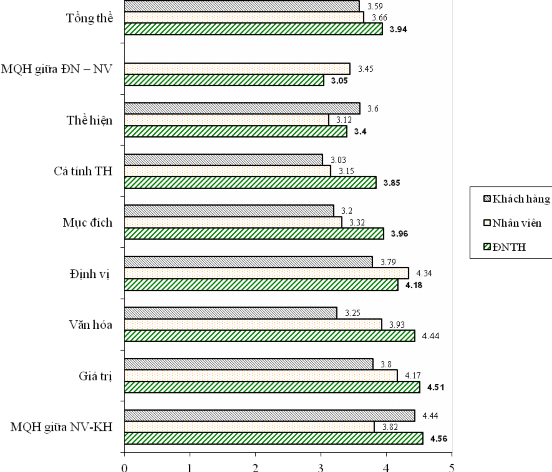
Figure 3-4: Similarities between objects in terms of brand identity
Overall, brand identity scores were higher among marketing teams than employees, and employees rated it higher than customers.
Regarding the specific components of brand identity, most internal brand identity ratings were higher than customer ratings, except for the criteria ―Employee-Customer Relationships‖ and ―Expression‖. The criterion ―Employee-Customer Relationships‖ was rated highest by customers and the brand team and 4th highest by employee ratings.
The criteria that were highly rated by both customers and the brand team were ―Value‖ and ―Positioning‖. The criterion ―Personality‖ was rated low by both internal and customer. The internal score was lower/higher than the external rating. Criteria
“Culture” has the biggest difference between the brand team and customer ratings, customers rate Vietcombank culture 1.19 points lower than the brand team. Some other criteria also have a big difference between customers and the brand team, such as “Brand purpose” and “Brand personality”.
Through statistical results, it is shown that there is a difference between customers' assessment of brand identity and the assessment of the brand team. The average similarity between customers and team members on brand positioning is 3.58 with 1 being very different and 5 being very similar. This may be because through transactions, employees have not clearly expressed the nature of the brand for customers to feel. Vietcombank should actively increase external communication to promote its brand to customers to increase brand performance.
Conclude:
The descriptive statistics show that the variables measuring customer opinions, brand team and staff in Vietcombank's brand identity revolve around the average value of about 3 to 3.5 points, corresponding to the average and agreement levels in all survey questions. Although this level is higher than the average value, it is not as expected because the branding team must be people who understand very well the nature of Vietcombank's brand, so their half-hearted understanding will greatly affect the unified communication of Vietcombank's brand image to employees and customers through internal and external communications. Thereby, it can be seen that Vietcombank's brand management and brand building are at a fairly average level and have not really made a breakthrough for all three survey subjects.
In addition, in the questions about the communication channels that bank employees direct to customers, the values are also at a moderate level, around the average value of 3.5. This shows that the current communication channels are effective but have not really made an impression on customers. The communication channels with the highest average scores are at the transaction counter and communication via phone. Currently, Vietcombank's external communication is not enough for customers to understand and remember the bank's brand identity. This wastes the effort of building a new brand identity when meaningful messages are not directed to its main target, customers.
In the next section, to clarify this issue further, the author uses quantitative analysis methods to identify internal factors affecting the gap between brand identity and reputation, thereby proposing measures for brand management.
3.8 Quantitative analysis
To determine the factors that help position the Vietcombank brand in the minds of each research subject, the thesis performs regression of equation (1) using Ordered Probit Regression, Tobit estimation. The results are presented in the following sections.
3.8.1 Customer brand positioning factors
To determine the factors that define Vietcombank's brand identity as well as their effects on the level of Vietcombank's brand identity recognition among customers, the study conducted regression with the component variables of brand identity and the level of brand identity recognition among customers. The results are shown in Table 1, Appendix 4.
The regression results using the two Obrobit and Tobit methods show that the variables that affect the level of brand awareness of Vietcombank to customers are identified through the following variables: var1, var6, var16, var18, var29, var30, var35,
var41. Corresponding to variables var1: Green and sustainable development for the community, var6: Continuous development, var16: Leading retail bank, About transaction staff: var18: Practicality, var29: Respect, var30: Politeness, var35: Practicality shown when using Vietcombank brand, var41: High class.
Through that, it can be seen that Vietcombank's brand image has been positioned by customers with the following characteristics: sustainable green development for the community, and continuous development through the green color of the bank's logo and slogan, along with the tireless efforts of the staff and leaders who have gradually helped the bank affirm its position.
Leading retail bank, although it has only recently shifted from wholesale to retail, from the customer's perspective, Vietcombank is leading in the retail sector, a very good result thanks to the efforts to change its brand identity in recent times.
Regarding the attitude of the transaction staff, the attitudes that impress customers are respect, politeness and gentleness when communicating with customers. However, Vietcombank still lacks other important attitudes such as friendliness, enthusiasm, patience, cooperation and prestige. Therefore, it is necessary to further improve the service quality of bank staff in the process of positioning the brand to customers.
Regarding the value when customers use the Vietcombank brand, there are two meaningful characteristics: practicality and high class. Through that, it can be seen that the current brand has a practical view and creates value in terms of class for customers who are using it.
Next, the thesis runs a research model on the level of brand positioning of the brand team and the staff team to assess the similarity between the level of brand identity recognition of the brand team and the staff team.
customers, thereby assessing the level of internal communication and the level of external communication.
3.8.2 Brand positioning elements of the brand team
The regression results according to the two Obrobit and Tobit methods in Table 2, Appendix 4 show:
Regarding the level of communication within the brand team, the variables that affect brand positioning within the communication team are: var9, var12, var22, var24, var32, var34, corresponding to the meanings: var9: Difference in Vietcombank brand characteristics, var12: Vietcombank brand culture standards; Regarding Vietcombank brand personality: var22: Vietcombank brand personality, var24: Vietcombank brand credibility, var32: friendly, var34: respect and listen to opinions between the brand team and employees working with customers.
Regarding the level of communication between the brand team and employees, the variables that affect brand positioning are: var26, var32, var40, var43, corresponding to the meanings: var26: Strong brand personality, var32: Friendly between the brand team and employees working with customers, var40: Up-to-date on customer personality, var43: High-class customer personality.
The results show that the messages that Vietcombank's brand team and staff position and convey to customers are relatively different from the positioning of Vietcombank's brand from the customer's perspective, in addition to the high-class value of personality. This shows that the propaganda and promotion of the brand image as well as the brand awareness of the team and staff are still limited and need to be further developed.
3.8.3 Brand positioning elements of the staff
The regression results (Table 3, Appendix 4) show that the variables that affect Vietcombank's brand positioning are: var2, var3, var35, var43 corresponding to the variables var2: One of the two leading banks in Vietnam with great influence in the region, var3: Becoming one of the 300 largest financial groups in the world by 2020, var35: polite to customers, var43: updated when using the Vietcombank brand.
From the results, it can be seen that the effectiveness in brand awareness between employees and the brand team, as well as the way of conveying messages to customers is not good, leading to the difference between the awareness of the brand team, employees and customers.
3.8.4 Analysis of factors affecting the gap between brand identity and reputation
3.8.4.1 Model fit assessment
The coefficient of determination R 2 and adjusted R 2 are used to evaluate the model's fit. Since R 2 increases when adding more independent variables to the model, using adjusted R 2 is safer when evaluating the model's fit. The larger the adjusted R 2 , the better the model's fit.
Table 3-4: Model fit assessment
Model
R | R Square | Adjusted R Square | Std. Error of the Estimate | |
1 | .942a | .930 | .917 | . 059 |
Maybe you are interested!
-

 Assessing the level of satisfaction of individual customers with savings deposit services at Saigon Commercial Joint Stock Bank SCB - Ninh Kieu Branch - 13
 -
 The effectiveness of marketing communication activities for the program "An gia lap nghiep" for individual customers at Vietnam Joint Stock Commercial Bank for Investment and Development - Thua Thien Hue branch - 13
 -
 Employees, Managers, Executives of Credit Institutions and Foreign Bank Branches Are Not Allowed to Disclose the Organization's Business Secrets
 -
 The impact of job satisfaction on employees' intention to quit Saigon Commercial Joint Stock Bank - 16
 -
 Correlation Coefficient Results and Significance Level of Correlation Coefficient Test for Joint Stock Commercial Bank Group
a. Predictors: (Constant), X5, X2, X 4, X1, X 3
Source: Author's own calculation
The adjusted coefficient of determination R2 is 0.917, which shows that the compatibility of the observed variables with the model is very high. So the gap between brand identity and reputation can be explained by 5 variables in the model. However, this compatibility is only true for sample data. To test whether the model can be inferred to the real population, we must test the model's suitability.
3.8.4.2 Model fit testing
Hypothesis H0: β1 = β2 = β3 = β4 = 0.
To test the suitability of the multiple linear regression model, we use the F value in the following ANOVA analysis table:
Table 3-5: ANOVA analysis
ANOVA b
Model
Sum of Squares | df | Mean Square | F | Sig. | ||
1 | Regression | 81,897 | 4 | 20,474 | 111.131 | .000d |
Residual | 93,223 | 506 | .184 | |||
Total | 175,119 | 510 |
a. Predictors: (Constant), X 5, X 2, X 4, X 1, X 3
b. Dependent Variable: The gap between brand identity and reputation
Source: Author's own calculation
The sig. value of the F value of the numerical model is very small (< 0.05), so we reject the hypothesis H 0 that the model fits the data set and can be extrapolated to the entire population.