
- Thailand is a typical country among ASEAN countries in publicly presenting specific plans for the entire economy and always amending, supplementing, and perfecting mechanisms and policies to attract FDI to suit each stage of development.
- The Thai government guarantees not to nationalize the means of production of foreign investors under any circumstances, and ensures the right to compete equally with newly established domestic enterprises.
- The Thai government has no restrictions on foreign currency conversion and the transfer of profits and investment capital abroad.
- Thailand signed investment protection agreements with 21 countries, including Vietnam (2001), and signed double taxation avoidance agreements with more than 40 countries.
Maybe you are interested!
-
 Lessons Learned That Can Be Applied to Vietnam
 -
 Korea's experience in developing small and medium enterprises and lessons learned for Vietnam - 14
 -
 Experience in Improving Export Credit Quality and Lessons Learned for Vietnam Bank for Agriculture and Rural Development
 -
 Lessons Learned in Accounting for Financial Instruments for Non-Financial Enterprises in Vietnam
 -
 Lessons Learned From Related Studies For M&A Activities In Vietnam
Service - tourism is one of the industries that attracts the most money for Thailand. Therefore, Thailand constantly has policies to improve the quality of the industry and attract FDI . There are 2 points to note here:
First, general policy on the service sector:
Improve related areas to increase the efficiency and competitiveness of Thai services. Including: developing human resources for the service sector, diversifying service delivery forms, developing technology and infrastructure.
Arrange organizations and agencies in related fields, in accordance with development goals to fully utilize available potentials. Thanks to that, services can attract more FDI, earn foreign currency, and local income through tourism, education, health care, medical treatment, sports, entertainment, etc.
Strengthen the development of large service contractors to take advantage of their qualifications, management capabilities, service standards and foreign language skills. This will help strengthen Thai services.
Second is the policy to promote tourism development :
Strengthen and enhance relations and cooperation with neighboring countries in the region to develop Thailand into a major gateway
for regional tourism in terms of market, transportation, investment, management as well as solving obstacles to investment in tourism for foreign investors.
Strengthening the restoration of cultural heritages from rural to urban areas to create many new tourist areas, attracting investment and construction attention from foreign investors. Enhancing the role of the private sector in coordinating with the community, preserving the unique features of tourist areas and the lifestyle of the Thai people.
Strengthening infrastructure serving the tourism industry, ensuring safety for tourists, creating a foundation for foreign investors to invest.
4. Lessons learned for Vietnam
Experience from developed countries is a valuable asset for Vietnam. However, despite the differences in natural conditions and socio-economic circumstances, the application of experience must be creative and appropriate to the specific circumstances and conditions of one’s country. Through studying the policies of developed countries, the following lessons can be drawn for Vietnam:
Firstly, nowadays international economic integration has become a common trend of all countries, therefore, Vietnam needs to perfect the mechanism and policies to attract FDI in the direction of trade liberalization, expanding the area as well as the fields allowing foreign investment to operate as China has done.
Second , Vietnam is a new member of the WTO. To demonstrate itself in the WTO environment, we must perfect the mechanism in accordance with international practices. In the immediate future, we need to study the requirements of the WTO to develop an attraction policy in accordance with the requirements of this organization.
Third , to create an e-commerce environment similar to other countries in the region, Vietnam needs to improve policies towards gradually reducing and eliminating tariff and non-tariff barriers, reforming the management apparatus as well as working methods in the fields of banking - finance - currency, tax and especially the administrative sector.
Fourth, Vietnam needs to learn from China and Thailand in using tax incentives to encourage foreign investors.
Fifth , focus on synchronous development and modernization of infrastructure, successfully building special economic zones. Infrastructure is a condition to promote increased FDI, creating initial incentives for investors. For example, to attract FDI, Malaysia has paid attention to upgrading the quality of communication network equipment, upgrading the transportation system, communications and telegraph rates.
Sixth , attach importance to training a high-quality workforce. A reality in the world shows that the more FDI capital flows into a country, the more effectively it is exploited when that country has a high capacity to absorb FDI capital. Asian countries favor the form of training two birds with one stone according to FDI projects. Investors are encouraged to organize training for local workers to suit their projects. However, that is only suitable for large investors, long-term investments, while most other investors only like to recruit qualified workers from the receiving country and to be able to meet this requirement, countries often establish vocational schools next to industrial parks and export processing zones.
For Hanoi , there is a high possibility of economic development to become a financial, commercial and technological service center of the country, it needs to learn from Singapore with their experiences. Specifically, improve FDI attraction policy towards encouraging foreign investors to invest in the financial, commercial and high-tech sectors.
CHAPTER II: CURRENT STATUS OF FDI IN THE SERVICE SECTOR OF HANOI
I. OVERVIEW OF HANOI
1. Natural factors
Geography : Hanoi is located in the center of the Red River Delta, bordering 5 provinces: Thai Nguyen to the North, Bac Ninh and Hung Yen to the East, Vinh Phuc to the West, Ha Tay to the South.
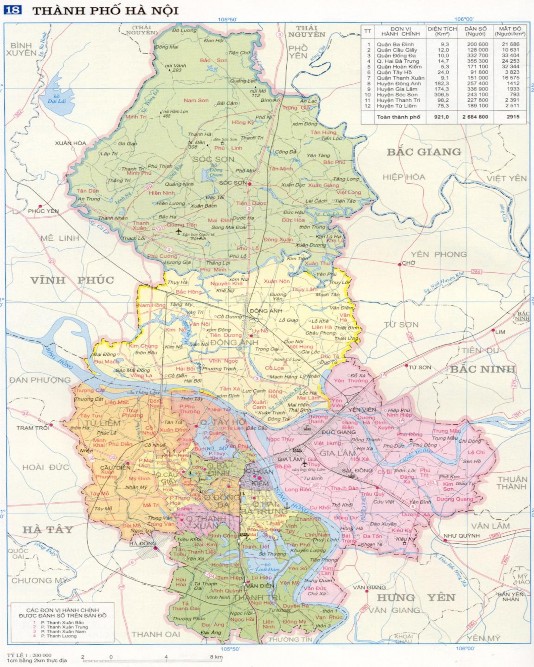
Map of Hanoi and Northern provinces. Source: www.hanoi.gov.vn
Currently, Hanoi has 9 districts with 142 wards and 5 counties with 107 communes and 6 towns. The total area is 92,097 hectares, equivalent to 0.28% of the total area of the country. The Red River area accounts for 5.96% and the mountain area accounts for 0.13%.
Terrain : Hanoi City is located in the center of the Northern Delta, at a position between 20 degrees 25' to 21 degrees 23' North latitude, 105 degrees 15' to 106 degrees 03' East longitude. The basic terrain of Hanoi is plain. Only Soc Son district and part of Dong Anh district have hilly terrain. In Hanoi, there are many low-lying areas. The construction of dikes to prevent floods on the Red River hundreds of years ago led to the low-lying areas caused by the Red River not continuing to be filled with alluvium and thus the land remains low-lying until now. Currently, in Soc Son district, there are many low-lying areas mixed with hills.
Hanoi also has many lakes and ponds, which are traces of the Red River that used to pass through it. In Thanh Tri and Hoang Mai districts, there are many large and shallow lakes, including Linh Dam lake and Yen So lake. Because there are many lakes and ponds, the district is called Thanh Tri. Before the dike was built, the Red River often changed its course, causing some sections of the river to be cut off into large and deep lakes. Typical of this type of lake are West Lake and Hoan Kiem Lake, which used to be a very large lake, but during the French colonial period, more than half of it was filled in. Giang Vo Lake, Ngoc Khanh Lake, and Thu Le Lake used to be connected, but now many places have been filled in, creating different lakes.
In addition to the Red River (the section passing through Hanoi is called Nhi Ha), there are also small rivers such as To Lich River, Lu River, Set River... These rivers are encroached upon, waste is dumped on both sides of the riverbanks, as well as mud and soil flowing down with wastewater, making them narrow and shallow. Currently, Hanoi is implementing measures such as embankment, dredging, and building wastewater filtration systems before discharging into the river. Some rivers have completely disappeared, such as the Ngoc Ha River flowing through the Imperial Citadel.
Climate : Hanoi's climate is typical of the Northern climate with the characteristics of a tropical monsoon climate: hot, humid summers with lots of rain, cold, dry winters with little rain. Because it is located in the tropics, Hanoi receives abundant solar radiation all year round and has high temperatures. The average total annual radiation in Hanoi is 122.8 kcal/cm2 and the average air temperature is 122.8 kcal/cm2.
The average annual temperature is 23.6 degrees Celsius. Due to the influence of the sea, Hanoi has a fairly high humidity and rainfall. The average annual humidity is 79%. The average annual rainfall is 1245mm and there are about 114 rainy days each year. From May to September is the hot and rainy season (rainfall 1682mm/year). From November to March of the following year is winter, the weather is dry. Between those two seasons there are two transitional weather (April and October) so it can be said that Hanoi has four seasons : Spring, Summer, Autumn and Winter. Some years Hanoi is cold early, some years it is cold late. The city had a very cold year with the lowest temperature down to 2.7 degrees Celsius (January 1955) and the hottest year with the outdoor temperature reaching 42.8 degrees Celsius (May 1926) (Source: www.thudo.hanoi.gov.vn)
Mineral resources : Hanoi is located in the center of the Red River Delta, concentrating new types of fertile alluvium suitable for many types of tropical plants. If rivers, lakes and residential land are not counted, there are only 68,796 hectares left, accounting for 74.9% of the natural area, of which 8,370 hectares of unused land. In general, Hanoi's total land fund is not large and needs to be calculated for thorough and economical use.
Thanks to its special structural location (where many tectonic zones converge), Hanoi and its surrounding areas have abundant and diverse minerals, but their reserves are not large. However, there are some types that can partially meet the requirements.
2. Political and social factors
Politics : Hanoi is the capital of Vietnam, the political-cultural-economic-social center of the whole country. The increasingly improved transportation system helps Hanoi easily communicate with other localities in the country and other countries in the world. Hanoi has favorable conditions to promptly access information and scientific and technological achievements in the world, to participate in the international division of labor and easily integrate into the international economic development process.
Political stability has a strong impact on the economy. While the world is exploding with conflicts, terrorism, and war, Hanoi is considered a safe destination, a city for peace.
Population : By 2005, Hanoi had 3.2 million people, accounting for about 3.5% of the country's population. Population density was 3,500 people/km2. According to the 2007 periodic population statistics, the city currently had 3,398,889 people with 784,881 households. Compared to a year ago, the capital's population increased by 3.5%, equivalent to over 138,100 people.
3. Human resource factor
The regular labor force is large, with nearly 5,000 university graduates. Hanoi has a fairly abundant human resource, a young workforce with a fairly high level of education, the rate of trained workers is 40% (high compared to other localities). Hanoi is one of the two largest educational centers in Vietnam (along with Ho Chi Minh City). There are currently 30 universities and colleges in operation in Hanoi. Hanoi has a very diverse system of high schools including public schools, university-affiliated schools, semi-public schools, and private schools. Among them, some schools are considered to have the best training quality in the country, attracting many excellent high school students not only in Hanoi but also in the North.
However, the training structure is not balanced, mainly in the industrial production sector, the state-owned, foreign and rural economic sectors. The quality of labor in the suburbs is still low, the number of people facing difficulties and destitute from other provinces coming to find work tends to increase, making the city overloaded in many aspects.
4. Infrastructure and facilities system
Transportation: Hanoi is the capital of Vietnam and also one of the cities with the highest population and population density in the country, so transportation is of great importance in meeting the increasing demand for travel and transportation of passengers and goods.
Hanoi's transportation system is very diverse, including public transportation such as buses, taxis, and personal transportation such as motorbikes and cars. In particular, Hanoi has cyclos to transport tourists. In addition, Hanoi is also the largest railway and air hub in the North.
Hanoi has a fairly large river system, especially the Red River flowing through the city, convenient for river transport. In recent years, there has been an additional type of tourism by boat on the Red River.
Hanoi currently has four bridges across the Red River, in order from North to South: Thang Long Bridge, Long Bien Bridge, Chuong Duong Bridge, Thanh Tri Bridge. Vinh Tuy Bridge is under construction and will be the fifth bridge across the Red River. In addition, Tu Lien, Nhat Tan, and Bac Cau bridges (over the Duong River) are planned.
Noi Bai International Airport is an airport in Northern Vietnam. This airport is an important gateway not only for the capital Hanoi but also for the whole North. This is the second largest airport in Vietnam after Tan Son Nhat Airport in Ho Chi Minh City.
After more than 20 years of renovation, the infrastructure system has improved, but it still cannot meet the requirements of the economic restructuring process to keep up with the urbanization speed. However, Hanoi is still considered to have the strongest scientific and technological potential in the country.
5. Cultural factors
Thang Long Hanoi has a history of nearly 1000 years with many unique traditional features. Hanoi has many famous scenic spots, unique historical sites, many traditional craft villages and Hanoi people are famous for their elegance and hospitality.
Hanoi has long been considered a major cultural center of Vietnam. Many great literary and artistic works were born in Hanoi, many Vietnamese cultural celebrities worked in Hanoi, many arts from the feudal period still exist today in the capital Hanoi such as ca tru and water puppetry. These things have created a unique feature for Hanoi culture, many literary and artistic works were composed with the main theme of Hanoi and its people.
The largest library in Hanoi and also the largest in the country is the National Library of Vietnam located on Trang Thi Street. Museum system in Hanoi