
In the past 5 years, the city has only implemented 17 social housing projects for low-income people with 3,600 apartments and more than 4,700 plots of land.
In the high-end market, as the investment environment in Vietnam continues to improve, the number of Vietnamese enterprises and foreign enterprises investing in Vietnam has increased, on the one hand, causing the supply in the rental market of high-end apartments and especially office rentals to increase significantly, on the other hand, most buildings have a very high rental area ratio. The real estate market experts of CB Richard Ellis Vietnam said that in the Hanoi area, both the class A and class B office markets have high rental rates: 99% for class A offices and 95% for class B offices. In Hanoi, the supply of the office rental market can be seen in the table on the side:
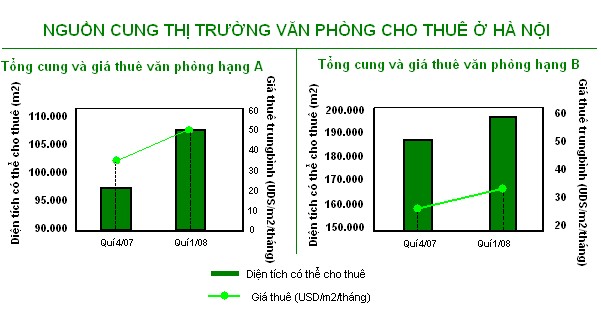
(Source: CBRE Vietnam)
Current supply still cannot meet demand because localities have not prepared well for investment infrastructure. According to the Ministry of Planning and Investment, the lack of land to hand over to investors is happening in most localities. For example, the South Fork project, licensed in late 2004 in Binh Thuan province, once considered the first Disneyland in Vietnam, is still on paper due to problems in clearance and compensation.
Thus, it can be seen that the supply of real estate goods in the market has increased significantly in recent times. The process of promoting the country's industrialization, urban renovation and expansion, and strengthening economic, technical and social infrastructure has changed the land use structure, contributing to making land more effectively used, increasing the supply of land for urban construction, housing projects and infrastructure.
2.2.4. Bridge
Demand for real estate goods is created from two sources: Demand from the actual need to use real estate and demand from the desire to buy and resell to profit from the difference. Currently, demand for goods in the real estate market, regardless of the source, tends to increase sharply.
Real estate demand increases due to population growth and people's income. Currently, our country's population is about 80 million people. According to forecasts, by 2010, our country's population will be about 88.3 million people, of which the urban population will be about 29.2 million people, accounting for 33% of the total national population. The rural population is about 59.1 million people. The urbanization process is taking place very quickly. The wave of migration to urban areas is increasing, so the demand for settlement in urban areas is increasing. After 20 years of renovation, nearly 200 urban areas have been established and currently the country has 729 urban areas. By 2007, the urban land use plan was completed 3 years ahead of schedule. It is estimated that Vietnam's urban population is currently 27 million people and according to calculations by the Ministry of Construction, this number will increase to about 46 million people by 2020. The need for work and residence pushes the demand for real estate up more and more.
Demand in the high-end office and housing rental market is increasing. Demand-stimulating factors such as economic growth, FDI growth, WTO roadmap, the establishment of new multinational corporate offices, the expansion of multinational companies operating in Vietnam and large Vietnamese companies, and increased tourists are the reasons for the high demand in this area.
The increase in real estate demand also comes from speculative activities. The gap between high demand and limited supply has created hot and cold fevers in the market, at the same time, it also has the potential for large profits when buying and selling real estate. Investors see the profit
high, by all means try to buy real estate goods waiting for the opportunity for prices to increase and then release them to the market.
2.2.5. Price
Price transparency in the Vietnamese real estate market is very low. The two-price mechanism has existed for a long time and has not been thoroughly resolved due to conflicts in the law, people's awareness, and shortcomings in state land management.
Real estate prices vary greatly between localities. Each region and each place has a different price, and prices also depend a lot on planning. Speculation or using land for other purposes than the original also affects real estate prices.
Land prices in cities in Vietnam are unreasonably high. Land prices in London are currently the most expensive in the world at 49,200 USD/m2 , followed by Monaco at 46,900 USD/m2 , and New York at 34,200 USD/m2 . In Asia, Hong Kong is at the top with prices
26,300 USD/m 2 , Tokyo is 23,500 USD/m 2 . Meanwhile, in Vietnam, the price of luxury apartments in big cities like Ho Chi Minh City, currently fluctuates from 2,000 - 2,500 USD/m 2 . If compared, the land price in Vietnam is about 10 times lower than in Tokyo or Hong Kong, but the income per capita of Vietnamese people is 50-60 times lower than in Japan. This is evidence of unrealistically inflated prices. ( Source: Research published in The Independent magazine - USA in May 2007 by Knight Frank Real Estate Company in collaboration with Citi Private Bank )
In addition, there is an uncontrolled increase in prices with a very large change rate from the previous year to the same period of the following year. As illustrated in the table below, unreasonably high land prices are not only limited to Hanoi and Ho Chi Minh City but have spread to surrounding provinces. Land for a new urban development project in Thu Dau Mot (Binh Duong) has now reached 26 million/m2 . This means that the price of a 100m2 plot of land will be more than 160,000 USD. This price, appearing in a province with an increasingly high population density, means that many people will
Not only can they not own a “decent” home, they can't even afford to pay rent.
Table 2: Land prices in some new urban areas in the Southeast region:
Location
12/2006 | 12/2007 | % change | |
Ho Chi Minh City | |||
Phu My – Van Phat Hung, District 7 | 11.0 | 27.0 | 145% |
Thai Son, Nha Be district | 5.5 | 16.0 | 191% |
South Saigon, Hong Linh, Binh Chanh District | 4.3 | 13.0 | 202% |
Thach My Loi, Huy Hoang, District 2 | 16.0 | 26.5 | 66% |
Gia Hoa, District 9 | 5.5 | 14.0 | 155% |
Surrounding provinces | |||
Long Tho – HUD, Nhon Thach, Dong Nai | 1.0 | 2.5 | 150% |
Long Hau, Long An | 3.2 | 6.5 | 103% |
Chanh Nghia, Thu Dau Mot, Binh Duong | 6.7 | 26.0 | 288% |
Maybe you are interested!
-

 Development Orientation of Vietnam's Real Estate Market
 -
 Characteristics of the Real Estate Market at the Present Time
 -
 Real Estate Market Lacks Professionalism and Complicated Procedures
 -
 Forecasting the Development of the Real Estate Market
 -
 The Real Estate Market Is Closely Related To The Financial Market
(Source: Choosing Success Report, David Dapice, Harvard University, USA)
It can be seen that the current land price exceeds the affordability of people in Ho Chi Minh City and Hanoi, even those considered to have high income in society have to save for 30 - 40 years to be able to buy an apartment with an area of about 100m2 with average quality. According to Euro Capital, the "real estate bubble" poses many serious risks to the economy. Many
In 2007, businesses shifted to investing in real estate, dispersing core business activities; banks lent based on mortgages and real estate with overpriced prices, leaving the possibility that borrowers could not repay the loan when real estate prices fell. That phenomenon caused a stir in the US with subprime real estate loans.
Land acquisition for project implementation has made an important contribution to socio-economic development. To acquire land, the State must carry out compensation, support and resettlement for people whose land is acquired. According to Clause 1, Article 9 of Decree No. 197/2004/ND-CP dated December 3, 2004 of the Government, the land price for compensation calculation is the land price according to the current purpose of use at the time of the land acquisition decision announced by the Provincial People's Committee according to the Government's regulations; compensation is not based on the land price that will be converted to another purpose. Article 4 of Decree No. 17/2006/ND-CP dated January 27, 2006 of the Government has been amended to state that the land price for compensation calculation is
Land price according to the current purpose of use has been regulated and announced by the People's Committee of the province or centrally-run city; no compensation will be made according to the land price that will be converted to another purpose of use; in case at the time of the decision to recover the land, this price is not close to the actual land use right transfer price on the market under normal conditions, the People's Committee of the province or centrally-run city shall decide on a specific land price accordingly.
But in reality, the land compensation work has not been carried out well, becoming one of the most prominent issues in the State's land management, giving rise to many complaints from citizens. Currently, the common compensation price in localities is to take the price according to the regulations announced by the Provincial People's Committee and then add a buffer for land damage support. This support level depends on each type of land and each project. The compensation price for land in many cases is lower than the actual transfer price on the market. Compensation for agricultural land is often not enough to receive the transfer of similar agricultural land areas or not enough to switch to other industries. According to the results of a one-year inspection of the implementation of the 2003 Land Law, among the complaints about compensation, site clearance, and resettlement, up to 70% of the complaints were about agricultural land compensation prices being too low.
2.3. CURRENT STATUS OF VIETNAM'S REAL ESTATE MARKET
Although there have been certain developments in the process of innovation and economic integration; however, the real estate market in our country is still in the early stages of development and has many limitations.
2.3.1 Lack of information transparency
General assessment: Vietnam's real estate market is the least transparent in the world:
According to the report of the world's leading group in money management and real estate services Jones Lang LaSalle on the 2006 Real Estate Market Transparency Index (RETI - Real Estate Transparency Index) for 56 countries and territories, Vietnam has the lowest real estate market transparency score in the world.
(56/56 countries surveyed) and the entire Asia - Pacific region (15/15 countries) with a score of 4.69: Table 2
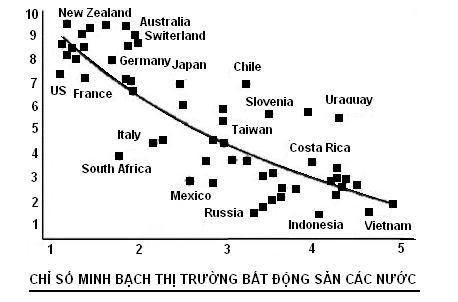
(Source: RETI - Real Estate Transparency Index Report 2006)
In the entire region, only Vietnam falls into the level 5 gray zone. Level 4 includes China, Macau and Indonesia. Australia, New Zealand, Hong Kong and Singapore are all in the level 1 group, the group with the highest level of transparency, respectively. Compared to the same report in 2004, Vietnam is still at the bottom of the list and has not improved as the 2006 RETI index shows that Vietnam is becoming less transparent, remaining at the lowest level of the scale and continuing to face many problems with ownership rights, limited market information and lack of legal regulations on information disclosure.
2.3.1.1. Primary market – the origin of lack of transparency:
The primary market is where the State allocates and leases land to project owners and businesses. The importance of the primary market is reflected in the fact that it is the first point of supply of real estate products to the market. If the primary market is weak, it will greatly affect the secondary market, causing many difficult problems. Reality shows that the Vietnamese primary real estate market has not fulfilled its role well.
From the two cases the author studied below, it is clear to see the lack of transparency in this market in many localities across the country:
Research Box 1:
At the end of March 2008, a working group from the Ministry of Construction went to Ha Tay to review the list of projects that the provincial government had hastily approved in the context of the Ha Tay-Hanoi merger project being announced. The working group discovered that most of the real estate projects were assigned directly to investors by the local government without auction or bidding. Explaining to the inspection group, the authorities at all levels said that because only one investor came to register, they immediately assigned the projects. But the reality is that although the project planning exists, it is not transparently announced, so it is impossible to create conditions for investors to know and participate in auctions and bidding. (Source: Saigon Marketing issue dated May 12, 2008)
Research Box 2:
Implementing the Prime Minister's directive from April to November 2008, the Ministry of Natural Resources and Environment will conduct inspections of land funds of organizations that have been allocated land by the State for lease nationwide. Ho Chi Minh City has had 6 years of implementing Decision 80 of the Prime Minister on handling and rearranging the State-owned land fund in the area. The initial review results have provided specific figures on the loss, misuse, and waste of large amounts of State-owned assets. The Ho Chi Minh City Department of Natural Resources and Environment has inspected 1,995/19,200 land plots, of which 142 were found to be subleased; 153 plots were used for the wrong purpose, 154 plots were abandoned... with an area of up to thousands of hectares. In fact, public land is being turned into hotels, office buildings, pubs... Revenue from exploiting public land does not go into the budget but is lost to the revenue of the units.
(Source: Exchange Research Magazine, Ministry of Finance, May 9, 2008)
Through the two research boxes above, we can see the current situation in the primary market. That is the situation of not providing information fairly and publicly to investors, there are signs of subjectivity of competent State agencies or the connection behind between investors who have projects and the public system.