
Vietnam Electricity Group (EVN). EVN is currently operating in the following fields: electricity, telecommunications, hotels, banking, real estate and according to information on the website www.vneco.vn (EVN's website), EVN is orienting its business to other fields to seek profits. Compiling the assessments of many domestic and foreign experts, EVN has really made a mistake in determining its priorities. The fields that EVN has expanded into not only do not help fulfill EVN's basic mission of "playing a key role in ensuring a stable and safe power supply for socio-economic development; implementing investment in the development of synchronous power grid projects to improve investment efficiency; investing in power source projects according to assigned tasks", but on the contrary, it also disperses the limited human and financial resources of the group. A state-owned monopoly enterprise like EVN will only function best if it focuses highly on its core mission and performs this mission effectively, while not being distracted by peripheral business activities.
Comment: The number of businesses in the real estate industry has increased in
The recent short-term growth partly reflects the development of the real estate market. However, it can also be seen that state-owned enterprises have not focused on taking advantage of the opportunities brought by Vietnam's accession to the World Trade Organization (WTO) to penetrate the international market. On the contrary, these corporations have transferred a large part of the economy's resources to non-production, high-profit purposes in the country. The issue of sustainable development of these enterprises as well as of the entire socialist economy needs to be concerned by the State and timely adjusted.
Maybe you are interested!
-

 Development Orientation of Vietnam's Real Estate Market
 -
 The main problems hindering the development of real estate business in Vietnam - 23
 -
 Characteristics of the Real Estate Market at the Present Time
 -
 Current Status of Real Estate Business Development of Song Hong Construction Joint Stock Company.
 -
 Real Estate Market Lacks Professionalism and Complicated Procedures
2.3.6.2. FDI increases sharply in the real estate market
After 20 years of implementing the "Doi Moi" policy, along with the open-door policy, Vietnam has attracted many foreign direct investment sources to participate in investment and development in many areas of the economy, including construction and real estate. In order to create a favorable and open investment environment, the National Assembly and the Government of Vietnam have issued many important legal documents to regulate the activities of the real estate market, such as the Land Law (2003), Construction Law (2003), Housing Law (2005), Real Estate Business Law (2006), Investment Law (2005) and accompanying guiding Decrees. Previously, to invest in the real estate sector (investment
In the case of investment in hotels, offices, apartments for rent, etc., foreign investors must form joint ventures with domestic enterprises; the foreign investor's capital contribution cannot be greater than 70% of the legal capital. Today, foreign investors can invest 100% of the capital. Previously, the maximum land lease term was 50 years, but now the land lease term is 70 years. If there is a need, the term of use can be extended, each time not exceeding 70 years; the fair rental price applies to both domestic and foreign investors.
With the facilitation of State laws, along with the attractiveness of the Vietnamese real estate market, the construction and real estate sectors in Vietnam have attracted nearly 700 foreign investment projects (as of April 2007). In 2007, registered FDI capital in real estate was 5.4 billion USD. It is expected that in 2008, about 20 billion USD will be poured into the real estate market. In terms of scale and proportion, the amount of FDI capital invested in Vietnamese real estate is at a record level. According to information from the Ho Chi Minh City Real Estate Association, foreign investors come from many countries such as the US, Australia, Canada, Italy, Japan, China, Singapore, Korea, Hong Kong, Thailand, Taiwan, Philippines, etc.
The amount of FDI invested in the real estate market is mostly focused on the high-end market segment - where demand is always higher than supply. Because the high-end market with great development potential requires large financial resources and highly developed professional management skills - which are not the strengths of domestic investors.
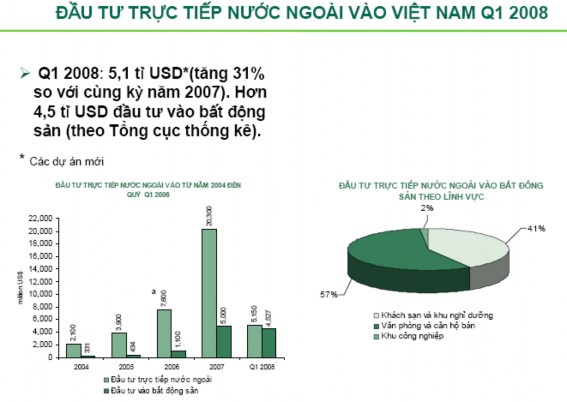
The situation of foreign direct investment in Vietnam in general and the Vietnamese real estate market in particular in the first 3 months of 2008 is as follows. Table 4:
(Source: Forecast 2008, Marc Townsend, CB Richard Ellis, Vietnam)
Comment: Looking at the chart, it can be concluded that FDI into Vietnam has increased sharply over the years. This is a positive signal and also shows the trend of shifting investment capital flows into developing countries in general and Vietnam in particular.
The ratio of FDI in real estate/Total FDI in Vietnam has increased gradually over the years. In the first quarter of 2008 alone, FDI in real estate accounted for nearly 90% of total FDI capital, so other production sectors such as industry and agriculture only received more than 10% of total FDI in Vietnam. This imbalance poses a requirement for State management: to be vigilant against signs of cross-border real estate speculation; and to have appropriate policies to attract FDI into sectors that actually create material wealth for society.
CHAPTER III: SOLUTIONS TO DEVELOP VIETNAM'S REAL ESTATE MARKET
3.1. FORECASTING THE DEVELOPMENT OF THE REAL ESTATE MARKET
3.1.1. Developments in Vietnam's real estate market in line with the general trend in the world
In the first quarter of 2008, the world economy was still dominated by record high gold and oil prices, world inflation, and the stagnation of the US economy. Specifically, some regions in the world are as follows:
- Eurozone, inflation rate 3.5% in 3 months.
- America: real estate values decrease; home loan interest rates do not decrease.
- Asia : rice and food prices surge; growth in East Asia falls below 8% in 2008.
(Source: Forecast 2008, Marc Townsend, CB Richard Ellis, Vietnam)
In the trend of globalization, the Vietnamese real estate market cannot be separated from the general trend such as: the decline of the US economy, the shift of capital from developed markets to developing markets, increasing interdependence of Asian countries , reducing dependence on the US and Europe.
In the real estate market in particular, Asia in the future will have the strongest urbanization rate in the world. For details, see:
Table 5: Number of cities with over 5 million people over time around the world :
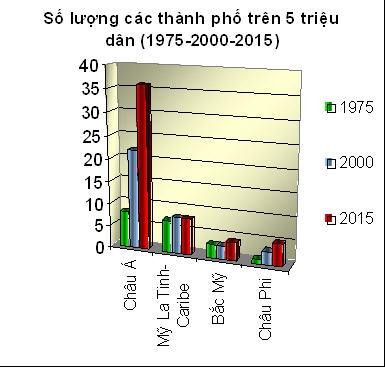
(Source: UN. World Urbanization Prospects: The 2001 Revision)
This general trend poses the problem for Vietnam of gradually withdrawing labor from agriculture, the industrialization process requires urban development not only in clusters and regions, but also spreading to neighboring peripheral areas.
The world in the future will have to deal with drought, population explosion and energy scarcity. From now until 2050, the world population will increase by 50% (Source: forecast of Taisei Corporation, Japan ), the problem of residential land area becomes more urgent. Vietnam is no exception.
3.1.2. Real estate demand continues to increase in the coming years
Vietnam has joined the WTO, which is an important turning point for the Vietnamese economy, and at the same time brings many opportunities for the development of the Vietnamese real estate market. Along with the process of industrialization and modernization of the country, with the goal of striving to become an industrial country by 2020, in
When the reality shows that Vietnam's real estate market is still in the early stages of development, the real estate industry promises more potential for development.
Vietnam currently has 729 urban areas, including 2 special urban areas, 3 type 1 urban areas, 14 type 2 urban areas... Vietnam's urbanization rate is expected to be very high in the coming time. It is forecasted that the urban land area will increase from the current 105,000 ha to 460,000 ha by 2020, the current urbanization rate of 28% is expected to reach about 45% by 2025. (Source: Vietnam Real Estate Association)
* The demand for housing , especially urban housing to meet the current urban population of about 23 million people, is expected to increase to 46 million people by 2025. If we only consider the demand for urban housing, on average each year Vietnam needs to develop an additional 35 million m2 of housing to strive to reach 20m2 of housing/person in urban areas by 2020. In the period 2007-2010 alone, Vietnam needs to build 366 million m2 of housing, of which 176 million m2 is in urban areas and 190 million m2 is in rural areas .
* The demand for offices, apartments for rent, hotels and commercial buildings is also increasing rapidly, especially the demand for type A, B offices, luxury apartments for rent, 3-5 star hotels in large cities. According to calculations, in Ho Chi Minh City alone, the demand for type A, B offices is about 200,000 m2 and 10,000 3-5 star hotel rooms in the next few years. In Hanoi, hotels serving customers
Internationally, there is also a serious shortage. In particular, after joining the WTO, Vietnam is attracting the attention of world retail corporations, also increasing the demand for commercial service facilities and supermarkets.
* Demand for the development of economic zones and concentrated industrial zones, high-tech zones : Up to now, Vietnam has about 150 industrial zones established with a total natural land area of over 32,000 hectares, attracting over 2,500 foreign-invested projects and over 2,700 domestic investment projects, with a total registered investment capital of up to 24 billion USD and 135,000 billion VND. The Government of Vietnam has also decided to establish 8 economic zones, including economic zones that have been started quickly such as Chu Lai Economic Zone, Dung Quat Economic Zone, Nhon Hoi Economic Zone, Phu Quoc Economic Zone. According to the planning for the development of industrial zones, from now until 2020,
In 2015, the country plans to establish over 100 new industrial parks with an estimated land area of about 26,000 hectares.
(Source: Vietnam Urban Development Strategy, Ministry of Construction, 2007)
3.1.3. Real estate supply increases but cannot immediately meet real estate demand
Although a series of domestic and foreign investment projects in real estate continue to be carried out, due to the characteristics of the real estate industry (it takes a relatively long time to establish a project, complete investment procedures, compensation, clearance, construction, completion, and reach consumers) and the current shortcomings of the market (speculation, slow and ineffective laws, etc.), the shortage of supply can only be slightly reduced.
For example, research on the housing market and office market in Hanoi, according to the report of CBRE Vietnam 9/2007, the future supply is as shown in table 6-7:
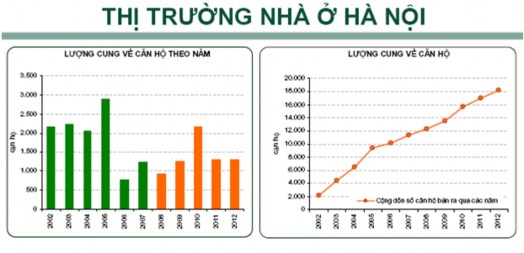
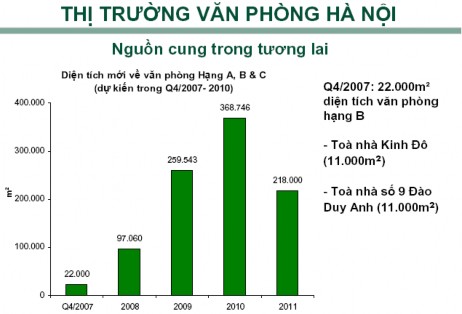
Comment: Looking at the two charts, it can be seen that the real estate supply in 2008 and 2009 was relatively low compared to the general level, the number of completed projects was limited. By 2010-2011, when the projects that had been started before were completed, the housing and office market in Hanoi was supplemented with a large amount of supply, at that time it could meet more demand.
Real estate projects are no longer only concentrated in two big cities like Hanoi and Ho Chi Minh City, but are spreading to other potential cities like Hai Phong, Da Nang, Nha Trang, Can Tho, Thai Nguyen...
On the other hand, for the market segment of low-income earners who account for a large proportion of the population, especially in the current situation of high real estate prices, there is still a great demand but the response is slow for social housing.
3.1.4. The defects of the real estate market can cause bad consequences if not promptly remedied.
Real estate market transparency cannot be achieved in a short time.
For many years, the lack of transparency in the Vietnamese real estate market has been a major defect that has not been overcome. With the current rate of 70-80% of informal transactions, in the near future, this rate can be reduced by many regulatory measures of the State (establishing real estate trading floors, perfecting policies, etc.).