
3.1.2. Tourism development goals of Dalat City: If in the period of 1995 - 2005, Lam Dong tourism was developed with the goal of becoming a strong and convincing economic sector in the spirit of Resolution 03/2001/NQ-TU of Lam Dong Provincial Party Committee. Then from now until 2010 and 2020, Lam Dong tourism must develop with the goal of truly becoming a spearhead economic sector as directed by the Prime Minister approved in Decision No. 409/2002/QD-TTg on: "Adjusting the planning of Dalat City, Lam Dong province and surrounding areas until 2020".
Accordingly, Lam Dong Provincial People's Committee also issued Decision No. 209/2005/QD-UBND regulating the mechanisms and policies to attract investment for development. In particular, Section 1/Chapter IV on "Tourism and service sector" has identified the main objectives as:
“Investing in tourism development, Dalat City deserves to be one of the tourist centers of Lam Dong in particular and the Central Highlands in general.”
And recently, Lam Dong Provincial Party Committee has added Resolution 06/2006/NQ-TU with the task and solution: "Breakthrough, accelerate tourism development in the coming years".
Along with international tourism, promote the development of domestic tourism to meet the needs of people for travel, visiting, and sightseeing, contributing to improving and enhancing the spiritual life of local people, especially improving the intellectual level and living conditions for people in remote areas.
The immediate goal of Dalat is to restore what has been lost in the past. The long-term goal is to build Dalat City with a unique style suitable for the domestic and international tourism markets. Based on the changes in the development trends of the world and domestic tourism markets, Lam Dong tourism focuses on both the tourism market and the business of welcoming guests (conferences, trade exhibitions and business meetings). Although both markets have some overlap, they are also quite different in terms of market, demand, facilities and competition to ensure separate handling. In the period up to 2010 and the 2020s, two main market groups are identified as follows:
3.1.2.1. Key markets : Key markets of Lam Dong tourism are identified to include a number of international and domestic tourist markets as follows:
International tourist market: Including markets with a large number of foreign tourists or business visitors to Vietnam, with high spending ability, long-term stay. The opportunity to exploit Dalat international tourist markets will increase when Lien Khuong airport is upgraded and direct flights are opened to a number of countries or through direct flights with major tourist centers of the country such as: Japan, China, Korea, Taiwan, USA, Germany, UK, France, Australia are the world's leading markets with great tourism potential that need to be prioritized. The ASEAN market, especially Singapore, Indonesia, Malaysia, is a key market that also needs to be focused on exploitation and development. ( Appendix 11 : Documents guiding tourism development)
Domestic tourist market: Due to the increasing trend of traveling thanks to economic development, higher living standards, more free time, and improved awareness of tourism information. For Lam Dong tourism, the traditional market is from Ho Chi Minh City, the coastal provinces of the South Central Coast, the Southeast and the Mekong Delta. In addition, after opening the direct flight route Dalat - Hanoi to expand the tourism market in the Northern regions. The exploitation direction for the domestic tourist market is to promote short-term and weekend tours with modern forms of relaxation and entertainment...
3.1.2.2. Potential markets : Mainly international tourist markets, typically the Netherlands, Russia, Canada, Italy, Switzerland, Sweden, Belgium, New Zealand, Luxembourg... due to the large number of foreign tourists to these countries every year. However, the number of these tourists coming to Lam Dong is currently limited, the spending capacity is not high due to difficult access to transportation, underdeveloped trade and tourism...
3.1.3. Dalat City tourism development indicators: The research and forecast of tourism development indicators is carried out in the context of the country's tourism industry developing at a relatively fast pace. Therefore, the specific strategic goals for Dalat City tourism development are:
3.1.3.1. Tourists: According to current trends, domestic tourists to Lam Dong
Copper is increasing day by day with a fairly high growth rate (17.2% per year). However, according to the regulation
This growth rate will gradually decrease from now until 2020. It is expected to increase by an average of 8-10% in the period 2005-2010; 7-9% in the period 2011-2015; 6.5-7.5% in the period 2016-2020.
International tourists to Lam Dong will increase by an average of only 5.4% per year in the next few years. To match the reality, the growth rate of international visitors to Lam Dong in the period of 2006 - 2010 is expected to fluctuate only between 6 - 7%. When the project to build tourist areas is gradually completed and put into stable operation, especially Lien Khuong airport becomes an international airport. It is expected to reach 5.5 - 7% in 2016 - 2020, because in fact, in 2005 the whole country welcomed nearly 3,470,000 international visitors (an increase of 18.4% compared to 2004) but by 2006 it reached 3.58 million visitors (an increase of only 3% compared to 2005).
In 2006, the average length of stay of visitors to Lam Dong was only 2.3 days. Currently, Dalat has a number of investment projects to build high-quality tourist areas that will certainly create many unique tourism products that will attract domestic and foreign tourists and extend their stay (especially eco-tourists, resorts, and medical tourists). The average length of stay of tourists to Lam Dong will increase: 2.8 - 3 days in 2010; 3.3 - 3.5 days in 2015 and 3.7 - 4 days in 2020. Specifically as follows:
Table 3.1 : Forecast of visitors and tourism revenue of Dalat tourist cluster and vicinity
Guest
Categories | 2010 | 2015 | 2020 | |
Number of visitors (thousand) | 106.0 | 140.0 | 176.0 | |
Country | Average stay date (days) | 3.2 | 3.8 | 4.4 |
economy | Total number of guest days (thousand) | 339.2 | 532.0 | 775.0 |
Revenue (million USD) | 33,920 | 58,520 | 93,000 | |
Number of visitors (thousand) | 1,785 | 2,400 | 3,150 | |
Internal | Average stay date (days) | 3.0 | 3.5 | 4.0 |
land | Total number of guest days (thousand) | 5.355 | 8,400 | 12,600 |
Revenue (million USD) | 133,875 | 252,000 | 441,000 | |
Total revenue (million USD) | 167,795 | 310,520 | 534,000 | |
Maybe you are interested!
-
 Solutions for tourism development in Tien Lang - 10
zt2i3t4l5ee
zt2a3gstourism, tourism development
zt2a3ge
zc2o3n4t5e6n7ts
- District People's Committees and authorities of communes with tourist attractions should support, promote, and provide necessary information to people, helping them improve their knowledge about tourism. Raise tourism awareness for local people.
*
* *
Due to limited knowledge and research time, the thesis inevitably has shortcomings. Therefore, I look forward to receiving guidance from teachers, experts as well as your comments to make the thesis more complete.
Chapter III Conclusion
Through the issues presented in Chapter II, we can come to some conclusions:
Based on the strengths of available tourism resources, the types of tourism in Tien Lang that need to be promoted in the coming time are sightseeing and resort tourism, discovery tourism, weekend tourism. To improve the quality and diversify tourism products, Tien Lang district needs to combine with local cultural tourism resources, at the same time combine with surrounding areas, build rich tourism products. The strengths of Tien Lang tourism are eco-tourism and cultural tourism, so developing Tien Lang tourism must always go hand in hand with restoring and preserving types of cultural tourism resources. Some necessary measures to support and improve the efficiency of exploiting tourism resources in Tien Lang are: strengthening the construction of technical facilities and labor force serving tourism, actively promoting and advertising tourism, and expanding forms of capital mobilization for tourism development.
CONCLUDE
I Conclusion
1. Based on the results achieved within the framework of the thesis's needs, some basic conclusions can be drawn as follows:
Tien Lang is a locality with great potential for tourism development. The relatively abundant cultural tourism resources and ecological tourism resources have great appeal to tourists. Based on this potential, Tien Lang can build a unique tourism industry that is competitive enough with other localities within Hai Phong city and neighboring areas.
In recent years, the exploitation of the advantages of resources to develop tourism and build tourist routes in Tien Lang has not been commensurate with the available potential. In terms of quantity, many resource objects have not been brought into the purpose of tourism development. In terms of time, the regular service time has not been extended to attract more visitors. Infrastructure and technical facilities are still weak. The labor force is still thin and weak in terms of expertise. Tourism programs and routes have not been organized properly, the exploitation content is still monotonous, so it has not attracted many visitors. Although resources have not been mobilized much for tourism development, they are facing the risk of destruction and degradation.
2. Based on the results of investigation, analysis, synthesis, evaluation and selective absorption of research results of related topics, the thesis has proposed a number of necessary solutions to improve the efficiency of exploiting tourism resources in Tien Lang such as: promoting the restoration and conservation of tourism resources, focusing on investment and key exploitation of ecotourism resources, strengthening the construction of infrastructure and tourism workforce. Expanding forms of capital mobilization. In addition, the thesis has built a number of tourist routes of Hai Phong in which Tien Lang tourism resources play an important role.
Exploiting Tien Lang tourism resources for tourism development is currently facing many difficulties. The above measures, if applied synchronously, will likely bring new prospects for the local tourism industry, contributing to making Tien Lang tourism an important economic sector in the district's economic structure.
REFERENCES
1. Nhuan Ha, Trinh Minh Hien, Tran Phuong, Hai Phong - Historical and cultural relics, Hai Phong Publishing House, 1993
2. Hai Phong City History Council, Hai Phong Gazetteer, Hai Phong Publishing House, 1990.
3. Hai Phong City History Council, History of Tien Lang District Party Committee, Hai Phong Publishing House, 1990.
4. Hai Phong City History Council, University of Social Sciences and Humanities, VNU, Hai Phong Place Names Encyclopedia, Hai Phong Publishing House. 2001.
5. Law on Cultural Heritage and documents guiding its implementation, National Political Publishing House, Hanoi, 2003.
6. Tran Duc Thanh, Lecture on Tourism Geography, Faculty of Tourism, University of Social Sciences and Humanities, VNU, 2006
7. Hai Phong Center for Social Sciences and Humanities, Some typical cultural heritages of Hai Phong, Hai Phong Publishing House, 2001
8. Nguyen Ngoc Thao (editor-in-chief, Tourism Geography, Hai Phong Publishing House, two volumes (2001-2002)
9. Nguyen Minh Tue and group of authors, Hai Phong Tourism Geography, Ho Chi Minh City Publishing House, 1997.
10. Nguyen Thanh Son, Hai Phong Tourism Territory Organization, Associate Doctoral Thesis in Geological Geography, Hanoi, 1996.
11. Decision No. 2033/QD – UB on detailed planning of Tien Lang town, Hai Phong city until 2020.
12. Department of Culture, Information, Hai Phong Museum, Hai Phong relics
- National ranked scenic spot, Hai Phong Publishing House, 2005. 13. Tien Lang District People's Committee, Economic Development Planning -
Culture - Society of Tien Lang district to 2010.
14.Website www.HaiPhong.gov.vn
APPENDIX 1
List of national ranked monuments
STT
Name of the monument
Number, year of decisiondetermine
Location
1
Gam Temple
938 VH/QĐ04/08/1992
Cam Khe Village- Toan Thang commune
2
Doc Hau Temple
9381 VH/QĐ04/08/1992
Doc Hau Village –Toan Thang commune
3
Cuu Doi Communal House
3207 VH/QĐDecember 30, 1991
Zone II of townTien Lang
4
Ha Dai Temple
938 VH/QĐ04/08/1992
Ha Dai Village –Tien Thanh commune
APPENDIX II
STT
Name of the monument
Number, year of decision
Location
1
Phu Ke Pagoda Temple
178/QD-UBJanuary 28, 2005
Zone 1 - townTien Lang
2
Trung Lang Temple
178/QD-UBJanuary 28, 2005
Zone 4 – townTien Lang
3
Bao Khanh Pagoda
1900/QD-UBAugust 24, 2006
Nam Tu Village -Kien Thiet commune
4
Bach Da Pagoda
1792/QD-UB11/11/2002
Hung Thang Commune
5
Ngoc Dong Temple
177/QD-UBNovember 27, 2005
Tien Thanh Commune
6
Tomb of Minister TSNhu Van Lan
2848/QD-UBSeptember 19, 2003
Nam Tu Village -Kien Thiet commune
7
Canh Son Stone Temple
2160/QD-UBSeptember 19, 2003
Van Doi Commune –Doan Lap
8
Meiji Temple
2259/QD-UBSeptember 19, 2002
Toan Thang Commune
9
Tien Doi Noi Temple
477/QD-UBSeptember 19, 2005
Doan Lap Commune
10
Tu Doi Temple
177/QD-UBJanuary 28, 2005
Doan Lap Commune
11
Duyen Lao Temple
177/QD-UBJanuary 28, 2005
Tien Minh Commune
12
Dinh Xuan Uc Pagoda
177/QD-UBJanuary 28, 2005
Bac Hung Commune
13
Chu Khe Pagoda
177/QD-UBJanuary 28, 2005
Hung Thang Commune
14
Dong Dinh
2848/QD-UBNovember 21, 2002
Vinh Quang Commune
15
President's Memorial HouseTon Duc Thang
177/QD-UBJanuary 28, 2005
NT Quy Cao
Ha Dai Temple
Ben Vua Temple
Tien Lang hot spring
div.maincontent .p { color: black; font-family:"Times New Roman", serif; font-style: normal; font-weight: normal; text-decoration: none; font-size: 14pt; margin:0pt; } div.maincontent p { color: black; font-family:"Times New Roman", serif; font-style: normal; font-weight: normal; text-decoration: none; font-size: 14pt; margin:0pt; } div.maincontent .s1 { color: black; font-family:"Times New Roman", serif; font-style: normal; font-weight: normal; font-size: 16pt; } div.maincontent .s2 { color: black; font-family:"Times New Roman", serif; font-style: italic; font-weight: bold; text-decoration: none; font-size: 14pt; } div.maincontent .s3 { color: black; font-family:"Times New Roman", serif; font-style: italic; font-weight: normal; text-decoration: none; font-size: 14pt; } div.maincontent .s4 { color: black; font-family:"Times New Roman", serif; font-style: normal; font-weight: normal; font-size: 14pt; } div.maincontent .s5 { color: black; font-family:"Times New Roman", serif; font-style: normal; font-weight: bold; font-size: 14pt; } div.maincontent .s6 { color: black; font-family:"Times New Roman", serif; font-style: normal; font-weight: normal; text-decoration: none; font-size: 14pt; } div.maincontent .s7 { color: black; font-family:"Times New Roman", serif; font-style: normal; font-weight: bold; text-decoration: none; font-size: 14pt; } div.maincontent .s8 { color: black; font-family:"Times New Roman", serif; font-style: normal; font-weight: normal; text-decoration: none; font-size: 9pt; vertical-align: 6pt; } div.maincontent .s9 { color: black; font-family:"Times New Roman", serif; font-style: normal; font-weight: bold; text-decoration: none; font-size: 12pt; } div.maincontent .s11 { color: black; font-family:"Times New Roman", serif; font-style: normal; font-weight: normal; tex
Solutions for tourism development in Tien Lang - 10
zt2i3t4l5ee
zt2a3gstourism, tourism development
zt2a3ge
zc2o3n4t5e6n7ts
- District People's Committees and authorities of communes with tourist attractions should support, promote, and provide necessary information to people, helping them improve their knowledge about tourism. Raise tourism awareness for local people.
*
* *
Due to limited knowledge and research time, the thesis inevitably has shortcomings. Therefore, I look forward to receiving guidance from teachers, experts as well as your comments to make the thesis more complete.
Chapter III Conclusion
Through the issues presented in Chapter II, we can come to some conclusions:
Based on the strengths of available tourism resources, the types of tourism in Tien Lang that need to be promoted in the coming time are sightseeing and resort tourism, discovery tourism, weekend tourism. To improve the quality and diversify tourism products, Tien Lang district needs to combine with local cultural tourism resources, at the same time combine with surrounding areas, build rich tourism products. The strengths of Tien Lang tourism are eco-tourism and cultural tourism, so developing Tien Lang tourism must always go hand in hand with restoring and preserving types of cultural tourism resources. Some necessary measures to support and improve the efficiency of exploiting tourism resources in Tien Lang are: strengthening the construction of technical facilities and labor force serving tourism, actively promoting and advertising tourism, and expanding forms of capital mobilization for tourism development.
CONCLUDE
I Conclusion
1. Based on the results achieved within the framework of the thesis's needs, some basic conclusions can be drawn as follows:
Tien Lang is a locality with great potential for tourism development. The relatively abundant cultural tourism resources and ecological tourism resources have great appeal to tourists. Based on this potential, Tien Lang can build a unique tourism industry that is competitive enough with other localities within Hai Phong city and neighboring areas.
In recent years, the exploitation of the advantages of resources to develop tourism and build tourist routes in Tien Lang has not been commensurate with the available potential. In terms of quantity, many resource objects have not been brought into the purpose of tourism development. In terms of time, the regular service time has not been extended to attract more visitors. Infrastructure and technical facilities are still weak. The labor force is still thin and weak in terms of expertise. Tourism programs and routes have not been organized properly, the exploitation content is still monotonous, so it has not attracted many visitors. Although resources have not been mobilized much for tourism development, they are facing the risk of destruction and degradation.
2. Based on the results of investigation, analysis, synthesis, evaluation and selective absorption of research results of related topics, the thesis has proposed a number of necessary solutions to improve the efficiency of exploiting tourism resources in Tien Lang such as: promoting the restoration and conservation of tourism resources, focusing on investment and key exploitation of ecotourism resources, strengthening the construction of infrastructure and tourism workforce. Expanding forms of capital mobilization. In addition, the thesis has built a number of tourist routes of Hai Phong in which Tien Lang tourism resources play an important role.
Exploiting Tien Lang tourism resources for tourism development is currently facing many difficulties. The above measures, if applied synchronously, will likely bring new prospects for the local tourism industry, contributing to making Tien Lang tourism an important economic sector in the district's economic structure.
REFERENCES
1. Nhuan Ha, Trinh Minh Hien, Tran Phuong, Hai Phong - Historical and cultural relics, Hai Phong Publishing House, 1993
2. Hai Phong City History Council, Hai Phong Gazetteer, Hai Phong Publishing House, 1990.
3. Hai Phong City History Council, History of Tien Lang District Party Committee, Hai Phong Publishing House, 1990.
4. Hai Phong City History Council, University of Social Sciences and Humanities, VNU, Hai Phong Place Names Encyclopedia, Hai Phong Publishing House. 2001.
5. Law on Cultural Heritage and documents guiding its implementation, National Political Publishing House, Hanoi, 2003.
6. Tran Duc Thanh, Lecture on Tourism Geography, Faculty of Tourism, University of Social Sciences and Humanities, VNU, 2006
7. Hai Phong Center for Social Sciences and Humanities, Some typical cultural heritages of Hai Phong, Hai Phong Publishing House, 2001
8. Nguyen Ngoc Thao (editor-in-chief, Tourism Geography, Hai Phong Publishing House, two volumes (2001-2002)
9. Nguyen Minh Tue and group of authors, Hai Phong Tourism Geography, Ho Chi Minh City Publishing House, 1997.
10. Nguyen Thanh Son, Hai Phong Tourism Territory Organization, Associate Doctoral Thesis in Geological Geography, Hanoi, 1996.
11. Decision No. 2033/QD – UB on detailed planning of Tien Lang town, Hai Phong city until 2020.
12. Department of Culture, Information, Hai Phong Museum, Hai Phong relics
- National ranked scenic spot, Hai Phong Publishing House, 2005. 13. Tien Lang District People's Committee, Economic Development Planning -
Culture - Society of Tien Lang district to 2010.
14.Website www.HaiPhong.gov.vn
APPENDIX 1
List of national ranked monuments
STT
Name of the monument
Number, year of decisiondetermine
Location
1
Gam Temple
938 VH/QĐ04/08/1992
Cam Khe Village- Toan Thang commune
2
Doc Hau Temple
9381 VH/QĐ04/08/1992
Doc Hau Village –Toan Thang commune
3
Cuu Doi Communal House
3207 VH/QĐDecember 30, 1991
Zone II of townTien Lang
4
Ha Dai Temple
938 VH/QĐ04/08/1992
Ha Dai Village –Tien Thanh commune
APPENDIX II
STT
Name of the monument
Number, year of decision
Location
1
Phu Ke Pagoda Temple
178/QD-UBJanuary 28, 2005
Zone 1 - townTien Lang
2
Trung Lang Temple
178/QD-UBJanuary 28, 2005
Zone 4 – townTien Lang
3
Bao Khanh Pagoda
1900/QD-UBAugust 24, 2006
Nam Tu Village -Kien Thiet commune
4
Bach Da Pagoda
1792/QD-UB11/11/2002
Hung Thang Commune
5
Ngoc Dong Temple
177/QD-UBNovember 27, 2005
Tien Thanh Commune
6
Tomb of Minister TSNhu Van Lan
2848/QD-UBSeptember 19, 2003
Nam Tu Village -Kien Thiet commune
7
Canh Son Stone Temple
2160/QD-UBSeptember 19, 2003
Van Doi Commune –Doan Lap
8
Meiji Temple
2259/QD-UBSeptember 19, 2002
Toan Thang Commune
9
Tien Doi Noi Temple
477/QD-UBSeptember 19, 2005
Doan Lap Commune
10
Tu Doi Temple
177/QD-UBJanuary 28, 2005
Doan Lap Commune
11
Duyen Lao Temple
177/QD-UBJanuary 28, 2005
Tien Minh Commune
12
Dinh Xuan Uc Pagoda
177/QD-UBJanuary 28, 2005
Bac Hung Commune
13
Chu Khe Pagoda
177/QD-UBJanuary 28, 2005
Hung Thang Commune
14
Dong Dinh
2848/QD-UBNovember 21, 2002
Vinh Quang Commune
15
President's Memorial HouseTon Duc Thang
177/QD-UBJanuary 28, 2005
NT Quy Cao
Ha Dai Temple
Ben Vua Temple
Tien Lang hot spring
div.maincontent .p { color: black; font-family:"Times New Roman", serif; font-style: normal; font-weight: normal; text-decoration: none; font-size: 14pt; margin:0pt; } div.maincontent p { color: black; font-family:"Times New Roman", serif; font-style: normal; font-weight: normal; text-decoration: none; font-size: 14pt; margin:0pt; } div.maincontent .s1 { color: black; font-family:"Times New Roman", serif; font-style: normal; font-weight: normal; font-size: 16pt; } div.maincontent .s2 { color: black; font-family:"Times New Roman", serif; font-style: italic; font-weight: bold; text-decoration: none; font-size: 14pt; } div.maincontent .s3 { color: black; font-family:"Times New Roman", serif; font-style: italic; font-weight: normal; text-decoration: none; font-size: 14pt; } div.maincontent .s4 { color: black; font-family:"Times New Roman", serif; font-style: normal; font-weight: normal; font-size: 14pt; } div.maincontent .s5 { color: black; font-family:"Times New Roman", serif; font-style: normal; font-weight: bold; font-size: 14pt; } div.maincontent .s6 { color: black; font-family:"Times New Roman", serif; font-style: normal; font-weight: normal; text-decoration: none; font-size: 14pt; } div.maincontent .s7 { color: black; font-family:"Times New Roman", serif; font-style: normal; font-weight: bold; text-decoration: none; font-size: 14pt; } div.maincontent .s8 { color: black; font-family:"Times New Roman", serif; font-style: normal; font-weight: normal; text-decoration: none; font-size: 9pt; vertical-align: 6pt; } div.maincontent .s9 { color: black; font-family:"Times New Roman", serif; font-style: normal; font-weight: bold; text-decoration: none; font-size: 12pt; } div.maincontent .s11 { color: black; font-family:"Times New Roman", serif; font-style: normal; font-weight: normal; tex -
 Characteristics of the Tourism Market
 -
 Perfecting state management of tourism in Lam Dong province - 9
 -
 On Implementing Key Tourism Development Indicators
 -
 Market Research and Tourism Program Design.
( Source : Forecast of Tourism Research Institute)
The average spending level of visitors in Lam Dong today is about 110 USD per day for international visitors and over 500,000 VND (equivalent to 30 USD) for domestic visitors. In the coming years, the spending level of visitors will certainly increase.
Table 3.2 : Estimated average daily spending per tourist :
Stage
International guests | Domestic guests | |
2006 - 2010 2011 - 2015 | 110USD 120USD | 30USD 35USD |
2016 - 2020
130USD | 40USD |
( Source : - Forecast of Tourism Research Institute)
3.1.3.2. Tourism revenue : Local tourism revenue includes revenue from accommodation, food and beverage, transportation, shopping and other services such as Post Office, Banking, Healthcare, Insurance, entertainment services, etc. Calculating local tourism revenue is based on key indicators such as number of visitors, average days of stay, average spending per day per visitor. Specifically:
Table 3.3 : Forecast of tourism revenue in Lam Dong for the period 2005 - 2020
Unit: Million USD
Tourist cluster
Revenue Type | 2005 | 2010 | 2015 | 2020 | |
Dalat & vicinity | Revenue from international visitors Revenue from domestic visitors Total | 17,157 65,428 83,185 | 33,920 133,875 167,795 | 58,520 252,000 310,520 | 93,000 441,000 534,000 |
Bao Loc | Revenue from international visitors Revenue from domestic customers | 0.999 3,630 | 2,500 10,500 | 6,325 29,400 | 12,600 66,150 |
Total | 4,629 | 13,000 | 35,725 | 78,750 | |
Cat Tien | Revenue from international visitors Revenue from domestic customers | 0.180 0.616 | 0.980 3,925 | 2,640 12,600 | 7,200 36,750 |
Total | 0.796 | 4,905 | 15,240 | 43,950 | |
Provincewide | Revenue from international visitors Revenue from domestic customers | 18,936 69,674 | 37,400 148,300 | 67,485 294,000 | 112,800 543,900 |
Total | 88,610 | 185,700 | 361,485 | 656,700 |
(Source : Forecast of Tourism Research Institute)
3.1.3.3. Total tourism GDP and investment needs: Research shows that intermediary costs in tourism activities account for an average of 30-35% of total revenue (of which accommodation 10%; food and beverage 55-60%; tourist transportation 20%; souvenirs 65-70%; customer services 15%). Thus, the potential contribution of Lam Dong tourism industry to the local GDP structure is calculated as follows:
Table 3.4 : Forecast of total GDP and investment capital demand for tourism in Lam Dong in the period 2005 - 2020
The indicators
Unit | 2005 | 2010 | 2015 | 2020 | |
Total tourism revenue of the Province Total value of tourism GDP Tourism GDP growth rate Tourism ICOR coefficient (**) Total tourism investment capital needs | Million USD Million USD % - Million USD | 90,064 62,144 16.5 3.2 28,774 | 185,700 126,176 14.7 3.0 188,352 | 361,485 234,965 13.2 2.8 304,329 | 656,700 420,288 12.3 2.5 463,308 |
(Source : - Forecast of Tourism Research Institute.
- (*) Actual data.
- (**) Only calculates investment in technical facilities of the tourism industry)
Investment capital demand : To achieve the basic adjustment target of Lam Dong tourism industry in the period of 2005 - 2020, comprehensive and synchronous investment in infrastructure, technical facilities, training, propaganda and promotion; conservation of resources and environment... is very important. According to the calculation results, the investment capital demand for Lam Dong tourism industry from now to 2020 is about 1 billion USD, of which the period from now to 2010 is about 220 million USD; the period from 2011 - 2020 is about 780 million USD. This is not a large amount of capital, requiring attraction from many different sources (both central and local) and mobilization from many sources such as accumulation of tourism enterprises, bank loans, joint ventures, associations (both domestic and foreign) and private investment capital...
Hotel demand : The study, calculation and adjustment of hotel demand forecasts in the coming years are based on the total number of guests, number of days of stay and average occupancy, as well as the number of people staying in a room according to the following formula:
(Number of guests)*(Average number of days of stay)
Number of rooms required = ----------------------------------------------------------------------------------
(365 days)*(Room occupancy)*(Average number of guests/room)
In which, according to forecast: Average number of days of stay is 2.5 - 4 for international guests and from 2.3 - 3.7 for domestic guests. Average annual room occupancy rate will reach about 60 - 65% (currently 56%). According to the general trend, hotels often build each room for 2 people. Thus, the demand for hotels in Lam Dong by 2020 will be:
Table 3.5 : Forecast of hotel demand in Lam Dong period 2010 - 2020 (Rooms)
Cluster
Demand for tourist objects | 2010 | 2015 | 2020 | |
Dalat and vicinity | Demand for international visitors Demand for domestic visitors Total | 820 12,880 13,700 | 1,200 19,100 20,300 | 1,650 26,500 28,150 |
Bao Loc | Demand for international visitors Demand for domestic customers | 65 1,035 | 145 2,245 | 220 3,980 |
Total | 1,100 | 2,390 | 4,200 | |
Cat Tien | Demand for international visitors Demand for domestic customers | 25 375 | 55 955 | 130 2,220 |
Total | 400 | 1,010 | 2,350 | |
Provincewide | Demand for international visitors Demand for domestic customers | 910 14,290 | 1,400 22,300 | 2,000 32,700 |
Total | 15,200 | 23,700 | 34,700 |
( Source : Forecast of Tourism Research Institute)
Labor demand in tourism : Currently, the average hotel quota in Dalat is only 0.6 workers/room (nationwide 1.5 -1.6). So the demand by 2020 will be:
Table 3.6 : Labor demand in Dalat tourist cluster and vicinity
Category
Demand for the subject | Unit of measure | 2010 | 2015 | 2020 | |
Tourists | Room | 13,700 | 20,300 | 28,150 | |
Hotel | Demand for international visitors | Room | 820 | 1,200 | 1,650 |
Demand for domestic customers | Room | 12,880 | 19,100 | 26,500 | |
Total | People | 53,430 | 97,440 | 152,010 | |
Labor | Direct labor | People | 17,810 | 32,480 | 50,670 |
Indirect labor | People | 35,620 | 64,960 | 101,340 |
( Source : Forecast of Tourism Research Institute)
Table 3.7 : Forecast of labor demand in Lam Dong tourism: 2010 -2020
Unit: Room
Tourist cluster
Type of labor | 2010 | 2015 | 2020 | |
Dalat and vicinity | Direct labor in tourism Indirect labor outside society Total | 17,810 35,620 53,430 | 32,480 64,960 97,440 | 50,670 101,340 152,010 |
Bao Loc | Direct labor in tourism Indirect labor outside society | 1,430 2,860 | 3,824 7,648 | 7,560 15,120 |
Total | 4,290 | 11,472 | 22,680 | |
Cat Tien | Direct labor in tourism Indirect labor outside society | 0.520 1,040 | 1,616 3,232 | 4,230 8,460 |
Total | 1,560 | 4,848 | 12,690 | |
Provincewide | Direct labor in tourism | 19,760 | 37,920 | 62,460 |
Indirect labor outside society | 39,520 | 75,840 | 124,920 | |
Total | 59,280 | 113,760 | 187,380 | |
Average labor/1 hotel room (person) | 1.3 | 1.6 | 1.8 | |
(Source : Forecast of Tourism Research Institute)
Thus : Because the group of tourist destinations of national and international significance from now until 2020 is mainly concentrated in the Dalat City area and its vicinity. Therefore, in the period of 2006 - 2010, investment will be made to renovate, upgrade and construct tourist facilities that have been and are being exploited. In the period of 2010 - 2020, investment will be made to construct large tourist areas at the same time as exploitation and in-depth investment to expand and upgrade exploited areas. In addition, it is necessary to expand investment in tourist areas in the vicinity of Dalat to reduce the pressure of large numbers of tourists coming to Dalat and to enrich tourism activities in this central tourist cluster. Thus, in the future, to reduce pressure on resources and the environment in the Dalat cluster, investment in the synchronous development of the two tourist clusters of Bao Loc and Cat Tien is very important and necessary.
It is expected that in the period 2005 - 2010, Dalat and its vicinity will still account for about 80% of the province's visitors. In the period 2011 - 2020, when Bao Loc and Cat Tien are relatively fully invested, they will attract more tourists to come here; it is expected that in this period, Dalat and its vicinity will account for about 70-75% of the province's visitors. That orientation has been implemented in practice by building and upgrading the road system in Dalat, re-planning over 80 tourist attractions, encouraging investors to invest in tourism products, renovating and upgrading many scenic spots such as Prenn waterfall, Than Tho lake, Love Valley, Datanla... Dambri waterfall, Tuyen Lam lake tourist area,... and is continuing with larger-scale projects. ( Appendix 12 : Development orientation data on Dalat tourism)
3.2. Orientation for building and selecting tourism marketing strategy : Organizing tourism space based on the socio-economic spatial planning of the province and tourism relationships with neighboring provinces to have a suitable tourism marketing strategy.
Based on the distribution and characteristics of the tourism resource system of Lam Dong province, three main tourism clusters can be formed corresponding to three interconnected tourism spaces, in which Dalat and its northern vicinity play a central role. Dalat is considered an important pole of the country's key tourism triangle in the South Central region: Nha Trang - Ninh Chu - Dalat. Moreover, the growing tourism triangle of Ho Chi Minh - Dalat - Nha Trang and the Vung Tau - Dalat tourism axis have been and are being formed. This has affirmed the central role of Dalat in the tourism development of Lam Dong in particular, of the region as well as the whole country in general.
Period 2006 - 2010: Focus on investing in upgrading and constructing tourist facilities that have been and are being exploited, mainly: Tuyen Lam Lake National Tourism Area, the ethnic cultural tourism village in Lat commune will be a miniature image of the Central Highlands with all typical simulations of customs, activities, cultural traditions, festivals of each ethnic group in the community such as Bana, Ede, Giarai, K'ho, Paco, Cham... and tourist attractions such as Than Tho Lake, Cam Ly Waterfall, Dalanta, Love Valley...
Period 2010 - 2020: Focus on investing in building large tourist areas at the same time as exploiting and investing in depth to expand and upgrade exploited areas such as: Langbiang Mountain Sports Tourism Area as a national park serving tourism and conservation.
natural conservation, combining eco-tourism and sightseeing of major landscapes not only of Lam Dong but also of the whole region. DanKia - Suoi Vang tourist area is one of the largest comprehensive tourist areas in our country. In addition, in this period, it is necessary to expand investment in tourist areas in the vicinity of Dalat to reduce the pressure of a large number of tourists coming to Dalat and enrich tourism activities in the central cluster such as: Dai Ninh Lake tourist area with tourist attractions such as Voi waterfall, Nam Ban hot spring, Gougah waterfall, Voi mountain - Pougour waterfall. Da Nhim Lake tourist area combines Ngoan Muc pass scenic spot; Da Lang hot spring (Lac Duong).
( Appendix 13 : Service facilities and tourism programs in Dalat)
The decision to choose the Dalat City Tourism Marketing strategy must be based on the influence of the macro environment, the operating environment, the micro environment (internal) and the international business environment. Not only that, to compete, it is necessary to apply a new technical market strategy in the globalization trend. Because, when opening up, Dalat's industry factors will also change according to the "5 forces" model of M Micichhaaeel lP Poortreterr: More competitors, the appearance of substitute products, internal pressure, the power of suppliers and buyers (increase/decrease?) as follows:
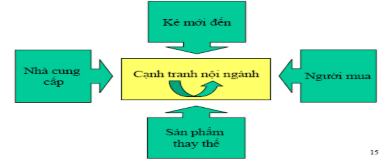
Someone said: "Same industry but not same profit, competition is inevitable in the market" . Competition is the comparison, verification of basic strength, threats, challenges and opportunities mainly obtained from the confrontation process in many aspects: Product quality - Brand Distribution - Price - Communication...
Therefore, Dalat needs to proactively exchange information with the whole social environment, consider and evaluate the situation and have initiatives to proactively deal with sudden changes or incidents. Especially, create a different business mindset, grasp the opportunity so that when there is an "opportunity", take advantage of the time. However, because the tourism industry of Dalat City is currently