
Chapter 3 Summary
Based on the results of a field survey combined with investigations and interviews with four stakeholders in tourism activities in Don Duong district (local people, tourists, local authorities and the private sector), the content of chapter 3 thoroughly analyzes the actual conditions for developing community-based tourism in Don Duong, including attractiveness of tourism resources, access to destinations, community factors, tourist market conditions and support conditions. On the other hand, this chapter also analyzes the current situation and needs for community-based tourism development in Don Duong, emphasizing the current situation of local people's participation in tourism activities, their wishes and needs for community-based tourism development in the locality. From there, analyze the strengths, weaknesses, opportunities and challenges of Don Duong district in developing community-based tourism through the SWOT method, based on the combination of the SWOT matrix to propose practical solutions in the following chapter to develop community-based tourism in Don Duong district, Lam Dong province.
Product orientation
Community tourism associated with the culture of the Churu ethnic group: exploiting the value of the gong cultural space of the Churu people, traditional crafts including pottery, silver rings, weaving, and making rice wine in Lac Xuan, Tu Tra, and Próh communes; traditional cuisine and daily life of the local community.
Farmstay tourism is associated with typical agricultural products of local residents; visiting and experiencing the "a day as a farmer" tour at farms growing green vegetables, tomatoes, Cayenne pineapples or environmentally friendly dairy farms; enjoying local agricultural products combined with learning about intensive farming culture, experiencing the farming and labor process of farmers.
Maybe you are interested!
-
 Research on community tourism development in Don Duong district, Lam Dong province - 5
 -
 Research on some factors affecting the development of community tourism in the Northwest sub-region - 22
 -
 Identify Rating Levels and Rating Scales
zt2i3t4l5ee
zt2a3gstourism,quan lan,quang ninh,ecology,ecotourism,minh chau,van don,geography,geographical basis,tourism development,science
zt2a3ge
zc2o3n4t5e6n7ts
of the islanders. Therefore, this indicator will be divided into two sub-indicators:
a1. Natural tourism attractiveness a2. Cultural tourism attractiveness
b. Tourist capacity
The two island communes in Quan Lan have different capacities to receive tourists. Minh Chau Commune is home to many standard hotels and resorts, attracting high-income domestic and international tourists. Meanwhile, Quan Lan Commune has many motels mainly built and operated by local people, so the scale and quality are not high, and will be suitable for ordinary tourists such as students.
c. Time of exploitation of Quan Lan Island Commune:
Quan Lan tourism is seasonal due to weather and climate conditions and festivals only take place on certain days of the year, specifically in spring. In Quan Lan commune, the period from April to June and from September to November is considered the best time to visit Quan Lan because the cultural tourism activities are mainly associated with festivals taking place during this time.
Minh Chau island commune:
Tourism exploitation time is all year round, because this is a place with a number of tourist attractions with diverse ecosystems such as Bai Tu Long National Park Research Center, Tram forest, Turtle Laying Beach, so besides coming to the beach for tourism and vacation in the summer, Minh Chau will attract research groups to come for tourism combined with research at other times of the year.
d. Sustainability
The sustainability of ecotourism sites in Quan Lan and Minh Chau communes depends on the sensitivity of the ecosystems to climate changes.
landscape. In general, these tourist destinations have a fairly high level of sustainability, because they are natural ecosystems, planned and protected. However, if a large number of tourists gather at certain times, it can exceed the carrying capacity and affect the sustainability of the environment (polluted beaches, damaged trees, animals moving away from their habitats, etc.), then the sustainability of the above ecosystems (natural ecosystems, human ecosystems) will also be affected and become less sustainable.
e. Location and accessibility
Both island communes have ports to take tourists to visit from Van Don wharf:
- Quan Lan – Van Don traffic route:
Phuc Thinh – Viet Anh high-speed boat and Quang Minh high-speed boat, depart at 8am and 2pm from Van Don to Quan Lan, and at 7am and 1pm from Quan Lan to Van Don. There are also wooden boats departing at 7am and 1pm.
- Van Don - Minh Chau traffic route:
Chung Huong high-speed train, Minh Chau train, morning 7:30 and afternoon 13:30 from Van Don to Minh Chau, morning 6:30 and afternoon 13:00 from Minh Chau to Van Don.
f. Infrastructure
Despite receiving investment attention, the issue of infrastructure and technical facilities for tourism on Quan Lan Island is still an issue that needs to be resolved because it has a direct impact on the implementation of ecotourism activities. The minimum conditions for serving tourists such as accommodation, electricity, water, communication, especially medical services, and security work need to be given top priority. Ecotourism spots in Minh Chau commune are assessed to have better infrastructure and technical facilities for tourism because there are quite complete and synchronous conditions for serving tourists, meeting many needs of domestic and foreign tourists.
3.2.1.4. Determine assessment levels and assessment scales
Corresponding to the levels of each criterion, the index is the score of those levels in the order of 4, 3, 2, 1 decreasing according to the standard of each level: very attractive (4), attractive (3), average (2), less attractive (1).
3.2.1.5. Determining the coefficients of the criteria
For the assessment of DLST in the two communes of Quan Lan and Minh Chau islands, the students added evaluation coefficients to show the importance of the criteria and indicators as follows:
Coefficient 3 with criteria: Attractiveness, Exploitation time. These are the 2 most important criteria for attracting tourists to tourism in general and eco-tourism in particular, so they have the highest coefficient.
Coefficient 2 with criteria: Capacity, Infrastructure, Location and accessibility . Because the assessment area is an island commune of Van Don district, the above criteria are selected by the author with appropriate coefficients at the average level.
Coefficient 1 with criteria: Sustainability. Quan Lan has natural and human-made ecotourism sites, with high biodiversity and little impact from local human factors. Most of the ecotourism sites are still wild, so they are highly sustainable.
3.2.1.6. Results of DLST assessment on Quan Lan island
a. Assessment of the potential for natural tourism development
For Minh Chau commune:
+ Natural tourism attractiveness is determined to be very attractive (4 points) and the most important coefficient (coefficient 3), so the score of the Attractiveness criterion is 4 x 3 = 12.
+ Capacity is determined as average (2 points) and the coefficient is quite important (coefficient 2), then the score of Capacity criterion is 2 x 2 = 4.
+ Exploitation time is long (4 points), the most important coefficient (coefficient 3) so the score of the Exploitation time criterion is 4 x 3 = 12.
+ Sustainability is determined as sustainable (4 points), the important coefficient is the average coefficient (coefficient 1), so the score of the Sustainability criterion is 4 x 1 = 4 points
+ Location and accessibility are determined to be quite favorable (2 points), the coefficient is quite important (coefficient 2), the criterion score is 2 x 2 = 4 points.
+ Infrastructure is assessed as good (3 points), the coefficient is quite important (coefficient 2), then the score of the Infrastructure criterion is 3 x 2 = 6 points.
The total score for evaluating DLST in Minh Chau commune according to 6 evaluation criteria is determined as: 12 + 4 + 12 + 4 + 4 + 6 = 42 points
Similar assessment for Quan Lan commune, we have the following table:
Table 3.3: Assessment of the potential for natural ecotourism development in Quan Lan and Minh Chau communes
Attractiveness of self-tourismof course
Capacity
Mining time
Sustainability
Location and accessibility
Infrastructure
Result
Point
DarkMulti
Point
DarkMulti
Point
DarkMulti
Point
DarkMulti
Point
DarkMulti
Point
DarkMulti
CommuneMinh Chau
12
12
4
8
12
12
4
4
4
8
6
8
42/52
Quan CommuneLan
6
12
6
8
9
12
4
4
4
8
4
8
33/52
b. Assessment of the potential for humanistic tourism development
For Quan Lan commune:
+ The attractiveness of human tourism is determined to be very attractive (4 points) and the most important coefficient (coefficient 3), so the score of the Attractiveness criterion is 4 x 3 = 12.
+ Capacity is determined to be large (3 points) and the coefficient is quite important (coefficient 2), then the score of the Capacity criterion is 3 x 2 = 6.
+ Mining time is average (3 points), the most important coefficient (coefficient 3) so the score of the Mining time criterion is 3 x 3 = 9.
+ Sustainability is determined as sustainable (4 points), the important coefficient is the average coefficient (coefficient 1), so the score of the Sustainability criterion is 4 x 1 = 4 points.
+ Location and accessibility are determined to be quite favorable (2 points), the coefficient is quite important (coefficient 2), the criterion score is 2 x 2 = 4 points.
+ Infrastructure is rated as average (2 points), the coefficient is quite important (coefficient 2), then the score of the Infrastructure criterion is 2 x 2 = 4 points.
The total score for evaluating DLST in Quan Lan commune according to 6 evaluation criteria is determined as: 12 + 6 + 6 + 4 + 4 + 4 = 36 points.
Similar assessment with Minh Chau commune we have the following table:
Table 3.4: Assessment of the potential for developing humanistic eco-tourism in Quan Lan and Minh Chau communes
Attractiveness of human tourismliterature
Capacity
Mining time
Sustainability
Location and accessibility
Infrastructure
Result
Point
DarkMulti
Point
DarkMulti
Point
DarkMulti
Point
DarkMulti
Point
DarkMulti
Point
DarkMulti
Quan CommuneLan
12
12
6
8
9
12
4
4
4
8
4
8
39/52
Minh CommuneChau
6
12
4
8
12
12
4
4
4
8
6
8
36/52
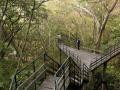
Basically, both Minh Chau and Quan Lan localities have quite favorable conditions for developing ecotourism. However, Quan Lan commune has more advantages to develop ecotourism in a humanistic direction, because this is an area with many famous historical relics such as Quan Lan Communal House, Quan Lan Pagoda, Temple worshiping the hero Tran Khanh Du, ... along with local festivals held annually such as the wind praying ceremony (March 15), Quan Lan festival (June 10-19); due to its location near the port and long exploitation time, the beaches in Quan Lan commune (especially Quan Lan beach) are no longer hygienic and clean to ensure the needs of tourists coming to relax and swim; this is also an area with many beautiful landscapes such as Got Beo wind pass, Ong Phong head, Voi Voi cave, but the ability to access these places is still very limited (dirt hill road, lots of gravel and rocks), especially during rainy and windy times; In addition, other natural resources such as mangrove forests and sea worms have not been really exploited for tourism purposes and ecotourism development. On the contrary, Minh Chau commune has more advantages in developing ecotourism in the direction of natural tourism, this is an area with diverse ecosystems such as at Rua De Beach, Bai Tu Long National Park Conservation Center...; Minh Chau beach is highly appreciated for its natural beauty and cleanliness, ranked in the top ten most beautiful beaches in Vietnam; Minh Chau commune is also home to Tram forest with a large area and a purity of up to 90%, suitable for building bridges through the forest (a very effective type of natural ecotourism currently applied by many countries) for tourists to sightsee, as well as for the purpose of studying and researching.
Figure 3.1: Thenmala Forest Bridge (India) Source: https://www.thenmalaecotourism.com/(August 21, 2019)
3.2.2. Using SWOT matrix to evaluate Quan Lan island tourism
General assessment of current tourism activities of Quan Lan island is shown through the following SWOT matrix:
Table 3.5: SWOT matrix evaluating tourism activities on Quan Lan island
Internal agent
Strengths- There is a lot of potential for tourism development, especially natural ecotourism and humanistic ecotourism.- The unskilled labor force is relatively abundant.- resource environmentunpolluted, still
Weaknesses- Poorly developed infrastructure, especially traffic routes to tourist destinations on the island.- The team of professional staff is still weak.- Tourism products in general
quite wild, originalintact
general and DLST in particularalone is monotonous.
External agents
Opportunity- Tourism is a key industry in the socio-economic development strategy of the province and Van Don economic zone.- Quan Lan was selected as a pilot area for eco-tourism development within the framework of the green growth project between Quang Ninh province and the Japanese organization JICA.- The flow of tourists and especially ecotourism in the world tends toincreasing
Challenge- Weather and climate change abnormally.- Competition in tourism products is increasingly fierce, especially with other localities in the province such as Ha Long, Mong Cai...- Awareness of tourists, especially domestic tourists, about ecotourism and nature conservation is not high.
Through summary analysis using SWOT matrix we see that:
To exploit strengths and take advantage of opportunities, it is necessary to:
- Diversify products and service types (build more tourism routes aimed at specific needs of tourists: experiential tourism immersed in nature, spiritual cultural tourism...)
- Effective exploitation of resources and differentiated products (natural resources and human resources)
div.maincontent .p { color: black; font-family:"Times New Roman", serif; font-style: normal; font-weight: normal; text-decoration: none; font-size: 14pt; margin:0pt; } div.maincontent p { color: black; font-family:"Times New Roman", serif; font-style: normal; font-weight: normal; text-decoration: none; font-size: 14pt; margin:0pt; } div.maincontent .s1 { color: black; font-family:"Times New Roman", serif; font-style: normal; font-weight: normal; text-decoration: none; font-size: 13pt; } div.maincontent .s2 { color: black; font-family:"Times New Roman", serif; font-style: normal; font-weight: normal; text-decoration: none; font-size: 13pt; } div.maincontent .s3 { color: #0D0D0D; font-family:"Times New Roman", serif; font-style: normal; font-weight: bold; text-decoration: none; font-size: 14pt; } div.maincontent .s4 { color: black; font-family:"Times New Roman", serif; font-style: italic; font-weight: normal; text-decoration: none; font-size: 14pt; } div.maincontent .s5 { color: black; font-family:"Times New Roman", serif; font-style: italic; font-weight: bold; text-decoration: none; font-size: 14pt; } div.maincontent .s6 { color: black; font-family:"Times New Roman", serif; font-style: italic; font-weight: normal; text-decoration: none; font-size: 14pt; vertical-align: -3pt; } div.maincontent .s7 { color: black; font-family:"Times New Roman", serif; font-style: italic; font-weight: normal; text-decoration: none; font-size: 14pt; vertical-align: -2pt; } div.maincontent .s8 { color: black; font-family:"Times New Roman", serif; font-style: italic; font-weight: normal; text-decoration: none; font-size: 14pt; vertical-align: -1pt; } div.maincontent .s9 { color: black; font-family:"Times New Roman", serif; font-style: normal; font-weight: normal; text-decoration: none; font-size: 14pt; } div.maincontent .s10 { color: black; font-family:"Times New Roman", serif; font-style: normal; font-weight: bold; text-decoration: none; font-size: 14pt; } div.maincontent .s11 { color: black; font-family:"Times New Roman", serif; font-style: normal; font-weight: normal; text-decoration: none; font-size: 14pt; } div.maincontent .s12 { color: black; font-family:Symbol, serif; font-style: normal; font-weight: normal; text-decoration: none; font-size: 14pt; } div.maincontent .s13 { color: black; font-family:Wingdings; font-style: normal; font-weight: normal; text-decoration: none; font-size: 14pt; } div.maincontent .s14 { color: black; font-family:"Times New Roman", serif; font-style: normal; font-weight: normal; text-decoration: none; font-size: 9pt; vertical-align: 5pt; } div.maincontent .s15 { color: black; font-family:"Times New Roman", serif; font-style: normal; font-weight: normal; text-decoration: none; font-size: 9pt; vertical-align: 5pt; } div.maincontent .s16 { color: black; font-family:Cambria, serif; font-style: italic; font-weight: normal; text-decoration: none; font-size: 14pt; } div.maincontent .s17 { color: #080808; font-family:"Times New Roman", serif; font-style: normal; font-weight: bold; text-decoration: none; font-size: 14pt; } div.maincontent .s18 { color: #080808; font-family:"Times New Roman", serif; font-style: normal; font-weight: normal; text-decoration: none; font-size: 14pt; } div.maincontent .s19 { color: black; font-family:"Times New Roman", serif; font-style: normal; font-weight: normal; text-decoration: none; font-size: 11pt; } div.maincontent .s20 { color: black; font-family:"Times New Roman", serif; font-style: normal; font-weight: normal; text-decoration: none; font-size: 10pt; } div.maincontent .s21 { color: black; font-family:"Times New Roman", serif; font-style: normal; font-weight: bold; text-decoration: none; font-size: 11pt; } div.maincontent .s22 { color: black; font-family:"Times New Roman", serif; font-style: normal; font-weight: normal; text-decoration: none; font-size: 11pt; } div.maincontent .s23 { color: black; font-family:"Times New Roman", serif; font-style: italic; font-weight: normal; text-decoration: none; font-size: 14pt; } div.maincontent .s24 { color: #212121; font-family:"Times New Roman", serif; font-style: normal; font-weight: normal; tex
Identify Rating Levels and Rating Scales
zt2i3t4l5ee
zt2a3gstourism,quan lan,quang ninh,ecology,ecotourism,minh chau,van don,geography,geographical basis,tourism development,science
zt2a3ge
zc2o3n4t5e6n7ts
of the islanders. Therefore, this indicator will be divided into two sub-indicators:
a1. Natural tourism attractiveness a2. Cultural tourism attractiveness
b. Tourist capacity
The two island communes in Quan Lan have different capacities to receive tourists. Minh Chau Commune is home to many standard hotels and resorts, attracting high-income domestic and international tourists. Meanwhile, Quan Lan Commune has many motels mainly built and operated by local people, so the scale and quality are not high, and will be suitable for ordinary tourists such as students.
c. Time of exploitation of Quan Lan Island Commune:
Quan Lan tourism is seasonal due to weather and climate conditions and festivals only take place on certain days of the year, specifically in spring. In Quan Lan commune, the period from April to June and from September to November is considered the best time to visit Quan Lan because the cultural tourism activities are mainly associated with festivals taking place during this time.
Minh Chau island commune:
Tourism exploitation time is all year round, because this is a place with a number of tourist attractions with diverse ecosystems such as Bai Tu Long National Park Research Center, Tram forest, Turtle Laying Beach, so besides coming to the beach for tourism and vacation in the summer, Minh Chau will attract research groups to come for tourism combined with research at other times of the year.
d. Sustainability
The sustainability of ecotourism sites in Quan Lan and Minh Chau communes depends on the sensitivity of the ecosystems to climate changes.
landscape. In general, these tourist destinations have a fairly high level of sustainability, because they are natural ecosystems, planned and protected. However, if a large number of tourists gather at certain times, it can exceed the carrying capacity and affect the sustainability of the environment (polluted beaches, damaged trees, animals moving away from their habitats, etc.), then the sustainability of the above ecosystems (natural ecosystems, human ecosystems) will also be affected and become less sustainable.
e. Location and accessibility
Both island communes have ports to take tourists to visit from Van Don wharf:
- Quan Lan – Van Don traffic route:
Phuc Thinh – Viet Anh high-speed boat and Quang Minh high-speed boat, depart at 8am and 2pm from Van Don to Quan Lan, and at 7am and 1pm from Quan Lan to Van Don. There are also wooden boats departing at 7am and 1pm.
- Van Don - Minh Chau traffic route:
Chung Huong high-speed train, Minh Chau train, morning 7:30 and afternoon 13:30 from Van Don to Minh Chau, morning 6:30 and afternoon 13:00 from Minh Chau to Van Don.
f. Infrastructure
Despite receiving investment attention, the issue of infrastructure and technical facilities for tourism on Quan Lan Island is still an issue that needs to be resolved because it has a direct impact on the implementation of ecotourism activities. The minimum conditions for serving tourists such as accommodation, electricity, water, communication, especially medical services, and security work need to be given top priority. Ecotourism spots in Minh Chau commune are assessed to have better infrastructure and technical facilities for tourism because there are quite complete and synchronous conditions for serving tourists, meeting many needs of domestic and foreign tourists.
3.2.1.4. Determine assessment levels and assessment scales
Corresponding to the levels of each criterion, the index is the score of those levels in the order of 4, 3, 2, 1 decreasing according to the standard of each level: very attractive (4), attractive (3), average (2), less attractive (1).
3.2.1.5. Determining the coefficients of the criteria
For the assessment of DLST in the two communes of Quan Lan and Minh Chau islands, the students added evaluation coefficients to show the importance of the criteria and indicators as follows:
Coefficient 3 with criteria: Attractiveness, Exploitation time. These are the 2 most important criteria for attracting tourists to tourism in general and eco-tourism in particular, so they have the highest coefficient.
Coefficient 2 with criteria: Capacity, Infrastructure, Location and accessibility . Because the assessment area is an island commune of Van Don district, the above criteria are selected by the author with appropriate coefficients at the average level.
Coefficient 1 with criteria: Sustainability. Quan Lan has natural and human-made ecotourism sites, with high biodiversity and little impact from local human factors. Most of the ecotourism sites are still wild, so they are highly sustainable.
3.2.1.6. Results of DLST assessment on Quan Lan island
a. Assessment of the potential for natural tourism development
For Minh Chau commune:
+ Natural tourism attractiveness is determined to be very attractive (4 points) and the most important coefficient (coefficient 3), so the score of the Attractiveness criterion is 4 x 3 = 12.
+ Capacity is determined as average (2 points) and the coefficient is quite important (coefficient 2), then the score of Capacity criterion is 2 x 2 = 4.
+ Exploitation time is long (4 points), the most important coefficient (coefficient 3) so the score of the Exploitation time criterion is 4 x 3 = 12.
+ Sustainability is determined as sustainable (4 points), the important coefficient is the average coefficient (coefficient 1), so the score of the Sustainability criterion is 4 x 1 = 4 points
+ Location and accessibility are determined to be quite favorable (2 points), the coefficient is quite important (coefficient 2), the criterion score is 2 x 2 = 4 points.
+ Infrastructure is assessed as good (3 points), the coefficient is quite important (coefficient 2), then the score of the Infrastructure criterion is 3 x 2 = 6 points.
The total score for evaluating DLST in Minh Chau commune according to 6 evaluation criteria is determined as: 12 + 4 + 12 + 4 + 4 + 6 = 42 points
Similar assessment for Quan Lan commune, we have the following table:
Table 3.3: Assessment of the potential for natural ecotourism development in Quan Lan and Minh Chau communes
Attractiveness of self-tourismof course
Capacity
Mining time
Sustainability
Location and accessibility
Infrastructure
Result
Point
DarkMulti
Point
DarkMulti
Point
DarkMulti
Point
DarkMulti
Point
DarkMulti
Point
DarkMulti
CommuneMinh Chau
12
12
4
8
12
12
4
4
4
8
6
8
42/52
Quan CommuneLan
6
12
6
8
9
12
4
4
4
8
4
8
33/52
b. Assessment of the potential for humanistic tourism development
For Quan Lan commune:
+ The attractiveness of human tourism is determined to be very attractive (4 points) and the most important coefficient (coefficient 3), so the score of the Attractiveness criterion is 4 x 3 = 12.
+ Capacity is determined to be large (3 points) and the coefficient is quite important (coefficient 2), then the score of the Capacity criterion is 3 x 2 = 6.
+ Mining time is average (3 points), the most important coefficient (coefficient 3) so the score of the Mining time criterion is 3 x 3 = 9.
+ Sustainability is determined as sustainable (4 points), the important coefficient is the average coefficient (coefficient 1), so the score of the Sustainability criterion is 4 x 1 = 4 points.
+ Location and accessibility are determined to be quite favorable (2 points), the coefficient is quite important (coefficient 2), the criterion score is 2 x 2 = 4 points.
+ Infrastructure is rated as average (2 points), the coefficient is quite important (coefficient 2), then the score of the Infrastructure criterion is 2 x 2 = 4 points.
The total score for evaluating DLST in Quan Lan commune according to 6 evaluation criteria is determined as: 12 + 6 + 6 + 4 + 4 + 4 = 36 points.
Similar assessment with Minh Chau commune we have the following table:
Table 3.4: Assessment of the potential for developing humanistic eco-tourism in Quan Lan and Minh Chau communes
Attractiveness of human tourismliterature
Capacity
Mining time
Sustainability
Location and accessibility
Infrastructure
Result
Point
DarkMulti
Point
DarkMulti
Point
DarkMulti
Point
DarkMulti
Point
DarkMulti
Point
DarkMulti
Quan CommuneLan
12
12
6
8
9
12
4
4
4
8
4
8
39/52
Minh CommuneChau
6
12
4
8
12
12
4
4
4
8
6
8
36/52
Basically, both Minh Chau and Quan Lan localities have quite favorable conditions for developing ecotourism. However, Quan Lan commune has more advantages to develop ecotourism in a humanistic direction, because this is an area with many famous historical relics such as Quan Lan Communal House, Quan Lan Pagoda, Temple worshiping the hero Tran Khanh Du, ... along with local festivals held annually such as the wind praying ceremony (March 15), Quan Lan festival (June 10-19); due to its location near the port and long exploitation time, the beaches in Quan Lan commune (especially Quan Lan beach) are no longer hygienic and clean to ensure the needs of tourists coming to relax and swim; this is also an area with many beautiful landscapes such as Got Beo wind pass, Ong Phong head, Voi Voi cave, but the ability to access these places is still very limited (dirt hill road, lots of gravel and rocks), especially during rainy and windy times; In addition, other natural resources such as mangrove forests and sea worms have not been really exploited for tourism purposes and ecotourism development. On the contrary, Minh Chau commune has more advantages in developing ecotourism in the direction of natural tourism, this is an area with diverse ecosystems such as at Rua De Beach, Bai Tu Long National Park Conservation Center...; Minh Chau beach is highly appreciated for its natural beauty and cleanliness, ranked in the top ten most beautiful beaches in Vietnam; Minh Chau commune is also home to Tram forest with a large area and a purity of up to 90%, suitable for building bridges through the forest (a very effective type of natural ecotourism currently applied by many countries) for tourists to sightsee, as well as for the purpose of studying and researching.
Figure 3.1: Thenmala Forest Bridge (India) Source: https://www.thenmalaecotourism.com/(August 21, 2019)
3.2.2. Using SWOT matrix to evaluate Quan Lan island tourism
General assessment of current tourism activities of Quan Lan island is shown through the following SWOT matrix:
Table 3.5: SWOT matrix evaluating tourism activities on Quan Lan island
Internal agent
Strengths- There is a lot of potential for tourism development, especially natural ecotourism and humanistic ecotourism.- The unskilled labor force is relatively abundant.- resource environmentunpolluted, still
Weaknesses- Poorly developed infrastructure, especially traffic routes to tourist destinations on the island.- The team of professional staff is still weak.- Tourism products in general
quite wild, originalintact
general and DLST in particularalone is monotonous.
External agents
Opportunity- Tourism is a key industry in the socio-economic development strategy of the province and Van Don economic zone.- Quan Lan was selected as a pilot area for eco-tourism development within the framework of the green growth project between Quang Ninh province and the Japanese organization JICA.- The flow of tourists and especially ecotourism in the world tends toincreasing
Challenge- Weather and climate change abnormally.- Competition in tourism products is increasingly fierce, especially with other localities in the province such as Ha Long, Mong Cai...- Awareness of tourists, especially domestic tourists, about ecotourism and nature conservation is not high.
Through summary analysis using SWOT matrix we see that:
To exploit strengths and take advantage of opportunities, it is necessary to:
- Diversify products and service types (build more tourism routes aimed at specific needs of tourists: experiential tourism immersed in nature, spiritual cultural tourism...)
- Effective exploitation of resources and differentiated products (natural resources and human resources)
div.maincontent .p { color: black; font-family:"Times New Roman", serif; font-style: normal; font-weight: normal; text-decoration: none; font-size: 14pt; margin:0pt; } div.maincontent p { color: black; font-family:"Times New Roman", serif; font-style: normal; font-weight: normal; text-decoration: none; font-size: 14pt; margin:0pt; } div.maincontent .s1 { color: black; font-family:"Times New Roman", serif; font-style: normal; font-weight: normal; text-decoration: none; font-size: 13pt; } div.maincontent .s2 { color: black; font-family:"Times New Roman", serif; font-style: normal; font-weight: normal; text-decoration: none; font-size: 13pt; } div.maincontent .s3 { color: #0D0D0D; font-family:"Times New Roman", serif; font-style: normal; font-weight: bold; text-decoration: none; font-size: 14pt; } div.maincontent .s4 { color: black; font-family:"Times New Roman", serif; font-style: italic; font-weight: normal; text-decoration: none; font-size: 14pt; } div.maincontent .s5 { color: black; font-family:"Times New Roman", serif; font-style: italic; font-weight: bold; text-decoration: none; font-size: 14pt; } div.maincontent .s6 { color: black; font-family:"Times New Roman", serif; font-style: italic; font-weight: normal; text-decoration: none; font-size: 14pt; vertical-align: -3pt; } div.maincontent .s7 { color: black; font-family:"Times New Roman", serif; font-style: italic; font-weight: normal; text-decoration: none; font-size: 14pt; vertical-align: -2pt; } div.maincontent .s8 { color: black; font-family:"Times New Roman", serif; font-style: italic; font-weight: normal; text-decoration: none; font-size: 14pt; vertical-align: -1pt; } div.maincontent .s9 { color: black; font-family:"Times New Roman", serif; font-style: normal; font-weight: normal; text-decoration: none; font-size: 14pt; } div.maincontent .s10 { color: black; font-family:"Times New Roman", serif; font-style: normal; font-weight: bold; text-decoration: none; font-size: 14pt; } div.maincontent .s11 { color: black; font-family:"Times New Roman", serif; font-style: normal; font-weight: normal; text-decoration: none; font-size: 14pt; } div.maincontent .s12 { color: black; font-family:Symbol, serif; font-style: normal; font-weight: normal; text-decoration: none; font-size: 14pt; } div.maincontent .s13 { color: black; font-family:Wingdings; font-style: normal; font-weight: normal; text-decoration: none; font-size: 14pt; } div.maincontent .s14 { color: black; font-family:"Times New Roman", serif; font-style: normal; font-weight: normal; text-decoration: none; font-size: 9pt; vertical-align: 5pt; } div.maincontent .s15 { color: black; font-family:"Times New Roman", serif; font-style: normal; font-weight: normal; text-decoration: none; font-size: 9pt; vertical-align: 5pt; } div.maincontent .s16 { color: black; font-family:Cambria, serif; font-style: italic; font-weight: normal; text-decoration: none; font-size: 14pt; } div.maincontent .s17 { color: #080808; font-family:"Times New Roman", serif; font-style: normal; font-weight: bold; text-decoration: none; font-size: 14pt; } div.maincontent .s18 { color: #080808; font-family:"Times New Roman", serif; font-style: normal; font-weight: normal; text-decoration: none; font-size: 14pt; } div.maincontent .s19 { color: black; font-family:"Times New Roman", serif; font-style: normal; font-weight: normal; text-decoration: none; font-size: 11pt; } div.maincontent .s20 { color: black; font-family:"Times New Roman", serif; font-style: normal; font-weight: normal; text-decoration: none; font-size: 10pt; } div.maincontent .s21 { color: black; font-family:"Times New Roman", serif; font-style: normal; font-weight: bold; text-decoration: none; font-size: 11pt; } div.maincontent .s22 { color: black; font-family:"Times New Roman", serif; font-style: normal; font-weight: normal; text-decoration: none; font-size: 11pt; } div.maincontent .s23 { color: black; font-family:"Times New Roman", serif; font-style: italic; font-weight: normal; text-decoration: none; font-size: 14pt; } div.maincontent .s24 { color: #212121; font-family:"Times New Roman", serif; font-style: normal; font-weight: normal; tex -
 Research and exploit the cultural values of the Dao people in Phu Tho province to serve the development of community tourism - 15
 -
 Lessons Learned From Community Tourism Development Models
Craft village tourism associated with Lac Lam rice paper products: visit and learn about the handmade rice paper production process of households migrating from Kinh Bac region to Don Duong for more than 30 years, forming the traditional rice paper production village of Lac Lam, especially enjoying grilled rice paper with shrimp paste created by villagers and has become a typical product of the craft village.
Sightseeing and sightseeing based on the wild beauty of natural landscapes such as Cha Tay waterfall, Thien Thai waterfall, Chau Son pine hill, Ma Danh lake, Da Ron lake, Da Nhim lake, wild flower hills; visiting and admiring the unique beauty of architectural works imbued with the culture of the Churu people such as Ka Don church, Churu ancient house.
Photo tourism is based on the mountain terrain with many beautiful landscapes, many spectacular mountain passes, many seasonal natural flowers and the simplicity in the daily life of the indigenous people.
Orientation of tourism development according to territorial space
For Don Duong district, it is necessary to plan tourism development according to tourist spots on the basis of exploiting attractive tourist spots:
- Community tourism spots: Diom A village - Lac Xuan commune, Pro commune, Tu Tra commune with a large concentration of Churu ethnic people and is a place that still preserves the traditional cultural values of Churu, people strongly support tourism development.
- Management Board: drafts tourism regulations in the village, inspects, reviews, and grasps the operational situation to issue appropriate regulations for each functional group, local people, and tourists; is responsible for managing the general operations of the model and is a bridge between the community tourism model and outside individuals and organizations. Management Board members include prestigious and influential people in the village, especially the Churu people and representatives of Lac Xuan commune government. The head of the Management Board must be a prestigious person in the village, always interested in all aspects of social life, always helping village members, and having a high sense of responsibility for the work.
- Operational Team: coordinate functional groups to cooperate in serving customers, assign tasks, and urge implementation to ensure that tourists' travel process is not delayed or interrupted; develop new business strategies as well as create many attractive tourism products for tourists. This team should be established from the beginning, including 4-5 members who are local people, living long-term in Diom A village, to organize tours, determine appropriate capacity as well as arrange sightseeing and experiences.
- Functional Group: undertakes different tasks during tourism activities. This group should mobilize human resources in the village and divide into different specialized groups based on exploiting the strengths of the member groups.
+ Gong performance group: gathers members of the Churu ethnic group in Diom A village, especially under the direction of gong performance artist Ma Bio.
+ Guide and explanation group (directions): take tourists to visit the village's unique tourism resources that have been selected in the model, combining explanations and interpretations of the ethnic origin, customs, religions, traditional cultural festivals, crafts and daily life of the Churu people.
+ Culinary group: build menus, prepare and serve traditional Churu dishes and drinks based on local ingredients and food sources.
+ Accommodation group: serving the overnight accommodation needs of tourists, this group is responsible for preparing accommodation and necessary items to ensure the essential needs of guests; it is necessary to pay attention to the original elements associated with the cultural values of the Churu community to give tourists the opportunity to experience the daily life of the Churu community in Diom A village, Lac Xuan commune.
+ Costume group: collect and preserve traditional costumes of the Churu people. During the process of serving tourists, all members wear traditional costumes. In addition, it is necessary to ensure that the costumes are always clean and tidy so that they can be rented to tourists for taking photos or participating in community cultural activities.
+ Medical team: ready to take care of tourists whenever they have health problems, first aid. This team needs to be fully prepared with necessary medical equipment as well as equipped with basic medical knowledge and skills to serve guests in emergencies.
+ Community cleaning group: responsible for cleaning and waste disposal in all places that tourists can pass through and visit. At the same time, propagate to everyone in the community to be responsible for protecting the environment, waste disposal to contribute to ensuring the landscape in the whole village and have the right to handle violators according to the regulations of the Management Board.
Based on the survey results of the conditions for developing community-based tourism and the investigation of opinions of relevant parties, the topic proposes tourism products for the specific model as follows:
+ Visit and learn about the indigenous cultural architecture at the Churu ancient stilt house: currently in the whole village there are about 4-5 houses with many traditional features preserved by the people. With a simple and modest architecture, the house is completely made of wood, in front of the house is always a large yard, visitors can visit here.
+ Visit and experience the agricultural production activities of the Churu people here in the vegetable gardens.
+ Enjoy local cuisine prepared by Churu people from available ingredients.
+ Learn about the traditional wine making process of the Churu people introduced by artisan Ma Bio and enjoy the delicious taste of wine here.
+ Admire and learn about Churu cultural values through the Churu gong set preserved by artisan Ma Bio through many generations of family.
+ Enjoy the Central Highlands gong culture performed by the Churu ethnic community by the flickering fire at the Churu ancient house.
+ Stay at a local's house: sleep overnight and chat with the locals to have a deep experience of Churu culture.
On the other hand, the topic analyzes the strengths, weaknesses, opportunities and challenges of Don Duong district in developing community tourism through the SWOT tool. The research results show that: In terms of strengths, Don Duong has a favorable location and is a neighboring district of Da Lat tourism cluster, so it has the opportunity to welcome visitors. On the other hand, Don Duong is also the place with the largest concentration of Churu ethnic people in the whole province, where the traditional values of indigenous people are preserved and has beautiful, wild and simple natural landscapes. In particular, local people support and are willing to participate in developing community tourism in Don Duong. In terms of weaknesses, local tourism planning and promotion are limited, attractive tourist resources are scattered, local people do not have the skills to welcome and serve tourists, and the connection between local authorities and the private sector is limited. In terms of opportunities, community tourism is becoming a trend that is encouraged to develop in rural areas as well as in developing countries. Tourists are increasingly aware of their responsibility towards the environment and society, and they tend to seek new experiences. However, localities also face many challenges in developing community tourism, which is that the success and popularity of some community tourism models in the country will lead to a comparison mentality in tourists' decision to choose a new destination. Meanwhile, tourists increasingly have higher demands on the quality of tourism products as well as the quality of destinations.
From the combined strategies of the SWOT matrix, from the perspective of local authorities, the topic proposes 06 groups of solutions for developing community tourism in Don Duong district, including solutions on mechanisms and policies; tourism planning; investment, upgrading infrastructure, technical facilities for tourism; technical information support for local people; proposing a model of community tourism spots in Diom A village, Lac Xuan commune and solutions for promotion and association with the private sector. Through recommendations to local authorities at all levels, the topic hopes to contribute to the development of community tourism in Don Duong to help local people preserve and promote indigenous cultural values, emphasizing the culture of the Churu ethnic group, improving income through tourism activities, creating opportunities for exchange and contact with tourists, aiming at the goal of sustainable socio-economic development and building the image of Don Duong destination.
Vietnamese Documents
REFERENCES
1. Ministry of Culture, Sports and Tourism (2013), Master plan for tourism development in the Central Highlands region to 2020, vision 2030 , Hanoi.
2. Ministry of Culture, Sports and Tourism (2013), Master plan for Vietnam tourism development to 2020, vision 2030 , Hanoi.
3. Central Highlands Hydrometeorological Station (2015), Report on hydrometeorological situation of Lam Dong province in 2014 , Lam Dong.
4. Nguyen Van Dinh and Tran Thi Minh Hoa (2006), Tourism economics textbook , National Economics University Publishing House, Hanoi.
5. Nguyen Dinh Hoe and Vu Van Hieu (2001), Sustainable tourism , Hanoi National University Publishing House, Hanoi.
6. Vietnam Red Cross Society (1997), Social work training materials (for cadres, members, Red Cross youth volunteers and volunteers) , Hanoi.
7. To Duy Hop and Luong Hong Quang (2000), Community Development - Theory and Application , Culture and Information Publishing House, Hanoi.
8. Nguyen Thi Huong (2011), Community tourism in the mountainous areas of Northern Vietnam (case study of Sa Seng village, Ta Phin, Sapa, Lao Cai and Lac village, Chieng Chau, Mai Chau, Hoa Binh) , Master's thesis in Ethnology, University of Social Sciences and Humanities, Hanoi.
9. Pham Trung Luong (2000), Vietnam Tourism Resources and Environment , Vietnam Education Publishing House, Hanoi.
10. Nguyen Van Luu (2014), "Lam Dong tourism - telling numbers", Vietnam Tourism Magazine . No. 9/2014, pp. 32 - 33.
11. Pham Trung Luong et al. (2002), Research on building and protecting the tourism environment with community participation to contribute to sustainable tourism development on Cat Ba Island - Hai Phong , Ministry of Culture, Sports and Tourism, Hanoi.
12. Nguyen Thi Mai (2013), Community tourism development in Buon Don district, Dak Lak province , Master's thesis in Tourism, University of Social Sciences and Humanities, Hanoi.
13. Le Van Minh (2014), "Central Highlands develops tourism market and products", Vietnam Tourism Magazine . No. 7/2014, pp. 37 - 38.
14. Nguyen Huu Nhan (2004), Community Development , Publishing House. Hanoi National University, Hanoi.
15. Nguyen Thi Thu Nhan (2010), Developing tourism associated with ethnic minority communities in Sapa towards sustainable development, Master's thesis in Tourism, University of Social Sciences and Humanities, Hanoi.
16. Nguyen Thi Oanh (2000), Community Development , Ho Chi Minh City Open University Publishing House, Ho Chi Minh City.
17. PATA (2009), “Vietnam voted as one of the 10 most attractive tourist destinations in the world”, accessed at 4:00 p.m. on June 21, 2016, at https://www.vietravel.com/vn/tin-tuc-du-lich/viet-nam-duoc-binh-chon-la-1-trong-10- diem-du-lich-hap-dan-nhat-the-gioi-v4409.aspx.
18. Department of Culture and Information of Don Duong district (2015), Summary report for the period 2011 - 2015 , Lam Dong.
19. National Assembly of the Socialist Republic of Vietnam (2005), Law on Tourism , Hanoi.
20. Vo Que (2014), “Developing community tourism in Western Nghe An to contribute to poverty reduction”, Workshop on Evaluating the effectiveness of poverty reduction policies in Western Nghe An , Nghe An.
21. Vo Que (2006), Community Tourism - Theory and Application (Volume 1), Science and Technology Publishing House, Hanoi.
22. Department of Culture, Sports and Tourism of Lam Dong province (2015), Summary report for the period 2011 - 2015 , Lam Dong.
23. Tran Duc Thanh (2003), Introduction to Tourism Science , National University Publishing House, Hanoi.
24. Tran Van Thong (2006), Overview of Tourism , Ho Chi Minh City National University Publishing House, Ho Chi Minh City.
25. Tran Dinh Thu (1999), Ethnicity - Migration Lam Dong , Statistical Publishing House, Hanoi.
26. Vietnam National Administration of Tourism (2014), “Lam Dong - Don Duong Tourism Needs a Breakthrough”, Hanoi, accessed at 21:16 on March 12, 2016, at the website http://www.vietnamtourism.com/index.php/news/items/11574.
27. Lam Dong Provincial People's Committee (2010), Master plan for tourism development in Lam Dong province to 2020, vision to 2030 , Lam Dong.
28. People's Committee of Don Duong district (2015), Report on implementation results and direction of new rural construction in Don Duong district, Lam Dong province, period 2011 - 2015 , Lam Dong.
29. Institute of Ethnology (1984), Churu ethnic group, Ethnic minorities in Vietnam (Southern provinces) , Social Sciences Publishing House, Hanoi.
30. Institute for Tourism Development Research, Vietnam National Administration of Tourism and Japan International Cooperation Agency (JICA) (2013), Practical handbook on rural tourism development in Vietnam , Publishing House. Institute for Tourism Development Research, Hanoi.
31. Vietnam Institute for Rural Industry Research and Development (2012), Guidelines on community tourism development , Hanoi.
32. Quoc Vu (2014), “Don Duong builds a new model high-tech rural area”, Vietnam Bank for Social Policies , accessed at 17:30 on March 19, 2016, at the website http://vbsp.org.vn/don-duong-xay-dung-nong-thon-moi-kieu- mau-cong-nghe-cao.html.
33. Bui Thi Hai Yen (2007), Tourism planning , Vietnam Education Publishing House, Hanoi.
34. Bui Thi Hai Yen and Pham Hong Long (2011), Tourism resources , Vietnam Education Publishing House, Hanoi.
35. Bui Thi Hai Yen (editor) (2012), Community tourism , Vietnam Education Publishing House, Hanoi.
English Documents
36. Beeton, S. (2006). Community development through tourism . Australia: Landlinks Press.
37. Brass, J.L. (1996). Community Tourism Assessment Handbook . United States: Oregon State University.