
brand; Be careful when expanding the brand: Obviously, the brand created will create a good premise when wanting to expand by product line, product group... related or unrelated. However, it can lead to lowering the brand value. Must maintain the characteristic personality. There are brands that exist for decades without changing or expanding, not because they are lazy; In the current process, many leaders have forgotten a very simple thing: legalizing the brand. That is an expensive lesson when participating in the integration process.
Due to cost constraints, small and medium enterprises hardly hire employees who specialize in building strategies to build and protect brands and brand images in the hearts of customers. SMEs hardly hire consultants and trademark lawyers to easily choose solutions while it is increasingly difficult to create new brands and manage them. Vietnamese small and medium enterprises are not used to spending these costs. They even think that these costs are unnecessary, wasting limited capital without bringing any benefits. However, there is an assertion that: It is not a wasted and useless cost.
3.3. Brand protection on the internet
In the digital age, businesses can build their brands through the internet, but it is also necessary to pay attention to the issue of brand protection on the internet.
From the massive propaganda campaigns on mass media or from their own business experience, more and more businesses realize the importance of brands (trademarks, service marks) and give the brand a worthy investment in their business strategy. To be easy to remember, attract attention and at the same time market themselves, entities often register domain names under the name
Maybe you are interested!
-

 International Cooperation in Management and Enforcement of Copyright Protection
 -
 Some solutions to limit risks in international goods trading activities of Vietnamese traders - 10
 -
 Viewpoints and Solutions for Perfecting Human Obligations in International Law and Vietnamese Law
 -
 Patent Protection under the Patent Cooperation Treaty - 2
 -
 Solutions for developing international payment activities at Techcombank, period 2007 - 2010 - 2
trade names, trademarks or patents, industrial designs, copyrights… owned by them.
In these forms, the domain name has been known as the brand on the Internet of the enterprise. A characteristic of a brand is its uniqueness within a certain territory, usually a country or a group of countries that recognize each other's trademark registration. The domain name also has similar characteristics, and moreover, the domain name is unique worldwide. Moreover, the domain name along with the accompanying website content gives readers a lot of information about that enterprise. This is a particularly necessary supplement for new brands that have just "launched" or have not left a deep impression on consumers. Using an email address with the business domain name is both professional and shows interest in brand development.
Usually, companies or individuals steal trademarks, brands and domain names for personal gain. Because, as we all know, registering a domain name only costs a few dozen USD, but when reselling it, the price must be thousands of USD; registering a trademark or brand only costs about 1200-1500 USD, but if buying it back, it will cost about 50 thousand to hundreds of thousands of USD, depending on the negotiation between the two parties.
Regarding domain names on the Internet, many businesses have been aware of registering and protecting them early, but for brand and trademark ownership, the problem is much more complicated, especially for reputable brands, because the brand is one of the most important business factors, which cannot be changed overnight. The difficulty for companies is that those who violate brand ownership or copyright ownership of trademarks are often their business partners. These partners have spent a long time learning about the company, grasping the points
strengths and weaknesses of the company, then they "make a move" to steal the copyright ownership of the brand.
When a new business method is born, it is also the time when businesses need to change the traditional method of building and protecting their brands. Although this method is quite new and is a real challenge for SMEs, in order to develop and integrate with the rapid development of information technology and e-commerce. If small and medium enterprises can take advantage of this new method in building and protecting their brands, it will become a strength and advantage for the "little people".
CHAPTER III: SOLUTIONS TO PROMOTE BRAND BUILDING AND PROTECTION ACTIVITIES OF VIETNAMESE SMALL AND MEDIUM ENTERPRISES
I. Solutions from the government
Recognizing the importance of small and medium enterprises to the economy, our State has also paid special attention and introduced many solutions to support small and medium enterprises. Many agencies at all levels and sectors have paid attention to the cells of the economy - small and medium enterprises.
Figure 3.1: Organizations supporting small and medium enterprises
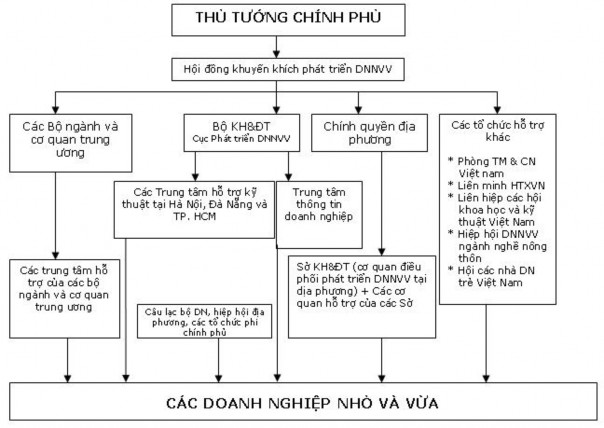
Source: Vietnam Association of Small and Medium Enterprises
Although the government has given many incentives to small and medium-sized enterprises, in the context of economic difficulties, many small and medium-sized enterprises are struggling and have to temporarily suspend operations. Building and protecting their brands is the shield that helps them withstand the storm. But to do that, small and medium-sized enterprises need help from the government. Below are solutions that the government can apply or increase its activities to help 95% of small and medium-sized enterprises in the economy.
1. Financial support solutions
Including investment incentives, commercial and short-term loan programs, credit support, existing financial leasing instruments
During the economic recession, small and medium enterprises are struggling. According to the Ministry of Planning and Investment, 80% of small and medium enterprises are facing difficulties in the context of economic recession and inflation. 2008 witnessed the disappearance of many small and medium enterprises and this situation is predicted to continue in 2009...
Faced with these difficulties, small and medium enterprises are in dire need of support in terms of loans and financial support from banks and credit institutions. Although activities are still ongoing, banks have almost applied many measures to rescue small and medium enterprises such as:
Banks and credit financial institutions lower lending interest rates, increase credit limits and give priority to small and medium enterprises:
For example, ViettinBank, OceanBank, ANZ, HSBC ... and many other banks. In which, with a loan of 20 million USD to finance small and medium enterprises and 50 million USD to finance import and export signed with IFC in 2008, Techcombank continues to improve its capacity to serve SMEs with a loan of 15 million USD with Proparco. Through this cooperation, Techcombank hopes to improve
The ability to support capital for small and medium enterprises, helping small and medium enterprises to have closer access to capital from banks and large financial institutions in the world to develop production and business.
A recent survey by the Enterprise Development Institute under the Vietnam Chamber of Commerce and Industry (VCCI) shows that, even in inflationary conditions, over 90% of non-state-owned small and medium enterprises still need to borrow capital, and 80% of small and medium enterprises are at risk of bankruptcy. However, only over 10% of them can borrow 100% of their needs.
On the business side, due to limitations such as low business efficiency, outdated technology, weak competitiveness... combined with the financial reports of small and medium enterprises often not being audited, it is very difficult for them to access bank loans. Small and medium enterprises often do not understand the requirements of banks, want to borrow but do not know where to start, lack a business plan, lack collateral... Some banks have just launched capital support programs for small and medium enterprises, such as the Bank for Investment and Development (BIDV), Joint Stock Commercial Bank for Foreign Trade (Vietcombank), each bank has set aside 3,000 billion VND for small and medium enterprises to borrow. In particular, the Bank for Industry and Trade has set aside
10,000 billion VND...
According to the State Bank's assessment, 23% of small and medium-sized enterprises with credit relations with commercial banks are currently operating effectively; 73.2% are operating averagely and 3.8% are facing difficulties; of which only 1.42% are likely to lose capital. The bad debt ratio for small and medium-sized enterprises of the entire banking system is about 3.64%, an increase of 1% compared to 2007 but a decrease of 0.19% compared to 2006.
Although capital is available, another major barrier that makes small and medium enterprises hesitate to access is the loan interest rate. With the current loan interest rate ranging from 18-20.5%/year, many small and medium enterprises
Small businesses can hardly bear it. To support businesses, some banks are calculating to reduce lending interest rates. It is known that Eximbank has just announced to apply a lending interest rate of 17.5%/year for small and medium enterprises. Currently, inflation is decreasing, deposit and lending interest rates are also decreasing. Small and medium enterprises are hoping that lending interest rates will decrease to a more "breathable" level.
In order to continue supporting and promoting the development of small and medium enterprises in the immediate and long-term periods, the State Bank of Vietnam has directed commercial banks to allocate a portion of credit capital to small and medium enterprises operating in the fields of import and export, production and trading of essential goods, employing a lot of labor, and participating in important national projects. The Ministry of Planning and Investment organizes monitoring of the performance of small and medium enterprises, annually reporting to the Prime Minister. Submitting to the Government a Decree replacing Decree No. 90/2001/ND-CP, in which it is noted to amend the criteria for classifying small and medium enterprises to better suit the practical situation. Complete the small and medium enterprise news page and urge relevant ministries and branches to build a small and medium enterprise domain on their websites to regularly update mechanisms, policies, technologies, etc. as well as changes in the regional and world economic situation for small and medium enterprises to promptly grasp and apply solutions.
The Ministry of Planning and Investment coordinates with VCCI and Associations to develop training programs to improve business management capacity and the qualifications and skills of employees. The Ministry of Labor, Invalids and Social Affairs needs to monitor and evaluate resources in small and medium-sized enterprises to research, propose and develop policies and programs for human resource development to meet the needs of these enterprises in the short, medium and long term.
The Ministry of Finance is studying to have measures to support the current tax payment deadline (postponement, extension) of small and medium-sized enterprises to create conditions for these enterprises to overcome difficulties in accessing, repaying debts and supplementing capital for maintaining and expanding production and business. The Ministry of Natural Resources and Environment needs to continue to promote administrative procedure reform to shorten the time for granting land use right certificates. Take the lead and coordinate with the People's Committees of provinces and centrally-run cities to review and evaluate the formation and development of small and medium-sized industrial zones and clusters, and the use of land by small and medium-sized enterprises. The Ministry of Science and Technology is promoting information and propaganda work so that small and medium-sized enterprises can access information, propagate so that small and medium-sized enterprises can access information and implement technological innovation, improve the ability to connect with other enterprises both domestically and internationally.
Once supported with capital, many of SMEs' difficulties can be solved, including difficulties in intellectual property protection and brand building.
2. Solutions to support international cooperation for small and medium enterprises
2.1. Policy transparency
- The State promulgates and makes transparent laws on small and medium enterprises, intellectual property laws, intellectual property protection, and raises awareness of intellectual property and trademark issues. The State continues to perfect and fill gaps in the intellectual property law system to comply with international commitments and national regulations.
- Simplify the procedure for registering intellectual property protection. Because of the fact that registration costs money, but the procedure is too complicated and time-consuming for businesses. And by the time they are registered, businesses have missed the golden opportunity to bring their products to market. Currently, on the website of the Intellectual Property Office, there is a section called