
God and man with the relationship between children and parents.
The above are the reasons proving that SuUn's Donghak ideology is the traditional ideology of the Korean people, and is also the ideology that continues the line of concepts and thoughts about an "omnipotent and universal existence" of the Korean people from ancient times to the present. And we believe that, in the process of contact with Western culture, the thoughts about God in the minds of the Korean people have been rekindled and found again in the history of this nation.
Chapter 2 Summary
Through the content presented above, it can be affirmed that Donghak ideology was born in the context of Joseon society falling into chaos due to the corruption of secular politics, the confusion and loss of trust of the people and the danger of invasion by foreign colonialists. The classes of Joseon people at that time, including the declining yangban upper class, could not find a way out of the reality that the country was facing. Donghak was created by SuUn Choi Jae U in that context. The concepts raised in his two works pointed out the context of Joseon as well as the mood of the people at that time. SuUn Choi Jae U pointed out the root of the problem that Joseon society was facing. That was the "heartlessness" of people and the forgetting of the God of Heaven existing in their hearts. It is also possible that, with the internal state of Joseon rotten, the people's hearts unstable and chaotic, and the external threats from foreign powers, the only thing SuUn could do at that time was to rekindle the 'God of Heaven' in people's hearts. And to rekindle the image of 'God' who regulates all things in the hearts of each person, SuUn not only recorded the path that he met the God of Heaven but also showed how others could find the God of Heaven in their hearts by 'seeing the Lord of Heaven', 'receiving the righteous mind', and by 'learning the mind' - looking back at one's own heart, observing one's own heart. Besides, in a situation where nothing could be done, the only thing a person could do was pray. Combining these two things, we understand that this is the reason
Why SuUn's doctrine easily becomes a religion? Because the way SuUn uses to guide people to reawaken the God of Heaven who regulates all things within each person has the form of religion: praying, training oneself, believing in a divine object, practicing rituals... This is also the reason why scholars misunderstand Donghak as Western learning. But as analyzed above, although "God of Heaven" is one, "learning" is different. The way Koreans perceive "God of Heaven" is certainly different from Westerners.
Maybe you are interested!
-
 Initial research on Dong Ky wooden village in tourism development in the Northern Delta - 6
 -
 Initial research on Dong Ky wooden village in tourism development in the Northern Delta - 10
 -
 Initial Research Model on Factors Affecting the Internal Control System on Social Insurance Collection
 -
 Initial research on the literary career of Nam Xuong - Nguyen Cat Ngac (in two genres: literary script and short story) - 1
 -
 Effect of Initial Glyphosate Concentration on Processability of Electrochemical Fenton Process
In Donghak, SuUn also found a solution to the problem of human-human relations in society. Through the concept of “God of Heaven” existing in each person of Donghak, the “God-seeking” person worships the god within himself with a strong, unwavering faith. But on the other hand, that “God-seeking” person is extended to each individual, each individual has a part of “God of Heaven” in them. Therefore, the “God-seeking” person is respectful to God of Heaven as his parents. This is also the difference between Donghak and the Christian ideology of the West.
Suun suddenly transcended the “nothingness” mindset, leading people to find the origin of things and events. Once again, Suun reminded the Joseon people to remember their origins in the face of the danger of the Joseon state collapsing. And so Suun’s Donghak is a patriotic doctrine, protecting the unique culture that is being lost and forgotten by the Joseon people.
CHAPTER III
THE INFLUENCE OF DONGHAK'S IDEOLOGY ON JOSEON SOCIETY IN THE LATE HALF OF THE 19TH CENTURY
After SuUn Choi Jae U was arrested and executed for “deceiving the people”, it seemed that Donghak ideology and SuUn Choi Jae U character only became a failed scholar. But the influence of this ideology was greater than what contemporaries assessed. In 1894, the Donghak peasant revolution broke out 30 years after SuUn was executed in the context of the country facing the threat of destruction and loss of the country, proving that the national spirit was preserved and developed in Donghak. Donghak ideology, from being just a new school, transformed into a religious form, then transformed into an armed force and community solidarity in the process of fighting for Korean national independence. These religious organizations were the core force in the movements fighting for national independence, the political nature of Korean religion was clearly shown at this point. Through the ups and downs of history in the following periods, after the country was divided into two regions with two different political systems, Donghak became a doctrine, and religions originating from Donghak returned to the role of religion in Korean society. As a doctrine of the Korean people, Donghak ideology and the character of SuUn became the most Korean representatives of this nation. This is valuable in studying this ideology as an ideology with a strong traditional Korean character.
3.1. Donghak Peasant Revolutionary Movement
When studying the Donghak peasant movement, there were many opinions about the name of this movement. The book "Modern History of Korea" - book
The history textbook for high school students (published in 2003, reprinted in 2007) calls this movement “The Donghak Peasant Army Uprising.” It can be seen that in essence, this was an uprising movement.
of the farmers led by Jeon Pong Jun ( 전봉준 - Toàn Bống Chuẩn, the ruler)
Donghak parish in Gobu county) led. Therefore, with the nature of a peasant uprising, this was the reaction of the peasants to the greed of the Joseon feudal government and the economic policy of Japan in the Korean peninsula at that time. However, recently, the Donghak peasant movement has been re-evaluated and re-examined. Donghak was not simply a spontaneous reaction of Joseon peasants but a revolution with two major goals: to overthrow the Joseon feudal regime and protect the nation from the danger of foreign invaders.
According to scholar Kim Young Jak in his book “ Research on HanMal Nationalism - Ideology and Reality ”, it was factors such as the expansion of the Donghak ideological movement in the rural social environment and the suppression of external forces - the intention of the Joseon state government to eliminate them that caused Donghak to be organized and institutionalized. From here, political capacity was formed to cope with the circumstances that Donghak followers were facing:
“The system of establishing branches or receiving ( 접 ) Donghak was organized by SuUn
from 1862 during the process of teaching and managing his students [35, 591]. The scholars of the Donghak branch participated in the „IFilJae Incident‟ ( 이필재 난 )
1871 shows that activities were still maintained. By 1890, the chapters were formed as a nationwide system” [35, 591].
In December 1884, this branch unit formed the „six-member talent‟ ( 육임재 ). It then attracted talented people to increase efficiency in
organization's activities and expand its social participation. In other words, to increase the number of Donghak organizations, the organizing unit
named „fo‟ (branch - 포 ) was established. Donghak's branch is
The unity of locality and specialization was based on the established branches. These branches after 1880 actively participated in social and political movements. It can be said that the organizational unit of this „branch‟
was completed and unified in the BoEun ( 보은 ) assembly event in 1893.
As a national organization in the process of fighting to restore the honor of the Pope, it combined with the peasant movements. This combination began to appear in national congresses in
GongJu ( 공주 ) and SamRye ( 삼례 ) in 1892, as well as the national convention at
BoEun in 1893. In the congress at SamRye, the lower-level Donghak believers used religious reasons to demand the honor of the leader, while the higher-level believers carried out activities to protest the oppression of local management, then joined with the peasant forces to create a large-scale organization. The process of organizing Donghak and the peasant movement combined with each other was somewhat clearer in the National Congress at BoEun in 1893, the religious demands were closed, political demands such as expelling foreign invaders and protecting the country were put forward.
Thus, it can be seen that the formation of the associations was organized by SuUn himself, but later, due to the suppression from external forces, in this case the feudal government, because this ideology was considered a reactionary ideology, similar to the West, Donghak gradually formed organizations. Combined with the mass movements of the people, political consciousness and national self-reliance consciousness in Donghak were formed. The main factor in the process of uniting the organization of the association with the peasant movement was the enlightenment of the peasant class and the consensus of the members of the Donghak association. And the inevitable result was the formation of a military force whose core was the peasants. This is also one of the characteristics of the Korean people that we can see in other historical periods. That is, the grouping of people following a school of thought
some theory of organizing armed forces to protect the nation from foreign invasion or loss of the country. The monks of the Hwa Lang sect ( 화랑도 ) are an example.
for this tradition of the Korean people.
Donghak ideology combined with peasant movements and was developed in a politicized direction and became a national revolutionary movement.
Mainly led by the GoBu ( 고부 ) peasant movement leader – Jeon Bong
Jun. About the character Jeon Bong Jun ( 전봉준 ): He was born on December 3, 1855 at No. 63 DangChon Village ( 단천마을 ) Lee JukRip ( 죽립리 ), GoChang Hamlet
( 고창읍 ), was the son of a scholar named Jeon Chang Hyok ( 전창혁 ), a teacher at a village school where he lived. Since childhood, he studied with his father and read many books. Later, he continued his father's teaching career.
In 1888, he met the Donghak leader Son Hwa Jung ( 손화중 , Sun).
He joined the Donghak organization. In 1890, he became the Gobu region's regent. In the face of the greed of the county magistrate Cho Pyong-gap ( 조평갑 ,
Trieu Binh Giap) of Gobu county tortured the farmers, levied high taxes, especially the tax on irrigation water at the Mansokpo ( 만석포 - Van Thach Phuc) reservoir with a tax of more than 700 sok ( 석 - stone) of rice. The conflict between farmers
and the feudal government reached its peak, on March 20, 1894, with nearly 4,000 armed men gathered in GiPhoChi ( 기포치 ) and announced the Declaration of Intention ( 창의문 ) opening the revolutionary uprising of the peasants.
Donghak people in the year of the Horse (1894) under the leadership of Jeon Bong Jun. Farmers occupied the local government office, seized weapons, and distributed rice to the people.
poverty, and destruction of Mansokpo Lake ( 만석보 ).
In response to the peasant uprising, the feudal government retaliated by arresting and executing a number of Donghak believers, and ordered the burning of Donghak religious establishments. Brutally trampled by the feudal government, the
movement leaders such as Jeon Bong Jun, Kim Kae-nam ( 김개남 - Kim Khai
Nam), Son Hwa-jung ( 송하중 - Sun Hwa-chung) and other believers planned
plan to re-uprising. They called on peasants to take up arms to defend the country and ensure the people's livelihood. The leaders of the movement issued an appeal: "The people are the roots of the nation. If the roots wither, the nation will be exhausted. The officials, who are responsible for helping the country and the people to be at peace, only know how to build luxurious mansions, embezzle public funds to enrich themselves... This country is one, our people are of one mind, upholding justice, and are willing to sacrifice to help the country and the people to be at peace..." [5, 413]. The uprising attracted a peasant force of up to 10,000 people, defeating more than 800 elite troops of the
The court led by Hong Kye Hun ( 홍계훈 , Hong Khai Huan) captured
Jeonju ( 전주 ). Below is a diagram of the first Donghak Peasant Uprising:
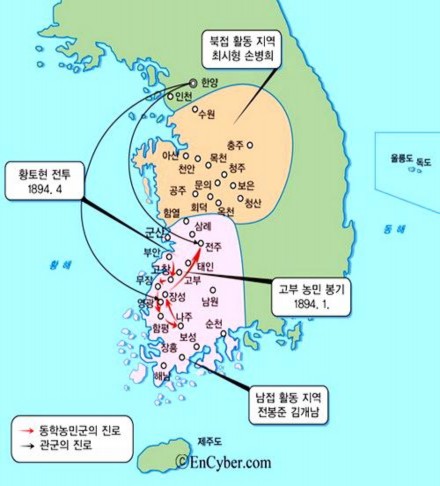
The march of the Donghak peasant army
The army's march
The first uprising ended with a reform proposal by the Peasant Army demanding that the Joseon feudal state implement 12 provisions:
1. Remove the suspicion between Donghak believers and the royal court, cooperate on financial difficulties.
2. Investigate corrupt officials and severely punish them.
3. Strictly punish the rich who profit from the arrogant habit of extorting money from the people.
4. Discipline those of the yangban class (whether officials or not) with poor morals
5. Burn documents related to slavery
6. Revise the treatment of those whose occupations fall under the “Seven Despicable Professions” (Seven Despicable Professions - for example, those serving in offices and those performing labor for the state) and free the Baiding thieves once so that they do not have to wear the P'yongyang (Pyongyang ly) bamboo hat, which is a class-discriminating hat.
7. Allow young widows to remarry
8. Abolish arbitrary and arbitrary taxes
9. When recruiting officials based on local and class discrimination, only talented people should be recruited.
10. Severely punish those who collude with Japan.
11. Cancel all outstanding debts, whether private or public.
12. Distribute land equally to all farmers, everyone has land to cultivate.
Faced with the growing momentum of the Donghak peasant movement, the Joseon feudal state saw the danger of its demise approaching. To deal with this situation, instead of accepting the demands of the reform project proposed by the Donghak peasants, the Joseon feudal state sought help from the Korean army.