
products, have conditions to invest in production, increase value per unit area. On the business side, they have also proactively sourced raw materials, increased product value, increased competitiveness in the market, and produced and traded effectively.
2.1.4. Group of indicators reflecting the "four houses" linkage
Maybe you are interested!
-
 Experience in Foreign Exchange Business Development of Some Banks in the World and Lessons for Vietnam
 -
 Experience in managing retail systems around the world and solutions applied to Vietnam - 11
 -
 Financial support for small and medium enterprises: world experience and lessons for Vietnam - 13
 -
 Experience in developing air transport in some countries in the world and lessons for Vietnam - 10
 -
 Identify Rating Levels and Rating Scales
zt2i3t4l5ee
zt2a3gstourism,quan lan,quang ninh,ecology,ecotourism,minh chau,van don,geography,geographical basis,tourism development,science
zt2a3ge
zc2o3n4t5e6n7ts
of the islanders. Therefore, this indicator will be divided into two sub-indicators:
a1. Natural tourism attractiveness a2. Cultural tourism attractiveness
b. Tourist capacity
The two island communes in Quan Lan have different capacities to receive tourists. Minh Chau Commune is home to many standard hotels and resorts, attracting high-income domestic and international tourists. Meanwhile, Quan Lan Commune has many motels mainly built and operated by local people, so the scale and quality are not high, and will be suitable for ordinary tourists such as students.
c. Time of exploitation of Quan Lan Island Commune:
Quan Lan tourism is seasonal due to weather and climate conditions and festivals only take place on certain days of the year, specifically in spring. In Quan Lan commune, the period from April to June and from September to November is considered the best time to visit Quan Lan because the cultural tourism activities are mainly associated with festivals taking place during this time.
Minh Chau island commune:
Tourism exploitation time is all year round, because this is a place with a number of tourist attractions with diverse ecosystems such as Bai Tu Long National Park Research Center, Tram forest, Turtle Laying Beach, so besides coming to the beach for tourism and vacation in the summer, Minh Chau will attract research groups to come for tourism combined with research at other times of the year.
d. Sustainability
The sustainability of ecotourism sites in Quan Lan and Minh Chau communes depends on the sensitivity of the ecosystems to climate changes.
landscape. In general, these tourist destinations have a fairly high level of sustainability, because they are natural ecosystems, planned and protected. However, if a large number of tourists gather at certain times, it can exceed the carrying capacity and affect the sustainability of the environment (polluted beaches, damaged trees, animals moving away from their habitats, etc.), then the sustainability of the above ecosystems (natural ecosystems, human ecosystems) will also be affected and become less sustainable.
e. Location and accessibility
Both island communes have ports to take tourists to visit from Van Don wharf:
- Quan Lan – Van Don traffic route:
Phuc Thinh – Viet Anh high-speed boat and Quang Minh high-speed boat, depart at 8am and 2pm from Van Don to Quan Lan, and at 7am and 1pm from Quan Lan to Van Don. There are also wooden boats departing at 7am and 1pm.
- Van Don - Minh Chau traffic route:
Chung Huong high-speed train, Minh Chau train, morning 7:30 and afternoon 13:30 from Van Don to Minh Chau, morning 6:30 and afternoon 13:00 from Minh Chau to Van Don.
f. Infrastructure
Despite receiving investment attention, the issue of infrastructure and technical facilities for tourism on Quan Lan Island is still an issue that needs to be resolved because it has a direct impact on the implementation of ecotourism activities. The minimum conditions for serving tourists such as accommodation, electricity, water, communication, especially medical services, and security work need to be given top priority. Ecotourism spots in Minh Chau commune are assessed to have better infrastructure and technical facilities for tourism because there are quite complete and synchronous conditions for serving tourists, meeting many needs of domestic and foreign tourists.
3.2.1.4. Determine assessment levels and assessment scales
Corresponding to the levels of each criterion, the index is the score of those levels in the order of 4, 3, 2, 1 decreasing according to the standard of each level: very attractive (4), attractive (3), average (2), less attractive (1).
3.2.1.5. Determining the coefficients of the criteria
For the assessment of DLST in the two communes of Quan Lan and Minh Chau islands, the students added evaluation coefficients to show the importance of the criteria and indicators as follows:
Coefficient 3 with criteria: Attractiveness, Exploitation time. These are the 2 most important criteria for attracting tourists to tourism in general and eco-tourism in particular, so they have the highest coefficient.
Coefficient 2 with criteria: Capacity, Infrastructure, Location and accessibility . Because the assessment area is an island commune of Van Don district, the above criteria are selected by the author with appropriate coefficients at the average level.
Coefficient 1 with criteria: Sustainability. Quan Lan has natural and human-made ecotourism sites, with high biodiversity and little impact from local human factors. Most of the ecotourism sites are still wild, so they are highly sustainable.
3.2.1.6. Results of DLST assessment on Quan Lan island
a. Assessment of the potential for natural tourism development
For Minh Chau commune:
+ Natural tourism attractiveness is determined to be very attractive (4 points) and the most important coefficient (coefficient 3), so the score of the Attractiveness criterion is 4 x 3 = 12.
+ Capacity is determined as average (2 points) and the coefficient is quite important (coefficient 2), then the score of Capacity criterion is 2 x 2 = 4.
+ Exploitation time is long (4 points), the most important coefficient (coefficient 3) so the score of the Exploitation time criterion is 4 x 3 = 12.
+ Sustainability is determined as sustainable (4 points), the important coefficient is the average coefficient (coefficient 1), so the score of the Sustainability criterion is 4 x 1 = 4 points
+ Location and accessibility are determined to be quite favorable (2 points), the coefficient is quite important (coefficient 2), the criterion score is 2 x 2 = 4 points.
+ Infrastructure is assessed as good (3 points), the coefficient is quite important (coefficient 2), then the score of the Infrastructure criterion is 3 x 2 = 6 points.
The total score for evaluating DLST in Minh Chau commune according to 6 evaluation criteria is determined as: 12 + 4 + 12 + 4 + 4 + 6 = 42 points
Similar assessment for Quan Lan commune, we have the following table:
Table 3.3: Assessment of the potential for natural ecotourism development in Quan Lan and Minh Chau communes
Attractiveness of self-tourismof course
Capacity
Mining time
Sustainability
Location and accessibility
Infrastructure
Result
Point
DarkMulti
Point
DarkMulti
Point
DarkMulti
Point
DarkMulti
Point
DarkMulti
Point
DarkMulti
CommuneMinh Chau
12
12
4
8
12
12
4
4
4
8
6
8
42/52
Quan CommuneLan
6
12
6
8
9
12
4
4
4
8
4
8
33/52
b. Assessment of the potential for humanistic tourism development
For Quan Lan commune:
+ The attractiveness of human tourism is determined to be very attractive (4 points) and the most important coefficient (coefficient 3), so the score of the Attractiveness criterion is 4 x 3 = 12.
+ Capacity is determined to be large (3 points) and the coefficient is quite important (coefficient 2), then the score of the Capacity criterion is 3 x 2 = 6.
+ Mining time is average (3 points), the most important coefficient (coefficient 3) so the score of the Mining time criterion is 3 x 3 = 9.
+ Sustainability is determined as sustainable (4 points), the important coefficient is the average coefficient (coefficient 1), so the score of the Sustainability criterion is 4 x 1 = 4 points.
+ Location and accessibility are determined to be quite favorable (2 points), the coefficient is quite important (coefficient 2), the criterion score is 2 x 2 = 4 points.
+ Infrastructure is rated as average (2 points), the coefficient is quite important (coefficient 2), then the score of the Infrastructure criterion is 2 x 2 = 4 points.
The total score for evaluating DLST in Quan Lan commune according to 6 evaluation criteria is determined as: 12 + 6 + 6 + 4 + 4 + 4 = 36 points.
Similar assessment with Minh Chau commune we have the following table:
Table 3.4: Assessment of the potential for developing humanistic eco-tourism in Quan Lan and Minh Chau communes
Attractiveness of human tourismliterature
Capacity
Mining time
Sustainability
Location and accessibility
Infrastructure
Result
Point
DarkMulti
Point
DarkMulti
Point
DarkMulti
Point
DarkMulti
Point
DarkMulti
Point
DarkMulti
Quan CommuneLan
12
12
6
8
9
12
4
4
4
8
4
8
39/52
Minh CommuneChau
6
12
4
8
12
12
4
4
4
8
6
8
36/52
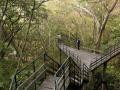
Basically, both Minh Chau and Quan Lan localities have quite favorable conditions for developing ecotourism. However, Quan Lan commune has more advantages to develop ecotourism in a humanistic direction, because this is an area with many famous historical relics such as Quan Lan Communal House, Quan Lan Pagoda, Temple worshiping the hero Tran Khanh Du, ... along with local festivals held annually such as the wind praying ceremony (March 15), Quan Lan festival (June 10-19); due to its location near the port and long exploitation time, the beaches in Quan Lan commune (especially Quan Lan beach) are no longer hygienic and clean to ensure the needs of tourists coming to relax and swim; this is also an area with many beautiful landscapes such as Got Beo wind pass, Ong Phong head, Voi Voi cave, but the ability to access these places is still very limited (dirt hill road, lots of gravel and rocks), especially during rainy and windy times; In addition, other natural resources such as mangrove forests and sea worms have not been really exploited for tourism purposes and ecotourism development. On the contrary, Minh Chau commune has more advantages in developing ecotourism in the direction of natural tourism, this is an area with diverse ecosystems such as at Rua De Beach, Bai Tu Long National Park Conservation Center...; Minh Chau beach is highly appreciated for its natural beauty and cleanliness, ranked in the top ten most beautiful beaches in Vietnam; Minh Chau commune is also home to Tram forest with a large area and a purity of up to 90%, suitable for building bridges through the forest (a very effective type of natural ecotourism currently applied by many countries) for tourists to sightsee, as well as for the purpose of studying and researching.
Figure 3.1: Thenmala Forest Bridge (India) Source: https://www.thenmalaecotourism.com/(August 21, 2019)
3.2.2. Using SWOT matrix to evaluate Quan Lan island tourism
General assessment of current tourism activities of Quan Lan island is shown through the following SWOT matrix:
Table 3.5: SWOT matrix evaluating tourism activities on Quan Lan island
Internal agent
Strengths- There is a lot of potential for tourism development, especially natural ecotourism and humanistic ecotourism.- The unskilled labor force is relatively abundant.- resource environmentunpolluted, still
Weaknesses- Poorly developed infrastructure, especially traffic routes to tourist destinations on the island.- The team of professional staff is still weak.- Tourism products in general
quite wild, originalintact
general and DLST in particularalone is monotonous.
External agents
Opportunity- Tourism is a key industry in the socio-economic development strategy of the province and Van Don economic zone.- Quan Lan was selected as a pilot area for eco-tourism development within the framework of the green growth project between Quang Ninh province and the Japanese organization JICA.- The flow of tourists and especially ecotourism in the world tends toincreasing
Challenge- Weather and climate change abnormally.- Competition in tourism products is increasingly fierce, especially with other localities in the province such as Ha Long, Mong Cai...- Awareness of tourists, especially domestic tourists, about ecotourism and nature conservation is not high.
Through summary analysis using SWOT matrix we see that:
To exploit strengths and take advantage of opportunities, it is necessary to:
- Diversify products and service types (build more tourism routes aimed at specific needs of tourists: experiential tourism immersed in nature, spiritual cultural tourism...)
- Effective exploitation of resources and differentiated products (natural resources and human resources)
div.maincontent .p { color: black; font-family:"Times New Roman", serif; font-style: normal; font-weight: normal; text-decoration: none; font-size: 14pt; margin:0pt; } div.maincontent p { color: black; font-family:"Times New Roman", serif; font-style: normal; font-weight: normal; text-decoration: none; font-size: 14pt; margin:0pt; } div.maincontent .s1 { color: black; font-family:"Times New Roman", serif; font-style: normal; font-weight: normal; text-decoration: none; font-size: 13pt; } div.maincontent .s2 { color: black; font-family:"Times New Roman", serif; font-style: normal; font-weight: normal; text-decoration: none; font-size: 13pt; } div.maincontent .s3 { color: #0D0D0D; font-family:"Times New Roman", serif; font-style: normal; font-weight: bold; text-decoration: none; font-size: 14pt; } div.maincontent .s4 { color: black; font-family:"Times New Roman", serif; font-style: italic; font-weight: normal; text-decoration: none; font-size: 14pt; } div.maincontent .s5 { color: black; font-family:"Times New Roman", serif; font-style: italic; font-weight: bold; text-decoration: none; font-size: 14pt; } div.maincontent .s6 { color: black; font-family:"Times New Roman", serif; font-style: italic; font-weight: normal; text-decoration: none; font-size: 14pt; vertical-align: -3pt; } div.maincontent .s7 { color: black; font-family:"Times New Roman", serif; font-style: italic; font-weight: normal; text-decoration: none; font-size: 14pt; vertical-align: -2pt; } div.maincontent .s8 { color: black; font-family:"Times New Roman", serif; font-style: italic; font-weight: normal; text-decoration: none; font-size: 14pt; vertical-align: -1pt; } div.maincontent .s9 { color: black; font-family:"Times New Roman", serif; font-style: normal; font-weight: normal; text-decoration: none; font-size: 14pt; } div.maincontent .s10 { color: black; font-family:"Times New Roman", serif; font-style: normal; font-weight: bold; text-decoration: none; font-size: 14pt; } div.maincontent .s11 { color: black; font-family:"Times New Roman", serif; font-style: normal; font-weight: normal; text-decoration: none; font-size: 14pt; } div.maincontent .s12 { color: black; font-family:Symbol, serif; font-style: normal; font-weight: normal; text-decoration: none; font-size: 14pt; } div.maincontent .s13 { color: black; font-family:Wingdings; font-style: normal; font-weight: normal; text-decoration: none; font-size: 14pt; } div.maincontent .s14 { color: black; font-family:"Times New Roman", serif; font-style: normal; font-weight: normal; text-decoration: none; font-size: 9pt; vertical-align: 5pt; } div.maincontent .s15 { color: black; font-family:"Times New Roman", serif; font-style: normal; font-weight: normal; text-decoration: none; font-size: 9pt; vertical-align: 5pt; } div.maincontent .s16 { color: black; font-family:Cambria, serif; font-style: italic; font-weight: normal; text-decoration: none; font-size: 14pt; } div.maincontent .s17 { color: #080808; font-family:"Times New Roman", serif; font-style: normal; font-weight: bold; text-decoration: none; font-size: 14pt; } div.maincontent .s18 { color: #080808; font-family:"Times New Roman", serif; font-style: normal; font-weight: normal; text-decoration: none; font-size: 14pt; } div.maincontent .s19 { color: black; font-family:"Times New Roman", serif; font-style: normal; font-weight: normal; text-decoration: none; font-size: 11pt; } div.maincontent .s20 { color: black; font-family:"Times New Roman", serif; font-style: normal; font-weight: normal; text-decoration: none; font-size: 10pt; } div.maincontent .s21 { color: black; font-family:"Times New Roman", serif; font-style: normal; font-weight: bold; text-decoration: none; font-size: 11pt; } div.maincontent .s22 { color: black; font-family:"Times New Roman", serif; font-style: normal; font-weight: normal; text-decoration: none; font-size: 11pt; } div.maincontent .s23 { color: black; font-family:"Times New Roman", serif; font-style: italic; font-weight: normal; text-decoration: none; font-size: 14pt; } div.maincontent .s24 { color: #212121; font-family:"Times New Roman", serif; font-style: normal; font-weight: normal; tex
Identify Rating Levels and Rating Scales
zt2i3t4l5ee
zt2a3gstourism,quan lan,quang ninh,ecology,ecotourism,minh chau,van don,geography,geographical basis,tourism development,science
zt2a3ge
zc2o3n4t5e6n7ts
of the islanders. Therefore, this indicator will be divided into two sub-indicators:
a1. Natural tourism attractiveness a2. Cultural tourism attractiveness
b. Tourist capacity
The two island communes in Quan Lan have different capacities to receive tourists. Minh Chau Commune is home to many standard hotels and resorts, attracting high-income domestic and international tourists. Meanwhile, Quan Lan Commune has many motels mainly built and operated by local people, so the scale and quality are not high, and will be suitable for ordinary tourists such as students.
c. Time of exploitation of Quan Lan Island Commune:
Quan Lan tourism is seasonal due to weather and climate conditions and festivals only take place on certain days of the year, specifically in spring. In Quan Lan commune, the period from April to June and from September to November is considered the best time to visit Quan Lan because the cultural tourism activities are mainly associated with festivals taking place during this time.
Minh Chau island commune:
Tourism exploitation time is all year round, because this is a place with a number of tourist attractions with diverse ecosystems such as Bai Tu Long National Park Research Center, Tram forest, Turtle Laying Beach, so besides coming to the beach for tourism and vacation in the summer, Minh Chau will attract research groups to come for tourism combined with research at other times of the year.
d. Sustainability
The sustainability of ecotourism sites in Quan Lan and Minh Chau communes depends on the sensitivity of the ecosystems to climate changes.
landscape. In general, these tourist destinations have a fairly high level of sustainability, because they are natural ecosystems, planned and protected. However, if a large number of tourists gather at certain times, it can exceed the carrying capacity and affect the sustainability of the environment (polluted beaches, damaged trees, animals moving away from their habitats, etc.), then the sustainability of the above ecosystems (natural ecosystems, human ecosystems) will also be affected and become less sustainable.
e. Location and accessibility
Both island communes have ports to take tourists to visit from Van Don wharf:
- Quan Lan – Van Don traffic route:
Phuc Thinh – Viet Anh high-speed boat and Quang Minh high-speed boat, depart at 8am and 2pm from Van Don to Quan Lan, and at 7am and 1pm from Quan Lan to Van Don. There are also wooden boats departing at 7am and 1pm.
- Van Don - Minh Chau traffic route:
Chung Huong high-speed train, Minh Chau train, morning 7:30 and afternoon 13:30 from Van Don to Minh Chau, morning 6:30 and afternoon 13:00 from Minh Chau to Van Don.
f. Infrastructure
Despite receiving investment attention, the issue of infrastructure and technical facilities for tourism on Quan Lan Island is still an issue that needs to be resolved because it has a direct impact on the implementation of ecotourism activities. The minimum conditions for serving tourists such as accommodation, electricity, water, communication, especially medical services, and security work need to be given top priority. Ecotourism spots in Minh Chau commune are assessed to have better infrastructure and technical facilities for tourism because there are quite complete and synchronous conditions for serving tourists, meeting many needs of domestic and foreign tourists.
3.2.1.4. Determine assessment levels and assessment scales
Corresponding to the levels of each criterion, the index is the score of those levels in the order of 4, 3, 2, 1 decreasing according to the standard of each level: very attractive (4), attractive (3), average (2), less attractive (1).
3.2.1.5. Determining the coefficients of the criteria
For the assessment of DLST in the two communes of Quan Lan and Minh Chau islands, the students added evaluation coefficients to show the importance of the criteria and indicators as follows:
Coefficient 3 with criteria: Attractiveness, Exploitation time. These are the 2 most important criteria for attracting tourists to tourism in general and eco-tourism in particular, so they have the highest coefficient.
Coefficient 2 with criteria: Capacity, Infrastructure, Location and accessibility . Because the assessment area is an island commune of Van Don district, the above criteria are selected by the author with appropriate coefficients at the average level.
Coefficient 1 with criteria: Sustainability. Quan Lan has natural and human-made ecotourism sites, with high biodiversity and little impact from local human factors. Most of the ecotourism sites are still wild, so they are highly sustainable.
3.2.1.6. Results of DLST assessment on Quan Lan island
a. Assessment of the potential for natural tourism development
For Minh Chau commune:
+ Natural tourism attractiveness is determined to be very attractive (4 points) and the most important coefficient (coefficient 3), so the score of the Attractiveness criterion is 4 x 3 = 12.
+ Capacity is determined as average (2 points) and the coefficient is quite important (coefficient 2), then the score of Capacity criterion is 2 x 2 = 4.
+ Exploitation time is long (4 points), the most important coefficient (coefficient 3) so the score of the Exploitation time criterion is 4 x 3 = 12.
+ Sustainability is determined as sustainable (4 points), the important coefficient is the average coefficient (coefficient 1), so the score of the Sustainability criterion is 4 x 1 = 4 points
+ Location and accessibility are determined to be quite favorable (2 points), the coefficient is quite important (coefficient 2), the criterion score is 2 x 2 = 4 points.
+ Infrastructure is assessed as good (3 points), the coefficient is quite important (coefficient 2), then the score of the Infrastructure criterion is 3 x 2 = 6 points.
The total score for evaluating DLST in Minh Chau commune according to 6 evaluation criteria is determined as: 12 + 4 + 12 + 4 + 4 + 6 = 42 points
Similar assessment for Quan Lan commune, we have the following table:
Table 3.3: Assessment of the potential for natural ecotourism development in Quan Lan and Minh Chau communes
Attractiveness of self-tourismof course
Capacity
Mining time
Sustainability
Location and accessibility
Infrastructure
Result
Point
DarkMulti
Point
DarkMulti
Point
DarkMulti
Point
DarkMulti
Point
DarkMulti
Point
DarkMulti
CommuneMinh Chau
12
12
4
8
12
12
4
4
4
8
6
8
42/52
Quan CommuneLan
6
12
6
8
9
12
4
4
4
8
4
8
33/52
b. Assessment of the potential for humanistic tourism development
For Quan Lan commune:
+ The attractiveness of human tourism is determined to be very attractive (4 points) and the most important coefficient (coefficient 3), so the score of the Attractiveness criterion is 4 x 3 = 12.
+ Capacity is determined to be large (3 points) and the coefficient is quite important (coefficient 2), then the score of the Capacity criterion is 3 x 2 = 6.
+ Mining time is average (3 points), the most important coefficient (coefficient 3) so the score of the Mining time criterion is 3 x 3 = 9.
+ Sustainability is determined as sustainable (4 points), the important coefficient is the average coefficient (coefficient 1), so the score of the Sustainability criterion is 4 x 1 = 4 points.
+ Location and accessibility are determined to be quite favorable (2 points), the coefficient is quite important (coefficient 2), the criterion score is 2 x 2 = 4 points.
+ Infrastructure is rated as average (2 points), the coefficient is quite important (coefficient 2), then the score of the Infrastructure criterion is 2 x 2 = 4 points.
The total score for evaluating DLST in Quan Lan commune according to 6 evaluation criteria is determined as: 12 + 6 + 6 + 4 + 4 + 4 = 36 points.
Similar assessment with Minh Chau commune we have the following table:
Table 3.4: Assessment of the potential for developing humanistic eco-tourism in Quan Lan and Minh Chau communes
Attractiveness of human tourismliterature
Capacity
Mining time
Sustainability
Location and accessibility
Infrastructure
Result
Point
DarkMulti
Point
DarkMulti
Point
DarkMulti
Point
DarkMulti
Point
DarkMulti
Point
DarkMulti
Quan CommuneLan
12
12
6
8
9
12
4
4
4
8
4
8
39/52
Minh CommuneChau
6
12
4
8
12
12
4
4
4
8
6
8
36/52
Basically, both Minh Chau and Quan Lan localities have quite favorable conditions for developing ecotourism. However, Quan Lan commune has more advantages to develop ecotourism in a humanistic direction, because this is an area with many famous historical relics such as Quan Lan Communal House, Quan Lan Pagoda, Temple worshiping the hero Tran Khanh Du, ... along with local festivals held annually such as the wind praying ceremony (March 15), Quan Lan festival (June 10-19); due to its location near the port and long exploitation time, the beaches in Quan Lan commune (especially Quan Lan beach) are no longer hygienic and clean to ensure the needs of tourists coming to relax and swim; this is also an area with many beautiful landscapes such as Got Beo wind pass, Ong Phong head, Voi Voi cave, but the ability to access these places is still very limited (dirt hill road, lots of gravel and rocks), especially during rainy and windy times; In addition, other natural resources such as mangrove forests and sea worms have not been really exploited for tourism purposes and ecotourism development. On the contrary, Minh Chau commune has more advantages in developing ecotourism in the direction of natural tourism, this is an area with diverse ecosystems such as at Rua De Beach, Bai Tu Long National Park Conservation Center...; Minh Chau beach is highly appreciated for its natural beauty and cleanliness, ranked in the top ten most beautiful beaches in Vietnam; Minh Chau commune is also home to Tram forest with a large area and a purity of up to 90%, suitable for building bridges through the forest (a very effective type of natural ecotourism currently applied by many countries) for tourists to sightsee, as well as for the purpose of studying and researching.
Figure 3.1: Thenmala Forest Bridge (India) Source: https://www.thenmalaecotourism.com/(August 21, 2019)
3.2.2. Using SWOT matrix to evaluate Quan Lan island tourism
General assessment of current tourism activities of Quan Lan island is shown through the following SWOT matrix:
Table 3.5: SWOT matrix evaluating tourism activities on Quan Lan island
Internal agent
Strengths- There is a lot of potential for tourism development, especially natural ecotourism and humanistic ecotourism.- The unskilled labor force is relatively abundant.- resource environmentunpolluted, still
Weaknesses- Poorly developed infrastructure, especially traffic routes to tourist destinations on the island.- The team of professional staff is still weak.- Tourism products in general
quite wild, originalintact
general and DLST in particularalone is monotonous.
External agents
Opportunity- Tourism is a key industry in the socio-economic development strategy of the province and Van Don economic zone.- Quan Lan was selected as a pilot area for eco-tourism development within the framework of the green growth project between Quang Ninh province and the Japanese organization JICA.- The flow of tourists and especially ecotourism in the world tends toincreasing
Challenge- Weather and climate change abnormally.- Competition in tourism products is increasingly fierce, especially with other localities in the province such as Ha Long, Mong Cai...- Awareness of tourists, especially domestic tourists, about ecotourism and nature conservation is not high.
Through summary analysis using SWOT matrix we see that:
To exploit strengths and take advantage of opportunities, it is necessary to:
- Diversify products and service types (build more tourism routes aimed at specific needs of tourists: experiential tourism immersed in nature, spiritual cultural tourism...)
- Effective exploitation of resources and differentiated products (natural resources and human resources)
div.maincontent .p { color: black; font-family:"Times New Roman", serif; font-style: normal; font-weight: normal; text-decoration: none; font-size: 14pt; margin:0pt; } div.maincontent p { color: black; font-family:"Times New Roman", serif; font-style: normal; font-weight: normal; text-decoration: none; font-size: 14pt; margin:0pt; } div.maincontent .s1 { color: black; font-family:"Times New Roman", serif; font-style: normal; font-weight: normal; text-decoration: none; font-size: 13pt; } div.maincontent .s2 { color: black; font-family:"Times New Roman", serif; font-style: normal; font-weight: normal; text-decoration: none; font-size: 13pt; } div.maincontent .s3 { color: #0D0D0D; font-family:"Times New Roman", serif; font-style: normal; font-weight: bold; text-decoration: none; font-size: 14pt; } div.maincontent .s4 { color: black; font-family:"Times New Roman", serif; font-style: italic; font-weight: normal; text-decoration: none; font-size: 14pt; } div.maincontent .s5 { color: black; font-family:"Times New Roman", serif; font-style: italic; font-weight: bold; text-decoration: none; font-size: 14pt; } div.maincontent .s6 { color: black; font-family:"Times New Roman", serif; font-style: italic; font-weight: normal; text-decoration: none; font-size: 14pt; vertical-align: -3pt; } div.maincontent .s7 { color: black; font-family:"Times New Roman", serif; font-style: italic; font-weight: normal; text-decoration: none; font-size: 14pt; vertical-align: -2pt; } div.maincontent .s8 { color: black; font-family:"Times New Roman", serif; font-style: italic; font-weight: normal; text-decoration: none; font-size: 14pt; vertical-align: -1pt; } div.maincontent .s9 { color: black; font-family:"Times New Roman", serif; font-style: normal; font-weight: normal; text-decoration: none; font-size: 14pt; } div.maincontent .s10 { color: black; font-family:"Times New Roman", serif; font-style: normal; font-weight: bold; text-decoration: none; font-size: 14pt; } div.maincontent .s11 { color: black; font-family:"Times New Roman", serif; font-style: normal; font-weight: normal; text-decoration: none; font-size: 14pt; } div.maincontent .s12 { color: black; font-family:Symbol, serif; font-style: normal; font-weight: normal; text-decoration: none; font-size: 14pt; } div.maincontent .s13 { color: black; font-family:Wingdings; font-style: normal; font-weight: normal; text-decoration: none; font-size: 14pt; } div.maincontent .s14 { color: black; font-family:"Times New Roman", serif; font-style: normal; font-weight: normal; text-decoration: none; font-size: 9pt; vertical-align: 5pt; } div.maincontent .s15 { color: black; font-family:"Times New Roman", serif; font-style: normal; font-weight: normal; text-decoration: none; font-size: 9pt; vertical-align: 5pt; } div.maincontent .s16 { color: black; font-family:Cambria, serif; font-style: italic; font-weight: normal; text-decoration: none; font-size: 14pt; } div.maincontent .s17 { color: #080808; font-family:"Times New Roman", serif; font-style: normal; font-weight: bold; text-decoration: none; font-size: 14pt; } div.maincontent .s18 { color: #080808; font-family:"Times New Roman", serif; font-style: normal; font-weight: normal; text-decoration: none; font-size: 14pt; } div.maincontent .s19 { color: black; font-family:"Times New Roman", serif; font-style: normal; font-weight: normal; text-decoration: none; font-size: 11pt; } div.maincontent .s20 { color: black; font-family:"Times New Roman", serif; font-style: normal; font-weight: normal; text-decoration: none; font-size: 10pt; } div.maincontent .s21 { color: black; font-family:"Times New Roman", serif; font-style: normal; font-weight: bold; text-decoration: none; font-size: 11pt; } div.maincontent .s22 { color: black; font-family:"Times New Roman", serif; font-style: normal; font-weight: normal; text-decoration: none; font-size: 11pt; } div.maincontent .s23 { color: black; font-family:"Times New Roman", serif; font-style: italic; font-weight: normal; text-decoration: none; font-size: 14pt; } div.maincontent .s24 { color: #212121; font-family:"Times New Roman", serif; font-style: normal; font-weight: normal; tex
1. Link participation rate, legitimate link rate, unofficial link rate.
2. Payment method in the link: receive the whole amount after sale, receive a part, receive after many sales, pay in advance.
3. Time to join the link.
4. Comments from the associated entity on the quality of the variety: guaranteed, not guaranteed.
5. Comments from the associated party on the price realized when affiliated: there is an agreement, price is accepted.
6. Loan amount in the association: sufficient or not sufficient.
7. Loan interest rate when linking: high, preferential, normal.
8. Loan term when linking: term, non-term.
9. Forms of borrowing capital when linking: contributing capital, borrowing capital.
10. Loan procedures when linking: cumbersome, convenient.
11. Linking time: early production stage, late production stage, throughout the entire production stage.
12. Link content: experience exchange, technical dissemination.
13. Basis for forming the association: from the needs of the associated object, according to the plan.
14. Relevance of link content: very relevant, relevant, not relevant.
15. Degree of connection: loose, normal, tight.
16. Impact of linkage on production and business results and efficiency: costs, revenue, mixed income, profit.
17. Impact of links on content about seed, food, and fertilizer supply: sufficient quantity, cheap price, guaranteed quality, timely supply, seeds purchased on credit, transportation support.
18. Impact of links on capital supply content: raising large capital
more, higher loan interest rates, timely response to loan needs.
19. Impact of links on disease prevention content: grasping disease prevention information earlier, better understanding of disease prevention, timely disease prevention.
20. Impact of linkage on technology transfer content: improving production knowledge and skills, replicating production models, increasing productivity.
21. Impact of linkage on consumption content: stable consumption volume, stable output price, better access to market information, timely payment, guaranteed products.
22. The needs of the House on the content of the association: seeds, fertilizers, food, capital, techniques, consumption.
23. The need for the Houses to link with the objects (other Houses) in terms of the form of connection and the content of the connection.
2.1.5. Experience in Vietnam and the world on association models
2.1.5.1.In Vietnam
Song Hau Farm
Implementing a model of close linkage between enterprises and farmers, solving the basic steps: providing capital, materials, science and technology and output consumption. This linkage model helps to improve production efficiency, reduce the cost of agricultural products, enhance competitiveness and profit of farmers. The farm provides materials at prices lower than market prices, reducing input costs for farmers, ensuring output for farmers and associated enterprises. The farm organizes a purchasing network, linking with processing and export enterprises. In addition, the farm also links with scientists at schools and institutes to have good and stable sources of seeds; transfer production techniques and agricultural extension through linkages with scientists; advance capital through linkages with
caves and nests
credit institution. As
So, the Farm plays the role of a business.
business - processing - export and the role of a bridge with scientists, banks and other businesses.
Consumption of agricultural products through contracts in An Giang province
Methods of agricultural product consumption contracts in An Giang can be seen as: contracts based on negotiated prices; floor prices; fixed prices; investment contracts and product consumption with fixed prices according to compensation mechanisms; livestock processing contracts. In the "four-house" linkage in An Giang, the role of economic components is highly emphasized.
Lam Son Sugarcane Joint Stock Company (Thanh Hoa)
The company's success in the association is: linking the interests of farmers with businesses; guaranteeing product consumption; solving difficulties in input factors in production by providing agricultural materials through capital advances; helping farmers improve their management capacity, organize production and apply science and technology. This model shows that the association also has the participation of scientists and banks.
Vinamilk Dairy Company
Contract to purchase 100% of raw milk from farmers according to signed contracts. The company invests capital to build raw material areas and technical facilities; supports farmers in technology and veterinary; consumes raw milk for farmers according to a public mechanism and standardizes standards on price and product quality.
Above are effective linkage models in agricultural production. The successes of the above models come from the problem of solving the economic interests of the participating parties.
Lessons learned from these models
Since the implementation of Decision 80/2002-TTg of the Government on signing contracts for agricultural product consumption, many linkage models have operated very effectively such as Lam Son Sugarcane Company, Song Hau Farm, Tan Hung Limited Liability Company in Ho Chi Minh City... Recently, there have been quite successful linkage models. A typical example is Ham Minh Cooperative in Binh Thuan Province, which specializes in producing dragon fruit for export. When it comes to harvest, each batch of the cooperative has exported hundreds of tons to demanding customers. That is the effectiveness of successful linkage. The reason for the above success is due to the close combination between producers and businesses, both producing and exporting. In order to sell products at high prices, they must strive to produce products of correspondingly high quality. Accompanying them, scientists have effectively supported the cooperative through the work of selecting varieties, fertilization techniques, pest control, etc.
Dragon fruit production methods according to VietGap standards, then GlobalGAP, and even lighting techniques, sterilization techniques for dragon fruit... The State has appropriate policies to encourage cooperatives to work hard, effectively utilizing land and labor for clean dragon fruit production.
There are also some highly effective linkage models in the rice export production sector. At My Thanh Cooperative, Cai Lay District, Tien Giang Province, on an area of 157 hectares of high-quality rice production, it was certified to meet GlobalGAP standards in 2008. Currently, the rice production area of this cooperative has expanded to about 500 hectares. On August 21, 2008, the Intellectual Property Office issued a decision to certify the protection of the collective trademark "My Thanh high-quality, safe rice produced according to a safe process". Farmers producing according to this process not only save costs but also sell at a higher price than normal rice, so they earn more profits. The above success is also due to the cooperative playing the role of both "two houses": farmers and businesses. The cooperative is supported by the State through the provincial Department of Agriculture and Rural Development, the provincial Agricultural Extension Center and the active participation of rice and plant protection scientists. When the cooperative cannot solve the output by itself, it links with rice exporting companies to sign purchase and sale contracts. Because the cooperative plays two roles, it is a fairly tight link and proves that in the "four-house" link, farmers and businesses must be the key forces.
A group of farmers in Bui Xa and Nhu Thi, Binh Giang district, Hai Duong province, and Yen Binh Green Technology Joint Stock Company have created a fairly close connection. Yen Binh Company found a partner in Israel who needed to buy high-quality clean rice. The company signed a contract with farmers Nhu Thi and Bui Xa to produce clean rice and consume the products, with a total initial area of 50 hectares (including some other localities). On the scientists' side, the Biogro Center for Microbiological Application Research, which produces microbial fertilizers from straw on farmers' clean rice fields, also participated. This "three-house" connection is quite tightly organized, with the State ensuring stable policies and agricultural and agricultural extension agencies providing guidance on selecting varieties and applying clean rice production techniques. The company is committed to using the Te Do rice variety recommended by the company with farmers, investing in materials for farmers, and after 2-3 years, the microbial straw composting process will be transferred to farmers for them to do it themselves. When harvesting, the company will purchase rice along with straw at a price of
9,000 VND/kg, while normal rice on the market at the same time was only sold for 3,500 VND.
VND/kg. Following the above linkage method, after deducting expenses, farmers have earned a profit of 40 - 42 million VND/ha. Up to now, on this land, there has never been a tree planted after 4 months that has such a profit. I think this is a fairly tight and sustainable linkage model. Although such good linkage models are still few, they are very important nuclei. If the State "breathes more life" and businesses have enough heart and skills, these nuclei will be replicated very quickly. The world rice market is expanding, farmers are assured of production.
In Son La province, a promising model of linking businesses with farmers has emerged. That is the birth of Son La Rubber Joint Stock Company. Its creator is the Vietnam Rubber Industry Group. Farmers contribute land, businesses with investment capital and technology stand up to organize a very special type of joint stock company with a clear and transparent policy regime, as follows:
Every hectare of land used for rubber plantation is converted into 10 million VND in equity capital. However, the land still belongs to the farmers, the red book is held by the farmers. In addition, if there are crops on the land, compensation will be given at the following rates: fruit trees 5 million VND/ha; crops 3 million VND/ha; regenerating forests 2 million VND/ha.
Households with land are recruited into the Company for every hectare of land, one employee on the payroll, and enjoy full benefits of monthly salary, social insurance, health insurance, and other standards of a member of the Company. All family members can participate in labor, doing the work (digging, weeding, fertilizing, security, etc.) and receiving the Company's labor rental price. Currently, if a person has a regular job during the month, he or she can earn about 1.3 million to 1.8 million VND. During the period when rubber trees are growing and have not yet covered the canopy, farmers who contribute land can also intercrop other crops, such as soybeans, potatoes, corn, peanuts, etc., according to the Company's technical instructions. Many households have a fairly large income from this intercropping.
Currently, Son La Rubber Joint Stock Company is continuing to search for suitable lands to expand the area (Tong Lanh commune, Thuan Chau district, Son La has about 300 hectares,...) and at the same time expanding relationships with hundreds of farming households in the province to continue to closely follow the reality with the Provincial Rubber Planting Steering Committee.
Together with businesses and farmers, we will remove obstacles in mechanisms and policies to create a mutually beneficial connection. Land will be damaged if we continue to cultivate short-term crops in the old way.
It can be seen that in the current production and consumption of agricultural products, some linkage models have appeared as follows:
Vertical linkage model, in which enterprises sign contracts directly with farmers, but mainly with farmers with relatively large production scale, capacity and resources. This linkage is based on capital contracts (enterprises invest capital for farmers to build initial facilities or enterprises coordinate with banks to lend capital to people), contracts on raw materials (enterprises support advance agricultural materials for farmers). Enterprises (buyers) strictly control the quantity and quality of agricultural products of households participating in the contract, providing minimum inputs to controlling the entire production process. This model is suitable for agricultural products that need a lot of processing. In this model, enterprises often have specialized technical teams to support and closely supervise the production process of the people. Enterprises often set a stable floor price and purchase price and are changed according to the agreement between the parties (usually more beneficial than the market price). In addition, the company also has risk insurance for the contract.
The model of association between farms and farm workers. State farms are equitized and land is allocated to households. Households are former farm workers and households around the farm area. The outstanding feature of this model is that the enterprise leases land to farmers or the enterprise supports materials and initial capital. The enterprise may have an insurance fund for contract risks for farmers. However, farmers must commit to hand over all products to the enterprise. If not, the enterprise can reclaim the allocated land. The enterprise may have a specialized technical team to support and supervise techniques for farmers.
The business model signs contracts with cooperatives or farmer groups for capital, input materials, and output products. The size and scope of the contract depends on the consumption capacity and capacity of the company. This model involves many different types of agricultural products. Diverse products from short-term crops
(such as rice, vegetables, cotton) to perennial crops (fruit trees, cashew nuts and coffee). This type of contract is very suitable for small-scale farmers producing high-risk agricultural products (such as safe vegetables) and needing to create a brand. In this model, contracts often have an advance investment in materials from the enterprise through the cooperative or farmer group, especially for perennial crops that require large investments. For short-term crops, either the enterprise or the cooperative also makes an advance investment for the cooperative member households.
2.1.5.2. World experience
a) China's experience
Production and consumption of agricultural products through contracts and four-party linkages is a relatively new form in China, but it has developed very rapidly in recent times and has become a tool to encourage more participation of industrial and commercial sectors to promote the development of agricultural production, creating a close link between production - processing and consumption of agricultural products. China calls it "agricultural industrialized business". This is a new type of agricultural business, in which the state coordinates with enterprises and scientists in the pre-production, production and post-production stages of millions of farming households, aiming at the market, improving economic efficiency, implementing the unification of production - processing - consumption, developing agricultural production in the direction of scale, specialization and intensification.
In the agricultural modernization program, the Chinese government has established policies to support and encourage the production and consumption of agricultural products through contracts in order to help the agricultural production sector gain more profits and become competitive. Contract production is considered an effective form to link small-scale farmers with large processing enterprises. Local governments also recognize the potential of contract production in transforming the agricultural structure and increasing farmers' income. Therefore, local governments have implemented many incentive policies such as credit support and tax reduction if contract production is implemented.
To promote contract production and create linkages among the “four houses” in agricultural production, the Chinese government has selected and appointed
Central or local enterprises with economic potential, large scale, technical and technological skills sign direct contracts with farmers. The National Agricultural Industrialisation Development Joint Committee sets standards and supervises the implementation of these enterprises. As a result, contract production between farmers and enterprises accounts for a fairly high proportion. However, the form of contract between farmers and intermediary buyers also accounts for a relatively large proportion. Other forms are village cooperative organizations and cooperatives. Basically, there are four main forms of agricultural industrialization in China:
Firstly, the form of processing and manufacturing enterprises is the subject: that is, enterprises seek domestic and foreign markets and then through the form of signing contracts, agreements, shares... then contact farmers and raw material production areas. In which, enterprises provide services, production orientation, and purchase agricultural products for farmers. Farmers ensure stable raw materials for production enterprises. The State creates conditions for enterprises and farmers to borrow capital, protects the interests of enterprises and farmers against market changes to make enterprises feel secure in investing and farmers feel secure in production.
Second, the form of agricultural cooperatives is the subject: farmer cooperative organizations stand up to contact processing enterprises, agricultural product trading units; on the other hand, organize farmers to produce agricultural products according to the needs of enterprises. They act as a bridge connecting farmers and agricultural product processing and consumption enterprises.
Third, the form of professional farmers' association: this is a form of information sharing, mutual support in terms of capital, production techniques, consumption... among farming households on a voluntary and mutually beneficial basis.
Fourth, the chain form of the wholesale market: in this form, the central nucleus is the wholesale markets and agricultural trading companies. That is, these markets and companies influence farmers to produce separate products, thereby forming specialized areas to provide inputs for their businesses.
Contract production between farmers and intermediary buyers, local authorities, cooperatives and cooperatives is mainly verbal. Prices