
Planning, determining routes, and developing regulations on tourism exploitation require consultation with travel companies.
Tourism businesses are units that organize tourism programs, travel agencies, tourism service providers, travel agencies, individuals, groups, etc. Tourism service providers are businesses that provide tourists with part or all of the tourism product, including:
- Accommodation and catering facilities;
- Transportation facilities;
Maybe you are interested!
-
 Identify Rating Levels and Rating Scales
zt2i3t4l5ee
zt2a3gstourism,quan lan,quang ninh,ecology,ecotourism,minh chau,van don,geography,geographical basis,tourism development,science
zt2a3ge
zc2o3n4t5e6n7ts
of the islanders. Therefore, this indicator will be divided into two sub-indicators:
a1. Natural tourism attractiveness a2. Cultural tourism attractiveness
b. Tourist capacity
The two island communes in Quan Lan have different capacities to receive tourists. Minh Chau Commune is home to many standard hotels and resorts, attracting high-income domestic and international tourists. Meanwhile, Quan Lan Commune has many motels mainly built and operated by local people, so the scale and quality are not high, and will be suitable for ordinary tourists such as students.
c. Time of exploitation of Quan Lan Island Commune:
Quan Lan tourism is seasonal due to weather and climate conditions and festivals only take place on certain days of the year, specifically in spring. In Quan Lan commune, the period from April to June and from September to November is considered the best time to visit Quan Lan because the cultural tourism activities are mainly associated with festivals taking place during this time.
Minh Chau island commune:
Tourism exploitation time is all year round, because this is a place with a number of tourist attractions with diverse ecosystems such as Bai Tu Long National Park Research Center, Tram forest, Turtle Laying Beach, so besides coming to the beach for tourism and vacation in the summer, Minh Chau will attract research groups to come for tourism combined with research at other times of the year.
d. Sustainability
The sustainability of ecotourism sites in Quan Lan and Minh Chau communes depends on the sensitivity of the ecosystems to climate changes.
landscape. In general, these tourist destinations have a fairly high level of sustainability, because they are natural ecosystems, planned and protected. However, if a large number of tourists gather at certain times, it can exceed the carrying capacity and affect the sustainability of the environment (polluted beaches, damaged trees, animals moving away from their habitats, etc.), then the sustainability of the above ecosystems (natural ecosystems, human ecosystems) will also be affected and become less sustainable.
e. Location and accessibility
Both island communes have ports to take tourists to visit from Van Don wharf:
- Quan Lan – Van Don traffic route:
Phuc Thinh – Viet Anh high-speed boat and Quang Minh high-speed boat, depart at 8am and 2pm from Van Don to Quan Lan, and at 7am and 1pm from Quan Lan to Van Don. There are also wooden boats departing at 7am and 1pm.
- Van Don - Minh Chau traffic route:
Chung Huong high-speed train, Minh Chau train, morning 7:30 and afternoon 13:30 from Van Don to Minh Chau, morning 6:30 and afternoon 13:00 from Minh Chau to Van Don.
f. Infrastructure
Despite receiving investment attention, the issue of infrastructure and technical facilities for tourism on Quan Lan Island is still an issue that needs to be resolved because it has a direct impact on the implementation of ecotourism activities. The minimum conditions for serving tourists such as accommodation, electricity, water, communication, especially medical services, and security work need to be given top priority. Ecotourism spots in Minh Chau commune are assessed to have better infrastructure and technical facilities for tourism because there are quite complete and synchronous conditions for serving tourists, meeting many needs of domestic and foreign tourists.
3.2.1.4. Determine assessment levels and assessment scales
Corresponding to the levels of each criterion, the index is the score of those levels in the order of 4, 3, 2, 1 decreasing according to the standard of each level: very attractive (4), attractive (3), average (2), less attractive (1).
3.2.1.5. Determining the coefficients of the criteria
For the assessment of DLST in the two communes of Quan Lan and Minh Chau islands, the students added evaluation coefficients to show the importance of the criteria and indicators as follows:
Coefficient 3 with criteria: Attractiveness, Exploitation time. These are the 2 most important criteria for attracting tourists to tourism in general and eco-tourism in particular, so they have the highest coefficient.
Coefficient 2 with criteria: Capacity, Infrastructure, Location and accessibility . Because the assessment area is an island commune of Van Don district, the above criteria are selected by the author with appropriate coefficients at the average level.
Coefficient 1 with criteria: Sustainability. Quan Lan has natural and human-made ecotourism sites, with high biodiversity and little impact from local human factors. Most of the ecotourism sites are still wild, so they are highly sustainable.
3.2.1.6. Results of DLST assessment on Quan Lan island
a. Assessment of the potential for natural tourism development
For Minh Chau commune:
+ Natural tourism attractiveness is determined to be very attractive (4 points) and the most important coefficient (coefficient 3), so the score of the Attractiveness criterion is 4 x 3 = 12.
+ Capacity is determined as average (2 points) and the coefficient is quite important (coefficient 2), then the score of Capacity criterion is 2 x 2 = 4.
+ Exploitation time is long (4 points), the most important coefficient (coefficient 3) so the score of the Exploitation time criterion is 4 x 3 = 12.
+ Sustainability is determined as sustainable (4 points), the important coefficient is the average coefficient (coefficient 1), so the score of the Sustainability criterion is 4 x 1 = 4 points
+ Location and accessibility are determined to be quite favorable (2 points), the coefficient is quite important (coefficient 2), the criterion score is 2 x 2 = 4 points.
+ Infrastructure is assessed as good (3 points), the coefficient is quite important (coefficient 2), then the score of the Infrastructure criterion is 3 x 2 = 6 points.
The total score for evaluating DLST in Minh Chau commune according to 6 evaluation criteria is determined as: 12 + 4 + 12 + 4 + 4 + 6 = 42 points
Similar assessment for Quan Lan commune, we have the following table:
Table 3.3: Assessment of the potential for natural ecotourism development in Quan Lan and Minh Chau communes
Attractiveness of self-tourismof course
Capacity
Mining time
Sustainability
Location and accessibility
Infrastructure
Result
Point
DarkMulti
Point
DarkMulti
Point
DarkMulti
Point
DarkMulti
Point
DarkMulti
Point
DarkMulti
CommuneMinh Chau
12
12
4
8
12
12
4
4
4
8
6
8
42/52
Quan CommuneLan
6
12
6
8
9
12
4
4
4
8
4
8
33/52
b. Assessment of the potential for humanistic tourism development
For Quan Lan commune:
+ The attractiveness of human tourism is determined to be very attractive (4 points) and the most important coefficient (coefficient 3), so the score of the Attractiveness criterion is 4 x 3 = 12.
+ Capacity is determined to be large (3 points) and the coefficient is quite important (coefficient 2), then the score of the Capacity criterion is 3 x 2 = 6.
+ Mining time is average (3 points), the most important coefficient (coefficient 3) so the score of the Mining time criterion is 3 x 3 = 9.
+ Sustainability is determined as sustainable (4 points), the important coefficient is the average coefficient (coefficient 1), so the score of the Sustainability criterion is 4 x 1 = 4 points.
+ Location and accessibility are determined to be quite favorable (2 points), the coefficient is quite important (coefficient 2), the criterion score is 2 x 2 = 4 points.
+ Infrastructure is rated as average (2 points), the coefficient is quite important (coefficient 2), then the score of the Infrastructure criterion is 2 x 2 = 4 points.
The total score for evaluating DLST in Quan Lan commune according to 6 evaluation criteria is determined as: 12 + 6 + 6 + 4 + 4 + 4 = 36 points.
Similar assessment with Minh Chau commune we have the following table:
Table 3.4: Assessment of the potential for developing humanistic eco-tourism in Quan Lan and Minh Chau communes
Attractiveness of human tourismliterature
Capacity
Mining time
Sustainability
Location and accessibility
Infrastructure
Result
Point
DarkMulti
Point
DarkMulti
Point
DarkMulti
Point
DarkMulti
Point
DarkMulti
Point
DarkMulti
Quan CommuneLan
12
12
6
8
9
12
4
4
4
8
4
8
39/52
Minh CommuneChau
6
12
4
8
12
12
4
4
4
8
6
8
36/52
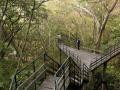
Basically, both Minh Chau and Quan Lan localities have quite favorable conditions for developing ecotourism. However, Quan Lan commune has more advantages to develop ecotourism in a humanistic direction, because this is an area with many famous historical relics such as Quan Lan Communal House, Quan Lan Pagoda, Temple worshiping the hero Tran Khanh Du, ... along with local festivals held annually such as the wind praying ceremony (March 15), Quan Lan festival (June 10-19); due to its location near the port and long exploitation time, the beaches in Quan Lan commune (especially Quan Lan beach) are no longer hygienic and clean to ensure the needs of tourists coming to relax and swim; this is also an area with many beautiful landscapes such as Got Beo wind pass, Ong Phong head, Voi Voi cave, but the ability to access these places is still very limited (dirt hill road, lots of gravel and rocks), especially during rainy and windy times; In addition, other natural resources such as mangrove forests and sea worms have not been really exploited for tourism purposes and ecotourism development. On the contrary, Minh Chau commune has more advantages in developing ecotourism in the direction of natural tourism, this is an area with diverse ecosystems such as at Rua De Beach, Bai Tu Long National Park Conservation Center...; Minh Chau beach is highly appreciated for its natural beauty and cleanliness, ranked in the top ten most beautiful beaches in Vietnam; Minh Chau commune is also home to Tram forest with a large area and a purity of up to 90%, suitable for building bridges through the forest (a very effective type of natural ecotourism currently applied by many countries) for tourists to sightsee, as well as for the purpose of studying and researching.
Figure 3.1: Thenmala Forest Bridge (India) Source: https://www.thenmalaecotourism.com/(August 21, 2019)
3.2.2. Using SWOT matrix to evaluate Quan Lan island tourism
General assessment of current tourism activities of Quan Lan island is shown through the following SWOT matrix:
Table 3.5: SWOT matrix evaluating tourism activities on Quan Lan island
Internal agent
Strengths- There is a lot of potential for tourism development, especially natural ecotourism and humanistic ecotourism.- The unskilled labor force is relatively abundant.- resource environmentunpolluted, still
Weaknesses- Poorly developed infrastructure, especially traffic routes to tourist destinations on the island.- The team of professional staff is still weak.- Tourism products in general
quite wild, originalintact
general and DLST in particularalone is monotonous.
External agents
Opportunity- Tourism is a key industry in the socio-economic development strategy of the province and Van Don economic zone.- Quan Lan was selected as a pilot area for eco-tourism development within the framework of the green growth project between Quang Ninh province and the Japanese organization JICA.- The flow of tourists and especially ecotourism in the world tends toincreasing
Challenge- Weather and climate change abnormally.- Competition in tourism products is increasingly fierce, especially with other localities in the province such as Ha Long, Mong Cai...- Awareness of tourists, especially domestic tourists, about ecotourism and nature conservation is not high.
Through summary analysis using SWOT matrix we see that:
To exploit strengths and take advantage of opportunities, it is necessary to:
- Diversify products and service types (build more tourism routes aimed at specific needs of tourists: experiential tourism immersed in nature, spiritual cultural tourism...)
- Effective exploitation of resources and differentiated products (natural resources and human resources)
div.maincontent .p { color: black; font-family:"Times New Roman", serif; font-style: normal; font-weight: normal; text-decoration: none; font-size: 14pt; margin:0pt; } div.maincontent p { color: black; font-family:"Times New Roman", serif; font-style: normal; font-weight: normal; text-decoration: none; font-size: 14pt; margin:0pt; } div.maincontent .s1 { color: black; font-family:"Times New Roman", serif; font-style: normal; font-weight: normal; text-decoration: none; font-size: 13pt; } div.maincontent .s2 { color: black; font-family:"Times New Roman", serif; font-style: normal; font-weight: normal; text-decoration: none; font-size: 13pt; } div.maincontent .s3 { color: #0D0D0D; font-family:"Times New Roman", serif; font-style: normal; font-weight: bold; text-decoration: none; font-size: 14pt; } div.maincontent .s4 { color: black; font-family:"Times New Roman", serif; font-style: italic; font-weight: normal; text-decoration: none; font-size: 14pt; } div.maincontent .s5 { color: black; font-family:"Times New Roman", serif; font-style: italic; font-weight: bold; text-decoration: none; font-size: 14pt; } div.maincontent .s6 { color: black; font-family:"Times New Roman", serif; font-style: italic; font-weight: normal; text-decoration: none; font-size: 14pt; vertical-align: -3pt; } div.maincontent .s7 { color: black; font-family:"Times New Roman", serif; font-style: italic; font-weight: normal; text-decoration: none; font-size: 14pt; vertical-align: -2pt; } div.maincontent .s8 { color: black; font-family:"Times New Roman", serif; font-style: italic; font-weight: normal; text-decoration: none; font-size: 14pt; vertical-align: -1pt; } div.maincontent .s9 { color: black; font-family:"Times New Roman", serif; font-style: normal; font-weight: normal; text-decoration: none; font-size: 14pt; } div.maincontent .s10 { color: black; font-family:"Times New Roman", serif; font-style: normal; font-weight: bold; text-decoration: none; font-size: 14pt; } div.maincontent .s11 { color: black; font-family:"Times New Roman", serif; font-style: normal; font-weight: normal; text-decoration: none; font-size: 14pt; } div.maincontent .s12 { color: black; font-family:Symbol, serif; font-style: normal; font-weight: normal; text-decoration: none; font-size: 14pt; } div.maincontent .s13 { color: black; font-family:Wingdings; font-style: normal; font-weight: normal; text-decoration: none; font-size: 14pt; } div.maincontent .s14 { color: black; font-family:"Times New Roman", serif; font-style: normal; font-weight: normal; text-decoration: none; font-size: 9pt; vertical-align: 5pt; } div.maincontent .s15 { color: black; font-family:"Times New Roman", serif; font-style: normal; font-weight: normal; text-decoration: none; font-size: 9pt; vertical-align: 5pt; } div.maincontent .s16 { color: black; font-family:Cambria, serif; font-style: italic; font-weight: normal; text-decoration: none; font-size: 14pt; } div.maincontent .s17 { color: #080808; font-family:"Times New Roman", serif; font-style: normal; font-weight: bold; text-decoration: none; font-size: 14pt; } div.maincontent .s18 { color: #080808; font-family:"Times New Roman", serif; font-style: normal; font-weight: normal; text-decoration: none; font-size: 14pt; } div.maincontent .s19 { color: black; font-family:"Times New Roman", serif; font-style: normal; font-weight: normal; text-decoration: none; font-size: 11pt; } div.maincontent .s20 { color: black; font-family:"Times New Roman", serif; font-style: normal; font-weight: normal; text-decoration: none; font-size: 10pt; } div.maincontent .s21 { color: black; font-family:"Times New Roman", serif; font-style: normal; font-weight: bold; text-decoration: none; font-size: 11pt; } div.maincontent .s22 { color: black; font-family:"Times New Roman", serif; font-style: normal; font-weight: normal; text-decoration: none; font-size: 11pt; } div.maincontent .s23 { color: black; font-family:"Times New Roman", serif; font-style: italic; font-weight: normal; text-decoration: none; font-size: 14pt; } div.maincontent .s24 { color: #212121; font-family:"Times New Roman", serif; font-style: normal; font-weight: normal; tex
Identify Rating Levels and Rating Scales
zt2i3t4l5ee
zt2a3gstourism,quan lan,quang ninh,ecology,ecotourism,minh chau,van don,geography,geographical basis,tourism development,science
zt2a3ge
zc2o3n4t5e6n7ts
of the islanders. Therefore, this indicator will be divided into two sub-indicators:
a1. Natural tourism attractiveness a2. Cultural tourism attractiveness
b. Tourist capacity
The two island communes in Quan Lan have different capacities to receive tourists. Minh Chau Commune is home to many standard hotels and resorts, attracting high-income domestic and international tourists. Meanwhile, Quan Lan Commune has many motels mainly built and operated by local people, so the scale and quality are not high, and will be suitable for ordinary tourists such as students.
c. Time of exploitation of Quan Lan Island Commune:
Quan Lan tourism is seasonal due to weather and climate conditions and festivals only take place on certain days of the year, specifically in spring. In Quan Lan commune, the period from April to June and from September to November is considered the best time to visit Quan Lan because the cultural tourism activities are mainly associated with festivals taking place during this time.
Minh Chau island commune:
Tourism exploitation time is all year round, because this is a place with a number of tourist attractions with diverse ecosystems such as Bai Tu Long National Park Research Center, Tram forest, Turtle Laying Beach, so besides coming to the beach for tourism and vacation in the summer, Minh Chau will attract research groups to come for tourism combined with research at other times of the year.
d. Sustainability
The sustainability of ecotourism sites in Quan Lan and Minh Chau communes depends on the sensitivity of the ecosystems to climate changes.
landscape. In general, these tourist destinations have a fairly high level of sustainability, because they are natural ecosystems, planned and protected. However, if a large number of tourists gather at certain times, it can exceed the carrying capacity and affect the sustainability of the environment (polluted beaches, damaged trees, animals moving away from their habitats, etc.), then the sustainability of the above ecosystems (natural ecosystems, human ecosystems) will also be affected and become less sustainable.
e. Location and accessibility
Both island communes have ports to take tourists to visit from Van Don wharf:
- Quan Lan – Van Don traffic route:
Phuc Thinh – Viet Anh high-speed boat and Quang Minh high-speed boat, depart at 8am and 2pm from Van Don to Quan Lan, and at 7am and 1pm from Quan Lan to Van Don. There are also wooden boats departing at 7am and 1pm.
- Van Don - Minh Chau traffic route:
Chung Huong high-speed train, Minh Chau train, morning 7:30 and afternoon 13:30 from Van Don to Minh Chau, morning 6:30 and afternoon 13:00 from Minh Chau to Van Don.
f. Infrastructure
Despite receiving investment attention, the issue of infrastructure and technical facilities for tourism on Quan Lan Island is still an issue that needs to be resolved because it has a direct impact on the implementation of ecotourism activities. The minimum conditions for serving tourists such as accommodation, electricity, water, communication, especially medical services, and security work need to be given top priority. Ecotourism spots in Minh Chau commune are assessed to have better infrastructure and technical facilities for tourism because there are quite complete and synchronous conditions for serving tourists, meeting many needs of domestic and foreign tourists.
3.2.1.4. Determine assessment levels and assessment scales
Corresponding to the levels of each criterion, the index is the score of those levels in the order of 4, 3, 2, 1 decreasing according to the standard of each level: very attractive (4), attractive (3), average (2), less attractive (1).
3.2.1.5. Determining the coefficients of the criteria
For the assessment of DLST in the two communes of Quan Lan and Minh Chau islands, the students added evaluation coefficients to show the importance of the criteria and indicators as follows:
Coefficient 3 with criteria: Attractiveness, Exploitation time. These are the 2 most important criteria for attracting tourists to tourism in general and eco-tourism in particular, so they have the highest coefficient.
Coefficient 2 with criteria: Capacity, Infrastructure, Location and accessibility . Because the assessment area is an island commune of Van Don district, the above criteria are selected by the author with appropriate coefficients at the average level.
Coefficient 1 with criteria: Sustainability. Quan Lan has natural and human-made ecotourism sites, with high biodiversity and little impact from local human factors. Most of the ecotourism sites are still wild, so they are highly sustainable.
3.2.1.6. Results of DLST assessment on Quan Lan island
a. Assessment of the potential for natural tourism development
For Minh Chau commune:
+ Natural tourism attractiveness is determined to be very attractive (4 points) and the most important coefficient (coefficient 3), so the score of the Attractiveness criterion is 4 x 3 = 12.
+ Capacity is determined as average (2 points) and the coefficient is quite important (coefficient 2), then the score of Capacity criterion is 2 x 2 = 4.
+ Exploitation time is long (4 points), the most important coefficient (coefficient 3) so the score of the Exploitation time criterion is 4 x 3 = 12.
+ Sustainability is determined as sustainable (4 points), the important coefficient is the average coefficient (coefficient 1), so the score of the Sustainability criterion is 4 x 1 = 4 points
+ Location and accessibility are determined to be quite favorable (2 points), the coefficient is quite important (coefficient 2), the criterion score is 2 x 2 = 4 points.
+ Infrastructure is assessed as good (3 points), the coefficient is quite important (coefficient 2), then the score of the Infrastructure criterion is 3 x 2 = 6 points.
The total score for evaluating DLST in Minh Chau commune according to 6 evaluation criteria is determined as: 12 + 4 + 12 + 4 + 4 + 6 = 42 points
Similar assessment for Quan Lan commune, we have the following table:
Table 3.3: Assessment of the potential for natural ecotourism development in Quan Lan and Minh Chau communes
Attractiveness of self-tourismof course
Capacity
Mining time
Sustainability
Location and accessibility
Infrastructure
Result
Point
DarkMulti
Point
DarkMulti
Point
DarkMulti
Point
DarkMulti
Point
DarkMulti
Point
DarkMulti
CommuneMinh Chau
12
12
4
8
12
12
4
4
4
8
6
8
42/52
Quan CommuneLan
6
12
6
8
9
12
4
4
4
8
4
8
33/52
b. Assessment of the potential for humanistic tourism development
For Quan Lan commune:
+ The attractiveness of human tourism is determined to be very attractive (4 points) and the most important coefficient (coefficient 3), so the score of the Attractiveness criterion is 4 x 3 = 12.
+ Capacity is determined to be large (3 points) and the coefficient is quite important (coefficient 2), then the score of the Capacity criterion is 3 x 2 = 6.
+ Mining time is average (3 points), the most important coefficient (coefficient 3) so the score of the Mining time criterion is 3 x 3 = 9.
+ Sustainability is determined as sustainable (4 points), the important coefficient is the average coefficient (coefficient 1), so the score of the Sustainability criterion is 4 x 1 = 4 points.
+ Location and accessibility are determined to be quite favorable (2 points), the coefficient is quite important (coefficient 2), the criterion score is 2 x 2 = 4 points.
+ Infrastructure is rated as average (2 points), the coefficient is quite important (coefficient 2), then the score of the Infrastructure criterion is 2 x 2 = 4 points.
The total score for evaluating DLST in Quan Lan commune according to 6 evaluation criteria is determined as: 12 + 6 + 6 + 4 + 4 + 4 = 36 points.
Similar assessment with Minh Chau commune we have the following table:
Table 3.4: Assessment of the potential for developing humanistic eco-tourism in Quan Lan and Minh Chau communes
Attractiveness of human tourismliterature
Capacity
Mining time
Sustainability
Location and accessibility
Infrastructure
Result
Point
DarkMulti
Point
DarkMulti
Point
DarkMulti
Point
DarkMulti
Point
DarkMulti
Point
DarkMulti
Quan CommuneLan
12
12
6
8
9
12
4
4
4
8
4
8
39/52
Minh CommuneChau
6
12
4
8
12
12
4
4
4
8
6
8
36/52
Basically, both Minh Chau and Quan Lan localities have quite favorable conditions for developing ecotourism. However, Quan Lan commune has more advantages to develop ecotourism in a humanistic direction, because this is an area with many famous historical relics such as Quan Lan Communal House, Quan Lan Pagoda, Temple worshiping the hero Tran Khanh Du, ... along with local festivals held annually such as the wind praying ceremony (March 15), Quan Lan festival (June 10-19); due to its location near the port and long exploitation time, the beaches in Quan Lan commune (especially Quan Lan beach) are no longer hygienic and clean to ensure the needs of tourists coming to relax and swim; this is also an area with many beautiful landscapes such as Got Beo wind pass, Ong Phong head, Voi Voi cave, but the ability to access these places is still very limited (dirt hill road, lots of gravel and rocks), especially during rainy and windy times; In addition, other natural resources such as mangrove forests and sea worms have not been really exploited for tourism purposes and ecotourism development. On the contrary, Minh Chau commune has more advantages in developing ecotourism in the direction of natural tourism, this is an area with diverse ecosystems such as at Rua De Beach, Bai Tu Long National Park Conservation Center...; Minh Chau beach is highly appreciated for its natural beauty and cleanliness, ranked in the top ten most beautiful beaches in Vietnam; Minh Chau commune is also home to Tram forest with a large area and a purity of up to 90%, suitable for building bridges through the forest (a very effective type of natural ecotourism currently applied by many countries) for tourists to sightsee, as well as for the purpose of studying and researching.
Figure 3.1: Thenmala Forest Bridge (India) Source: https://www.thenmalaecotourism.com/(August 21, 2019)
3.2.2. Using SWOT matrix to evaluate Quan Lan island tourism
General assessment of current tourism activities of Quan Lan island is shown through the following SWOT matrix:
Table 3.5: SWOT matrix evaluating tourism activities on Quan Lan island
Internal agent
Strengths- There is a lot of potential for tourism development, especially natural ecotourism and humanistic ecotourism.- The unskilled labor force is relatively abundant.- resource environmentunpolluted, still
Weaknesses- Poorly developed infrastructure, especially traffic routes to tourist destinations on the island.- The team of professional staff is still weak.- Tourism products in general
quite wild, originalintact
general and DLST in particularalone is monotonous.
External agents
Opportunity- Tourism is a key industry in the socio-economic development strategy of the province and Van Don economic zone.- Quan Lan was selected as a pilot area for eco-tourism development within the framework of the green growth project between Quang Ninh province and the Japanese organization JICA.- The flow of tourists and especially ecotourism in the world tends toincreasing
Challenge- Weather and climate change abnormally.- Competition in tourism products is increasingly fierce, especially with other localities in the province such as Ha Long, Mong Cai...- Awareness of tourists, especially domestic tourists, about ecotourism and nature conservation is not high.
Through summary analysis using SWOT matrix we see that:
To exploit strengths and take advantage of opportunities, it is necessary to:
- Diversify products and service types (build more tourism routes aimed at specific needs of tourists: experiential tourism immersed in nature, spiritual cultural tourism...)
- Effective exploitation of resources and differentiated products (natural resources and human resources)
div.maincontent .p { color: black; font-family:"Times New Roman", serif; font-style: normal; font-weight: normal; text-decoration: none; font-size: 14pt; margin:0pt; } div.maincontent p { color: black; font-family:"Times New Roman", serif; font-style: normal; font-weight: normal; text-decoration: none; font-size: 14pt; margin:0pt; } div.maincontent .s1 { color: black; font-family:"Times New Roman", serif; font-style: normal; font-weight: normal; text-decoration: none; font-size: 13pt; } div.maincontent .s2 { color: black; font-family:"Times New Roman", serif; font-style: normal; font-weight: normal; text-decoration: none; font-size: 13pt; } div.maincontent .s3 { color: #0D0D0D; font-family:"Times New Roman", serif; font-style: normal; font-weight: bold; text-decoration: none; font-size: 14pt; } div.maincontent .s4 { color: black; font-family:"Times New Roman", serif; font-style: italic; font-weight: normal; text-decoration: none; font-size: 14pt; } div.maincontent .s5 { color: black; font-family:"Times New Roman", serif; font-style: italic; font-weight: bold; text-decoration: none; font-size: 14pt; } div.maincontent .s6 { color: black; font-family:"Times New Roman", serif; font-style: italic; font-weight: normal; text-decoration: none; font-size: 14pt; vertical-align: -3pt; } div.maincontent .s7 { color: black; font-family:"Times New Roman", serif; font-style: italic; font-weight: normal; text-decoration: none; font-size: 14pt; vertical-align: -2pt; } div.maincontent .s8 { color: black; font-family:"Times New Roman", serif; font-style: italic; font-weight: normal; text-decoration: none; font-size: 14pt; vertical-align: -1pt; } div.maincontent .s9 { color: black; font-family:"Times New Roman", serif; font-style: normal; font-weight: normal; text-decoration: none; font-size: 14pt; } div.maincontent .s10 { color: black; font-family:"Times New Roman", serif; font-style: normal; font-weight: bold; text-decoration: none; font-size: 14pt; } div.maincontent .s11 { color: black; font-family:"Times New Roman", serif; font-style: normal; font-weight: normal; text-decoration: none; font-size: 14pt; } div.maincontent .s12 { color: black; font-family:Symbol, serif; font-style: normal; font-weight: normal; text-decoration: none; font-size: 14pt; } div.maincontent .s13 { color: black; font-family:Wingdings; font-style: normal; font-weight: normal; text-decoration: none; font-size: 14pt; } div.maincontent .s14 { color: black; font-family:"Times New Roman", serif; font-style: normal; font-weight: normal; text-decoration: none; font-size: 9pt; vertical-align: 5pt; } div.maincontent .s15 { color: black; font-family:"Times New Roman", serif; font-style: normal; font-weight: normal; text-decoration: none; font-size: 9pt; vertical-align: 5pt; } div.maincontent .s16 { color: black; font-family:Cambria, serif; font-style: italic; font-weight: normal; text-decoration: none; font-size: 14pt; } div.maincontent .s17 { color: #080808; font-family:"Times New Roman", serif; font-style: normal; font-weight: bold; text-decoration: none; font-size: 14pt; } div.maincontent .s18 { color: #080808; font-family:"Times New Roman", serif; font-style: normal; font-weight: normal; text-decoration: none; font-size: 14pt; } div.maincontent .s19 { color: black; font-family:"Times New Roman", serif; font-style: normal; font-weight: normal; text-decoration: none; font-size: 11pt; } div.maincontent .s20 { color: black; font-family:"Times New Roman", serif; font-style: normal; font-weight: normal; text-decoration: none; font-size: 10pt; } div.maincontent .s21 { color: black; font-family:"Times New Roman", serif; font-style: normal; font-weight: bold; text-decoration: none; font-size: 11pt; } div.maincontent .s22 { color: black; font-family:"Times New Roman", serif; font-style: normal; font-weight: normal; text-decoration: none; font-size: 11pt; } div.maincontent .s23 { color: black; font-family:"Times New Roman", serif; font-style: italic; font-weight: normal; text-decoration: none; font-size: 14pt; } div.maincontent .s24 { color: #212121; font-family:"Times New Roman", serif; font-style: normal; font-weight: normal; tex -
 Korea's experience in developing small and medium enterprises and lessons learned for Vietnam - 14
 -
 Managing math teaching activities towards developing capacity for first graders in primary schools in District 10, Ho Chi Minh City - 1
 -
 Necessary Conditions for Developing Ecotourism
 -
 Solutions for managing and exploiting ecotourism in Vietnam's national parks towards sustainable development: Case study of Cuc Phuong National Park - 20
- Entertainment services (festive season);
- Additional services.
Tourism businesses play a huge role in bringing tourists to the National Park and providing them with rewarding and effective trips. It can be said that all tourism revenue of any location is mainly brought by tourists. Thus, the more tourists increase, the more economic benefits for the tourist destination increase.
Group related to tourism resources
Tourism resources are an important decisive factor in tourism development. Tourism resources are a special form of nature in general, it is always associated with the concept of tourism. Tourism resources are natural landscapes, historical relics, revolutionary relics, cultural values, creative works of human labor that can be used to satisfy tourism needs, which are the basic factors to form tourist spots and tourist areas to create attraction for tourists.
In the development of ecotourism, tourism resources play a decisive role. Only places with rich resources and diverse ecosystems will have higher attractiveness and efficiency of tourism activities.
Tourist related groups
Tourists coming to the National Park not only visit the natural landscapes but also come to enjoy the cool, refreshing air after stressful working hours or during holidays. In part, they want to learn about the role and significance of
forests, trees and animals, the importance of conservation, thereby creating more awareness and responsibility for natural resources. In addition, when there are tourism activities, infrastructure and facilities are improved and upgraded and tourists will enjoy some of the services brought by tourism activities.
The main ecotourism activities that visitors often use are visiting nature trails, admiring the amazing natural landscapes, observing wildlife, participating in environmental education activities organized by the park, etc.
1.4. Experience in developing ecotourism and managing national parks in the world
1.4.1. Experience in developing ecotourism
1.4.1.1. Ecotourism in Galápagos National Park – Ecuador [56][72]
The Galápagos Islands of Ecuador, located in the Pacific Ocean about 1,000 km from the South American mainland, consist of 19 large islands, more than 107 small islands and rocky shores and a marine reserve that is known as a unique “living museum and showcase of evolution”. The islands form an area of 1,009 km 2 of land , of which 97% is part of the Galápagos National Park; and an additional 1,000 km 2 of sea protected in the marine reserve. In addition to reflecting the stages of formation and development of the Earth's history, the Galápagos Islands also reflect important changes in ecosystems and biota as well as changes in natural habitats to form biodiversity on earth.
In 1944 the Ecuadorian government established the Natural Wildlife Reserve, and in 1966 the hunting of certain species was officially banned. In 1959, after a vigorous campaign by a group of prominent scientists, the Galápagos National Park was established and Charles Darwin gave birth to the Galápagos Islands. In 1977, UNESCO recognized the Galápagos National Park archipelago as a World Heritage Site, and in 19 it was recognized as a Biosphere Reserve. In 1966, the Galápagos Marine Reserve was established, and in 1990 it was recognized as a whale sanctuary. Month
/199, a set of laws specific to the Galápagos was established as the basis for the formation of
The Galápagos Marine Reserve includes the inland waters plus waters within about 40 miles of the shorelines of the various islands.
Tourism began in this island region in 1969 when two travel companies,
etropolitan Touring and Turismundial, were contacted by Lars Eric Lindblad and other cruise ship operators (Southgate and Whitaker,1992). The first ship, the “Lina A” arrived in the islands in 1969 and since then tourist activities have increased steadily.
Although there were less than 1,000 visitors in 1970, the number of visitors increased to more than 66,000 in 1999.
Since 1977, the Galápagos National Park Management Board has set a maximum of 12,000 visitors per year on the islands. This number has increased several times as demand has increased. There is now no limit to the total number of visitors allowed to visit the Galápagos Islands. Instead, visitor capacity limits for each terrestrial attraction are in place, a key tool for effective conservation and management of the sites. The methodology for determining visitor capacity was first applied in 194 and was then refined and partially implemented in 1991. This capacity is determined after studying a number of factors, including: duration, length of visit, available area, susceptibility to erosion, group size, sediment and tidal patterns, and management capacity.
Subsequently, many new measures and regulations were applied to further enhance the effectiveness of nature conservation and environmental protection in the archipelago, such as: establishing a system of standards and regulations on management and supervision of tourist attractions; training and licensing of tour guides; requiring tour guides to ensure order and safety for tourists, manage tourists, avoid possible negative impacts on the nature and ecosystem of Galapagos, provide detailed tourist information about Galapagos; building a system to synthesize and process information using electronic computers... Whenever visiting specific sites in Galapagos, visitors must commit not to harm the environment, flora and fauna of the archipelago and must be under the supervision of trained and certified tour guides.
The Galápagos NP charges entrance fees, or tours, for visitors at different rates determined by the Special Law for the Conservation and Sustainable Development of the Galápagos Islands, for example: the entrance fee for the National Park for international visitors is 100 USD, for Ecuadorian citizens or residents is 6 USD…
Ecotourism in the Galápagos NP provides important sources of funding for the management and conservation of the biodiversity values of the site through the allocation of revenues from visitor fees, of which 4% is directly allocated to the Management Board of the Galápagos NP and the marine reserve. Through visitor fees, tourism today makes an important economic contribution to the archipelago. Tourism can contribute to the preservation of traditions and increase the economic benefits of conservation, and the experience of developing ecotourism in the Galápagos is a testament to this.
1.4.1.2. Ecotourism in Annapurna Conservation Area – Nepal [56][74]
Nepal has nearly four decades of experience in tourism development, and tourism is the main source of foreign exchange for Nepal. Initially, tourism activities were concentrated in the Katzmandu valley. In the following years, areas such as Annapurna, Everest and Langtang became popular trekking destinations for organized trekkers (OGTs) and later for independent trekkers (FITs). The increase in the number of FITs led to a rapid increase in tea houses and homestays along all major trekking routes in the mountainous regions. This forever changed the nature and impact of tourism on the country. In 1990, tourism brought Nepal $124 million, contributing 1.5% of the country's GDP.
The Annapurna Conservation Area Tourism Development Project is a successful example of combining ecotourism development with community participation.
The Annapurna region is one of the most popular trekking destinations for tourists. The conservation project for the region was initiated in 196 with a small project in Ghanduk village, aiming to minimize negative impacts and maximize positive impacts of tourism on the local ecosystem, economy and culture. The project has assisted the Government of Nepal in
The establishment of many plant nurseries to serve the new planting and reforestation programs, to end the degradation of forest resources. In addition, local people are involved in special forestry training programs and enjoy special rights in the use of forest resources if they sign a commitment to protect the forest. This is followed by activities to gradually replace traditional fuel and energy sources with new fuel and energy sources. The use of firewood has been gradually replaced by solar energy, and small hydroelectric systems are owned by the community.
People in the conservation area have gradually abandoned their traditional lifestyles, replacing them with activities that are beneficial to the environment. Along the mountain slopes and trails, people here have removed animal barns and replaced them with “clean” tea shops and motels. Here, visitors will be provided with free information about tourism, as well as advice on strict regulations in protecting resources and the environment in the area.
Another issue is solid waste management. At the Annapurna Reserve, each lodge has two waste pits: one for biodegradable or burnable materials, the other for non-biodegradable materials, which makes it easier for environmental workers to separate and take appropriate measures for disposal. In addition, local officials, students and villagers are often seen cleaning up, collecting trash, draining surface water, and renovating tourist sites, especially at the end of the tourist season.
In 1999, the Government of Nepal decided to charge a fee to visit the Annapurna Conservation Area, at 1000 rupees per person for a 7-day tour. All of this money is reinvested directly into the conservation area, of which 40-60% is spent on management and development of activities for residents in the buffer zone.
The Annapurna Conservation Area Ecotourism Project (ACAP) also plans to develop two separate ecotourism zones. The first zone will focus on natural ecotourism, the second zone will combine both natural and cultural tourism activities. Homestays will be located at suitable distances to allow for control of tourist numbers.
The two ecotourism areas are designed to encourage visitors to visit the two sites rather than to stay in all areas within the two sites. It is hoped that visitors will feel a sense of responsibility to preserve the natural and cultural environment, as well as a greater sense of safety and comfort while visiting the two sites. Ultimately, ACAP hopes that the two ecotourism areas will serve as models for sustainable tourism management not only in Annapurna but also throughout Nepal.
To date, the “Towards Local Communities” program, a lesson in tourism development with the participation of local communities in Nepal, is a typical example of the initial success of sustainable ecotourism development. Nepal’s experience shows that if the interests of local people are integrated with the tourism development process, it will not only determine the success of conservation efforts but also be important in maintaining those efforts.
1.4.1. . Ecotourism in Maasai Mara National Park – Kenya [56][73]
The Republic of Kenya is a country in East Africa, located in the tropical climate zone and varies by region, the coastal climate is tropical, and the inland climate is continental. Kenya is also considered the "cradle of mankind", is one of the world's major tourist destinations, famous and attractive for the diversity of wild flora and fauna, natural landscapes and traditional cultural values.
Kenya is like a giant national park. There are more than 65 national parks and wildlife reserves throughout the country. The wildlife in each region is different. Many of the native African flora cannot be found anywhere else but Kenya.
Ecotourism development is being viewed by tourism professionals in Kenya in particular and Africa in general as a serious new idea for economic growth, contributing to creating a sustainable macroeconomic environment for investment, development, job creation, factors that contribute to generating revenue and improving the lives of African people and bringing hope for a bright future for the black continent. one of
The most successful ecotourism projects are those implemented in Aasai province.
Kenyan ara.
Maasai Mara National Park is located in southwestern Kenya (the northern extension of Tanzania's Serengeti Nature Reserve) with an area of about 1,000 square kilometers . This is the main attraction for international tourists and the main source of foreign currency for the country... Here, for two days, visitors are taken on a tour around the ara savanna by specialized vehicles with open roofs for easy photography and filming, but absolutely safe if they are attacked by wild animals. They can see hundreds of zebras, antelopes, wildebeests, elephants, leopards,
hyenas, giraffes, rhinos..., and if lucky, there is a chance to see a whole family of lions hunting and "enjoying" their hunted meal together... and easily taking pictures of them. The management and development of ecotourism in this national park is carried out through specific tasks:
- Control the number of visitors and contribute to the local budget. Every year, aasai ara attracts about 220 thousand visitors to visit and relax. To control and manage this number of tourists in accordance with the capacity of the reserve, the Management Board and local authorities have applied measures to increase the fee for visiting the reserve from 1 USD/adult and 7 USD/child to the same level of 60 USD/visitor and not exceeding 24 hours. This regulation on collection levels has contributed to reducing the overload of visitors at a time, and contributed to creating a source of income for the Management Board and local budget, of which a part of this income is directly allocated for conservation activities and especially building schools for aasai children.
- Use alternative energy sources - Solar energy The accommodation facilities at aasai ara are designed in the form of canvas tents hidden under the forest canopy, each tent has 2 beds placed on a brick floor supported by wooden poles. In the tent, only the toilet is built of bricks and stones. The overall architecture of these tents is very harmonious with the natural landscape and surrounding environment. The accommodation facilities here all use solar energy to
lighting and living services. In addition to solar energy projects, investment projects to develop alternative energy sources by recycling organic waste into briquettes are also widely deployed in the community.
aasai. This has contributed to reducing deforestation activities for raw materials and firewood.
- Waste management The amount of solid and liquid waste from the eco-lodges in the national park has been a headache for Kenyan environmental and tourism managers for many years until the country received support from the European Community for a waste sorting and recycling project. Waste from the lodges and restaurant and kitchen areas within the tourist area is collected at a point, where the sorting process begins: organic waste is recycled into biological detergents, the wastewater after being treated and filtered is partly returned to natural surface water sources and partly is drained for use in construction sites for houses and schools for ethnic minority children.
- Protecting clean water - a rare and extremely expensive commodity in semi-arid protected areas like aasai ara. Proposed initiatives range from simple activities such as encouraging guests to reuse towels to more stringent measures such as limiting water use at certain times of the day, installing low-pressure showerheads and collecting and reusing rainwater. In addition, cooperative programs between homestay owners and local communities in projects to re-vegetate bare land, plant forests... to prevent erosion and protect the soil.
- Resolving human-wildlife conflicts. Until the advent of ecotourism, humans and wild animals and plants on the Ara plains still coexisted. The Aasai community, through many generations, taught each other ways to survive and fight wild animals by painting their bodies, creating brave dances... to ward off wild animals. However, to ensure the safety of not only the community but also tourists, the construction of