
Figure 4.1 shows the first axial free vibration frequency of three types of material pipes, with the double-end clamp boundary condition (CC). In which, Figure 4.1 a, b, c are of armchair pipes and d, e, f are of zigzag pipes. Through the figures, it can be seen that, with the double-end clamp boundary condition, the axial vibration frequency is proportional to the pipe diameter, the diameter increases, the frequency increases. This trend is also consistent with the research results of SS Gupta, RC Batra 2008 [49] (formula number 3).
The frequency increase process is similar for all three materials and for both zigzag and armchair tubes. The frequency increases rapidly at the small tube diameter stage (1.0 nm – 1.5 nm), then increases more slowly at large tube diameters. This is consistent with the previous research results of ND School [1] (Figure 4.2) on the change of elastic modulus with tube diameter. In which, the elastic modulus increases rapidly at small tube diameters while the density of the structure is assumed to be constant according to the research of Gupta, RC Batra (2008) [49]
In the small tube diameter stage of 1.0-1.5 nm, the frequency increase reached 90% of the total value. In which, the frequency of carbon nanotubes (CNTs) always has the largest value, specifically, about 16% larger than the frequency of BN tubes and more than 53% of SiC tubes. This is consistent with previous studies [1] (Table 4.3) because the elastic modulus of carbon tubes is larger than that of silicon carbide and boron nitrite, leading to larger element stiffness and overall stiffness of CNT tubes than that of BN and SiC when these tubes have the same geometrical dimensions.
The natural frequency change trend of zigzag tube is similar to armchair tube, the frequency value of zigzag tube is approximately equal to armchair tube in all three types of materials investigated.
Maybe you are interested!
-
 The Effect of Cable Span Length on the Maximum Amplitude of Dragon Fruit Basket Oscillation
 -
 Effect of Initial Glyphosate Concentration on Processability of Electrochemical Fenton Process
 -
 Test Results of Optimal Mode Effect on Mechanical Properties
 -
 Djiko Soetrisno And Mahyuddin MD (1994), “Effect Of Graizing Systems On Reproductive Performance And The Net Return Of Milk Yielded By Shiwal – Friesian (Fs) Cows”, Proceeding Of The 7Th
 -
 Fostering students' self-study ability in teaching some knowledge of Mechanics and Electromagnetism in high school Physics with the support of social network Facebook - 21
The results of the axial free vibration frequency when changing the diameter for the single-end clamp boundary condition (CF) are shown in Figure 4.2. In which Figure 4.2 a, b, c show the results of armchair tubes and d, e, f are of zigzag tubes. The relationship between diameter and frequency is still proportional, that is, as the diameter increases, the frequency increases. The frequency increase process is similar to the case of CC boundary condition, that is, it increases rapidly at the small diameter stage and slows down when the tube reaches a certain length, specifically 1.5nm here. The frequency of CNT tube is 53% larger than that of SiC tube and 16% larger than that of BN tube. In the case of CF boundary condition, it also shows that the axial vibration frequency of zigzag tube is equivalent to armchair tube, the difference is insignificant.
Continue to examine the pipes with free-end boundary conditions (FF). The results of the oscillation frequency are shown in Figure 4.3 (here, the author has ignored the rigid body modes). Observing Figure 4.3 shows that the dependence of the axial oscillation frequency is similar to the two boundary conditions CC and CF. The frequency increases as the pipe diameter increases. The frequency transformation process according to the diameter is similar to the two boundary conditions examined. The value of the frequency of this case is approximately the same as the boundary condition case
The CC is negligibly smaller for all material and tube diameter cases, namely about 0.5%. The frequency of carbon nanotubes (CNTs) in this case also gives the largest value, about 50% larger than that of SiC and 16% larger than that of BN. This value is similar to the above cases.
Thus, the influence of pipe diameter on the axial free vibration frequency has been investigated. The results are as follows:
- The axial oscillation frequency is proportional to the pipe diameter, the diameter increases, the frequency also increases. It increases rapidly at the stage of small pipe diameter (1.0 nm - 1.5 nm), then increases more slowly at large pipe diameter.
- The variation trend and frequency values of the zigzag tube are similar to those of the armchair tube in the whole diameter range, for all tube materials and all three boundary conditions.
- Under the same boundary conditions, the frequency of carbon nanotubes (CNTs) always has the largest value, about 50% larger on average than SiC tubes and 16% larger than BN tubes.
- The cases of pipes with double-end clamping boundary conditions (CC) give the largest axial frequency values, specifically twice larger than pipes with single-end clamping boundary conditions CF.
- The pipe diameter increases 4 times but the frequency only changes by an average of 2%, so it can be seen that the axial frequency is not much affected by the diameter. This is true for all the pipe cases surveyed. In which, the frequency of zigzag pipes changes by about 2.3% while the frequency of aimchair pipes changes by 1.6%, so zigzag pipes are affected by larger pipe diameters than armchair pipes.
4.3.2 Effect of length on axial free vibration frequency
Continue to consider the carbon, SiC, BN material tubes with vector step for zigzag tubes is n = 19 and armchair n = 11; m = 11. The three types of boundary conditions are the same as in section 4.3.1. The tube length is changed by changing the length to diameter ratio ( L/D) . This ratio is changed gradually from 5, each step is 5. We have the sequence L/D = 5,10,15...50.
Thus, 10 tubes were investigated for each material and each boundary condition. In total, 180 tubes were investigated for the effect of length on the axial frequency.
The results of the axial free vibration frequency when changing the pipe length are calculated and given in figures 4.4 - 4.6.
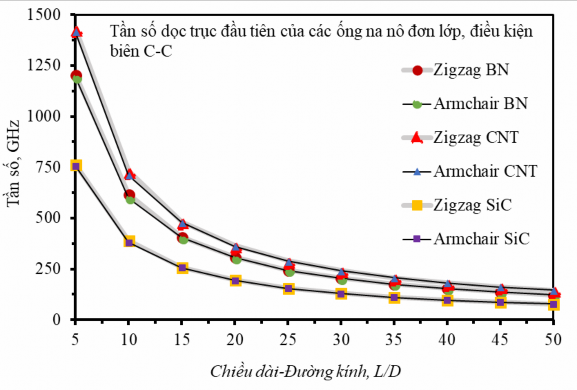
Figure 4.4 First axial free vibration frequency of zigzag nanotube(19,0) and armchair (11,11), boundary condition CC.
Figure 4.4 shows the first frequency of axial oscillation when changing the pipe length of three types of material pipes, with double-end clamp boundary condition (CC). Through this figure, it can be seen that, with double-end clamp boundary condition, the axial free oscillation frequency is inversely proportional to the pipe length, increasing the length, the frequency decreases. This is consistent with the study of SS Gupta, RC Batra (2008) [49].
The frequency reduction process is similar for all three materials and for both zigzag and armchair tubes. The frequency decreases rapidly at the small tube length stage ( L/D = 15), then decreases more slowly at large tube lengths. The small tube length stage corresponding to L/D in the range of 5-15 has a frequency reduction of 75% of the total value. Among them, the frequency of carbon nanotubes (CNT) always has the largest value, specifically about 18.5% larger than that of BN tubes and more than 87% larger than that of SiC tubes. Among them, the frequency of zigzag tubes (19, 0) is approximately the same as that of armchair tubes (11, 11), the frequency of zigzag tubes (19, 0) is slightly larger than that of armchair tubes (11, 11), averaging about 0.7% for all three materials examined.
The results of the axial free vibration frequency when changing the length for the single-end clamp boundary condition (CF) are shown in Figure 4.5.
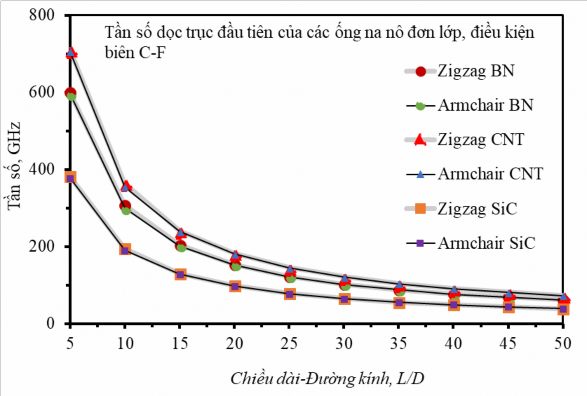
Figure 4.5 First axial free vibration frequency of zigzag(19,0) and armchair (11,11) nanotube, boundary condition CF.
The relationship between diameter and frequency is still inversely proportional, that is, as the length increases, the frequency decreases. The frequency reduction process is similar to the case of CC boundary condition, that is, it decreases rapidly at the small length stage and becomes slower when the tube reaches a certain length, specifically here the ratio L/D = 15. The frequency of CNT tube is still 87% larger than that of SiC tube and 18.5% larger than that of BN tube.
In the case of CF boundary condition, it is also shown that the axial oscillation frequency of the zigzag tube is insignificantly larger than that of the armchair tube, about 0.7% for all cases as for the case of the two-end clamp boundary condition (CC) that has been investigated. The frequency of the zigzag tube and the armchair tube in this case is also approximately the same as the case of the boundary condition (CC). In which, at the same size, the frequency value in the boundary condition (CF) is lower than the frequency in the boundary condition (CC). Specifically, in the boundary condition (CC), the zigzag graphene sheet decreases from 1430.2 GHz to 145.5 GHz, while the frequency in the boundary condition (CF) decreases from 711.1 GHz to 72.7 GHz when the L/D ratio increases from 5 to 50 respectively.
Continue to examine the tubes with free-end boundary conditions (FF). The results of oscillation frequencies are shown in Figure 4.6 (here, the author has ignored the rigid body modes of the free-end boundary conditions).
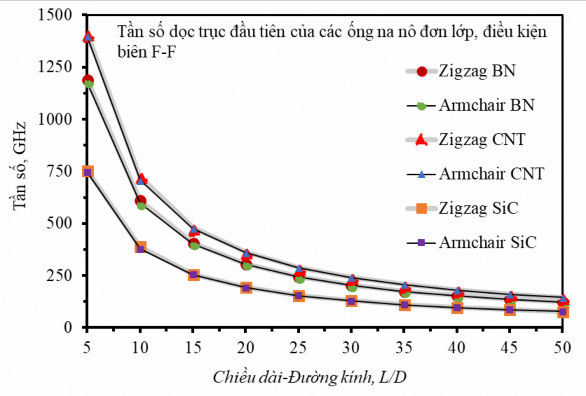
Figure 4.6 First axial free vibration frequency of zigzag nanotube (19,0) and armchair (11,11), boundary condition FF.
Observation of Figure 4.6 shows that the influence of the axial oscillation frequency on the tube length is similar to the two boundary condition cases CC and CF. The frequency decreases as the tube length increases. The frequency transformation process along the length is similar to the two boundary condition cases investigated. In terms of value, the boundary condition case FF gives a magnitude approximately equal to the case of the double-end clamp boundary condition (CC), slightly smaller for all investigated cases, specifically about 1.3%. The frequency of carbon nanotubes (CNT) in this case also gives the largest value, about 86.7% larger on average than SiC and 18.5% larger than BN, this value is similar to the boundary condition cases CC and CF investigated.
Thus, the influence of pipe diameter on the axial free vibration frequency has been investigated. The results are as follows:
- The axial oscillation frequency is inversely proportional to the tube length, as the tube length increases the frequency also decreases. The decreasing trend is rapid in the short tube stage and slower when the tube reaches a certain length.
- The frequency of the zigzag tube is approximately the same as that of the armchair tube, being about 0.7% larger on average over the entire range of L/D ratios examined. This is true for all material tubes and all three boundary conditions.
- Under the same boundary conditions, the frequency of carbon nanotubes (CNTs) always has the largest value, about 87% larger on average than SiC tubes and 18.5% larger than BN tubes.
- The cases of pipes with double-end clamping boundary conditions (CC) give the largest axial frequency values, specifically more than twice as large as pipes with single-end clamping boundary conditions CF.
- The 10-fold decrease in frequency over the entire length range examined shows that the axial frequency is strongly influenced by the length of the pipe. This is true for all the pipe cases examined. The lengths affecting the axial frequency of zigzag and armchair pipes are similar.
4.4 Free bending vibration of nanotubes
4.4.1 Effect of diameter on bending free vibration frequency
The object of this section is similar to the case of the influence of diameter on the axial oscillation frequency in section 4.3.1. The CNT, SiC, BN material tubes, tube length L = 23nm with three boundary conditions: clamped at both ends (CC), clamped at one end (CF) and free at both ends (FF) are investigated. Thus, there will still be 216 tube models investigated for the influence of diameter on the free bending oscillation frequency. The results are calculated and given in Figures 4.7 - 4.9.
Figure 4.7 shows the first free oscillation frequency of three types of material tubes, with the double-end clamp boundary condition (CC). In which, Figure 4.7 a, b, c are for armchair tubes and d, e, f are for zigzag tubes. Through the figures, it can be seen that, with the double-end clamp boundary condition, the bending oscillation frequency is proportional to the tube diameter, the diameter increases, the frequency increases. The frequency increase process is similar for all three types of materials and for both zigzag and armchair tubes. The increase process in this case is different from the case of the influence of diameter on the axial frequency examined in section 4.3.1. Specifically, in this case, the frequency increases quite linearly for the entire diameter range examined. In which, the frequency of carbon nanotubes (CNT) always has the largest value, about 15.5% larger than BN tubes and 26.5% larger than SiC tubes. This is consistent with previous studies [1] (Table 4.3) due to the larger elastic modulus of carbon tubes compared to silicon carbide and boron nitrite resulting in higher element stiffness and overall stiffness of the tubes.
CNTs are larger than BN and SiC when the tubes have the same geometrical dimensions. The zigzag tube frequencies are similar, with values approximately equal to those of armchair tubes for all three materials examined.
The results of the free oscillation frequency of the armchair tube with the single-end clamp boundary condition (CF) are shown in Figure 4.8. In which Figure 4.8 a, b, c show the frequency results of the armchair tube and d, e, f are those of the zigzag tube. The relationship between diameter and frequency is similar to the CC case, the frequency increases linearly over the entire diameter range investigated. The frequency of the CNT tube is 27% larger than that of the SiC tube and 15% larger than that of the BN tube. In the case of the CF boundary condition, the free oscillation frequency of the zigzag tube is similar to that of the armchair tube in both trend and value. The difference is insignificant, about 1.5% as in the case of the double-end clamp boundary condition (CC).
Continue to examine the pipes with free-end boundary conditions (FF) as for the two cases CC and CF examined. The results of the bending oscillation frequency are shown in Figure 4.3 (here, the author has ignored the rigid body modes). Observing Figure 4.3 shows that the dependence of the bending oscillation frequency is similar to the two cases CC and CF. The frequency increases as the pipe diameter increases. The trend of frequency variation according to the diameter is similar to the two cases of boundary conditions examined. The case of FF boundary condition gives a frequency magnitude approximately similar to the case of clamped-end boundary condition (CC), less than 0.2% for all cases of pipes examined. Among the three types of material tubes, the frequency of carbon nanotubes (CNT) in this case also gives the largest value, about 26.5% larger than SiC and 15% larger than BN, this value is similar to the cases of C-C and CF boundary conditions that have been investigated.
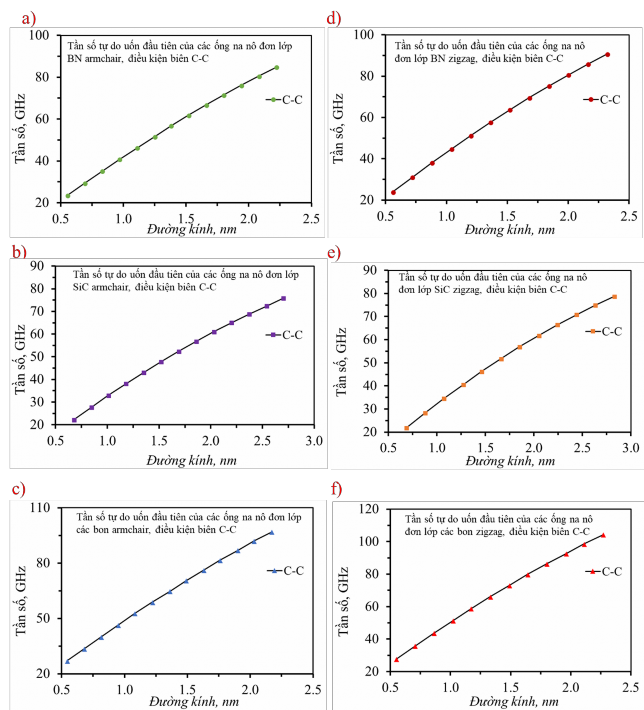
Figure 4.7 First frequency of bending oscillation of nanotube, length L=23nm, boundary condition CC: a) First frequency of bending oscillation of BN armchair tube; b) First frequency of bending oscillation of SiC armchair tube; c) First frequency of bending oscillation of CNT armchair tube; d) First frequency of bending oscillation of BN zigzag tube, L=23nm; e) First frequency of bending oscillation of SiC zigzag tube; f) First frequency of bending oscillation of CNT zigzag tube.