
process of economic restructuring. On the other hand, the State can also encourage the movement of labor to areas with resources but labor shortages... The impact of management mechanisms will create a balanced production and population structure, develop productive forces, reduce the development gap between sectors and regions, and reduce the income and living standards gap between rural and urban areas.
Now that Vietnam has become a member of the World Trade Organization, Vietnam's relationship with major countries in the world is a cooperative relationship with great powers in many aspects. The impact of the international division of labor is even more significant in the process of choosing a reasonable and effective economic structure for Vietnam.
In short, the process of economic restructuring of each country is affected by many factors, so this process is both objective, historical, social, and subjective. Therefore, to build a reasonable economic structure, it must be strategic and have a long-term plan.
2.2. Shifting the economic structure of the industry in Vietnam during the renovation process from 1990 to present
During the renovation period, the picture of our country's economic structure has developed and achieved many successes. From the reality in the years of renovation, to the 7th National Congress of the Party, there has been a change in the trend of economic restructuring as well as the relationship in the industrial, agricultural and service sectors. The structure of industry, agriculture and services has been concretized into the policy: developing agriculture - forestry - fishery associated with processing industry and building new rural areas is the top priority task to stabilize the socio-economy, increase the proportion and speed of industry, expand the service economy... The policy set out at the end of the transition period is to form a structure
basically an industrial economy with an industrial-agricultural-service economic structure associated with increasingly deep division of labor and international economic cooperation.
The breakthrough of the “Three major economic programs” in 1991 created a remarkable change in agriculture and at the same time a “self-adjusting” change in industry, especially the prosperous and vibrant circulation sector, forming a clear service sector. Thanks to the change in economic model and economic restructuring, the relationship between industry, agriculture and services in our country has undergone important changes. Since the economic renovation process, especially since the 1990s, the structure of our country’s economic sectors has changed in many positive directions, the comparative advantages in each sector have been gradually exploited, contributing to promoting economic development at a high and stable speed and significantly improving people’s lives.
2.2.1. Shifting the economic structure of the industry according to the sub-industry of the General Statistics Office
The industry structure calculated by GDP of the economy over the past 18 years (from 1990 to present) has shifted quite a bit.
During the years of renovation, the change in economic structure mainly took place between two basic material production sectors : agriculture tended to decrease almost at the same rate as industry increased.
Table 2.1: GDP structure by economic sector of the General Statistics Office (%)
Year
Agriculture, forestry and fishery | Industry and construction | Service | |
1990 | 38.74 | 22.67 | 38.59 |
1995 | 27.18 | 28.76 | 44.06 |
2000 | 24.54 | 36.73 | 38.73 |
2001 | 23.24 | 38.13 | 38.63 |
2002 | 23.03 | 38.49 | 38.48 |
2003 | 22.54 | 39.47 | 37.99 |
2004 | 21.76 | 40.09 | 38.73 |
Maybe you are interested!
-

 Overview of the Party's Viewpoints and Guidelines on Economic Structure Shift in Vietnam Through Congresses
 -
 Concept of Economic Structure, Economic Structure Shift
 -
 Some Theoretical Models on Economic Sector Structure Shift
 -
 Current Status of Economic Structure Shift in Ninh Binh Province in the Period 2001-2005
 -
 Indicators Reflecting and Factors Affecting the Shift of Rural Economic Structure Towards Sustainable Development.
2005
20.50 | 41.00 | 38.50 | |
2006 | 20.40 | 41.53 | 38.07 |
2007 | 20.30 | 41.58 | 38.12 |
2008 | 21.99 | 39.91 | 38.10 |
Source: Statistical Yearbook 2000, 2007, 2008
Along with the high growth rate of GDP, the domestic economic structure has changed significantly. From 1990 to 2008, the proportion of the agricultural sector decreased from 38.74% to 21.99% of GDP, giving way to an increase in the proportion of the industrial and construction sector from 22.67% to 39.91%, while the service sector remained almost unchanged: 38.59% in 1990 and 38.10% in 2008. In each industry group, the structure also changed positively.
The agricultural sector has made important strides, creating the foundation for the process of accelerating industrialization and modernization.
The proportion of GDP in agriculture, forestry and fishery decreased from 38.74% in 1990 to 27.2% in 1995, with a downward trend until 2007, continuing to decrease to 20.30%, an average decrease of 1.2% and an increase in 2008 to 21.99%. Our country's agriculture gradually shifted to a commodity economy and strongly oriented towards export, with an average increase of 16% in export value. In 1990, export turnover reached 1.106 billion USD, in 2000 it reached 4.5 billion USD,
accounting for 40% of total export value.
Agriculture and rural areas of our country implemented the 2007 plan with many difficulties and advantages intertwined. However, with the experience in organization, management, operation, and great efforts of the entire political system of the country, agriculture and rural areas of our country continued to maintain a positive growth rate. As of 2007, the total product of the agricultural, forestry and fishery sector accounted for 20.30% of the national economic structure, an increase of 3.4% compared to 2006, the growth of the whole sector has contributed to
contributed 0.61 percentage points in 2007 and 0.68% in 2008 to the overall growth of the economy.
The proportion of agriculture, forestry and fishery in Vietnam's GDP is still quite high, currently ranking 4th out of 10 countries in the region (higher than the proportion of 16% in Indonesia, 15% in the Philippines, 10% in Thailand, and 8% in Malaysia).
The industry and construction sector has made new strides in transforming production structure, product structure and technology structure towards modernity. The average growth rate in the year (2000-2008) reached 14%, many important products of strategic significance, having a great impact on many economic sectors have achieved a good growth rate. The structure of industrial sectors has shifted significantly, forming a number of key products, a number of industrial zones with many modern technology production facilities.
During the years of renovation, the proportion of industry and construction increased quite rapidly, from 22.67% in 1990 to 41.58% in 2007 and in 2008, the economy had fluctuations so it decreased to 39.91%; an average increase of more than 1.2% per year. Thus, the industrial sector has truly played a leading role in the development and restructuring of the entire economy.
For the construction industry, import turnover reached about 789.2 million USD, equal to 117.8% of the yearly plan, up 46.2% over the same period in 2007. Export turnover reached about 214.5 million USD, reaching 104% of the yearly plan, up 89.6% over the same period in 2007.
In 2008, industrial production value increased by 14.6% compared to 2007. During the same period, in the industrial sectors, the production value of the processing industry accounted for the largest proportion in the total production value of the whole sector with 88.9%, an increase of 16%; electricity, gas and water industry increased by 13.4%, accounting for 16.4%.
5.7% and the total production value of the mining industry decreased by 3.5% due to the decrease in crude oil exploitation, accounting for 5.4%.
In industry, strongly develop key industries with high added value (mining industry, manufacturing industry, food processing industry, electricity industry, etc.) to serve domestic research and export, reduce the proportion of mineral exports and heavy industrial products. In particular, the growth rate of the industrial sector is higher than that of the national economy, accelerating the transformation of the industrial structure of the industrialization and modernization period.
The service sector has developed rapidly and is increasingly diversified. However, the growth rate of the service sector is lower than that of industry and construction. Over the past 15 years, it has tended to decrease, with an average decrease of 0.03%, from 38.6% in 1990 to a slight decrease over the years to 38.5% in 2005 and 2010.
2007 reached 38.12% to 2008 reached 38.1% (see table 2.1).
The commercial sector has developed comprehensively, creating economic dynamism, increasing socio-economic efficiency and promoting production development. Tourism has grown from a very small scale to an important service industry with many diverse types of tourism, with revenue reaching 7-8 trillion VND/year. Transportation has basically met the demand for goods circulation to develop the socio-economy and improve people's lives. Post and telecommunications have developed rapidly, taking the lead in modern technology.
In the service sector, some important service sectors are accounting for a low proportion and tending to decrease, especially finance and credit (only 1.81% in 2007); science and technology in 2007 accounted for 0.62%. Banking services are still too small compared to the world. Between the sectors, there has been initial mutual support, creating general development in the economy as well as the development of each sector.
In the process of economic innovation, industrialization and modernization, Vietnam has entered a period of rapid and stable growth (chart 2.1), the country's economic potential has changed, the annual GDP growth rate in the period 1991-2002 reached 7.04%; GDP of the economy in 2002 was 2.37 times higher than in 1990 and by 2003-2008 reached 7.74%, in which industry increased 3.5 times, export increased nearly 6.9 times and services increased faster than the growth rate of agriculture. In 2007, the growth rate was 8.48%, the highest since the Asian financial crisis in 1997. In 2008, affected by macroeconomic instability and financial crisis, GDP growth reached 6.19% and in the first quarter of 2009, GDP growth reached 3.1%.
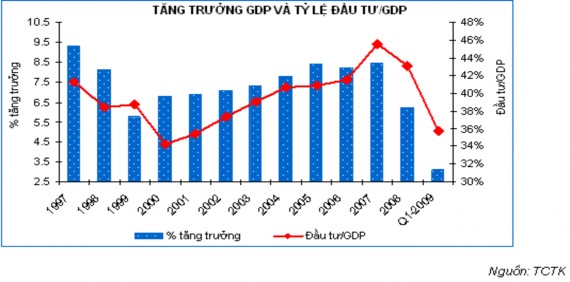
Chart 2.1: GDP growth and investment/GDP ratio in the period 1997- Q1/2009
The progress of economic growth rate reflects the positive reality of maintaining the growth momentum of each year increasing compared to the previous year continuously until 2007 (excluding 1998 and 1999 when there was a relative decline due to the impact of the Asian financial and monetary crisis, GDP decreased to 5.26%); therefore, our country's economy ranks second in East Asia and the world, only after China in terms of GDP growth rate achievements in
over the past two decades. In 2008 alone, in the difficult and challenging context of the global economic downturn, our country's economy fell into a state of inflation, leading to a relative decline in economic growth and GDP reaching 6.23%.
The total value of domestic products has increased steadily over the years, there has been a shift in the economic structure, the growth rate of the industrial and service sectors has increased at a low rate and increased higher than that of the agricultural sector (see table 2.2). In particular, in 2008, the growth rate of the total value of domestic products of the industrial and construction sectors decreased sharply from 10.60% in 2007 to 6.33% in 2008 and services in 2007 reached 8.68% to 7.2% in 2008.
Table 2.2: Growth rate of production value in the period 1995-2008 by sub-sector of the General Statistics Office
Year
Total product value (billion VND) | Growth rate in industries (%) | |||
Agriculture, forestry, fishery | Industrial and build | Service | ||
1995 | 195567 | 4.8 | 13.60 | 9.83 |
1997 | 231264 | 4.33 | 12.62 | 7.14 |
2000 | 273666 | 4.63 | 10.07 | 5.32 |
2002 | 313247 | 4.17 | 9.48 | 6.54 |
2004 | 362435 | 4.36 | 10.22 | 7.62 |
2006 | 425373 | 3.7 | 10.38 | 8.3 |
2007 | 461443 | 3.82 | 10.60 | 8.68 |
2008 | 490181 | 3.8 | 6.33 | 7.2 |
Source: Statistical Yearbook 2007, 2008
In fact, the change in the economic structure in recent times originated from the rapid increase in the industrial and construction sectors. On average, from 1990 to 2008, the industrial and construction sector increased by 10.4% per year, more than 1.4 times the GDP growth rate of the entire economy at 7.3% and 2.7 times the agricultural sector. The service sector had an increase equal to the GDP growth rate of the entire economy, so the proportion remained unchanged. Although the growth rate was nearly 3 times higher than the agricultural sector, because the absolute scale was smaller, the degree of change in the correlation ratio between the two sectors was
Agriculture and industry do not correspond to industrial growth. During the period from 1990 to present, the change in the correlation of GDP ratio between sectors is mainly due to the increase in output and the impact of price factors.
The economic structure has changed according to the open-door policy, international and regional economic integration and export growth orientation , reflecting the change in social development investment structure that has supported and promoted the shift in economic structure.
Social investment has increased in both scale and growth rate, creating resources for the development of domestic production of export-oriented products. From 1990 to present, GDP growth has been high, internal accumulation of the economy has increased, and together with additional capital from foreign investment, development investment has increased in both quantity and proportion. By 1998, due to the negative impact of the regional financial and monetary crisis, foreign investment decreased, development investment still increased by 8% compared to the previous year. From 2000 to present, it has still achieved a stable growth rate, social development investment in 2008 reached 637.3 trillion VND, equivalent to 43.1% of GDP and increased by 22.2% compared to 2007. This result shows that our country's economic potential has increased, which is the resource base to ensure the foundation for the process of economic restructuring.
The structure of investment development by industry has many positive changes, focusing on exploiting the advantages of each industry and each region for development . The shift of economic sectors, the proportion of investment capital for agriculture, forestry and fishery in the total development investment capital has decreased from 13.2% in 1995 to 6.5% in 2007, the average annual investment capital accounts for about 11%. The proportion of the service industry tends to increase from 52.7% in 1995 to 50% in 2007, although it decreased to 48.8% in 2000, it reached a high level and the average annual proportion of investment capital for service development during this period accounted for 53.9% of the total social development investment capital. The proportion of investment capital for development of industry and construction changed insignificantly, 43.1% in 2007.