
One of the last remaining Group A forests in Vietnam with 16,900 hectares covered by primary forest, it is home to about 2,147 plant species (54 species listed in the Vietnam Red Book) and 1,175 animal species (69 species listed in the Vietnam Red Book).
In addition, TT-Hue province also has other natural tourist attractions with the potential to develop into attractive tourist destinations. Typically: in Phong Dien district (Thanh Tan Hot Spring Resort), Phu Loc district (Elephant Spring Tourist Area), ...
- Sea and lagoons: TT-Hue province owns the Tam Giang - Cau Hai lagoon system with an area of 22,000 hectares and is known as the largest lagoon system in the world. This is home to more than 30 species of native waterfowl and a stopover for more than 30 species of migratory waterfowl, many of which are listed in the Vietnam Bird Book.
Besides the lagoon, TT-Hue province also has a series of beautiful beaches and the most prominent is Lang Co Bay. With a length of 42.5 km, more than 60 km from Hue City and 20 km from Da Nang; Lang Co Bay is an almost pristine bay located at the foot of Hai Van Pass. This place possesses a diverse and rich ecosystem and is also a part of the Central Heritage Road and is located on the East-West economic corridor. With the values bestowed by nature, Lang Co Bay is honored to be named in the list of 30 most beautiful bays in the world [134].
Maybe you are interested!
-
 Tourism economy towards sustainable development in Thua Thien Hue province - 27
 -
 Private economic development in Hue city, Thua Thien Hue province - 14
 -
 Evaluating the economic efficiency of rice production of farming households in Loc Bon commune, Phu Loc district, Thua Thien Hue province - 1
 -
 Tourism economy towards sustainable development in Thua Thien Hue province - 2
 -
 Credit quality assessment at the Bank for Agriculture and Rural Development, North Song Huong branch, Thua Thien Hue province - 1
* Human tourism resources
- Historical and cultural relic system: With a history of nearly 400 years (1558 - 1945) as the capital of 9 Nguyen lords in Dang Trong, the capital of the Tay Son dynasty and 13 Nguyen kings, TT-Hue province currently preserves nearly 900 relics, including 84 national relics and 52 provincial relics. Of which, the most typical is the Complex of Relics of the Ancient Capital which has been compared to the thousand-year-old wonders of mankind in the list of UNESCO World Cultural Heritage. The total architecture of the complex is built on an area of over 500 hectares including a system of mausoleums, palaces, religious architectural works, civil architecture (palaces, ancient houses) ... and is surrounded by three walls: Kinh Thanh, Hoang Thanh and Tu Cam Thanh.
In addition, TT-Hue province also owns a system of 7 mausoleums built by the royal court with distinct architectural styles reflecting the life and personality of the resting owner: Gia Long, Minh Mang, Thieu Tri, Tu Duc, Duc Duc, Dong Khanh and Khai Dinh. Along with that is a system of unique architectural works associated with
The royal institution has contributed significantly to the cultural and historical values of this civilized land, including: Phu Van Lau, Dan Nam Giao...
In addition, TT-Hue province also has over 500 revolutionary historical relics (the historical relic site of the nine tunnels, A Don Tunnels...) and a system of memorial relics of famous people such as Phan Boi Chau, Nguyen Tri Phuong, Tran Cao Van...
The average density of historical and cultural relics in Thua Thien Hue province is 0.18 relics/km2 and Hue City is the place with the highest density of relics, nearly 30 times higher than the average density of the whole province. The high density of relics will create favorable conditions for the development of tourism [54].
- System of pagodas and Buddhist halls: TT-Hue province is proud to be home to more than 300 large and small pagodas and Buddhist halls, including over 100 ancient pagodas, most of which still retain the ancient features of Asian and Vietnamese architecture. In addition, TT-Hue province is also proud to have a system of peaceful garden houses, an architectural and landscape complex that harmoniously combines two basic elements: House and Garden, creating a living space imbued with the characteristics of Hue culture.
- The system of long-standing traditional handicraft villages: TT-Hue province is also famous for its system of famous craft villages with a long history, where cultural and historical values are preserved and crystallized in each sophisticated product. The province currently has 88 craft villages; including 69 traditional craft villages, 8 small-scale handicraft villages and 11 newly introduced craft villages with over 2,600 production establishments. Typical craft villages are: Phuong Duc bronze casting, Thanh Tien paper flowers (Phu Vang), Lang Sinh paintings, Phuoc Tich pottery, Bao La weaving, Zeng weaving (A Luoi)...
- Intangible heritage and World documentary heritage: Hue royal court music has become the pride of Thua Thien Hue province in particular and Vietnam in general when it became the first intangible heritage of Vietnam to be listed among 28 masterpieces of intangible and oral heritage of humanity for the second time. In addition, the Woodblocks and Royal Records of the Nguyen Dynasty were also recognized as World Documentary Heritage by the United Nations Educational, Scientific and Cultural Organization in 2009 and 2014. In which, Woodblocks are Chinese-Nom scripts engraved in reverse on wood to print books in Vietnam in the 19th and early 20th centuries and Royal Records are administrative documents of the last dynasty in Vietnam's feudal history.
- System of folk festivals and royal festivals: One of the important factors contributing to the unique cultural nuances of the land of TT-Hue province is the festivals.
Traditional festivals are solemnly organized. Festivals are “the bright spot of the convergence of unique cultural and artistic activities of the people - a community activity capable of meeting many aspects of that cultural need” [174].
The most prominent and culturally characteristic of the Hue Royal Court is the system of important royal festivals such as: Nam Giao ceremony, Xa Tac ceremony, Truyen Lo ceremony, etc. In recent years, in order to preserve traditional rituals imbued with Hue's cultural identity, many festivals in Hue have been researched and restored, typically the Royal Court festivals.
- Rich and diverse culinary culture: Hue cuisine has a unique local identity and was formed through a long historical process, mainly during the period when it played the role of the country's capital under the Nguyen Dynasty. Hue culinary culture has both a luxurious, royal style and a simple, rustic style, including both vegetarian and non-vegetarian dishes. Hue culinary culture is considered a tourism resource and is the content of most tours to Hue.
3.1.1.3. Socio-economic development situation
- Economic growth rate:
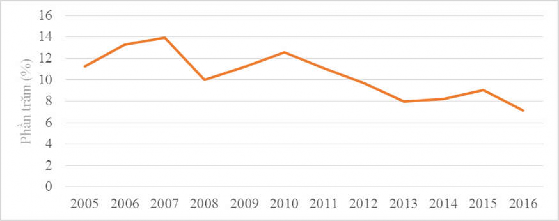
Chart 3.1: Economic growth rate of Thua Thien Hue province in the period 2005 - 2016
Source: [26]; [27]; [28]; [29]; [30]
During the period 2005 - 2016, the average economic growth rate of TT-Hue province was quite high, reaching 9.04%/year, higher than the average growth rate of the whole country. However, due to the influence of many objective and subjective factors, local economic growth was still uneven. By the end of 2016, the service sector increased by 11.7%, the construction industry increased by 9.7% and agriculture increased by 3.3%, the province's GDP increased more than 9 times compared to 2005 and the average income per capita reached 1,636 USD/person, contributing to creating
premise for the development of tourism and other economic sectors in Thua Thien Hue province in recent times.
- Economic structure: TT-Hue province's economic structure in the period of 2005 - 2016 shifted towards services, industry and agriculture. In which, the tourism service industry always accounted for the highest proportion, reaching 56.6% in 2016, followed by the industry and construction industry with a gradually increasing proportion, reaching 32.00% in 2016; on the contrary, the proportion of the agricultural industry decreased from 20.20% in 2005 to 11.21% in 2016.
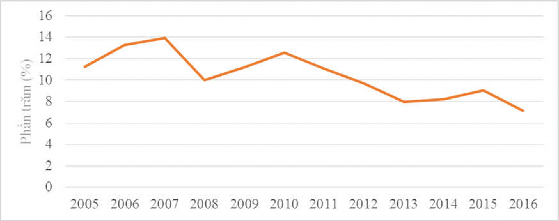
Chart 3.2: GDP structure by economic sector in Thua Thien Hue province in the period 2005 - 2016 (at actual prices)
Source: [26]; [27]; [28]; [29]; [30]
The service sector has a high growth trend with an average annual production value increase of 11.3%, of which the average growth rate of the hotel and restaurant sector is 9.04%. The types of services are diverse, the facilities of some high value-added service sectors are invested in modern technology, expanding in scale such as services: information technology, post and telecommunications, banking, insurance, healthcare, education, transportation... especially the hotel and restaurant sector is developing rapidly, contributing to the development of the tourism and service sector in Thua Thien Hue province.
Industrial and construction sectors: production value remained high, increasing by an average of 14.5%. Industrial production capacity continued to expand, forming many factories and enterprises with advanced technology. In particular, since the development of the tourism industry, many hotels, resorts, and restaurants have been built; at the same time, industrial parks, industrial clusters - small-scale industries, and craft villages have been planned and invested in technical infrastructure, attracting more and more workers and contributing to promoting economic restructuring in a positive direction.
The agriculture, forestry and fishery sector witnessed the lowest average annual growth in production value among all sectors, specifically 5.2%. However, the rapid development of the tourism industry, along with the demand for food consumption, has partly created conditions for the agricultural sector to develop further.
Thus, in the period of 2005 - 2016, the economic structure of TT-Hue province has shifted reasonably and in line with the general trend of society. The tourism industry has been developing strongly in the direction of increasingly accounting for a high proportion in the economic structure of the province. This is the industry with the ability to best exploit resources, socio-economic potential and production and business organization capacity of all economic sectors, contributing to promoting economic growth of TT-Hue province and the whole country. In addition, the total investment capital of the province has also increased gradually over the years, from 3,493,000 million VND in 2005 to 9,200,000 million VND in 2010 and reaching 11,760,953 million VND in 2016.
- Infrastructure: Identify the importance of infrastructure in promoting the development of local socio-economy in general and tourism in particular. In recent years, Thua Thien Hue province has prioritized resources for the construction and completion of technical infrastructure to serve the requirements of socio-economic development.
In recent years, TT-Hue province has focused on developing the transport network with localities in the Central Key Economic Zone to create momentum for socio-economic development, specifically: coordinating and supporting the Ministry of Transport to implement the project to upgrade the road in the West of Hue city, implementing projects to upgrade highways and national highways through the province. In addition, the province has also invested in upgrading the province's transport network into a unified system connecting the dynamic economic zones in the province.
Regarding the aviation system, TT-Hue province has Phu Bai international airport, 13 km southeast of Hue city center, with a capacity of more than 1.2 million passengers in 2015. Currently, there are three airlines: Vietnam Airlines, Vietjet Air and Jestar Pacific operating flights from Hanoi - Hue - Hanoi and Ho Chi Minh City - Hue - Ho Chi Minh City using A320 and A321 aircraft with 24 flights/day.
Regarding the waterway system, the province has Chan May deep-water seaport and Thuan An port. Of which, Chan May seaport is the closest and most convenient gateway to the East Sea for regions in the East-West Economic Corridor, and is also close to the national key tourist areas (Canh Duong - Lang Co - Hai Van, Bach Ma National Park). With a favorable geographical location and development potential, Chan May port has the opportunity to
The opportunity to develop into a port that can receive the largest cruise ships in the world will create favorable conditions for Thua Thien Hue province in developing cruise tourism.
Other infrastructures such as power distribution system, water supply system, environmental sanitation, healthcare, education, training, science and technology, etc. have recently received investment attention, contributing to improving the quality of life of the people and creating favorable conditions for the development of the tourism industry in Thua Thien Hue province.
- Social resources: the population of TT-Hue province in 2016 was 1,143,572 people, the 4th most populous province in the Central Key Economic Zone and 58th in the country, with 51.4% of the population living in rural areas. However, the population is unevenly distributed in the province, most concentrated in Hue city, Phu Vang district, Phu Loc district with rates of 31%, 15.9%, 12% respectively, while the two mountainous districts of Nam Dong and A Luoi have the lowest population rates with 2.2% and 4.1%.
In addition, in order to meet the requirements of socio-economic development tasks, the quality of the province's human resources has basically improved significantly through each period. In the 5 years from 2011 to 2015, 192 thousand people were newly trained, by training level: primary vocational and technical workers about 124 thousand people (accounting for 65%), intermediate vocational and intermediate professional about 45 thousand people (accounting for 23%), college, university and postgraduate about 23 thousand people (accounting for 12%). In particular, TT-Hue province witnessed a clear shift in human resource development towards services - industry - agriculture, specifically human resources in the service sector increased from 201.2 thousand people in 2010 (accounting for 36.1% of the total human resources in the national economy) to 273 thousand people in 2016 (accounting for 43.0% of the total human resources in the national economy); the industrial - construction sector maintained a relative increase from 97.6 thousand people in 2010 to about 142 thousand people in 2016; meanwhile, the agriculture, forestry and fishery sector witnessed a decrease in human resources from 203.6 thousand people in 2010 to 133 thousand in 2016. With this human resource development structure, TT-Hue province will have many opportunities to achieve the goal of developing tourism into a spearhead economic sector of the province [157].
TT-Hue province is a major education and training center of the Central region and the whole country. The whole province has 02 universities (Hue University, Phu Xuan Private University), 02 academies (Central Region Administrative Academy, Hue Music Academy), 05 colleges (Hue Industrial College, Pedagogical College, Tourism Vocational College, Vocational College No. 23 of the Ministry of National Defense, Medical College), 08 intermediate schools and more than 20 establishments participating in vocational training.
3.1.2. Some advantages and disadvantages for tourism economy towards sustainable development from natural conditions, tourism resources and socio-economic situation of Thua Thien Hue province
3.1.2.1. Some advantages
- Located on the important traffic axis across the North - South, the East - West corridor axis and being one of the 5 provinces in the Central Key Economic Zone, it creates favorable conditions for TT-Hue province to focus on exploiting its strengths and linking with other localities with other strengths to bring better quality tours to tourists, thereby helping to develop the province's tourism industry.
- With diverse terrain and full range of terrain types including forests, mountains, hills, coastal plains, lagoons, lagoons and sea, TT-Hue province has the opportunity to develop many different types of tourism such as sea tourism, eco-tourism, resort tourism... In particular, with one of the most beautiful bays in the world, Lang Co Bay, and a world-class lagoon system such as Tam Giang - Cau Hai lagoon system, TT-Hue province can focus on exploiting and developing resort tourism and eco-tourism along with community tourism around these destinations.
- Hue culture is the convergence of quintessence values from cuisine, traditional festivals and the long-standing traditional craft village system. The delicate combination of royal cuisine with the rusticity and simplicity of local dishes has created a unique and outstanding culinary identity of TT-Hue province. In addition, there is a system of traditional craft villages that have existed for a long time and many of these craft villages are still maintained and developed, contributing to the preservation, promotion and dissemination of unique cultural values of the community in the craft villages to domestic and foreign tourists. In particular, the richness of folk festivals and royal festivals helps TT-Hue province become a typical festival city of the country, playing an important role in attracting tourists to Hue each festival.
- The rich and diverse system of historical and cultural relics plays an important role in promoting the development of TT-Hue tourism, creating an image of a "heritage city" for tourists. Typical examples include the Complex of Hue Monuments, the system of hundreds of pagodas and Buddhist temples and the unique system of garden houses, which have contributed to making Hue an attractive destination for tourists.
- With a system of universities, colleges, intermediate schools and many training centers currently training in many different professions. Especially two training facilities
The Faculty of Tourism - Hue University and Hue College of Tourism provide the labor market with thousands of students each year and contribute to solving the labor demand for the tourism industry in Hue in particular and the Central Highlands in general.
- The province has focused on investing in infrastructure over the past years, upgrading traffic infrastructure to create favorable conditions for serving tourism activities in the province. A typical example is the water environment improvement project implemented through funding from the Japan International Cooperation Agency (JICA) with the aim of building, renovating and expanding the rainwater drainage system, developing a system to collect and treat domestic wastewater in the inner city and overcoming environmental pollution caused by untreated wastewater, thereby contributing to improving the environmental situation in Hue City and building an image of a green, clean and beautiful tourism city for tourists.
3.1.2.2. Some difficulties
- Located in an area affected by the tropical monsoon climate, the weather in Hue is divided into two distinct seasons: sunny and rainy, making tourism business highly seasonal compared to other localities. Especially in the rainy season, with quite large amounts of rain lasting for many months, it leads to serious degradation of many historical and cultural relics in the province and makes it difficult to develop tourism business during this time.
- Tourism infrastructure is still limited, especially the exploitation of international flights to Hue via Phu Bai airport is still very limited, mainly only exploited at two ends in Ho Chi Minh City and Hanoi. Meanwhile, neighboring localities such as Da Nang are directly exploiting many international flights to Korea, China, Thailand. In addition, the transportation infrastructure system to tourism destinations and the infrastructure system serving tourists at the destinations are still limited, not creating convenience for tourists as well as not having high connectivity from Hue City to districts and towns far from the city center. In addition, the infrastructure system of transportation, irrigation, water supply, environmental treatment in coastal areas and lagoons is lacking in synchronization, not meeting development requirements, causing tourism activities here to not develop commensurate with their inherent potential.
- Investment capital in the tourism industry is still limited. Especially the support resources from businesses for tourism product development. Currently, TT-Hue province does not have many investors or large businesses with enough investment potential to create products.