
Training programs help employees have the skills required for the job. If the company has an external recruitment policy, it is necessary to carefully research the labor market and have measures to be able to recruit employees with the desired qualities.
Job analysis
It is a thorough study of job performance to develop optimal work procedures and to train employees to perform the job. This analysis focuses on the competencies and personal characteristics of employees, and is used to determine who is capable of doing the job and what knowledge and skills they lack, so that training in those skills can be focused on.
Maybe you are interested!
-

 Some Online Content Marketing Solutions To Improve Business Efficiency Of Ani International Training Academy
 -
 Measure 2: Tighten Management of the Development and Implementation of Program Content, Teaching Plans, Education and Training in Disaster Prevention
 -
 Current Status of Implementing the Content of the Vocal Music Training Program
 -
 Content of Training on Teaching Capacity for High School Teachers According to the New General Education Program
 -
 Organizing Capacity Training to Develop School Education Programs According to the New General Education Program for Management and Teaching Staff
Other information can also be used to determine training needs:
- According to the report of the managers, the supervisors
- As required by management
- Based on achievements and individual targets achieved
- Knowledge responsibility
- Survey questionnaire
1.1.3.2. Determine training objectives
Determining training objectives is essentially determining the desired results of the
training program. After the training program, they will receive:
- Specific skills that need to be trained and skill levels acquired after training.
- Number and structure of students
- Training time.
- A good training objective allows for fair assessment and scoring, and the identification of a training program that is consistent between content and objectives effectively encourages employees to self-assess because they know what to achieve and want to train better.
Therefore, training objectives must follow the SMART principle: Clear, specific,
measurable, achievable, relevant and time-bound
1.1.3.3. Training planning
1.1.3.3.1. Determine training location
There are 2 locations to choose from:
- At the enterprise: With this location, the enterprise provides on-site training or employee mentoring, taking place right in the enterprise.
- Outside the company: sending employees to centers, universities or abroad...
1.1.3.3.2. Choosing the training method
There are 4 popular training forms:
- New training is training workers who move from one field to another and need professional training.
- Retraining is training people who are weak in professional skills and need training.
recreate to strengthen professional skills.
- Advanced training is training to improve professional skills so that workers can take on more complex job positions.
- Professional training is in-depth training in the field or profession being worked in.
1.1.3.3.3. Select training subjects
Training target selection is the selection of specific people for training, based on research and determination of workers' training needs and motivations, the impact of training on workers and the career abilities of each person.
To be able to choose the right training subjects, it is necessary to rely on training needs and evaluate the quality of the current workforce of the enterprise.
The subjects selected for training must ensure the following factors: The training must be for the right person, the right job, must ensure fairness, effectiveness, and timeliness for the employee and the job. To do so, before selecting the subjects, it is necessary to research the needs and aspirations of each employee, whether their motivation to study is legitimate or not, or whether the hotel can meet it; at the same time, it is possible to rely on the results of the job analysis (including 3 copies: Job description, job requirements for the performer and job performance standards) to select the training subjects more accurately.
1.1.3.3.4. Determine the training program, content and duration of the training program
A training program is a system of subjects and lessons taught, showing what knowledge and skills need to be taught and for how long. Based on that, choose the appropriate training method. The content of the training program is different for each selected subject:
- For managers: the learning content focuses on improving management skills, changing concepts or improving practical skills of managers at all levels. Including courses on staff management skills, information processing, problem solving skills, professional expertise and foreign languages.
- For employees: mainly theoretical and practical lectures on professional expertise, basic and necessary skills for performing the job, training in hotel culture, language proficiency, providing knowledge about culture and customs of tourists.
Training programs include:
- Professional and technical training: focuses on basic and specialized knowledge of the job that employees must master to be able to undertake assigned work, helping employees apply the knowledge they have been trained in to practice more conveniently and easily, fostering qualities and experience so that employees can work voluntarily and enthusiastically.
- Political and theoretical training: political training includes resolutions, state laws and policies, and contents on business ethics and social responsibility to help employees have correct concepts and strong ideology.
- Corporate culture training: Focus on contents about values, viewpoints, behaviors, regulations, internal rules... to help employees get acquainted and adapt to the working environment.
- Training on working methods: Including methods of carrying out work, methods of arranging and organizing time, methods of coordinating work with other departments and individuals with the aim of improving the efficiency of completing work of employees.
Training duration:
Depending on the courses in the training program, there will be different training durations such as:
- Training courses on management skills, expertise, politics and culture will have time
Training duration ranges from 1 to 2 days.
- Vocational training courses will have a minimum training duration of 7 days.
1.1.3.3.5. Choosing training methods
Human resource training methods:
- On the job training
- Off-the-job training
1.1.3.3.6. Selection and training of lecturers
For human resource training programs, teacher selection plays a very important role, it determines the quality of training. The selection of lecturers must be based on the qualifications, experience, and reputation of that person. In addition, the selection of teachers is also influenced by the training method of the enterprise.
Choosing lecturers: Businesses can choose lecturers from internal sources or lecturers outside the business.
Selecting skilled workers and experienced managers in the enterprise to participate in teaching. This option is both cost-effective and provides students with practical skills that are close to the reality of the enterprise. However, there are also many limitations such as: difficulty in updating new information and knowledge and can affect the work that the person selected as a teacher undertakes.
Select teachers from external training institutions (lecturers from universities, centers, etc.). This method can provide knowledge and updated information to keep up with the progress of the profession. However, this method has the disadvantage of low implementation, not close to businesses, and high cost.
1.1.3.3.7. Estimated training costs
Human resource training is an activity that requires a budget to be used for certain expenses. The budget for human resource training is taken from a portion of the enterprise's revenue or taken from the enterprise's own fund for human resource training. Costs for human resource training include:
- Costs for learning: technical equipment, materials used in the teaching process, learning materials.
- Costs for school management staff, teaching staff, and staff costs
guidance and assistance for learners.
Human resource training costs must be fully and accurately established based on the financial capacity of the enterprise, depending on revenue and profit, etc. This year's training costs are the basis for determining next year's costs and are the basis for evaluating the business performance of the enterprise.
1.1.3.4. Training organization
Organizing training within the enterprise. Implementing training within the enterprise includes the following tasks: inviting lecturers, announcing the list and gathering learners according to needs, developing and approving training and development plans, preparing documents according to the content, determined programs and selected training methods, preparing material conditions and implementing reasonable remuneration policies for both lecturers and learners based on the budget for training and human resource development.
Organizing training outside the enterprise. Enterprises contact external training organizations to send employees to participate in various training and coaching courses. Implementation includes selecting partners capable of meeting the set requirements, signing contracts with selected partners to implement the proposed plan, approving teaching materials developed by the facilities if appropriate, monitoring implementation progress, changes in content, form and teaching methods, and participation of learners.
1.1.3.5. Arrangement of human resources after training
The goal of all organizations is to maximize their profits. So when spending money on training, companies want to get as much benefit as possible from it.
To make good use of trained human resources, companies need to pay attention to the following issues:
after:
- Create opportunities for employees to use the knowledge and skills they have acquired.
train.
- Expanding jobs for workers
- Gradually give workers autonomy in solving problems.
- Timely encourage and motivate employees when performing new tasks.
- Increase wages for workers commensurate with new qualifications.
1.1.3.6. Evaluation of training effectiveness
Effectiveness is one of the main criteria for evaluating training. Evaluation is usually done after the training program has been completed, this step not only determines the amount of knowledge and skills that the trainees have acquired but also helps the training organization find areas that need improvement and adjustment. The most widely used evaluation model today is the Kirkpatrick evaluation model.
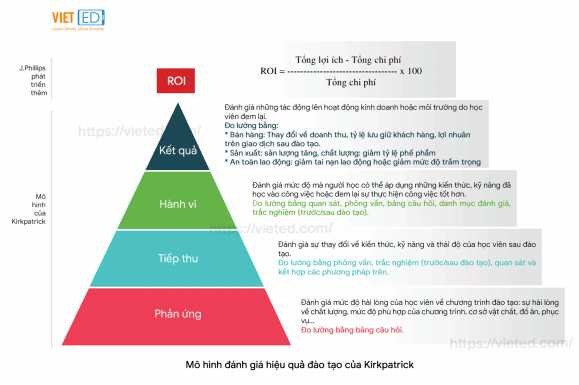
(Donald Kirkpatrick, Evaluating Training Programs, 1994)
Figure 1.1. Kirkpatrick evaluation model
Learner Response Evaluation: This is the process by which learners will give their evaluations of the training program after completing the program, which will include evaluations of the content, structure, teaching and learning methods of the training program. Through the evaluation of learner response, educational institutions will determine which aspects of the training program need to be strengthened and developed, and which aspects need to be revised and improved. From the evaluation information collected, educational institutions will set standards for the next training program.
According to. Training program evaluation at this level is easy to implement and collect information.
Learning Assessment: Is the process of assessing what knowledge and skills learners have acquired when participating in the training program and whether they have achieved the objectives of the training program or not? Training program evaluation at this level can be conducted continuously throughout the program implementation process to improve, expand and enhance the knowledge and skills of learners. Training program evaluation at the cognitive level must closely follow the objectives of the training program.
Behavioral assessment: Is the process of assessing changes and progress of learners after completing the training program. At this level, program assessment will focus on the level of application of knowledge and skills that learners have achieved in their work.
Result Evaluation: Is the process of evaluating the impact of the training program on the subjects. At this level, program evaluation will aim to evaluate the return on training investment.
In general, the higher the level, the more difficult and time-consuming the evaluation process becomes, although they yield more valuable information and higher outcome validity.
Kirkpatrick believes that the evaluation should be conducted from level 1, then depending on time and budget, we proceed sequentially to levels 2, 3, 4. Depending on available resources (finance, human resources, time, ...), the evaluator can decide whether to implement all four levels or not. However, Kirkpatrick believes that no level should be ignored and, more importantly, ROI should not be measured without evaluating all four levels.
1.2. Human resource training methods
1.2.1. On-the-job training methods
On-the-job training is a method of direct training at the workplace, in which learners will learn the knowledge and skills necessary for the job, often under the guidance of more skilled workers.
 The advantages of on-the-job training methods are:
- Training content is closely linked to actual work, learners will quickly master job performance skills.
- Low training costs because it saves the cost of sending people for training and the cost of hiring training instructors.
- Limit the situation of employees leaving the unit after the training course because the skills they learn from on-the-job training are sometimes only compatible with the operational characteristics and production and business characteristics of the unit that trained them.
 Disadvantages of on-the-job training.
- Learners can learn advanced elements but can also learn unreasonable elements and limitations of the teacher, especially when the teacher does not have pedagogical skills or is not enthusiastic in teaching.
- Indirect costs for training can be huge when learners interrupt the source of
work, damage the organization's reputation with customers, damage machinery...
- Training scale is usually small.
This group includes the following methods:
1.2.1.1. Job instruction training
This is a common method used to teach job skills to most production workers and even some management jobs. The training process begins with the instructor introducing and explaining the objectives of the job and giving detailed, step-by-step instructions on how to observe, discuss, learn, and try to master the task under the instructor's close guidance and direction.
1.2.1.2. Apprenticeship training
In this method, the training program begins with theoretical learning in the classroom, then the trainees are sent to work under the guidance of skilled workers for a few years, performing tasks of the trade to be learned until they master all the skills of the trade. This method is used to teach a complete trade to workers.