
really good about the current training goals of the school such as; the ability to work and connect in groups is not professional and knows how to flexibly handle situations or the ability to be flexible and agile in vocal techniques, average 2.20. From that, it can be seen that the current skill training goals of the school are implemented quite well, meeting the basic requirements of the training goals.
The lowest rating in the specific target group is the attitude target. Most of the comments are at the average and above average levels . From this, it can be seen that the school mainly focuses its training resources on professional training for students. Meanwhile, the professional attitude of workers in the field of culture and arts has a relative influence on the success or failure of students. Therefore, there needs to be synchronous solutions for skills training and knowledge provision to create harmony between qualities and abilities.
From the survey results in Table 2.4, the researcher found that the current implementation of the school's training goals and tasks for the vocal music industry is at a fairly good level, with the average of the survey being 2.63 . This level is not really commensurate with the current scale and potential of the school. Specific solutions are needed to improve and enhance the quality of training.
The Cronbach's Alpha statistic measured 0.986 shows that the reliability of the scale is completely trustworthy.
2.3.2. Current status of implementing the content of the vocal music training program
The content of the training program is the entire teaching plan of the school, to ensure that the process of organizing educational activities is carried out in accordance with the purpose of training requirements for the vocal music industry as previously set out. Table 2.5 is the result of the evaluation of the implementation of the training program content at Can Tho College of Culture and Arts.
Table 2.5. Current status of training program implementation
STT
Content | Implementation results (%) | Medium | Deviation standard | ||||
Good | Rather | Central jar | Weak | ||||
1 | Ensure mining targets create intermediate and college level | 8 | 38 | 54 | 0 | 2.54 | 0.646 |
2 | The program content is developed based on the ministry's program framework with reference to the needs of society. festival | 14 | 42 | 44 | 0 | 2.70 | 0.707 |
3 | Meet output standards knowledge, skills, attitudes | 6 | 12 | 62 | 20 | 2.04 | 0.755 |
4 | The training program ensures a balance between theory and practice. onion | 10 | 34 | 42 | 14 | 2.40 | 0.857 |
5 | Training programs are built on people's abilities. learn | 4 | 30 | 48 | 18 | 2.20 | 0.782 |
6 | Training content is built in sync with teaching methods and assessment of learning outcomes | 10 | 38 | 52 | 0 | 2.58 | 0.673 |
7 | Ensure connectivity between training levels and between training programs in the same program. level | 14 | 42 | 34 | 10 | 2.60 | 0.857 |
8 | Added, adjusted periodic | 36 | 50 | 14 | 0 | 2.22 | 0.679 |
9 | Fit for resources of the school | 8 | 42 | 46 | 4 | 2.54 | 0.706 |
Average | 2.42 | ||||||
Overall rating | Medium | ||||||
Reliability of the scale ( Cronbach's Alpha) | 0.977 | ||||||
Maybe you are interested!
-

 Current Status of Inspection and Evaluation of Vocal Music Training Activities
 -
 Car body electrical practice - 8
zt2i3t4l5ee
zt2a3gs
zt2a3ge
zc2o3n4t5e6n7ts
If the voltage is out of specification, replace the wire or connector.
If the voltage is within specification, install the front fog light relay and follow step 5.
Step 5 Check the front fog light switch
- Remove the D4 connector of the fog light switch
- Use a multimeter to measure the resistance of the front fog light switch.
Measurement location
Condition
Standard
D4-3 (BFG) -D4-4 (LFG)
Light switchFront Fog OFF
>10kΩ
D4-3 (BFG) -D4-4 (LFG)
Front fog light switchON
<1 Ω
- Standard resistor
D4 connector is located on the combination switch assembly.
If the resistance is out of specification, replace the combination switch (the fog light switch is located in the combination switch).
If the resistance is within specification, follow step 6.
Step 6 Check wiring and connectors (front fog light relay-light selector switch)
- Disconnect connector D4 of the combination switch assembly
- Use a voltmeter to measure the voltage value of jack D4 on the wire side.
Measurement location
Control modecontrol
Standard
D4-3 (BFG) - (-) AQ
TAIL
11 to 14 V
D4 connector for the wiring of the combination switch assembly
If the voltage does not meet the standard, replace the wire or connector.
If the voltage is within standard, there may have been an error in the previous measurements.
Step 7 Check the front fog lights
- Remove the front fog light electrical connector.
- Supply battery voltage to the fog lamp terminals
Jack 8, B9 of front fog lamp on the electrical side
blind first.
Power supply location
Terms and Conditions
Battery positive terminal - Terminal 2Battery negative terminal - Terminal 1
Fog lightsbefore morning
- If the light does not come on, replace the bulb.
If the light is on, re-plug the jack and continue to step 8.
Step 8 Check wiring and connectors (relay and front fog lights)
- Disconnect the B8 and B9 connectors of the front fog lights.
- Use a voltmeter to measure voltage at the following locations:
Measurement location
Switch location
Terms and Conditions
B8-2 - (-) AQ
Electric lock ON TAIL size switchFog switch ON
11 to 14 V
B9-2 - (-) AQ
Electric lock ONTAIL size switch Fog switch ON
11 to 14 V
B8 and B9 connectors on the front fog lamp wiring side
Voltage is not up to standard, repair or replace the jack. If up to standard, there may have been an error in the measurement process.
2.2.4. Procedure for removing, installing and adjusting fog lights 1. Procedure for removing
- Remove the front inner ear pads
Use a screwdriver to remove the 3 screws and remove the front part of the front inner ear liner
-Remove the fog light assembly
+ Disconnect the connector.
+ Use a screwdriver to remove 3 screws to remove the fog light cover
2. Installation sequence
-Rotate the fog lamp bulb in the direction indicated by the arrow as shown in the figure and remove the fog lamp from the fog lamp assembly.
-Rotate the fog light bulb in the direction indicated by the arrow as shown in the figure and install the light into the fog light assembly.
- Use a screwdriver to install the fog light cover
-Install the electrical connector
Attention: Be careful not to damage the plastic thread on the lamp assembly.
- Install the front inner ear pads
Use a screwdriver to install the front inner bumper with 3 screws.
3. Prepare the vehicle to adjust the fog light convergence. Prepare the vehicle:
- Make sure there is no damage or deformation to the vehicle body around the fog lights.
- Add fuel to the fuel tank
- Add oil to standard level.
- Add engine coolant to standard level.
- Inflate the tire to standard pressure.
- Place spare tire, tools and jack in original design position
- Do not leave any load in the luggage compartment.
- Let a person weighing about 75 kg sit in the driver's seat.
4. Prepare to check the fog light convergence
a/ Prepare the vehicle status as follows:
- Place the car in a dark enough place to see the lines. The lines are the dividing line, below which the light from the fog lights can be seen but above which it cannot.
- Place the car perpendicular to the wall.
- Keep a distance of 7.62 m between the center of the fog lamp and the wall.
- Park the car on level ground.
- Press the car down a few times to stabilize the suspension.
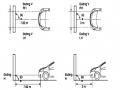
Note: A distance of approximately 7.62 m is required between the vehicle (fog lamp center) and the wall to adjust the convergence correctly. If the distance of 7.62 m cannot be achieved, set the correct distance of 3 m to check and adjust the fog lamp convergence. (Since the target area varies with the distance, please follow the instructions as shown in the figure.)
b/ Prepare a piece of thick white paper about 2 m high and 4 m wide to use as a screen.
c/ Draw a vertical line through the center of the screen (line V).
d/ Set the screen as shown in the picture. Note:
- Keep the screen perpendicular to the ground.
- Align the V line on the screen with the center of the vehicle.
e/Draw the reference lines (H, V LH and V RH lines) on the screen as shown in the figure.HINT:
Mark the center of the fog lamp on the screen. If the center mark cannot be seen on the fog lamp, use the center of the fog lamp or the manufacturer's name mark on the fog lamp as the center mark.
H line (fog light height):
Draw a line across the screen so that it passes through the center mark. Line H should be at the same height as the center mark of the fog light bulb.
Line V LH, V RH (center mark position of left fog lamp LH and right fog lamp RH):
Draw two lines so that they intersect line H at the center marks.
5. Check the fog light convergence
a/ Cover the fog lamp or remove the connector of the other side fog lamp to prevent light from the unchecked fog lamp from affecting the fog lamp convergence test.
b/ Start the engine.
c/ Turn on the fog lights and make sure that the dividing line is outside the standard area as shown in the drawing.
6. Adjust the fog light convergence
Use a screwdriver to adjust the fog light to the standard area by turning the toe adjustment screw.
Note: If the screw is adjusted too far, loosen it and then tighten it again, so that the last rotation of the light adjustment screw is clockwise.
3. Self-study questions
1. Describe the operating principle of the lighting system with automatic headlight function
2. Describe the operating principle of the lighting system with the function of rotating headlights when turning
3. Draw diagram and connect lighting system on Hyundai Porter car
4. Draw diagram and connect lighting system on Honda Accord 1992
5. Draw the lighting circuit on a 1993 Toyota Lexus
LESSON 3 MAINTENANCE AND REPAIR OF SIGNAL SYSTEM
I. IMPLEMENTATION GOAL
After completing this lesson, students will be able to:
- Distinguish between types of signals on cars
- Correctly describe common symptoms and suspected areas causing damage.
- Connecting signal circuits ensures technical requirements
- Disassemble, install, check, maintain and repair the signal system to ensure technical requirements.
- Ensure safety in work and industrial hygiene
II. LESSON CONTENT
1. General description
The signal system equipped on cars aims to create signals to notify other vehicles participating in traffic about the vehicle's operating status such as: stopping, parking, braking, reversing, turning...
Signals are used either by light such as headlamps, brake lights, turn signals….. or by sound such as horns, reverse music….
Just like the lighting system. A signal system circuit usually consists of: battery, fuse, wire, relay, electrical load and control switch. Only some switches of the signal system are on the combination switch. The switches of other signals are usually located in different locations such as in the gearbox or brake pedal……
2. Maintenance and repair
2.1. Turn signals and hazard lights
The installation location of the turn signal is shown in Figure 3.1. The turn signal control switch is located in the combination switch under the steering wheel. Turning this switch to the right or left will make the turn signal turn right or left.
The hazard light switch is used when the vehicle has a problem while participating in traffic. When the hazard light switch is turned on, all the turn signals on the vehicle will light up at a certain frequency. The hazard light switch is usually placed separately from the turn signal switch (some old cars integrate the hazard and turn signal switches on the same combination switch cluster).
Figure 3.1 Turn signal switch Figure 3.2 Hazard switch
The part that generates the flashing frequency for the lights is called a turn signal relay. The turn signal relay usually has 3 terminals: B (positive power supply); E (negative power supply); L (providing the turn signal switch to distribute to the
lamp)
2.1.1. Circuit diagram
To generate the frequency for the turn signal, a turn signal relay is used in the turn signal circuit. The current from the turn signal relay will be sent to the turn signal switch assembly to distribute the current to the turn signal lights for the driver's purpose.
Figure 3.3. Schematic diagram of a turn signal circuit without a hazard switch
1. Battery; 2. Electric lock; 3. Turn signal relay; 4. Turn signal switch; 5. Turn signal lamp; 6. Turn signal lamp; 7. Hazard switch
Figure 3.4 Schematic diagram of turn signal circuit with hazard switch
1. Battery; 2. Combination switch cluster; 3. Turn signal;
4. Turn signal light; 5. Turn signal relay
Today's cars no longer use three-pin turn signal relays (B, L, E) but use eight-pin turn signal relays (figure 3.5) (pin number 8 is used for hazard lights).
For this type, the current supplying the turn signal lights is supplied directly from the turn signal relay to the lights.
div.maincontent .p { color: black; font-family:"Times New Roman", serif; font-style: normal; font-weight: normal; text-decoration: none; font-size: 14pt; margin:0pt; } div.maincontent p { color: black; font-family:"Times New Roman", serif; font-style: normal; font-weight: normal; text-decoration: none; font-size: 14pt; margin:0pt; } div.maincontent .s1 { color: black; font-family:"Times New Roman", serif; font-style: normal; font-weight: normal; text-decoration: none; font-size: 13pt; } div.maincontent .s2 { color: black; font-family:"Times New Roman", serif; font-style: italic; font-weight: normal; text-decoration: none; font-size: 14pt; } div.maincontent .s3 { color: black; font-family:"Times New Roman", serif; font-style: normal; font-weight: normal; text-decoration: none; font-size: 14pt; } div.maincontent .s4 { color: black; font-family:"Times New Roman", serif; font-style: normal; font-weight: normal; text-decoration: none; font-size: 13pt; } div.maincontent .s5 { color: black; font-family:"Times New Roman", serif; font-style: normal; font-weight: normal; text-decoration: none; font-size: 13pt; vertical-align: 1pt; } div.maincontent .s6 { color: black; font-family:"Times New Roman", serif; font-style: normal; font-weight: normal; text-decoration: none; font-size: 11pt; } div.maincontent .s7 { color: black; font-family:"Times New Roman", serif; font-style: normal; font-weight: normal; text-decoration: none; font-size: 14pt; vertical-align: -9pt; } div.maincontent .s8 { color: black; font-family:"Times New Roman", serif; font-style: normal; font-weight: normal; text-decoration: none; font-size: 11pt; } div.maincontent .s9 { color: #008000; font-family:"Times New Roman", serif; font-style: normal; font-weight: normal; text-decoration: none; font-size: 14pt; } div.maincontent .s10 { color: black; font-family:"Times New Roman", serif; font-style: italic; font-weight: normal; te
Car body electrical practice - 8
zt2i3t4l5ee
zt2a3gs
zt2a3ge
zc2o3n4t5e6n7ts
If the voltage is out of specification, replace the wire or connector.
If the voltage is within specification, install the front fog light relay and follow step 5.
Step 5 Check the front fog light switch
- Remove the D4 connector of the fog light switch
- Use a multimeter to measure the resistance of the front fog light switch.
Measurement location
Condition
Standard
D4-3 (BFG) -D4-4 (LFG)
Light switchFront Fog OFF
>10kΩ
D4-3 (BFG) -D4-4 (LFG)
Front fog light switchON
<1 Ω
- Standard resistor
D4 connector is located on the combination switch assembly.
If the resistance is out of specification, replace the combination switch (the fog light switch is located in the combination switch).
If the resistance is within specification, follow step 6.
Step 6 Check wiring and connectors (front fog light relay-light selector switch)
- Disconnect connector D4 of the combination switch assembly
- Use a voltmeter to measure the voltage value of jack D4 on the wire side.
Measurement location
Control modecontrol
Standard
D4-3 (BFG) - (-) AQ
TAIL
11 to 14 V
D4 connector for the wiring of the combination switch assembly
If the voltage does not meet the standard, replace the wire or connector.
If the voltage is within standard, there may have been an error in the previous measurements.
Step 7 Check the front fog lights
- Remove the front fog light electrical connector.
- Supply battery voltage to the fog lamp terminals
Jack 8, B9 of front fog lamp on the electrical side
blind first.
Power supply location
Terms and Conditions
Battery positive terminal - Terminal 2Battery negative terminal - Terminal 1
Fog lightsbefore morning
- If the light does not come on, replace the bulb.
If the light is on, re-plug the jack and continue to step 8.
Step 8 Check wiring and connectors (relay and front fog lights)
- Disconnect the B8 and B9 connectors of the front fog lights.
- Use a voltmeter to measure voltage at the following locations:
Measurement location
Switch location
Terms and Conditions
B8-2 - (-) AQ
Electric lock ON TAIL size switchFog switch ON
11 to 14 V
B9-2 - (-) AQ
Electric lock ONTAIL size switch Fog switch ON
11 to 14 V
B8 and B9 connectors on the front fog lamp wiring side
Voltage is not up to standard, repair or replace the jack. If up to standard, there may have been an error in the measurement process.
2.2.4. Procedure for removing, installing and adjusting fog lights 1. Procedure for removing
- Remove the front inner ear pads
Use a screwdriver to remove the 3 screws and remove the front part of the front inner ear liner
-Remove the fog light assembly
+ Disconnect the connector.
+ Use a screwdriver to remove 3 screws to remove the fog light cover
2. Installation sequence
-Rotate the fog lamp bulb in the direction indicated by the arrow as shown in the figure and remove the fog lamp from the fog lamp assembly.
-Rotate the fog light bulb in the direction indicated by the arrow as shown in the figure and install the light into the fog light assembly.
- Use a screwdriver to install the fog light cover
-Install the electrical connector
Attention: Be careful not to damage the plastic thread on the lamp assembly.
- Install the front inner ear pads
Use a screwdriver to install the front inner bumper with 3 screws.
3. Prepare the vehicle to adjust the fog light convergence. Prepare the vehicle:
- Make sure there is no damage or deformation to the vehicle body around the fog lights.
- Add fuel to the fuel tank
- Add oil to standard level.
- Add engine coolant to standard level.
- Inflate the tire to standard pressure.
- Place spare tire, tools and jack in original design position
- Do not leave any load in the luggage compartment.
- Let a person weighing about 75 kg sit in the driver's seat.
4. Prepare to check the fog light convergence
a/ Prepare the vehicle status as follows:
- Place the car in a dark enough place to see the lines. The lines are the dividing line, below which the light from the fog lights can be seen but above which it cannot.
- Place the car perpendicular to the wall.
- Keep a distance of 7.62 m between the center of the fog lamp and the wall.
- Park the car on level ground.
- Press the car down a few times to stabilize the suspension.
Note: A distance of approximately 7.62 m is required between the vehicle (fog lamp center) and the wall to adjust the convergence correctly. If the distance of 7.62 m cannot be achieved, set the correct distance of 3 m to check and adjust the fog lamp convergence. (Since the target area varies with the distance, please follow the instructions as shown in the figure.)
b/ Prepare a piece of thick white paper about 2 m high and 4 m wide to use as a screen.
c/ Draw a vertical line through the center of the screen (line V).
d/ Set the screen as shown in the picture. Note:
- Keep the screen perpendicular to the ground.
- Align the V line on the screen with the center of the vehicle.
e/Draw the reference lines (H, V LH and V RH lines) on the screen as shown in the figure.HINT:
Mark the center of the fog lamp on the screen. If the center mark cannot be seen on the fog lamp, use the center of the fog lamp or the manufacturer's name mark on the fog lamp as the center mark.
H line (fog light height):
Draw a line across the screen so that it passes through the center mark. Line H should be at the same height as the center mark of the fog light bulb.
Line V LH, V RH (center mark position of left fog lamp LH and right fog lamp RH):
Draw two lines so that they intersect line H at the center marks.
5. Check the fog light convergence
a/ Cover the fog lamp or remove the connector of the other side fog lamp to prevent light from the unchecked fog lamp from affecting the fog lamp convergence test.
b/ Start the engine.
c/ Turn on the fog lights and make sure that the dividing line is outside the standard area as shown in the drawing.
6. Adjust the fog light convergence
Use a screwdriver to adjust the fog light to the standard area by turning the toe adjustment screw.
Note: If the screw is adjusted too far, loosen it and then tighten it again, so that the last rotation of the light adjustment screw is clockwise.
3. Self-study questions
1. Describe the operating principle of the lighting system with automatic headlight function
2. Describe the operating principle of the lighting system with the function of rotating headlights when turning
3. Draw diagram and connect lighting system on Hyundai Porter car
4. Draw diagram and connect lighting system on Honda Accord 1992
5. Draw the lighting circuit on a 1993 Toyota Lexus
LESSON 3 MAINTENANCE AND REPAIR OF SIGNAL SYSTEM
I. IMPLEMENTATION GOAL
After completing this lesson, students will be able to:
- Distinguish between types of signals on cars
- Correctly describe common symptoms and suspected areas causing damage.
- Connecting signal circuits ensures technical requirements
- Disassemble, install, check, maintain and repair the signal system to ensure technical requirements.
- Ensure safety in work and industrial hygiene
II. LESSON CONTENT
1. General description
The signal system equipped on cars aims to create signals to notify other vehicles participating in traffic about the vehicle's operating status such as: stopping, parking, braking, reversing, turning...
Signals are used either by light such as headlamps, brake lights, turn signals….. or by sound such as horns, reverse music….
Just like the lighting system. A signal system circuit usually consists of: battery, fuse, wire, relay, electrical load and control switch. Only some switches of the signal system are on the combination switch. The switches of other signals are usually located in different locations such as in the gearbox or brake pedal……
2. Maintenance and repair
2.1. Turn signals and hazard lights
The installation location of the turn signal is shown in Figure 3.1. The turn signal control switch is located in the combination switch under the steering wheel. Turning this switch to the right or left will make the turn signal turn right or left.
The hazard light switch is used when the vehicle has a problem while participating in traffic. When the hazard light switch is turned on, all the turn signals on the vehicle will light up at a certain frequency. The hazard light switch is usually placed separately from the turn signal switch (some old cars integrate the hazard and turn signal switches on the same combination switch cluster).
Figure 3.1 Turn signal switch Figure 3.2 Hazard switch
The part that generates the flashing frequency for the lights is called a turn signal relay. The turn signal relay usually has 3 terminals: B (positive power supply); E (negative power supply); L (providing the turn signal switch to distribute to the
lamp)
2.1.1. Circuit diagram
To generate the frequency for the turn signal, a turn signal relay is used in the turn signal circuit. The current from the turn signal relay will be sent to the turn signal switch assembly to distribute the current to the turn signal lights for the driver's purpose.
Figure 3.3. Schematic diagram of a turn signal circuit without a hazard switch
1. Battery; 2. Electric lock; 3. Turn signal relay; 4. Turn signal switch; 5. Turn signal lamp; 6. Turn signal lamp; 7. Hazard switch
Figure 3.4 Schematic diagram of turn signal circuit with hazard switch
1. Battery; 2. Combination switch cluster; 3. Turn signal;
4. Turn signal light; 5. Turn signal relay
Today's cars no longer use three-pin turn signal relays (B, L, E) but use eight-pin turn signal relays (figure 3.5) (pin number 8 is used for hazard lights).
For this type, the current supplying the turn signal lights is supplied directly from the turn signal relay to the lights.
div.maincontent .p { color: black; font-family:"Times New Roman", serif; font-style: normal; font-weight: normal; text-decoration: none; font-size: 14pt; margin:0pt; } div.maincontent p { color: black; font-family:"Times New Roman", serif; font-style: normal; font-weight: normal; text-decoration: none; font-size: 14pt; margin:0pt; } div.maincontent .s1 { color: black; font-family:"Times New Roman", serif; font-style: normal; font-weight: normal; text-decoration: none; font-size: 13pt; } div.maincontent .s2 { color: black; font-family:"Times New Roman", serif; font-style: italic; font-weight: normal; text-decoration: none; font-size: 14pt; } div.maincontent .s3 { color: black; font-family:"Times New Roman", serif; font-style: normal; font-weight: normal; text-decoration: none; font-size: 14pt; } div.maincontent .s4 { color: black; font-family:"Times New Roman", serif; font-style: normal; font-weight: normal; text-decoration: none; font-size: 13pt; } div.maincontent .s5 { color: black; font-family:"Times New Roman", serif; font-style: normal; font-weight: normal; text-decoration: none; font-size: 13pt; vertical-align: 1pt; } div.maincontent .s6 { color: black; font-family:"Times New Roman", serif; font-style: normal; font-weight: normal; text-decoration: none; font-size: 11pt; } div.maincontent .s7 { color: black; font-family:"Times New Roman", serif; font-style: normal; font-weight: normal; text-decoration: none; font-size: 14pt; vertical-align: -9pt; } div.maincontent .s8 { color: black; font-family:"Times New Roman", serif; font-style: normal; font-weight: normal; text-decoration: none; font-size: 11pt; } div.maincontent .s9 { color: #008000; font-family:"Times New Roman", serif; font-style: normal; font-weight: normal; text-decoration: none; font-size: 14pt; } div.maincontent .s10 { color: black; font-family:"Times New Roman", serif; font-style: italic; font-weight: normal; te -
 Current Status of Awareness of Vocational Education Content According to National Education Orientation in High Schools of Dong Hy District
 -
 Current Status of Teachers Implementing Methods of Using Materials in Organizing Activities to Develop Skills for 5-6 Year Old Preschool Children
 -
 Current Status of Organizing and Implementing Training on Teaching Capacity According to Stem Education Orientation for High School Teachers

Training content is ultimately a measure of the school's training capacity. If the training content is rich and suitable for practice, the capacity of students after graduation will be accepted by society and the school's position will be affirmed. Therefore, training content must, on the one hand, reflect the needs of society and the expectations of learners. According to the evaluation results in Table 2.5, the implementation of training content has not been really highly appreciated. Less than 50% are evaluated at a good level of implementation . Over 50% are implemented at an average level. Some positive assessments of the implementation of training content are: The program content is built on the basis of the ministry's curriculum framework with reference to the needs of society, average score 2.70. Ensuring connectivity with training levels and between training programs at the same level, average score 2.60. Ensuring the training goals of intermediate and college levels, the score is 2.54. These are the contents that have received many high ratings during the implementation process. The contents that have not received much consensus are; Meeting the output standards of knowledge, skills, and attitudes, the average is 2.04, this score is in the average evaluation range , which shows that the school's ability to ensure training meets output standards is not really good. This is one of the important criteria to ensure the capacity of the training institution for society. The training program content is built on the capacity of the learner, which is also not highly appreciated, the average survey score is 2.20, the assessment level of this content is only average . Individualization in the training process is one of the goals that any training institution wants to aim for. Because this both demonstrates the ability to approach learners in a systematic and professional manner and at the same time demonstrates the school's in-depth training capacity. Or the program content is supplemented and adjusted periodically but is not highly appreciated by the comments. Average score 2.22 .
From the survey results in Table 2.5, it can be seen that most of the survey contents on the implementation of the current training program at the school are not highly evaluated. The average score of the survey is 2.42, which is at the average implementation assessment level . The main operating environment of students after graduating from the vocal music major is the environment where they mainly interact with society. Therefore
The capacity of workers in this field often has a direct impact and is often highly sensitive. Therefore, the training program must ensure basic professional skills while also regularly updating the demands, needs, and tastes of society to include in the training program in the most timely and appropriate manner.
According to the interview results of code QL04, " the current program content is still heavy on theory and little on practice, and there needs to be adjustments and supplements to suit the practical situation. We should not pay less attention to capacity and practical needs because of quantity." Code QL02 said that " the current theoretical time takes up a lot of teachers' time. The organization of vocational skills training sessions is not commensurate with some students, leading to the phenomenon of homogenizing the quality of some subjects." Thus, the interview opinions of management staff do not really agree with the current program content structure.
In general, with the current situation as surveyed above, the implementation of the current training program content at Can Tho College of Culture and Arts has not really fully met the training goals as well as the expectations of society in the vocal music industry that the school is training. To further improve the quality of the graduating students, there must be appropriate solutions to synchronously improve the current training process.
2.3.3. Current status of organizational forms, training methods and training facilities
The way educational activities are organized as well as the flexible application of teaching methods to the vocal training process has a great influence on the quality of training. Table 2.6 is the survey result on the current implementation of teaching forms and methods.
Table 2.6. Assessment of the current status of teaching organization of managers, teachers and students
STT
Content | Student | Managers & Teachers | |||
Medium | Degree standard deviation | Medium | Degree standard deviation | ||
I | Form of training organization (teaching) | ||||
1 | Diversify teaching methods | 2.42 | 0.67 | 2.18 | 0.691 |
2 | Small group study by topic teacher's guidance | 2.27 | 0.632 | 2.84 | 0.792 |
3 | Group discussion in class | 2.54 | 0.639 | 2.24 | 0.744 |
4 | Student internship and practice under the guidance of the teacher | 3.16 | 0.598 | 3.40 | 0.606 |
5 | Students tutor each other on Teacher's lesson plan | 2.68 | 0.615 | 3.34 | 0.626 |
6 | Self-improvement and training professional skills | 2.73 | 0.632 | 2.82 | 0.800 |
II | Training method (teaching) | ||||
1 | Applying verbal teaching methods: presentation, conversation, working with textbooks and references… | 2.66 | 0.639 | 2.88 | 0.799 |
2 | Applying visual teaching methods: observing objects and phenomena; based on media intuitive | 3.07 | 0.845 | 2.90 | 0.763 |
3 | Applying teaching methods practice: drill, review and experiment | 3.28 | 0.719 | 3.08 | 0.778 |
4 | Applying modern teaching methods: problem solving; small group teaching; teaching project | 3.08 | 0.707 | 2.26 | 0.443 |
III | Use of teaching aids | ||||
1 | Exploiting the group of support tools school vocal teaching | 3.03 | 0.71 | 3.06 | 0.767 |
STT
Content | Student | Managers & Teachers | |||
Medium | Deviation standard | Medium | Deviation standard | ||
2 | Make the most of learning support devices personal practice | 2.70 | 0.726 | 3.22 | 0.708 |
3 | Exchange and share learning tools between individuals | 3.20 | 0.584 | 3.02 | 0.714 |
4 | Exploiting technology applications information on learning and research | 3.19 | 0.559 | 2.90 | 0.707 |
Average | 2.86 | 2.87 | |||
Overall rating | Rather | Rather | |||
Reliability of the scale ( Cronbach's Alpha) | 0.984 | 0.980 | |||
Table 2.6 is the evaluation results of managers, teachers and students on the teaching forms and methods currently being implemented at Can Tho College of Culture and Arts.
Although the assessments come from different perspectives, there is basically no significant difference in the implementation contents. Only in some contents, due to different approaches and expectations, the comments are subjective to the respondents. This difference does not greatly affect the quality of the survey.
Regarding teaching methods. In general, the assessments mainly focused on the average and good levels of implementation. Managers and teachers assessed the average level lower than students. The average score of students in diversifying teaching methods was 2.42, while that of managers and teachers was 2.18. Thus, students believed that lecturers used many different teaching methods during the learning process. However, the assessment of managers and teachers was that the level of use was not high and not commensurate with the current training content. The average score of students for group discussion in class was 2.54, while that of managers and teachers was 2.24. The scores showed that students highly appreciated the group discussion activities organized by teachers. However, managers said that this activity was still lacking in scale and organization.
The organization is not flexible and not suitable for the learning object. However, the content of the internship and practice of students under the guidance of teachers, received low evaluation from students. The average survey was 3.16 of managers and teachers was 3.34. The evaluation level of teachers was at the level of good implementation while that of students was only at the level of fair. The content of self-improvement and professional skills training of students was also highly evaluated by managers and teachers at 2.82 , while the average score of students was only
2.73. Thus, from the survey results on the current training organization of the school, the researcher found that both the scale and the current implementation results have only reached the required level. Meanwhile, the teaching organization form has a great significance to the results of imparting knowledge and professional skills to students. If this activity is interested by management levels in each stage such as; planning, implementation, inspection and evaluation, the effectiveness of this activity will be continuously improved and ensure the training criteria that the school has previously set.
Regarding training methods. The survey results show that students rate the methods used by lecturers in the teaching process higher than the evaluation of managers and teachers. For the group of verbal teaching methods: presentations, conversations, working with textbooks and reference materials... the average score of students is 2.66 and that of managers and teachers is 2.88. The difference in scores shows that students need to be provided with more practical information about the quality and presentation methods of teachers for this group of teaching methods. For the group of visual teaching methods: observing objects and phenomena; based on visual aids, the average score of students is 3.07 and that of managers and teachers is 2.90. The difference in opinions is not high but also shows that from the perspective of teachers and managers, this group of methods must be implemented on a larger scale and more systematically. Because this is a group of methods that have a direct and regular impact on the characteristics of vocal training. For the group of modern teaching methods: problem solving; small group teaching; project teaching. There is a relative difference in the comments. The average of students is 3.08, achieving a good level of assessment . The average of managers and teachers is 2.26, achieving an average level of assessment . Thus, according to the survey results
In terms of expectations, those working in management and teaching are very high for the group of modern teaching methods. They want teachers to constantly update the latest achievements in teaching methods in their majors. This is also one of the factors that demonstrate the capacity of teachers and the quality of training of the school. In general, through the survey results on teaching methods, we see that the majority of students do not really appreciate the content related to teaching activities that the school and teachers have applied in the past. In order for this activity to meet the teaching requirements as well as ensure the effectiveness of the set goals, there must be synchronous solutions.
Regarding the use of teaching aids. The survey results show that there is no significant difference between the two respondents regarding the content related to the use of teaching aids. The content of exploiting the group of tools to support vocal teaching of the school, has similar survey results. The score of 3.03 students of managers and teachers is 3.06. This score is considered to be quite good. The content of making the most of personal learning support equipment, has a significant difference. The average score of students is 2.70, this score is considered to be average. The score of managers and teachers is
3.02 achieved a Fair level . The content of exchanging and sharing learning tools between individuals also has differences in opinions. Student 3.20 achieved a Fair level, Managers & Teachers 3.02 achieved a Fair level. Regarding the content of exploiting the application of information technology in learning and research, there are also similar results. This shows that teachers' expectations for students in the learning process should make the most of learning support equipment is relatively high. Support equipment not only helps students acquire knowledge faster and practice professional skills more systematically, but also demonstrates a quick understanding of changes and social expectations for the profession they study. If approached correctly and quickly, students will easily acquire the values and standards that they will experience during the learning process as well as after graduation.
Interview code QL01 said that " To innovate current teaching methods, it is necessary to innovate synchronously. First of all, the qualifications of lecturers must be updated regularly and in line with the trends of life. Teaching support equipment