
CHAPTER I: BASIC ISSUES OF CORPORATE CULTURE
I. CONCEPT OF CORPORATE CULTURE
1. Culture
Maybe you are interested!
-
 Vietnamese Enterprises' Perception of the Role of Corporate Culture (2003)
 -
 Typical Cultural Features of Vietnamese Corporate Culture in the Current Period.
 -
 The Role of Building Corporate Culture of Vietnamese Enterprises in the Context of International Economic Integration
 -
 Building a strong corporate culture for the survival and development of Vietnamese enterprises - 14
 -
 Building a strong corporate culture for the survival and development of Vietnamese enterprises - 2
Edgar H. Schein, a famous American administrator, said: "Corporate culture is associated with social culture, is a step forward of social culture, is the deepest level of social culture". Therefore, to understand what corporate culture is most clearly, we must first understand the concept of social culture.
Socio-culture (culture) is closely linked to the birth of mankind and is a diverse and complex issue that has been discussed by anthropologists, sociologists, historians and philosophers for thousands of years. Up to now, there have been many widely accepted definitions such as:
The first widely accepted definition of culture was that given by anthropologist EB Tylor: “Culture is that complex whole which includes knowledge, beliefs, arts, morals, laws, customs and any other skills and habits acquired by man as a member of society” 1 ; This definition covers quite fully all aspects of spiritual culture, but pays little attention to material culture, a fairly rich part of the human cultural treasure.
There is another definition that is easier to understand and closer to the nature of culture. Today, many people agree with the definition of Ferderico Mayor, former director general of UNESCO: "Culture includes everything that makes one nation different from another, from the most sophisticated, modern products to the most
1 Edward. Tylor 1920[1871]. Primitive Culture. New York: JP> Putnam‟s Sons. Pp1(Vietnamese version by Huyen Giang (2000), Culture and Arts magazine. p. 13
beliefs, customs, practices, ways of life and work” [1] This definition was accepted by the international cultural community at the 1970 intergovernmental conference on cultural policies in Venice.
2. Corporate culture
The concept of culture in a business is similar to the concept of culture in society, and is also very diverse and rich. Here are some popular concepts of corporate culture:
According to the International Labor Organization ILO - International Labor Organization: "Corporate culture is a set of values, standards, habits and traditions, attitudes and behaviors that are unique to a given organization" [2].
According to Denison (1990): “Culture refers to the implicit beliefs, values, and principles that form the basis for managing an organization as well as for the set of management actions and management behaviors that both exemplify and reinforce those basic principles” [3].
According to Georges de Saite Marie, a French expert on small and medium enterprises: "Corporate culture is a synthesis of values, symbols, myths, rituals, taboos, philosophical and ethical views that form the deep foundation of the enterprise" [2].
In short, corporate culture or organizational culture is understood as an organic system of values, standards, concepts and behaviors created and accumulated by members of that enterprise in the process of interacting with the external environment and integrating within the organization. It has been effective and considered correct, therefore, shared and widely disseminated among generations of members as a standard method for perceiving, thinking and feeling in relation to the problems they face [7].
Corporate culture is a system of meanings, values, core beliefs, perceptions and thinking methods that are agreed upon by all members of an organization and have a wide influence on the way members act. It is a synthesis of common concepts that members of the enterprise learn in the process of solving internal problems and handling problems with the surrounding environment. The above concepts have certain differences in the way of expression and the scope of expression of corporate culture. However, the most common point is that the concepts all affirm that Corporate Culture belongs to the spiritual category, demonstrating the development at a higher level of the enterprise.
II. FUNCTIONS OF CORPORATE CULTURE
Corporate culture plays a very important role in the sustainable development of a business. Its importance is determined by its inherent functions. These are the following five functions:
1. Command function
Corporate culture is formed in a process, led by the business owner, so it has an effect on the operation of the entire business. Corporate culture itself becomes a system of norms and standard values that no individual in the business dares to go against. In turn, once formed, Corporate culture makes the business develop in a direction that is consistent with the set goals. The guiding function of Corporate culture is shown in that it has a guiding effect on the actions and thoughts of each individual in the business [18].
2. Binding function
Corporate culture has a binding function because it exerts an effect on the thoughts, psychology and actions of each member in the enterprise. The binding function of Corporate Culture is not legal like administrative regulations but it is a soft mechanism, based on self-awareness. The binding function of Corporate Culture is shown in that spiritual cultural contents such as collective consciousness; public opinion; customs and practices of the community in the enterprise... create strong pressure and motivation for the psychology and actions of each individual and the enterprise collective.
3. Link function
Corporate culture has a binding function because, after being voluntarily accepted by the enterprise community, Corporate culture becomes a glue, creating a unified block of solidarity in the enterprise. It becomes the driving force to help each individual participate in the enterprise's activities... In fact, Corporate culture is a collective consciousness created by the creativity of all members in the enterprise. Corporate culture has set out ideals, hopes and requirements for the members in the enterprise. It is also closely related to the destiny and future of each member in the enterprise. Therefore, Corporate culture becomes a glue, creating the driving force to help all members in the enterprise participate in the tasks of the enterprise, promoting the intelligence and wisdom of each member in contributing to the enterprise.
4. Incentive function
Corporate culture has the function of encouragement because, valuing talented people, considering management work as the focus is the core content of Corporate Culture. Corporate culture is not only an external driving force but also
is also a strong internal force to encourage employees. That helps employees have a spirit of self-awareness, initiative; meet many needs and have the ability to adjust unreasonable needs of employees.
5. Propagation function
Corporate culture has a spreading function because: When a business has formed its own culture, it will have a great influence on every individual and organization inside and outside the business. Corporate culture has an influence on society through many different communication channels, but is mainly divided into two types: one is, taking advantage of propaganda through mass media and two is, through personal communication relationships. Through mass media and personal relationships, Corporate culture is widely spread, which is an important factor in building the brand of the business.
The functions of Corporate Culture as presented above also exist objectively. The task of business administrators is to know how to promote the synchronous effects of the above functions so that Corporate Culture truly becomes one of the effective management tools in the enterprise.
III. LEVELS AND STRUCTURE OF CORPORATE CULTURE
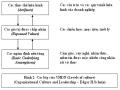
According to Edgar H. Schein, corporate culture has three layers of values: tangible values, accepted values, and fundamental values/concepts. The concept of “layer” here is understood as the level of perception of cultural values in the organization, or in other words, the tangibility of those cultural values.
1. Tangible values
These are the processes, the first elements that a person sees, hears, and feels when interacting with an organization with a culture such as the architecture of the work environment, language, technology, or behavioral norms. This layer also includes the behaviors of employees and groups within the organization. The basic characteristics of this surface layer are very noticeable but difficult to judge its true meaning. These tangible values do not have much impact on the thinking, behavior of employees and business performance.
a) Logo and traditional song of the enterprise
Logo is the symbol of the business, showing the strength and value of the business beyond language barriers. Logo is a visual signal or a way to create the name of a company, an organization with the most characteristic attributes, a simple refined image for easy recognition of a unit, an agency, a social organization that affirms the copyright of the unit, agency or social organization for its logo product. Logo or business cards are important points of contact between you and customers or partners, helping you build first impressions with them. Therefore, if your logo or business card is unprofessionally designed, customers and partners will not trust the business . The traditional song of the business can be composed by the staff of that business based on their feelings and emotions for that business. The traditional song is also a cultural feature of the company, aiming to strengthen solidarity among employees.
b) Commercial slogan
Commercial slogans are always considered an extremely important advertising, marketing, and branding weapon. It is an intangible asset but has great value that is built up over time. It not only reminds customers of the existence of the business, encourages customers to buy products, but also becomes the business's operating motto.
c) Rules, regulations, uniforms
When entering a business, we often have different feelings: solemn, cozy, happy or serious... these feelings show the power of material symbols in creating the personality of the business. For example, the board of rules, the rules of the business, the way employees dress (wearing uniforms or not)
d) Enterprise architecture
That is the ground, trees, tables and chairs... all are used to create a sense of familiarity with customers, with employees as well as create the best working environment for employees. Architecture becomes a symbol of the development of the enterprise, a common home for all employees in the enterprise.
e) Communication behaviors
Behavioral culture of superiors towards subordinates: Behavioral culture of superiors towards subordinates is extremely important. It determines the nature of the relationship between employees and leaders: if a close, strong relationship is built, cooperation between the two sides is extremely favorable; on the contrary, if leaders have not created a sustainable relationship with employees, it will create barriers in
work has a negative impact on the business. Therefore, leaders should respect the following working principles: First , leaders who use the right people in the right place will promote their talents and create passion for their work. Second , a fair reward and punishment system. Rewards will motivate employees to work, but they need to be based on common interests and respect fairness. When reprimanding, it should also be based on common interests. Doing so will make subordinates respect them, not oppose them and happily accept them. Third , win over subordinates, this requires leaders to have the "art" of management and understand human psychology. Fourth , listen to feedback from employees. If leaders do not listen to feedback from employees, it will create resentment, poor work morale and can lead to quitting.
Behavioral culture of subordinates towards superiors: subordinates need to show respect and behave properly towards superiors. In addition, employees need to make efforts, enthusiastically perform assigned tasks well, and show a cooperative attitude towards leaders.
Behavioral culture between colleagues The enterprise is not only a good working environment but also a living environment for employees. In which, the relationship between members needs to be extremely open, friendly, united and help each other to progress together. Good relationships gradually form a system of customs, habits, routines, and standards in daily work behavior of employees.
Customer care: In the most general sense, it is all the activities aimed at satisfying the needs and expectations of customers. Customer care must be rooted in the culture and beliefs of the business, in which the image of the customer is the center that each employee needs to aim to care for. This culture is reflected in all activities such as information, transactions, negotiations, service attitudes... and needs to be unified among the entire staff.